





MS in Computer Science is the most competitive master’s program in the world. MIT, CMU, Stanford, and UIUC receive tens of thousands of applications every year from students with strong GPAs, GRE scores, and programming experience.
What separates admitted students from rejected ones is rarely the grade or the score. It is the SOP. Specifically, it is whether the SOP shows that you have a clear technical focus, real project outcomes, and a specific reason for choosing this program over every other program in the world.
This guide gives you the format, the sample, and the honest advice on what actually works in a CS SOP in 2026.
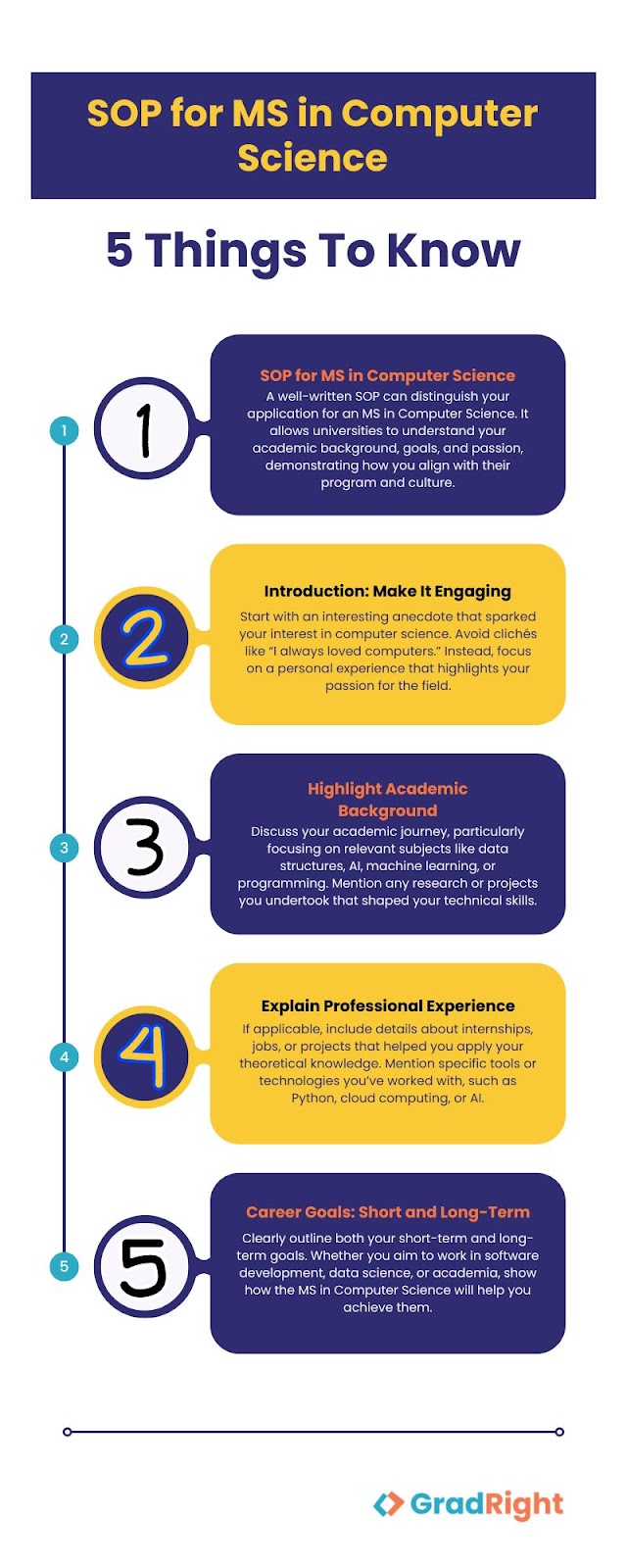
SOP for MS in Computer Science – Quick Reference
|
Question |
Answer |
|
What should a CS SOP emphasize? |
Technical projects with specific outcomes, your CS subfield interest (ML, systems, security, networks, etc.), faculty research alignment, and specific career goals. |
|
How long should it be? |
800-1,000 words for most US programs. Some programs specify their own limit – always check first. |
|
Fresher vs experienced applicant? |
Freshers: lead with academic projects, thesis, research, internships. Working professionals: lead with technical work experience and the specific gap an MS fills. |
|
Biggest mistake in CS SOPs? |
Listing programming languages without showing what you built. “Proficient in Python, Java, C++” tells the committee nothing. Show a real project with a real outcome. |
|
What makes a CS SOP stand out? |
A specific technical subfield, named faculty whose research connects to yours, and a concrete career goal – not just “software engineer at a top tech company.” |
What Makes an MS CS SOP Different from Other Programs?
CS admissions are highly competitive and highly technical. The faculty reading your SOP are researchers and engineers. They can immediately tell the difference between a student who understands their field and one who has written a generic essay.
|
CS SOP Must Show |
Most CS SOPs Only Show |
|
A specific subfield interest (ML, systems, HCI, security, networking, theory) |
General interest in “computer science and technology” |
|
Technical projects with specific outcomes and numbers |
A list of languages and tools without context |
|
Faculty research awareness – name the professor and their work |
Generic praise about the university’s “excellent faculty” |
|
Clear career goal within CS (ML engineer, systems researcher, etc.) |
“I want to work at a top tech company” |
|
Why an MS specifically – not just a job or self-study |
Vague statements about wanting to “deepen knowledge” |
Also Read: SOP for MS – How to Write, Format, Samples and Tips
SOP Format for MS in Computer Science – Section by Section
Here is the structure that works for MS CS applications at US, UK, and Canadian universities:
|
Section |
What to Write for MS CS |
Word Count |
|
1. Opening / Hook |
A specific technical problem, project challenge, or research question that drove you toward CS graduate study. Not “I have always loved computers.” A real technical moment. |
80-120 words |
|
2. Academic Background |
B.Tech or B.E. CGPA if strong, key CS courses (algorithms, OS, databases, ML, etc.), final year project or thesis with technical details and outcomes. |
150-180 words |
|
3. Technical Projects and Research |
Your 2-3 strongest projects. Each should have: what you built, what technical challenge you solved, what tools you used, and what the outcome was. Use numbers where possible. |
180-220 words |
|
4. Work Experience (if applicable) |
Industry roles, internships, or research positions. Focus on technical responsibilities and what you learned that you cannot learn without an MS. |
100-150 words |
|
5. Why This Program and CS Subfield |
Your specific area of interest within CS. Then why this program: name 1-2 faculty whose research connects to your interest, and 1-2 specific courses or labs. |
130-160 words |
|
6. Career Goals |
Short-term: specific role (ML engineer, systems researcher, software architect). Long-term: the technical problem or impact you want to work on. |
80-120 words |
|
7. Conclusion |
Two to three sentences connecting your background, this program, and your future. Confident, brief, no new information. |
40-60 words |
Total: 760-1,010 words. Add specific technical details to reach 900-1,000 words. Never go over the program’s specified word limit.
CS Subfield Focus – What to Emphasize by Area
Your SOP should show you have a specific area of interest within CS – not just general computer science. Here is what to emphasize by subfield:
|
CS Subfield |
Key Technical Skills to Mention |
What Your Projects Should Show |
|
Machine Learning / AI |
Python, TensorFlow/PyTorch, scikit-learn, mathematics (linear algebra, statistics, calculus) |
A model you built, the problem it solved, accuracy or performance metrics, dataset size |
|
Systems / OS / Distributed Systems |
C/C++, Linux internals, networking protocols, concurrency |
A systems project (OS kernel module, distributed cache, network stack) with performance benchmarks |
|
Data Science / Big Data |
Python, SQL, Spark, Hadoop, Tableau, statistical modeling |
A data pipeline or analysis project with real data and a business or research outcome |
|
Cybersecurity |
Network security, cryptography, penetration testing, Python/C for security tools |
A security research project, CTF participation, or vulnerability analysis with findings |
|
Human-Computer Interaction (HCI) |
User research methods, prototyping tools, front-end development, usability testing |
A user study, interface design project, or accessibility research with measurable outcomes |
|
Computer Vision |
Python, OpenCV, CNNs, image processing |
A vision project (object detection, image segmentation, medical imaging) with accuracy metrics |
|
Natural Language Processing (NLP) |
Python, transformers, BERT/GPT fine-tuning, text processing |
An NLP application (sentiment analysis, chatbot, translation model) with evaluation results |
|
Software Engineering / Cloud |
Java/Python, microservices, Docker/Kubernetes, AWS/GCP/Azure |
A production-level system you built or contributed to, with scale and reliability metrics |
Writing your MS CS SOP? GradSOP generates a personalized draft based on your technical background, projects, and target program. Try GradSOP Free
SOP for MS CS: Fresher vs Working Professional
|
Element |
Fresher (0-1 year experience) |
Working Professional (2+ years) |
|
Opening |
A final year project challenge or research problem |
A professional technical challenge that showed you the gap an MS fills |
|
Strongest section |
Academic projects, thesis, research internships |
Industry experience with technical impact and measurable outcomes |
|
Work experience section |
Internships only – focus on what you built, not just the company name |
Lead this section – describe technical roles, team size, systems built |
|
Why MS now? |
To deepen theoretical foundation before industry or to pursue research |
To move from implementation to system design / research / tech leadership |
|
Career goals |
Entry-level technical role or PhD pathway |
Senior technical or research role, specific industry domain |
|
Common mistake |
Listing courses without showing technical outcomes |
Not explaining why industry experience alone is not enough |
Also Read: Top Engineering Universities in USA – Rankings and Fees
Sample SOP for MS in Computer Science – USA University
Here is a sample SOP for an MS in Computer Science program. Read it to understand structure, specificity, and technical tone. Do not copy it – build your own around your real experiences.
[SAMPLE SOP – MS in Computer Science, USA University]
During my final year at NIT Trichy, I was trying to build a real-time object detection system for a traffic monitoring project. The model accuracy was acceptable in daylight conditions – but dropped from 91% to 63% in low-light environments. That gap between what worked in a controlled setting and what would work in production is the problem I want to spend graduate school understanding. It pushed me toward computer vision research, specifically the question of how deep learning models can be made robust to distribution shift.
I completed my B.Tech in Computer Science and Engineering from NIT Trichy with a CGPA of 8.7/10. My coursework covered algorithms, operating systems, computer vision, and deep learning. My final year thesis, ‘Adaptive Object Detection Under Adverse Lighting Conditions Using Domain Adaptation,’ involved training a YOLOv8 model and applying domain adaptation techniques to improve low-light performance from 63% to 82% mAP on a custom dataset of 15,000 annotated frames. I presented this work at my institute’s undergraduate research symposium.
Beyond my thesis, I built a distributed web scraping system in Python using Celery and Redis to collect and analyze 500,000+ product listings for a price comparison project. The system processed 10,000 requests per hour with a failure rate under 0.3%, which required solving distributed task scheduling and rate limiting problems I had not encountered in coursework. I also completed a research internship at IIT Bombay’s Computer Vision Lab, where I worked on 3D point cloud processing for autonomous vehicle perception – contributing to a dataset annotation pipeline that reduced manual labeling time by 40%.
I want to pursue an MS in Computer Science with a focus on computer vision and robust machine learning. I am specifically interested in Professor [Name]’s work on domain-adaptive object detection and the lab’s research on self-supervised representation learning for visual tasks – areas that directly extend my thesis work. The program’s course offerings in advanced computer vision and its industry practicum, which places students with computer vision teams at companies like Google and Adobe, are both important reasons I am applying to [University Name] specifically.
My short-term goal after the MS is to join a computer vision engineering team at a company working on real-world perception problems – autonomous vehicles, medical imaging, or robotics. In the longer term, I want to work on the fundamental problem of making visual AI systems that generalize reliably outside their training distribution – the same gap I encountered in my final year thesis, but at a level of rigor that requires the research training an MS provides.
The MS program at [University Name] is where I want to develop from a practitioner who has solved specific vision problems to a researcher who can work on the underlying principles. I look forward to contributing to the department’s research community.
[End of sample – approx. 480 words. Expand work experience and ‘why this program’ sections to reach 900-1,000 words for your final application.]
SOP for MS CS by Country
|
Country |
Tone and Focus |
Key Difference |
|
USA |
Technical + personal narrative. Show both your technical depth and your individual story. |
Name specific faculty and labs. Customize heavily per university. Research interests carry significant weight. |
|
UK |
Academic and technical. Minimal personal narrative. Subject expertise first. |
UK CS programs expect academic rigor and research awareness. Extracurriculars are less relevant. |
|
Canada |
Professional and technical. Balance of academic and industry experience. |
Mention connections to Canadian tech industry or research if relevant to your goals. |
|
Germany |
Structured and technical. State your background and motivation directly. |
German programs value clear academic credentials and structured reasoning over storytelling. |
|
Australia / Ireland |
Professional goals focused. Career direction weighted heavily. |
Show clear post-graduation plans and how the CS degree specifically enables them. |
Also Read: Study in USA – Complete Guide for Indian Students
MS CS SOP Dos and Don’ts
|
Do’s |
Don’ts |
|
Open with a specific technical problem or project challenge |
Start with ‘Since childhood, I have loved computers and technology’ |
|
Show projects with technical specifics and outcomes |
List programming languages without showing what you built |
|
Name your CS subfield interest clearly |
Say ‘I am interested in all areas of computer science’ |
|
Name specific faculty and their research |
Write ‘the university has excellent faculty and resources’ |
|
State a specific career goal within CS |
Say ‘I want to work at a top tech company in Silicon Valley’ |
|
Explain why an MS, not just a job |
Make the degree sound like a job application shortcut |
|
Customize the school section for every application |
Use the same SOP for CMU, MIT, Georgia Tech, and UIUC |
|
Keep sentences technical but clear |
Use jargon to sound impressive without explaining what you did |
SOP Tips for Top MS CS Programs
|
University |
SOP Focus |
|
CMU (School of Computer Science) |
Research focus is critical. Name the specific research group or lab. CMU values depth in one area over breadth. |
|
MIT CSAIL |
Strong research statement required. Your SOP should read almost like a mini research proposal with a specific question you want to work on. |
|
Stanford CS |
Balance of research and industry vision. Show that you have thought about both the technical depth and the real-world application. |
|
UIUC CS |
Research areas are well-defined. Align your SOP explicitly with one of UIUC’s research groups. |
|
Georgia Tech CS |
Interdisciplinary and applied CS valued. Show real-world impact of your projects and applications-focused research interests. |
|
UC San Diego CS |
Strong systems and ML presence. Specific lab alignment and technical depth important. |
Found your target MS CS programs? Find universities that match your technical profile and admit chances. Explore Universities on GradRight
Related SOP Guides and CS Resources
SOP for MS – Complete Guide, Format and Sample
How to Write an SOP – Tips and Format
SOP Samples – Course and Country-wise Guide
GradSOP – Free AI SOP Writing Tool
Top Engineering Universities in USA
MS in Computer Science Abroad
Study in USA – Complete Guide
Education Loan for USA
GRE Exam – Complete Guide
How to Write a Professional LOR




 Australia
  Canada
  France
  Germany
  India
India  Ireland
  UAE
UAE  United Kingdom
  United States