




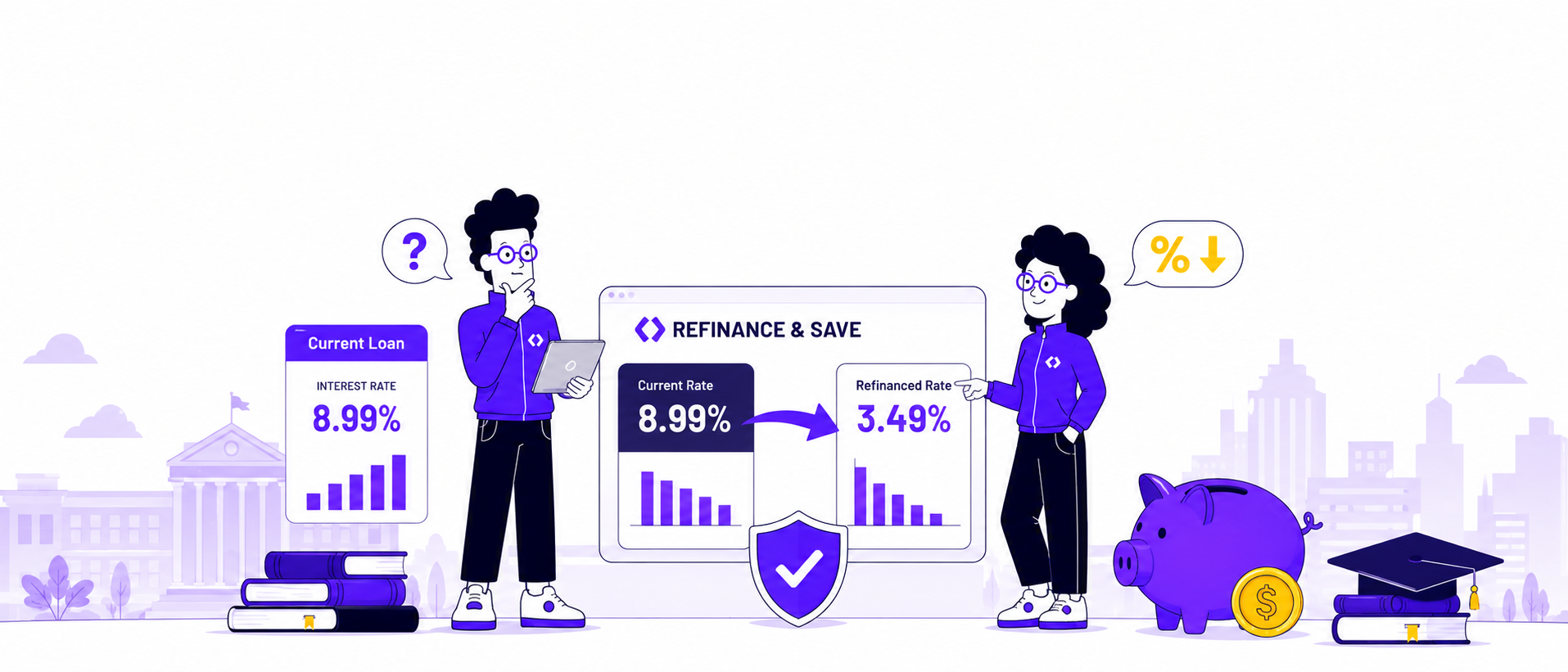
Refinancing can cut years off your repayment timeline and save you thousands of dollars, but only if you actually land a competitive rate. Most borrowers assume the interest rates for refinancing student loans are fixed by the market and there’s little they can do beyond “having good credit.” In reality, your rate is the outcome of several factors you can actively influence – your credit profile, the lender you pick, the loan term you choose, and even the day you choose to lock in your offer.
This guide breaks down exactly what drives interest rates for refinancing student loans, what a competitive rate looks like right now, and the specific steps that help you qualify for the lowest one available to you.
What “interest rate” actually means when you refinance
Before comparing offers, it helps to know what you’re comparing. Lenders don’t just quote one number; they quote a rate type and a cost structure, and mixing these up is the easiest way to accidentally pick a more expensive loan.
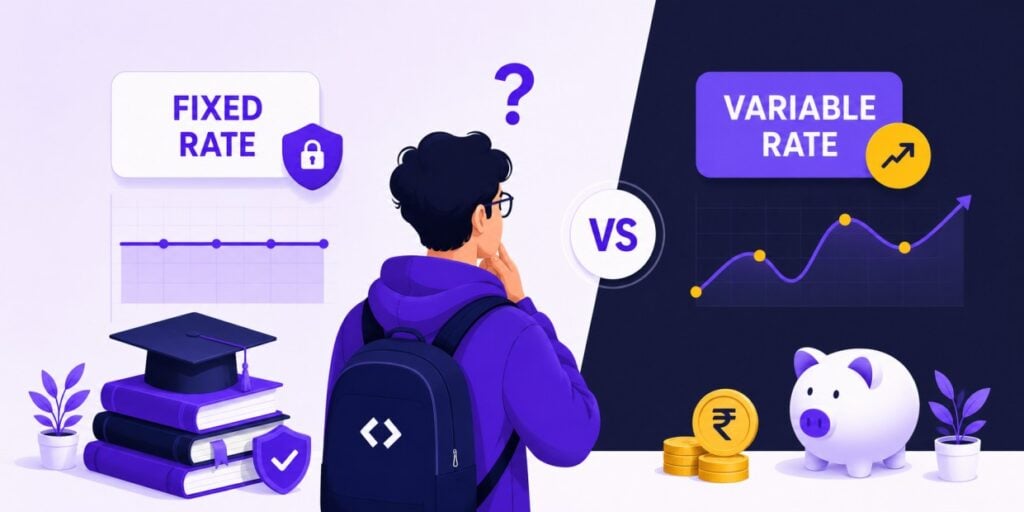
Fixed Rate Vs Variable Rate
A fixed rate stays the same for the entire loan term, so your monthly payment never changes. A variable rate is tied to a benchmark index (commonly SOFR, the Secured Overnight Financing Rate) and moves up or down over time as that index moves. Variable rates usually start lower than fixed rates, which makes them attractive if you plan to pay off the loan quickly or refinance again before rates climb. Fixed rates cost more upfront but protect you if market rates rise later.
APR Vs Interest Rate
The interest rate is the base cost of borrowing the principal. The Annual Percentage Rate (APR) includes the interest rate plus certain fees, giving you a more complete picture of the loan’s true annual cost. Always compare APRs, not just headline interest rates, since two loans with identical interest rates can have very different APRs once fees are factored in.
Also Read: Student Loan Refinancing in 2026: Everything Indian Students in the USA Need to Know
What determines the interest rate you personally qualify for
Advertised “starting at” rates are marketing numbers. Your actual offer is calculated from a smaller set of underwriting inputs.
Credit Score And Credit History
This is the single biggest lever. Lenders use your credit score and repayment history to estimate risk – a higher score signals lower risk, which translates directly into a lower rate. Late payments, high credit utilization, or a thin credit file (common for international students and recent graduates) all push your quoted rate higher.
Debt-To-Income Ratio
Lenders look at your total monthly debt obligations against your gross monthly income. A lower ratio tells the lender you have more breathing room to make payments, which can qualify you for a better rate even if your credit score is only average.
Income And Employment Stability
A steady salary, especially from a stable employer or industry, works in your favor. Some lenders specifically ask for proof of employment or a job offer letter if you’ve recently graduated, since predictable income lowers perceived default risk.
Loan Term Length
Shorter terms (5–7 years) typically carry lower rates than longer terms (15–20 years) because the lender’s money is at risk for less time. A shorter term also means less total interest paid, even before accounting for the rate difference.
Cosigner Strength
Adding a cosigner with strong credit and income can lower your rate meaningfully, particularly if your own credit history is limited. Some lenders also offer a cosigner release after a set number of on-time payments, so this doesn’t have to be a permanent arrangement.
Visa Or Residency Status
For non-U.S. citizens, including Indian students on OPT or H-1B, visa status affects which lenders will even quote a rate, and the rate itself. A borrower building U.S. credit history on a work visa will typically see better offers over time as their domestic credit profile matures.
How to actually get the lowest interest rate for refinancing student loans
Check Your Credit Report Before Applying
Pull your credit report and fix errors, pay down revolving balances, and avoid opening new credit lines in the months before you apply. Even a modest score improvement can shift you into a better rate tier.
Get Prequalified With Multiple Lenders
Prequalification uses a soft credit check, so comparing several lenders side by side doesn’t hurt your score. Because the spread between the best and worst advertised rates can be several percentage points, shopping around is often the single highest-impact step you can take.
Choose The Shortest Term You Can Comfortably Afford
A 5- or 7-year term will almost always carry a lower rate than a 15- or 20-year term. Run the numbers on your monthly budget before committing, since a shorter term also means a higher monthly payment.
Add A Strong Cosigner If Your Credit Is Thin
If your own credit history is limited, a cosigner with an established credit profile can be the difference between a mid-single-digit rate and a double-digit one.
Enroll In Autopay
Most lenders offer an automatic payment discount, commonly around 0.25 percentage points off your rate, simply for setting up autopay from a bank account.
Improve Your Debt-To-Income Ratio First
Pay down other debts, credit cards, personal loans, car loans, before applying. A lower DTI strengthens your application even if your income hasn’t changed.
Time Your Application Around Rate Trends
Since variable rates track a benchmark index, keep an eye on Fed policy and SOFR movements. If a rate cut looks likely, borrowers considering a variable rate may benefit from waiting a few weeks; if rates look set to rise, locking in a fixed rate sooner protects against future increases.
Also Read: How to Choose Among the Best Student Loan Refinancing Companies
Fixed or variable: Which gets you the lower cost over time
There’s no universal answer; it depends on your repayment horizon. If you plan to pay off the loan within 3–5 years, a variable rate’s lower starting point can save you money even if the index rises later, since there’s less time for increases to compound.
If you’re stretching repayment over 10–15 years, a fixed rate protects you from the risk of the index climbing significantly during that window. Borrowers who are risk-averse or on a fixed budget generally prefer the predictability of a fixed rate, even at a slightly higher starting cost.
Common mistakes that lead to a higher rate
- Applying with only one lender. Rate spreads are wide; skipping comparison shopping is the most expensive mistake you can make.
- Choosing the longest available term for a lower payment. This usually means a higher rate and significantly more interest paid overall.
- Not accounting for fees in the APR. A low headline interest rate with high origination fees can cost more than a slightly higher rate with none.
- Applying before fixing credit issues. Late payments or high utilization at the time of application lock you into a worse rate for the life of the loan.
- Ignoring visa or residency-specific lenders. International borrowers who apply to lenders that don’t specialize in their visa category often get rejected or quoted worse terms than a specialized lender would offer.
How GradRight helps you find the lowest rate without the guesswork
Manually comparing APRs, fees, visa eligibility, and repayment terms across a dozen lenders is genuinely time-consuming. GradRight’s refinancing platform is built to remove that friction: you share your current loan details once, and multiple lenders bid for your profile so you can compare real offers side by side instead of researching each lender’s website individually.
The platform’s eligibility checker also gives you a read on the lowest refinance rate you’re likely to qualify for, so you’re not applying blind. For Indian students and professionals working in the U.S. specifically, GradRight factors in visa status, U.S. credit history, and lender-specific eligibility rules – the details that generic rate-comparison sites typically don’t account for. The consultation and comparison process is free, with our team helping you through prequalification, document collection, and final lender selection.





 Australia
  Canada
  France
  Germany
  India
India  Ireland
  UAE
UAE  United Kingdom
  United States