



If you took an education loan to study abroad and you’re now working, chances are refinancing has crossed your mind. The problem isn’t finding a lender willing to refinance your loan. The problem is finding the right one out of dozens of options, each with different rates, fees, and eligibility rules that change based on your visa status.
This guide breaks down exactly what separates the best student loan refinancing companies from the rest, the mistakes that quietly cost borrowers thousands of dollars, and a step-by-step process to compare offers without losing weeks to spreadsheets and phone calls.
What is student loan refinancing (and why it matters for international students)
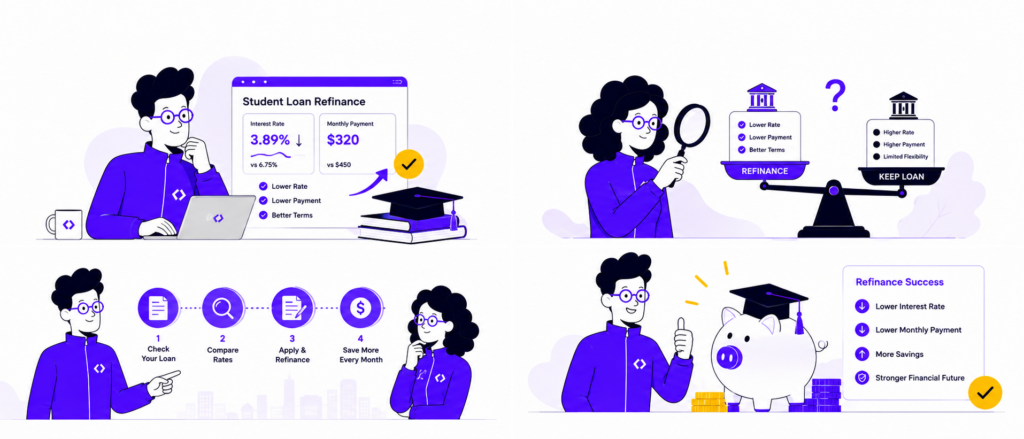
Student loan refinancing means a new lender pays off your existing education loan, and you begin repaying that new lender under fresh terms – typically a lower interest rate, a different tenure, and revised prepayment or foreclosure conditions. The new lender reassesses your credit profile, income, employment stability, and visa status before making an offer.
For Indian students in particular, refinancing usually means converting a rupee-denominated education loan into a USD or EUR loan. The core reason this makes financial sense is straightforward: developed nations typically offer meaningfully lower interest rates than developing nations. Refinancing into a foreign-currency loan can also help you start building a credit history abroad, which comes in handy later if you apply for a home loan or auto loan in that country.
The ideal candidate for refinancing has usually completed their education abroad and is either about to start working or already has some employment history. Career trajectory matters too, since lenders factor in income stability and growth potential when pricing your rate.
Key factors to look for in the best student loan refinancing companies
Not every lender fits every borrower. Before you compare rates, run each option against these factors.
Visa Status and Eligibility Requirements
Eligibility varies significantly by lender. Some refinancing companies only work with H-1B holders or permanent residents, while others are open to international students still on OPT. Before you get attached to a rate, confirm the lender actually serves your current visa status; this single filter eliminates a large share of options upfront.
Interest Rates and the 2% Rule
A common guideline in refinancing circles is the “2% rule”: only refinance if your new interest rate is at least 2 percentage points lower than your current rate. It’s a useful starting filter, but it’s just a guideline; it doesn’t account for loan tenure, currency risk, or how stable your income is. Look at the total effect on your repayment over the life of the loan, not just the headline rate difference.
Fees: Processing, Prepayment, and Late Payment Charges
A low advertised rate can be undone by fees. Watch for processing fees, prepayment penalties, and late payment charges – these quietly increase the real cost of a loan that looks cheap on paper. Many lenders advertise no origination and no prepayment fees, but this should always be verified directly on the lender’s page rather than assumed.
Deferment, Forbearance, and Flexible Repayment Options
Life abroad is unpredictable – job changes, visa transitions, and unexpected expenses happen. Lenders that offer deferment, forbearance, or flexible repayment plans during difficult stretches are a safer long-term pick than one offering only a slightly better rate with no cushion built in.
Autopay Discounts and Added Benefits
Small perks add up. Many major lenders offer a rate discount (commonly around 0.25%) for enrolling in autopay, and this is usually reflected in their lowest advertised APRs. Some lenders also throw in career support or networking opportunities, which can matter if you’re early in your career abroad.
Federal Loan Protections You Could Lose
If any portion of your loan is a US federal loan, understand what you’re giving up. Refinancing federal loans into a private loan means permanently losing access to Income-Driven Repayment (IDR) plans and certain forgiveness paths like Public Service Loan Forgiveness (PSLF). This is one of the most consequential and commonly overlooked tradeoffs in the entire decision.
How to compare multiple student loan refinance lenders without the guesswork
Once you’ve narrowed lenders down by eligibility, the actual comparison process matters just as much as the criteria.
Get Prequalified With a Soft Credit Check
Most reputable lenders and marketplaces let you prequalify using a soft credit check, meaning you can view estimated rates without any impact to your credit score. A hard credit pull only happens once you formally apply with a specific lender. This lets you shop broadly before committing anywhere.
Compare Offers on the Same Day
Rates move, sometimes daily. If you collect quotes from different lenders on different days, you’re not making an apples-to-apples comparison. Line up your offers on the same day so the numbers actually mean something next to each other.
Keep Documentation Ready Before You Apply
Have your payoff letters, proof of employment, and ID ready before you start applying. Applying before your documentation is in order slows down the process and can cost you a favorable rate window.
Apply to One Lender at a Time
Once you’ve compared prequalified offers and picked a front-runner, apply to that one lender first rather than multiple lenders simultaneously, since a formal application typically triggers a hard credit inquiry.
Also Read: SoFi Student Loan Refinancing Review 2026: Is It Right for Indian Students?
Common mistakes to avoid when choosing a refinance lender
Even borrowers who do their homework tend to trip on the same few issues:
- Refinancing federal loans without understanding the tradeoff. You permanently give up benefits like IDR and PSLF once you move to a private lender.
- Chasing the lowest EMI while ignoring total interest and term length. A lower monthly payment stretched over a longer tenure can cost more overall.
- Applying before your documentation is ready. Payoff letters, employment proof, and ID should be sorted first.
- Comparing offers collected on different days. Rates shift, so line up quotes together for a fair comparison.
Step-by-step: How to refinance with the best student loan refinancing companies
Step 1: Check Your Eligibility
Confirm which lenders serve your visa status, income level, and loan type before investing time in any application.
Step 2: Get Prequalified Offers
Use a soft credit check to see estimated rates from multiple lenders without affecting your credit score.
Step 3: Submit Documents
Share employment proof, visa documentation, and existing loan statements with your shortlisted lender.
Step 4: Compare and Choose
Line up prequalified offers side by side, rate, tenure, fees, and repayment flexibility, and pick the one with the best overall lifetime cost for your situation.
Step 5: Close the Old Loan
Once approved, your new lender repays your old loan directly, and you begin repayment under your new terms.
Also Read: Can You Refinance Federal Student Loans? What Indian Students Lose (and Gain)
How we make it easier to find the best student loan refinancing companies
Manually comparing lenders one by one means repeating the same paperwork, re-explaining your visa situation, and juggling rates that go stale by the time you’ve gathered them all. This is where refinancing marketplaces change the process.
Instead of applying to one lender at a time and hoping for the best, a marketplace lets you submit your loan details once and receive prequalified offers from multiple lenders in parallel, all viewable side by side. GradRight goes a step further with a reverse-auction mechanism, where lenders actively bid for your profile rather than you approaching them individually, increasing your chances of landing a more competitive offer while cutting out repetitive document submissions.
An eligibility checker built into a marketplace can also tell you the lowest refinance rate you’re likely to qualify for before you apply anywhere, so you’re not guessing which lenders are even worth your time.








 Australia
  Canada
  France
  Germany
  India
India  Ireland
  UAE
UAE  United Kingdom
  United States