





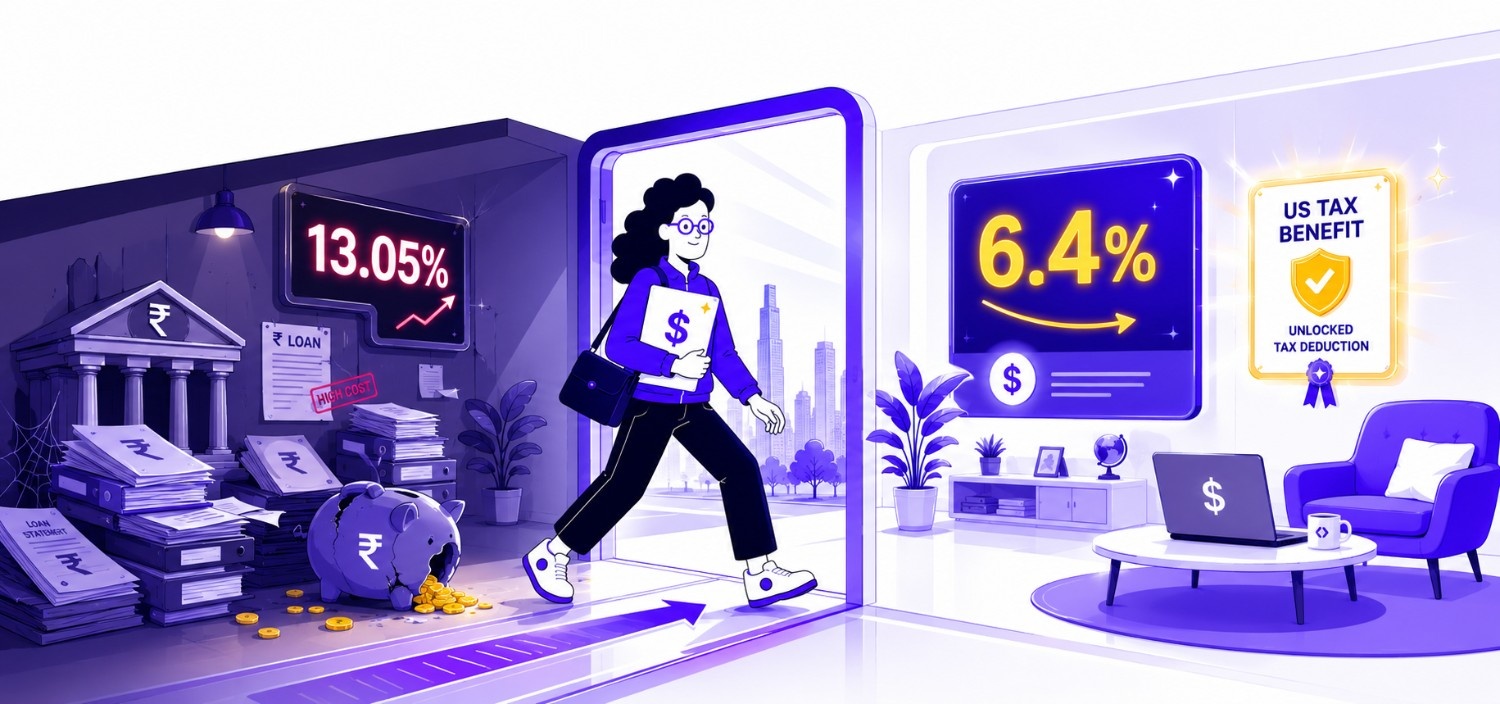
Working in the US on STEM OPT, Vandana converted a high-interest Indian loan into a dollar-aligned, low-cost US education loan – with zero processing fees.
Case Study Overview
Vandana was doing well by any measure – living in the US on a STEM OPT visa, earning $80,000 a year from a full-time job, and managing her finances carefully. But there was one line item on her balance sheet that didn’t reflect her current reality: an education loan of ₹72.48 lakhs at 13.05%.
It was an INR loan in a USD world. Every month, Vandana was effectively paying a premium to service a debt structured for a borrower in India – while living, working, and spending in the United States. The mismatch wasn’t just financially costly; it was strategically wrong for her stage of life.
GradRight assessed her full profile and facilitated a refinance to a US bank, converting the loan entirely into USD. The rate dropped from 13.05% to a fixed 6.4% APR. Monthly EMI reduced by approximately ₹32,000. Total savings over an 8-year tenure: ₹30-32 lakhs.
Student Financial Profile
| Visa Status | STEM OPT |
| Job Status | Full-time |
| Annual Income | $80,000 |
| Outstanding Loan Amount | ₹72.48 Lakhs |
| Original Interest Rate | 13.05% |
| Original Loan Currency | INR |
READ MORE: I Have EMI Bounces on My Indian Loan. Can I Still Refinance From the US?
Problem Statement
An INR Loan in a USD Life
Vandana’s education loan was structured for a borrower based in India – INR-denominated, at a rate designed for that context. But Vandana was living, earning, and spending in the US. Every monthly repayment meant converting USD to INR to service a loan that no longer matched her financial reality.
A Rate That Didn’t Reflect Her Profile
At 13.05%, the interest rate was built for a borrower yet to establish themselves professionally. Vandana had a full-time job, a stable income of $80,000, and a STEM OPT visa – a profile that US lenders would assess very differently from the one she had when she originally took the loan.
The Compounding Cost of Inaction
On ₹72.48 lakhs over an 8-year tenure, the difference between 13.05% and a competitive US fixed rate wasn’t marginal. Every month of delay compounded the gap between what Vandana was paying and what she could have been paying.
Solution
GradRight assessed Vandana’s complete profile – income, visa status, repayment history, and tenure flexibility – and identified her as a strong candidate for a direct refinance to a US bank. The move would do two things at once: eliminate the currency mismatch and secure a dramatically lower fixed rate.
Single Move – Original Lender to US Bank
Vandana’s loan of ₹72.58 lakhs was fully refinanced in a single transaction to a US bank at a fixed 6.4% APR. Processing fee: zero. The loan was now in USD – aligned with her income, her expenses, and her life.
Old Loan → New Loan
Old Loan
| Interest Rate | 13.05% |
| Outstanding Loan Amount | ₹72.48 Lakhs |
| Loan Currency | INR |
New Loan
| Lender | US Bank |
| Interest Rate | 6.4% Fixed APR |
| Disbursement Amount | ₹72.58 Lakhs |
| Processing Fee | ₹0 |
| Loan Currency | USD |
READ MORE: Student Loan Refinance Rates: How to Find the Lowest Deals Right Now
How Did GradRight Help?
Full Profile Assessment GradRight evaluated Vandana’s income, visa status, repayment history, and tenure flexibility to confirm her eligibility for a direct US bank refinance.
Currency Alignment Strategy GradRight identified that the right move wasn’t just a rate reduction – it was a structural shift from an INR loan to a USD loan, eliminating the currency mismatch entirely.
End-to-End Execution GradRight managed the full refinance process, securing a fixed 6.4% APR with zero processing fees and ensuring a clean transition from the original lender to the US bank.
Results
- Rate: 13.05% (INR) → 6.4% Fixed APR (USD)
- Disbursement: ₹72.58 Lakhs fully refinanced
- Processing Fee: ₹0
- Monthly EMI Reduction: ~₹32,000
- Total Savings Over 8-Year Tenure: ₹30-32 Lakhs
- New Benefit: Eligible for US student loan interest tax deduction
The shift wasn’t just about rate. It was about alignment. Vandana’s income is in USD. Her expenses are in USD. Her career is in the US. Her loan is now in USD too – with a fixed rate that won’t fluctuate and repayments that come out of the same account her salary goes into. And with the US student loan interest tax deduction now accessible, Vandana can offset a portion of her interest expense against her annual tax liability – a financial lever that simply wasn’t available with an Indian loan.







 Australia
  Canada
  France
  Germany
  India
India  Ireland
  UAE
UAE  United Kingdom
  United States
