





The excitement of your first paycheck after graduating in the USA is real. So is the reality check when you see that your education loan EMI is eating up almost 40% of your monthly take-home pay. Rent, groceries, health insurance, transportation – and then a loan payment that feels designed for a different income level.
Over 420,000 Indian students are currently enrolled in US universities. Most have borrowed between Rs 25 lakh and Rs 75 lakh to fund their education. They are repaying at rates of 11-14% on their Indian education loans while their American classmates refinanced to 5-7% after graduation. That gap – 5-9 percentage points on a loan you will be paying for 10 years – is the financial problem this article addresses.
Refinancing is not a magic fix. It is a specific tool that works well for specific profiles. This guide explains when it is the right answer, what alternatives exist if it is not, and the hidden tax benefits many Indian graduates miss entirely.
Why the EMI Feels Unaffordable: The Structural Mismatch
When you took your education loan as a student, the bank sized it based on projected future income – a guess, not a salary. Now that you have a job in the USA, your income profile has changed fundamentally. But the loan rate has not.
The mismatch is structural. Indian banks price education loans based on the risk of lending to a student with no income history, no US credit profile, and uncertain employment prospects. The rate reflects all that uncertainty – 11-14%. Once you are employed, creditworthy, and building a US financial footprint, that same risk profile no longer applies to you. Refinancing is how you reprice the loan to match your current reality.
| Situation | Your Old Loan Rate Reflects | Your Current Reality |
| Then (student) | No income, no US credit, no employment history – highest risk | N/A |
| Now (employed graduate) | Still 11-14% – rate set years ago for a different risk profile | Stable income, building US credit, documented employment – much lower risk |
| After refinancing | Repriced to reflect current risk | 5-9% USD – matches your actual profile now |
How Refinancing Reduces the EMI
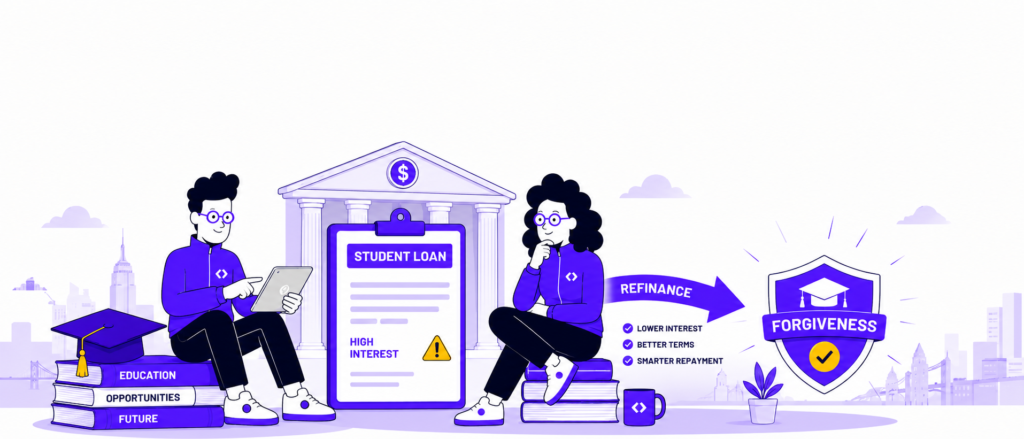
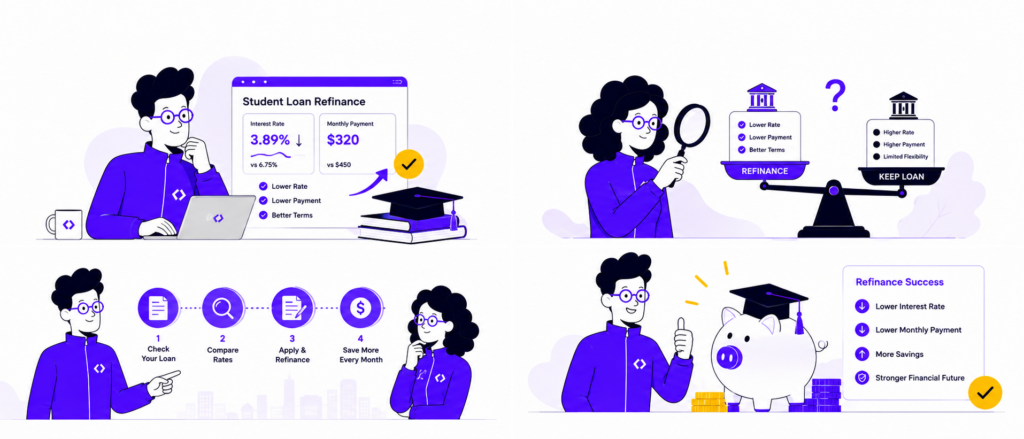
With a student loan refinance, you replace your current education loan with a new loan – typically a US loan at a lower rate. The monthly payment drops because interest makes up a smaller portion of each payment.
| Scenario | Monthly EMI (approx.) | Annual Interest Cost | Total Interest (10 years) |
| Rs 40 lakh at 13% (Indian NBFC, 10 years) | ~Rs 59,500 | ~Rs 5.2 lakh | ~Rs 31.4 lakh |
| Rs 40 lakh at 9% (after India-based refinancing, 10 years) | ~Rs 50,700 | ~Rs 3.7 lakh | ~Rs 20.8 lakh |
| $50,000 at 6% USD (after US refinancing, 10 years) | ~$555/month | ~$3,000/year | ~$16,600 total interest |
The EMI reduction from Rs 59,500 to Rs 50,700 may seem modest in absolute terms, but it frees approximately Rs 8,800 per month. Over 12 months that is Rs 1.05 lakh per year redirected to savings, rent, or investment instead of interest. And the total interest saving of Rs 10.6 lakh over 10 years is substantial.
Before Refinancing: Three Things to Check First
1. Do Not Give Up Federal Loan Benefits You Need
Refinancing a US federal loan into a private loan means permanently losing income-driven repayment plans, targeted forbearance options, and loan forgiveness programmes. This is a one-way door. Before refinancing any federal loans you may hold, make sure you do not need these protections. If your Indian loan is from an Indian bank or NBFC (which most are), this warning does not apply – Indian education loans are private by nature and have no federal benefits to lose.
2. Check the Two US Tax Benefits You Might Be Missing
Two US tax benefits apply to student loan borrowers that many Indian graduates do not know about:
| Tax Benefit | Amount | Who Qualifies | Notes |
| Student loan interest deduction (Form 1098-E) | Up to $2,500 per year | Borrowers below income phase-out thresholds (check current IRS limits) | Applies to both federal and private US loans. Your Indian loan repayments from the USA may not qualify for Form 1098-E – confirm with your tax advisor. |
| Employer educational assistance program | Up to $5,250 tax-free (through Dec 31, 2025 per current law) | Employees at companies that offer this benefit | Your employer may contribute up to $5,250/year toward your student loan repayment without it being taxable income. Check with HR whether your company offers this. |
3. Understand What “AutoPay Discount” Actually Means
Most refinancing lenders advertise a 0.25% rate reduction for enrolling in automatic payments. This is real – but regulators have flagged cases where websites misstated exactly who qualifies for AutoPay discounts and under what conditions. Read the disclosure box carefully when you receive your loan offer. Save a copy. Understand whether the discount applies from day one or has a waiting period, and whether missing a single payment removes it temporarily or permanently. Source: GradRight original article.
Also Read: Pros and Cons of Refinancing Your Education Loan
Risk Checklist Before Signing Any Refinancing Agreement
| Risk | What to Verify |
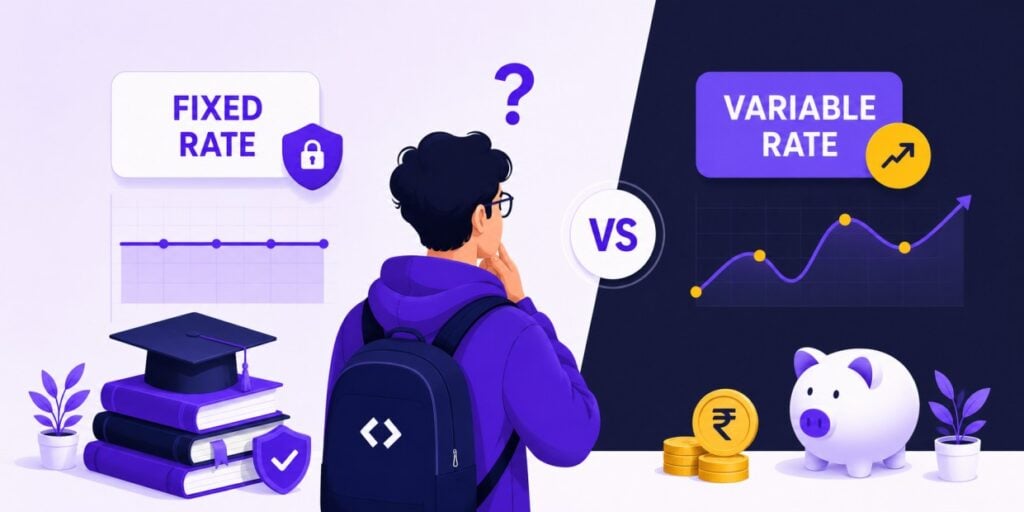
| Variable rate EMI increases | If the new loan is variable rate, your EMI can rise with market conditions. Confirm whether there is a rate cap and what the worst-case EMI would be. |
| Federal loan benefits lost | If refinancing any US federal loans: income-driven repayment, PSLF, and forbearance are permanently gone. Only relevant if you hold US federal loans. |
| Hidden fees | Check the disclosure for origination fees, late payment fees, returned-payment fees, and the exact conditions for autopay discount. |
| Prepayment penalty | Most good refinancing lenders have zero prepayment penalty. Confirm explicitly. |
| Right-to-cancel window | You have 3 business days to cancel after signing. Do not cancel Indian EMI until payoff is confirmed. |
| Currency risk (India-returning graduates) | If you plan to return to India and earn in INR, a USD loan increases in effective cost as the rupee weakens. Refinance in India instead if returning soon. |
| Cosigner implications | If you refinance with a cosigner, understand the cosigner release terms. Citizens Bank: 36 on-time payments. SoFi: 24 months. |
When Refinancing Is Not the Right Answer
Refinancing works well for graduates with stable income and improving credit who are staying abroad. It is not always the answer:
- If your FICO is below 650: you may not qualify or will get offered the top of the rate range – not worth the hard inquiry. Build credit for 6-12 months first.
- If you are returning to India within 12-18 months: a USD loan with Indian income becomes expensive as rupee weakens. Consider India-based refinancing (NBFC to public bank) instead.
- If you are still in the moratorium period on an Indian loan: moratorium ends at a set date. The EMI pressure is temporary. Refinancing may not be worth the transition costs for a moratorium you will exit soon anyway.
- If the rate difference is under 1%: calculate the break-even carefully. Transition costs (processing fee + Indian bank closure) may not be recovered.
Not sure if refinancing is right for your situation? Start a soft check at refinance.gradright.com – no impact to your credit score. Check Refinancing Eligibility on GradRight
Where to Start Comparing
Common refinance brands for US-based borrowers: SoFi, Earnest, Citizens Bank, Laurel Road, and ELFI. International-friendly options: MPower Financing (no cosigner, direct Indian bank payoff, accepts OPT/H-1B), Prodigy Finance (availability and criteria vary – verify on their site). Source: GradRight original article.
Compare fixed vs variable APRs, autopay discounts, cosigner release terms, and visa eligibility before applying. GradRight’s refinancing platform surfaces lenders matched to your visa status, income, and credit profile simultaneously – one submission, multiple competing offers.
Also Read: Student Loan Refinance Rates 2026: How to Find the Lowest
If you are unsure whether today’s rates work for you, start with rate checks at GradRight. No commitment, no impact to credit. Start Rate Check on GradRight
Related Guides
Pros and Cons of Refinancing Your Education Loan
Student Loan Refinance Rates 2026: How to Find the Lowest
Are You Eligible to Refinance Your Student Loans?
7 Myths About Refinancing Education Loans
How Refinancing Your Education Loan Can Save You Lakhs
Building Your US Credit History with Refinanced Education Loans
SoFi vs Citizens Bank: Which Refinance Is Better?




 Australia
  Canada
  France
  Germany
  India
India  Ireland
  UAE
UAE  United Kingdom
  United States
