




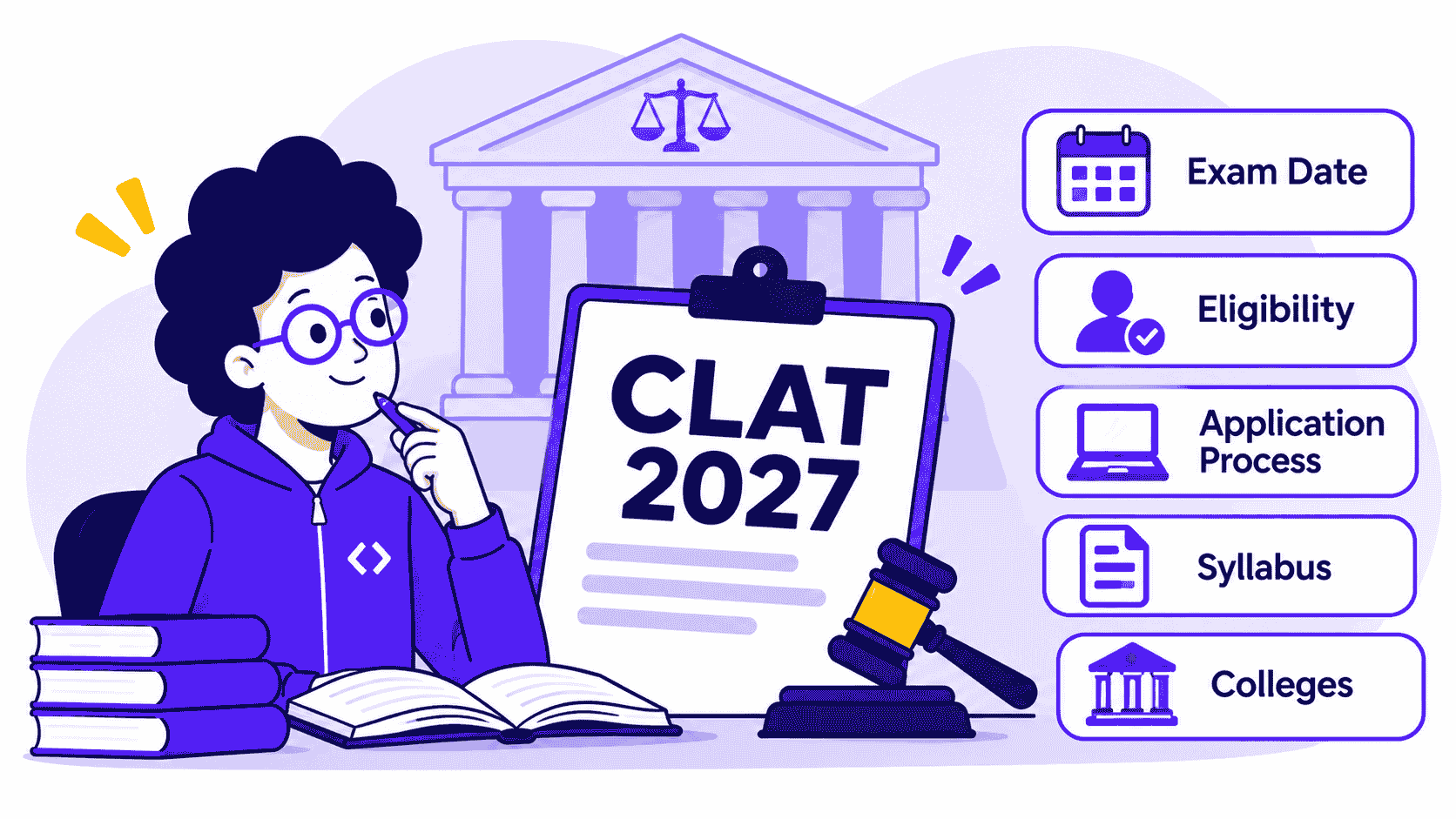
The Common Law Admission Test (CLAT) is a national-level entrance examination for admission to five-year integrated undergraduate law programs (such as B.A. LL.B., BBA LL.B., B.Com. LL.B., B.Sc. LL.B., and BSW LL.B.) and postgraduate LL.M. courses at 27 participating universities and campuses across India, including the National Law Universities (NLUs), the GNLU Silvassa campus and IIULER Goa.
The exam is conducted by the Consortium of National Law Universities, an association of representative NLUs. Several other universities and organizations also accept CLAT scores for admissions and recruitment.
CLAT 2027 will be conducted on Sunday, December 6, 2026, from 2:00 PM to 4:00 PM in offline mode. The application process started on August 3, 2026, and the extended deadline to submit applications was November 7, 2026.
The CLAT UG examination consists of 120 questions carrying one mark each. Candidates receive 1 mark for every correct answer, while 0.25 marks are deducted for each incorrect answer. The examination duration is two hours.
CLAT 2027 Important Dates
| Event | Date |
| CLAT 2027 Press Release | July 22, 2026 |
| Application Process Begins | August 3, 2026 |
| Original Application Deadline | October 31, 2026 |
| Extended Last Date to Apply | November 7, 2026 |
| Correction and Pending Fee Payment Deadline | November 10, 2026 |
| CLAT 2027 Exam | December 6, 2026 |
Eligibility for CLAT 2027
CLAT UG Eligibility
Candidates applying for CLAT UG 2027 must meet the following eligibility requirements:
- Age Limit: There is no upper age limit for candidates appearing for the CLAT UG examination.
- Educational Qualification: Candidates must have passed Class 12 or an equivalent examination with:
- At least 45% marks or its equivalent in grade
- At least 40% marks for candidates belonging to SC, ST, and PwD categories.
- Appearing Candidates: Students appearing for their Class 12 or equivalent examinations in March or April 2027 can also apply. However, they must provide proof of passing the examination at the time of admission. Failure to do so will result in disqualification from the admission process.
How To Apply for CLAT 2027
To apply for CLAT 2027, follow the below steps:
- Register on the official CLAT 2027 website (consortiumofnlus.ac.in) using a valid personal mobile number and email address. Verify the mobile number through the OTP received.
- Log in and fill out the application form with accurate personal and academic details matching the information on your official documents.
- Select the appropriate program (UG or PG) and category. Check these details carefully before proceeding.
- Upload the required documents, including your recent photograph, signature, and applicable category certificates.
- Review and submit the application form.
- Pay the application fee online to complete the registration process.
Important: Once the application form is submitted and the fee is paid, candidates cannot change their selected program, category, or BPL status.
*CLAT 2027 applications closed on November 7, 2026, and the final deadline for pending fee payments was November 10, 2026.
Application Fee
The application fee can be paid online.
| Category | Application Fee |
| General/OBC/NRI | ₹4,000 |
| SC/ST/BPL/PwD | ₹3,500 |
*The application fee is non-refundable.
CLAT UG 2027 Syllabus
The CLAT 2027 focuses on evaluating candidates’ comprehension, reading skills and abilities. Rather than testing prior knowledge, it focuses on the aptitude and skills required for legal education. However, having some background knowledge may be helpful in answering questions in the Current Affairs, including General Knowledge, section.
The exam consists of 5 subjects:
- English Language
- Current Affairs, including General Knowledge
- Legal Reasoning
- Logical Reasoning
- Quantitative Techniques
English Language
The UG-CLAT 2027 English Language section will include passages of approximately 450 words from contemporary or historically significant fiction and non-fiction. Questions will test candidates’ ability to understand key ideas, draw inferences, summarise passages, compare viewpoints, and interpret words and phrases in context. Each passage should take a Class 12 student around 5-7 minutes to read.
Current Affairs Including General Knowledge
This section will include passages of up to 450 words based on news, journalistic sources, and non-fiction writing. Questions will test candidates’ awareness of current affairs, arts and culture, international affairs, and significant historical events. Some questions may also cover legal information mentioned in the passage, without requiring prior legal knowledge.
Legal Reasoning
This section will include passages of around 450 words based on legal issues, public policy, or moral and philosophical questions. No prior legal knowledge is required. Questions will test candidates’ ability to identify legal principles, apply them to given situations, and understand how changes in these principles affect their application.
Logical Reasoning
This section will include short passages of approximately 450 words, followed by questions that assess candidates’ ability to identify arguments, premises, and conclusions; analyze reasoning; draw inferences; recognize relationships and contradictions; and evaluate how changes in evidence or assumptions affect an argument.
Quantitative Techniques
This section will include numerical data presented through short passages or sets of facts. Questions will test candidates’ ability to interpret and manipulate numerical information using Class 10 mathematical concepts, including ratios, proportions, basic algebra, mensuration, and statistics.
| Subject | Approximate Number of Questions |
| English Language | 22-26 questions, or roughly 20% of the paper |
| Current Affairs, including General Knowledge | 28-32 questions, or roughly 25% of the paper |
| Legal Reasoning | 28-32 questions, or roughly 25% of the paper |
| Logical Reasoning | 22-26 questions, or roughly 20% of the paper |
| Quantitative Techniques | 10-14 questions, or roughly 10% of the paper |
Participating NLUs for CLAT UG 2027
CLAT UG 2027 scores are used for admission to five-year integrated undergraduate law programs offered by participating National Law Universities (NLUs) across India. Here is the list of participating NLUs and their locations.
| Participating University | Location |
| National Law School of India University (NLSIU) | Bengaluru, Karnataka |
| NALSAR University of Law | Hyderabad, Telangana |
| National Law Institute University (NLIU) | Bhopal, Madhya Pradesh |
| The West Bengal National University of Juridical Sciences (WBNUJS) | Kolkata, West Bengal |
| National Law University (NLU) | Jodhpur, Rajasthan |
| Hidayatullah National Law University (HNLU) | Raipur, Chhattisgarh |
| Gujarat National Law University (GNLU) | Gandhinagar, Gujarat |
| Gujarat National Law University, Silvassa Campus | Silvassa, Dadra and Nagar Haveli and Daman and Diu |
| Dr. Ram Manohar Lohiya National Law University (RMLNLU) | Lucknow, Uttar Pradesh |
| Rajiv Gandhi National University of Law (RGNUL) | Patiala, Punjab |
| Chanakya National Law University (CNLU) | Patna, Bihar |
| National University of Advanced Legal Studies (NUALS) | Kochi, Kerala |
| National Law University Odisha (NLUO) | Cuttack, Odisha |
| National University of Study and Research in Law (NUSRL) | Ranchi, Jharkhand |
| National Law University and Judicial Academy (NLUJA) | Guwahati, Assam |
| Damodaram Sanjivayya National Law University (DSNLU) | Visakhapatnam, Andhra Pradesh |
| Tamil Nadu National Law University (TNNLU) | Tiruchirappalli, Tamil Nadu |
| Maharashtra National Law University (MNLU) | Mumbai, Maharashtra |
| Maharashtra National Law University (MNLU) | Nagpur, Maharashtra |
| Maharashtra National Law University (MNLU) | Chhatrapati Sambhajinagar, Maharashtra |
| Himachal Pradesh National Law University (HPNLU) | Shimla, Himachal Pradesh |
| Dharmashastra National Law University (DNLU) | Jabalpur, Madhya Pradesh |
| Dr. B. R. Ambedkar National Law University (DBRANLU) | Sonipat, Haryana |
| National Law University Tripura (NLUT) | Agartala, Tripura |
| Dr. Rajendra Prasad National Law University (RPNLU) | Prayagraj, Uttar Pradesh |
| India International University of Legal Education and Research (IIULER) | Goa |
| National Law University Meghalaya | Shillong, Meghalaya |
Note: Check each university’s brochure for its specific undergraduate program offerings and admission details.
CLAT UG 2027 Preparation Tips and Study Plan
Preparing for CLAT UG 2027 requires consistent practice, strong reading skills, and a clear understanding of the exam pattern. Since the exam tests comprehension and reasoning rather than rote learning, focus on improving your accuracy and time management.
One common question among CLAT aspirants is whether self-study is enough to crack the exam or whether joining a coaching institute is necessary. This concern also comes up in student discussions, as seen in the Reddit post below.
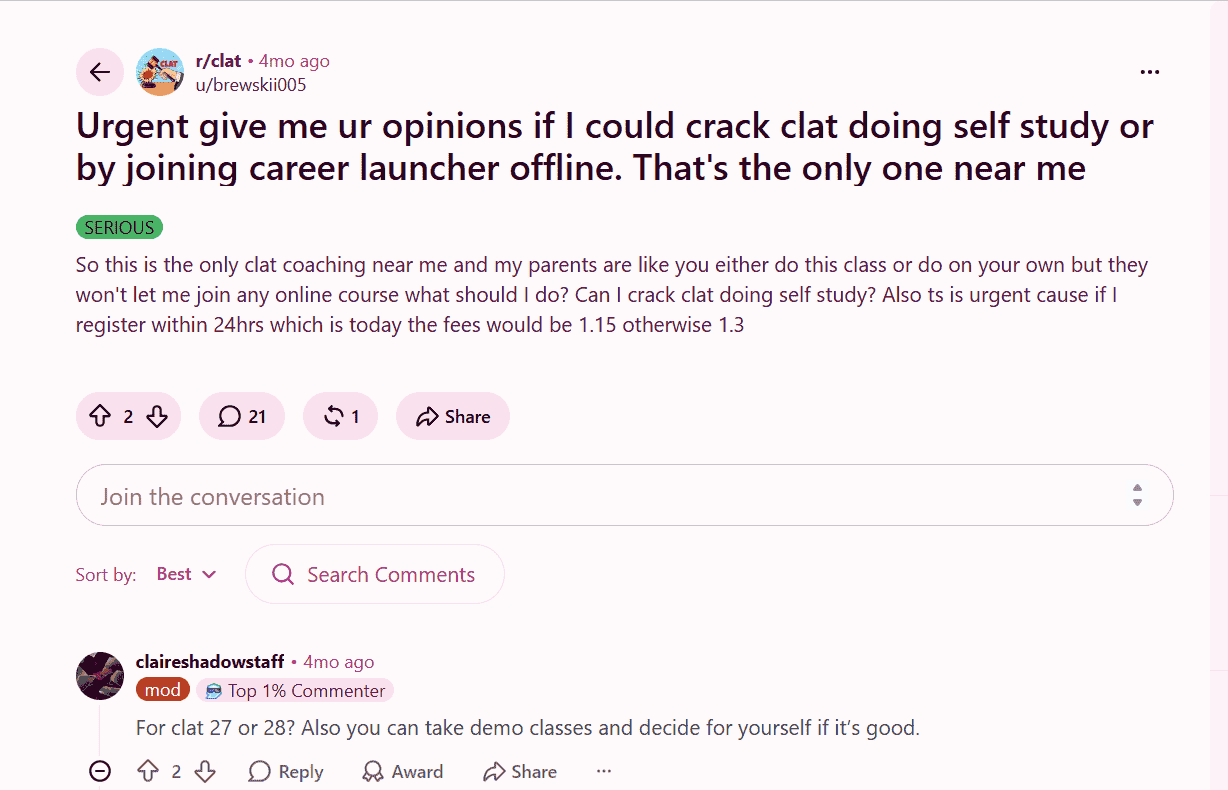
Whether you choose self-study or coaching, a structured preparation strategy, regular practice, and mock tests are important for CLAT preparation. Here are some tips to help you get started:
Here are some preparation tips to help you get started:
- Understand the exam pattern and syllabus: Familiarize yourself with the five sections: English Language, Current Affairs including General Knowledge, Legal Reasoning, Logical Reasoning, and Quantitative Techniques.
- Build a daily reading habit: Read newspapers, editorials, and articles to improve comprehension, vocabulary, and awareness of current affairs.
- Practice section-wise questions: Solve comprehension passages, legal reasoning questions, logical reasoning sets, and quantitative problems regularly.
- Revise current affairs: Keep track of important national and international events, legal developments, awards, sports, and significant historical events.
- Solve previous years’ question papers: This will help you understand the question format, identify weak areas, and improve your speed.
- Take mock tests: Attempt full-length mock tests under timed conditions and analyze your mistakes after each test.
CLAT UG Study Plan
A balanced study routine can help you cover all five sections without neglecting revision and practice.
| Daily Activity | Suggested Time |
| English Language and reading practice | 45 minutes |
| Current Affairs and General Knowledge | 45 minutes |
| Legal Reasoning | 1 hour |
| Logical Reasoning | 45 minutes |
| Quantitative Techniques | 45 minutes |
| Revision and mock test analysis | 1 hour |
Note: You can adjust the study hours based on your preparation level and areas that need more attention. Regular practice and mock test analysis are more important than simply increasing study hours.
What Happens After CLAT UG 2027?
After the CLAT UG 2027 results are announced, eligible candidates can participate in the centralized counselling process for admission to participating NLUs. The counselling process is conducted by the Consortium of National Law Universities and involves multiple rounds of seat allotment.
CLAT UG 2027 Counselling Process
Candidates who meet the counselling requirements will be invited to register for the admission process. The general steps include:
- Counselling invitation: Candidates eligible for counselling will receive an invitation through their registered email address, mobile number, and CLAT account.
- Counselling registration: Log in to the official CLAT portal, complete the counselling registration, and pay the applicable registration fee.
- Fill NLU preferences: Select and arrange participating NLUs in order of preference.
- Seat allotment: Seats are allotted based on CLAT rank, NLU preferences, category, seat availability, and the admission policies of individual universities.
- Accept the allotted seat: Candidates must respond to the allotment within the given deadline. Depending on the available options, they may choose to accept, freeze, or float their allotted seat.
- Complete admission formalities: Once a seat is confirmed, candidates must submit the required documents and pay the university admission fee within the prescribed timeline.
Note: The Consortium will release the official CLAT UG 2027 counselling schedule and detailed instructions after the results. Candidates should regularly check the official website for updates.







 Australia
 Canada
 France
 Germany
 India
 Ireland
 UAE
 United Kingdom
 United States