





If you are interested in accounting, economics, taxation, or finance, Bachelor of Commerce (BCom) may be the right fit for you. BCom is an undergraduate course that students can pursue after completing Class 12 from any stream (Arts, Commerce, and Science).
In this guide, we will explore the BCom course in detail, including its types, specializations, eligibility, subjects, fees, top colleges, higher education options, and career opportunities after graduation.
What is BCom?
Bachelor of Commerce (BCom) is an undergraduate degree that typically takes three years to complete after Class 12. Some universities also offer a four-year BCom Honours or Honours with Research program, depending on their undergraduate curriculum.
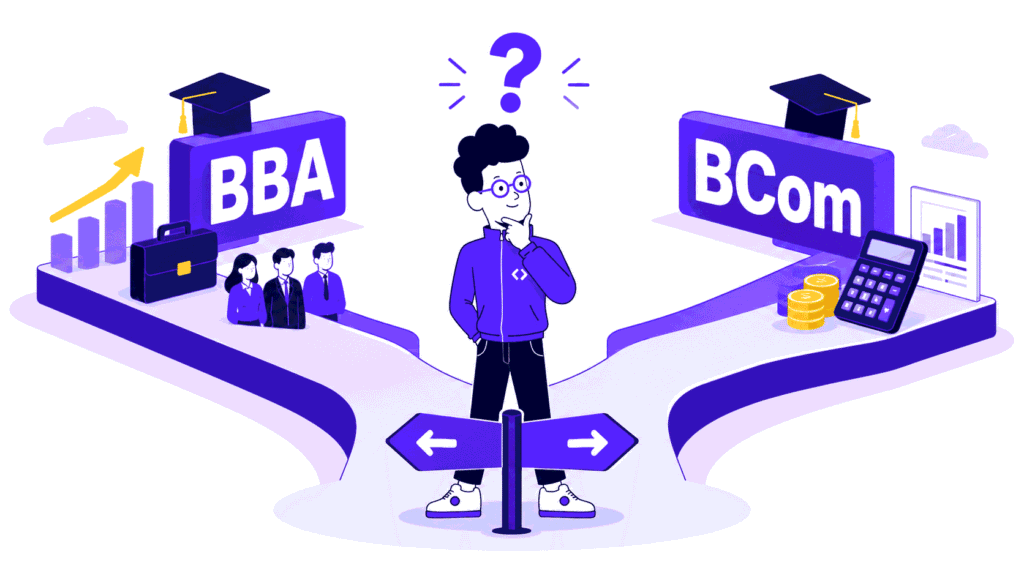
Students from Arts, Commerce, or Science streams can apply, depending on the eligibility criteria of the college. The BCom course focuses on subjects such as accounting, finance, taxation, and business management. It helps students build a strong foundation in financial and business concepts that are useful across industries. Not sure whether BCom or BBA suits you better? Read our BBA vs BCom comparison.
BCom Course Highlights
| Particulars | Details |
| Full form | Bachelor of Commerce |
| Degree level | Undergraduate |
| Course duration | Usually 3 years, with some four-year options |
| Eligibility | Class 12 or equivalent |
| Admission process | Merit-based or entrance exam |
| Popular subjects | Accounting, Economics, Business Law, Finance |
| Study mode | Full-time, distance, and online |
| Career options | Accountant, Financial Analyst, Tax Consultant, Banking Associate |
Eligibility for BCom
- Students must have passed Class 12 from a recognized board
- Many universities accept students from any stream, but commerce is preferred, and some colleges require it, especially for BCom (Honours).
- Most colleges ask for roughly 45–50% in Class 12, with relaxation for reserved categories. The exact cutoff varies by university.
Is Maths compulsory for pursuing BCom?
No. Maths is not compulsory for every BCom program. Many colleges offer general BCom courses to students who did not study Maths in Class 12. However, some BCom specializations and institutions may require Maths or a related subject. Always check the program-specific criteria before applying.
BCom Subjects
The BCom syllabus covers subjects related to accounting, finance, taxation, economics, and business management. While the exact subjects and their distribution vary across universities, students generally study the following areas as part of the program.
| Subject Area | Common Subjects |
| Accounting | Financial Accounting, Corporate Accounting, Cost Accounting, Management Accounting |
| Business Law | Business Regulatory Framework, Company Law, Business Law |
| Economics | Business Economics, Business Environment, Indian Economy |
| Finance | Financial Management, Money and Financial Systems |
| Taxation | Income Tax, Indirect Taxes |
| Business Management | Principles of Business Management, Fundamentals of Entrepreneurship |
| Mathematics and Statistics | Business Mathematics, Business Statistics |
| Auditing | Auditing, Corporate Governance |
| Computer Applications | Information Technology in Business, Computer Applications in Business |
| Communication | Business Communication |
Note: This is an indicative list of BCom subjects. The actual syllabus, electives, and semester-wise distribution vary by university and program.
BCom Syllabus Under NEP 2020
Under NEP 2020, the UGC introduced the Curriculum and Credit Framework for Undergraduate Programs (CCFUP), which gives universities greater flexibility in designing undergraduate courses. BCom programs continue to cover core commerce areas such as accounting, finance, business law, economics and taxation, although the subjects and their classification as Major or Minor papers may vary by university.
The framework also includes multidisciplinary courses, Ability Enhancement Courses, Skill Enhancement Courses, Value-Added Courses and internships. It provides multiple entry and exit options, allowing students to pursue a three-year bachelor’s degree or a four-year Honours or Honours with Research program, subject to the university’s requirements. As universities implement the framework differently, the semester-wise BCom syllabus and subject combinations can vary across institutions.
Popular BCom Specializations
Many universities offer a general BCom program that covers key areas of commerce, including accounting, economics, finance, and business law. Some institutions also offer specialized programs or electives that allow students to focus on a particular area. The table below highlights some popular BCom specializations and the subjects commonly associated with them.
| Specialization | Major Subjects |
| Accounting and Finance | Financial Accounting, Corporate Accounting, Cost Accounting, Financial Management, Auditing |
| Taxation | Income Tax, GST, Corporate Tax Planning, Indirect Taxation, Taxation Laws |
| Banking and Insurance | Banking Operations, Principles of Insurance, Risk Management, Financial Services, Banking Laws |
| Computer Applications | Computer Applications in Business, Accounting Software, Database Management, E-Commerce, Management Information Systems |
| Financial Markets | Financial Markets and Institutions, Investment Management, Security Analysis, Portfolio Management, Derivatives |
| Business Analytics | Business Statistics, Business Data Analysis, Financial Analytics, Marketing Analytics, Data Visualization |
| E-Commerce | E-Commerce, Digital Business, Online Marketing, Supply Chain Management, Payment Systems |
| Marketing Management | Consumer Behavior, Sales Management, Digital Marketing, Brand Management, Advertising, Marketing Research |
| Human Resource Management | Human Resource Management, Recruitment and Selection, Compensation Management, Labor Laws, Training and Development |
| International Business | International Trade, Export-Import Management, Foreign Exchange, Global Marketing, International Finance |
Note: The availability of these specializations and their subject combinations may vary across universities.
Types of BCom Courses in India
- BCom (General/Program): Covers a broad range of commerce subjects, including accounting, economics, taxation and business law.
- BCom (Honours): Provides in-depth knowledge of commerce subjects through advanced coursework and specialized electives.
- BCom (Honours with Research): A four-year program that includes a research project or dissertation in the final year for eligible students.
- Specialized BCom Programs: Focuses on specific fields such as Accounting and Finance, Banking and Insurance, Financial Markets and Computer Applications.
What is a BCom Honours?
BCom Honours is a three- to four-year undergraduate degree that students can pursue after completing Class 12. Compared to a general BCom program, it covers subjects in greater depth, including core areas like Financial Accounting, Corporate Law, Financial Management, and Taxation.
BCom Honours Course Highlights
| Aspects | Details |
| Full form | Bachelor of Commerce (Honours) |
| Eligibility | Passed Class 12 in any stream (Commerce, Science, or Arts) from a recognized board |
| Duration | Three to four years |
| Admission Process | Entrance-based (CUET-UG, IPU CET, etc.) or Merit-based |
| Popular Specializations | Financial Markets & Investment Management, FinTech & Digital Banking, Applied Economics, International Accounting & Finance (ACCA / CPA / CMA Integrated) |
*Note: Several universities require Mathematics or Accountancy in Class 12.
Key Differences between BCom and BCom (Honours)
While both degrees build a strong foundation in commerce, they differ in subject depth, specialization options, and admission competitiveness. The table below highlights the key differences between BCom and BCom (Honours):
| Parameters | BCom | BCom (Honours) |
| Course Focus | Gives a broad, general overview of commerce, business, and management. | Offers more focused and in-depth study of commerce subjects. |
| Admission Cutoffs | Generally has moderate cutoff scores. | Usually has higher cutoff scores and tougher competition in top colleges. |
| Specializations | May offer specialized programs or electives, depending on the university. | May offer advanced electives and focused study in areas like finance, accounting and taxation. |
Top Colleges for BCom
Several colleges across India offer BCom and BCom (Honours) programs with different fee structures and academic options. Here are some popular colleges to consider, along with their program offerings and fee figures.
| College | BCom Program | Fees (Latest Official Figure) |
| Shri Ram College of Commerce (SRCC) | BCom (Hons.) | ₹1.27 lakh |
| Hindu College | BCom (Hons.) | ₹86,010 |
| Hansraj College | BCom (Hons.) | ₹99,105 |
| NM College of Commerce and Economics | BCom | ₹74,960–₹4.5 lakh |
| Loyola College | BCom | ₹98,100–₹5.31 lakh |
| Sri Guru Gobind Singh College of Commerce | BCom | ₹1.17 lakh |
| St. Joseph’s College of Commerce | BCom | ₹3.61 lakh |
| Christ University | BCom | ₹3.60 lakh |
| St. Xavier’s College, Mumbai | BCom | ₹48,000–₹2.73 lakh |
Note: Fees may vary by academic year, category, board, campus, and program. Check the official college website before applying.
Higher Education Options After BCom
After completing a Bachelor of Commerce, students can pursue postgraduate degrees or professional qualifications to build expertise in a specific field. The right option depends on their interests and career goals.
| Course | Duration | What It Covers |
| MCom (Master of Commerce) | 2 years | Advanced accounting, finance, taxation, economics, and business studies |
| MBA (Master of Business Administration) | 2 years | Business management, marketing, finance, human resources, and operations |
| CA (Chartered Accountancy) | Varies | Accounting, auditing, taxation, financial reporting, and compliance |
| CS (Company Secretary) | Varies | Corporate law, company regulations, governance, and compliance |
| CMA (Cost and Management Accountancy) | Varies | Cost accounting, financial planning, budgeting, and management accounting |
| LLB (Bachelor of Laws) | 3 years | Legal studies, corporate law, taxation law, and commercial regulations |
| MSc in Finance | Usually 1-2 years | Financial analysis, investment management, risk management, and financial markets |
Students can also explore specialized postgraduate programs in fields such as financial analytics, banking, international business, and business analytics.
Note: Admission requirements and course duration vary by institution. Professional qualifications such as CA, CS, and CMA have separate examination and training requirements.
Choosing what to do after BCom can feel confusing, especially when you are unsure whether to start working or pursue higher studies. This is a common concern among commerce graduates, as reflected in the Reddit discussion below.
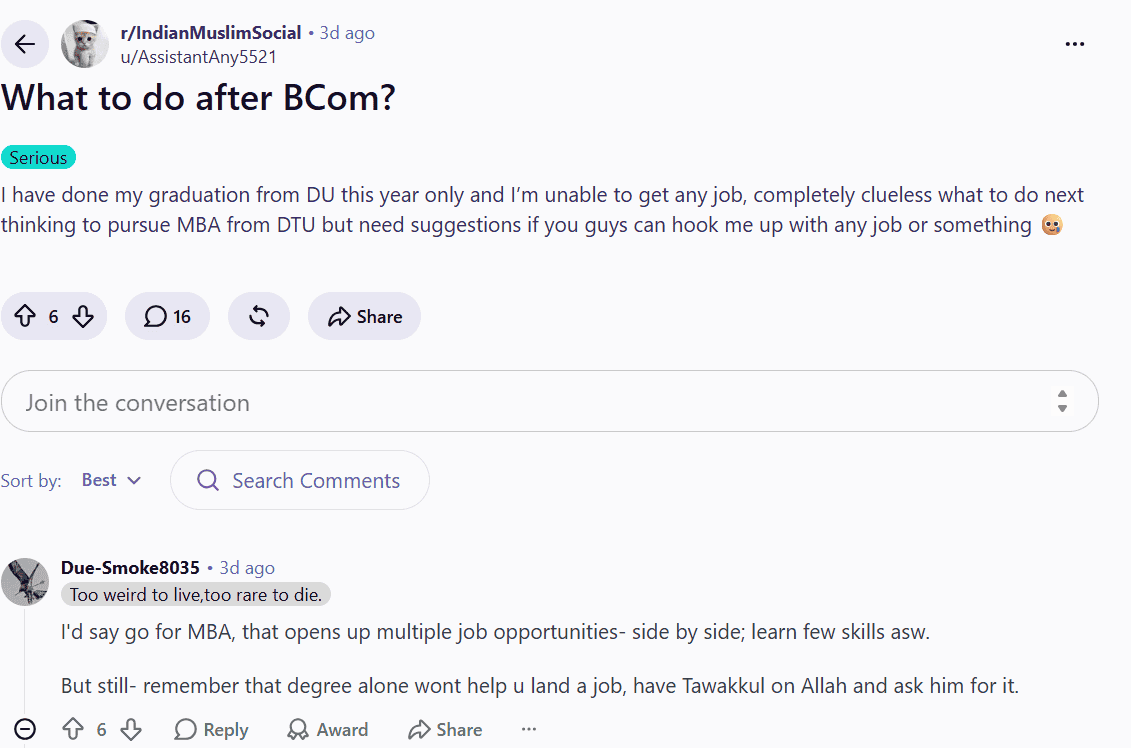
An online discussion where a BCom graduate seeks advice on pursuing an MBA and exploring career opportunities after graduation.
Reddit Link
Career Options and Salary After BCom
A BCom degree can open opportunities in accounting, banking, finance, taxation, business operations, and related fields. Graduates can apply for entry-level roles or pursue professional qualifications and postgraduate studies to build specialized expertise.
Some popular career options include:
- Accountant: Maintains financial records, prepares statements, and manages accounting transactions.
- Financial Analyst: Studies financial information to help businesses and clients make investment and budgeting decisions.
- Tax Consultant: Helps individuals and organizations understand tax rules, prepare returns, and manage tax compliance.
- Banking Associate: Supports banking operations, customer services, loan processing, and financial transactions.
- Audit Associate: Reviews financial records and checks whether an organization follows accounting standards and regulations.
- Business Analyst: Studies business processes and data to identify problems and recommend improvements.
Salary After BCom
| Job Roles | Typical Salary Range |
| Accountant | ₹3.4–3.8 LPA |
| Financial Analyst | ₹6.6–7.3 LPA |
| Tax Consultant | ₹7.6–8.4 LPA |
| Banking Associate | ₹3.5–3.8 LPA |
| Audit Associate | ₹5.8–6.4 LPA |
| Business Analyst | ₹9.6–10.6 LPA |
Source: AmbitionBox (2026). Salaries vary by experience, employer, city and specialization. For a detailed breakdown, see our guide on BCom salary in India.
ACCA After BCom
The Association of Chartered Certified Accountants (ACCA) is a globally recognized professional qualification in accounting and finance. BCom graduates interested in building careers in accounting, auditing, taxation, or financial management can pursue ACCA alongside or after their degree.
The qualification includes up to 13 exams across three levels: Applied Knowledge, Applied Skills, and Strategic Professional. BCom graduates may receive exemptions from certain exams depending on their university and subjects studied. Students must also complete an Ethics and Professional Skills Module and gain 36 months of relevant practical experience to become ACCA members.
ACCA can help graduates explore opportunities in financial reporting, audit, taxation, consulting, and corporate finance, including roles with multinational companies and accounting firms.





 Australia
 Canada
 France
 Germany
 India
 Ireland
 UAE
 United Kingdom
 United States