GraddieIcon

Choosing a college after 12th? Let’s make it make sense.

TAP HERE!

LineIcon
StudentImg
250k+ Students Served
LineIcon

Top Undergraduate Commerce Courses in India in 2026

Compare B.Com, B.Com (Hons.), BBA, Economics, and specialized Commerce programs. Filter by fees, duration, eligibility, entrance requirements, and curriculum focus.

Average starting salary
₹ 0 LPA+
Commerce programs
0 +
Colleges & Institutes
0 +

Compare UG Commerce Program Pathways at a Glance

Key differences between Commerce, business management, economics, and specialized undergraduate degree pathways.
Feature / Metric B.Com / B.Com (Hons.) BBA / BMS Bachelor's in Economics
Duration 3 to 4 Years 3 to 4 Years 3 to 4 Years
Eligibility 10+2, depending on institute 10+2, depending on institute 10+2, depending on institute
Average Fees ₹20,000 – ₹8 Lakhs ₹1 Lakh – ₹12 Lakhs ₹30,000 – ₹10 Lakhs
Core Focus Accounting, Finance, Taxation & Business Management, Marketing, Finance & Business Economics, Mathematics, Statistics & Policy
Target Jobs Accountant, Financial Analyst, Tax Associate Business Analyst, Marketing Executive, Management Trainee Economic Analyst, Research Associate, Data Analyst

Popular Commerce Courses After Class 12

Compare undergraduate Commerce degrees covering accounting, finance, taxation, economics, and business fundamentals.

B.Com

Students looking for a broad foundation in Commerce, accounting, finance, and business

What you’ll study:

Financial Accounting + Business Economics + Taxation + Business Law

Career options:

Accountant | Financial Analyst | Tax Associate

B.Com (Hons.)

Students looking for deeper academic and specialization-focused study in Commerce

What you’ll study:

Accounting + Finance + Economics + Business & Corporate Studies

Career options:

Financial Analyst | Accountant | Investment Analyst

Popular Business Management Courses After Class 12

Explore undergraduate business programs focused on management, finance, marketing, analytics, and entrepreneurship.

BBA

Students interested in business, management, entrepreneurship, and organizational roles

What you’ll study:

Business Management | Finance | Marketing | Operations

Career options:

Business Analyst | Management Trainee | Marketing Executive

BMS

Students interested in management, business strategy, and organizational decision-making

What you’ll study:

Management | Finance | Marketing | Organizational Behaviour

Career options:

Business Analyst | Management Associate | Marketing Executive

Specialized Commerce, Finance & Business Programs

Explore focused undergraduate degrees for students interested in finance, accounting, analytics, economics, and international business.

B.Com in Accounting & Finance

Students interested in accounting, finance, and financial management careers

Duration:

3 Years | Full-Time

Focus:

Accounting | Financial Management | Taxation | Corporate Finance

BBA in Finance

Students interested in corporate finance, banking, investments, and financial services

Duration:

3 to 4 Years | Full-Time

Focus:

Finance | Investment | Financial Management | Business Strategy

BBA in Business Analytics

Students interested in combining business knowledge with data and analytics

Duration:

3 to 4 Years | Full-Time

Focus:

Business Analytics | Statistics | Data Analysis | Business Intelligence

Bachelor's in Economics

Students interested in economics, research, finance, policy, and analytical careers

Duration:

3 to 4 Years | Full-Time

Focus:

Economics | Mathematics | Statistics | Econometrics

Short-Term Commerce, Finance & Business Certificates

Skill-focused programs for students and beginners looking to build practical business, finance, accounting, and analytics skills.

Certificate in Accounting & Taxation

Students looking to build foundational accounting and taxation skills

Duration:

3–6 Months | Online / Hybrid

Focus:

Accounting | GST | Taxation | Financial Records

Certificate in Financial Analysis

Beginners interested in finance and financial analysis

Duration:

3–6 Months | Online

Focus:

Financial Statements | Excel | Financial Analysis | Valuation

Diploma in Business Analytics

Students interested in applying data and analytics to business decisions

Duration:

6–12 Months | Hybrid / Offline

Focus:

Excel | SQL | Data Visualization | Business Analytics

Note: Diplomas and certificates build specific practical skills; they do not replace a bachelor’s degree where an undergraduate qualification is required.

How to Choose the Right UG Commerce Course

4 factors to consider before choosing a Commerce or business program.

Curriculum & Specialization

Check whether the curriculum covers the subjects relevant to your interests, such as accounting, finance, economics, taxation, marketing, management, or analytics.

Academic & Industry Exposure

Check for faculty expertise, industry interaction, case studies, guest lectures, business projects, and opportunities to apply classroom learning.

Internships & Projects

Look for internships, live projects, competitions, case studies, and practical opportunities that can help you build relevant experience.

Internships & Placements

Check for internship support, industry partnerships, placement assistance, recruiter networks, and the types of roles offered to graduates.

Essential Commerce Decision Guides

Popular Commerce courses and specializations after 12th

Commerce is offered through several undergraduate degree pathways in India. Depending on the university, students can choose programs such as B.Com, B.Com (Hons.), BBA, BMS, Economics, Accounting and Finance, Business Analytics, and other specialized Commerce and business degrees.

B.Com programs generally combine accounting, finance, economics, taxation, business law, and other Commerce subjects. B.Com (Hons.) programs can provide more specialized or in-depth study depending on the university. BBA and BMS programs focus more on business management, marketing, finance, operations, and organizational functions.

Students can also explore specialized programs in areas such as Finance, Accounting, Business Analytics, International Business, Economics, and Entrepreneurship.

Commerce course subjects and syllabus

The syllabus for an undergraduate Commerce course varies by university and degree, but most programs combine accounting, finance, economics, business, and management subjects.

Common Commerce subjects include:

  • Financial Accounting
  • Corporate Accounting
  • Business Economics
  • Business Law
  • Cost Accounting
  • Financial Management
  • Taxation
  • Business Statistics
  • Marketing Management
  • Organizational Behaviour
  • Business Communication
  • Entrepreneurship
  • Management Accounting
  • Business Analytics

Specialized programs may include additional subjects in investment management, financial markets, data analytics, international business, economics, or taxation.

Students comparing Commerce courses should check the complete syllabus instead of relying only on the course name, as programs with similar titles can have different subject structures and specialization options.

Entrance exams for Commerce courses after 12th

Admission requirements for Commerce undergraduate courses depend on the degree and institution. Some colleges admit students based on Class 12 marks, while others use national, university-level, or institution-specific entrance examinations.

CUET-UG is used by several participating universities for undergraduate admissions. Some universities and colleges may also conduct their own entrance examinations or use a combination of entrance scores and academic performance.

Eligibility, accepted entrance exams, minimum marks, subject requirements, and admission processes can vary across colleges. Students should check the latest admission criteria for each institution before applying.

How to compare Commerce colleges in India

When comparing Commerce colleges in India, students should look at the curriculum, specialization options, faculty, industry exposure, internships, placement information, and total cost.

The Commerce syllabus should provide sufficient exposure to the subjects relevant to the student’s career goals, such as accounting, finance, economics, taxation, management, marketing, or business analytics.

Students can also check whether the college offers internships, industry projects, case competitions, professional development opportunities, and career support.

Placement information should be reviewed carefully by checking the relevant graduating batch, published methodology, recruiters, and types of roles rather than relying only on a headline placement figure. Fees should also be compared across the complete duration of the program, including applicable academic and living costs.

B.Com vs B.Com (Hons.) vs BBA

B.Com, B.Com (Hons.), and BBA can all provide undergraduate pathways into business and Commerce-related careers, but their academic focus can differ.

B.Com generally provides a broad foundation in accounting, finance, economics, taxation, and business. B.Com (Hons.) can offer more detailed or specialized study depending on the institution and curriculum.

BBA focuses more strongly on management, business operations, marketing, finance, organizational behaviour, and entrepreneurship.

Students should compare the actual course structure, subjects, electives, duration, fees, eligibility, and career pathways rather than choosing based only on the degree title.

Commerce career paths by specialization

A Commerce degree can lead to different career paths depending on the specialization and skills developed during the program.

Students with a strong foundation in accounting and taxation can explore careers in accounting, audit, taxation, and financial reporting. Finance-focused programs can provide pathways into financial analysis, banking, investment, and corporate finance.

Business and management programs can lead to roles in business analysis, marketing, operations, sales, consulting, and management. Students studying Business Analytics can explore data-driven business roles involving reporting, analytics, and decision-making.

Projects, internships, communication skills, analytical ability, financial knowledge, and practical experience can influence the roles available to graduates. Career opportunities also vary by employer and individual qualifications.

What to know before choosing a Commerce course

Commerce covers a broad range of subjects, so students should understand what each program focuses on before selecting a course.

Students interested in accounting and finance may prefer programs with stronger coverage of financial accounting, taxation, financial management, and corporate finance. Students interested in business and management can explore BBA, BMS, or related programs.

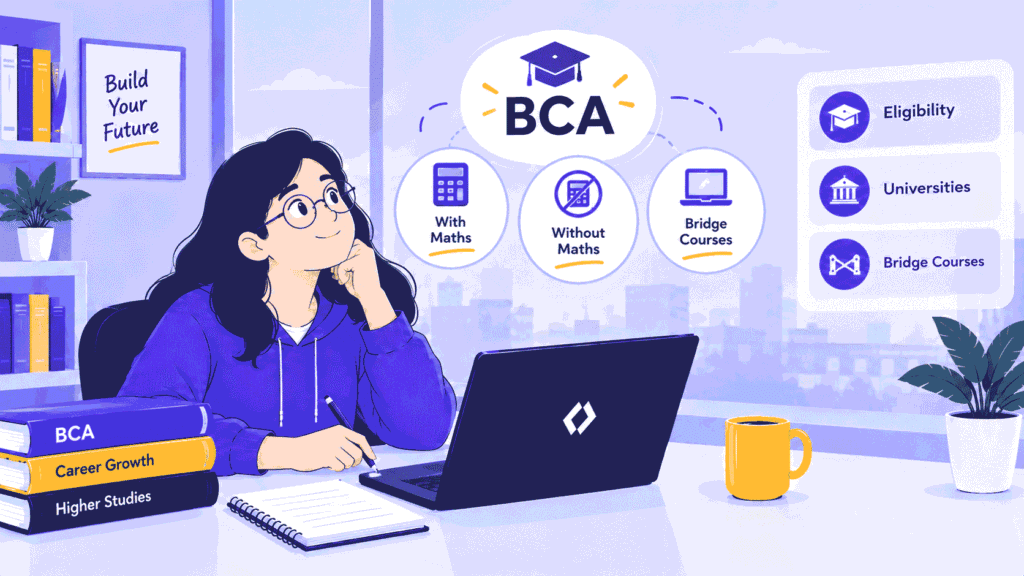
Mathematics requirements can also vary across Commerce and business programs. While many Commerce courses do not require advanced Mathematics, some Economics, Finance, or analytics-focused programs may have specific Mathematics or quantitative requirements.

Students should also consider whether they want a broad Commerce degree or a specialized program focused on areas such as Finance, Accounting, Business Analytics, Economics, or International Business.

Commerce education pathways after Class 12

Students interested in Commerce can choose different academic pathways after Class 12. B.Com and B.Com (Hons.) provide undergraduate pathways focused on Commerce, accounting, finance, economics, and business.

BBA and BMS provide business and management-focused routes, while Economics degrees can provide stronger exposure to economics, mathematics, statistics, and analytical methods.

Short-term Commerce diplomas and certificates can be used to develop specific skills in areas such as accounting, taxation, financial analysis, Excel, business analytics, or digital business. These programs are shorter than undergraduate degrees and can complement formal education or help students explore an area before committing to a longer program.

After completing an undergraduate degree, students can further specialize through postgraduate programs in Commerce, Finance, Economics, Business Analytics, Management, Accounting, or related fields. Professional qualifications in areas such as accounting, finance, taxation, and risk management can also be considered based on individual career goals.

Frequently Asked Questions

Which is better after 12th: B.Com or BBA?

B.Com generally provides greater emphasis on accounting, finance, taxation, economics, and Commerce-related subjects, while BBA focuses more on business management, marketing, finance, operations, and organizational functions. The right option depends on the student’s interests, preferred curriculum, and career goals.

B.Com is generally a broad undergraduate Commerce degree, while B.Com (Hons.) can provide more detailed study of Commerce and related subjects, depending on the university. Students should compare the actual curriculum, specialization options, duration, and eligibility requirements of individual programs.

Eligibility varies by college and course. Many Commerce programs do not require Mathematics, while some programs, particularly certain Economics, Finance, or analytics-focused degrees, may have Mathematics or other subject requirements. Students should check the eligibility criteria of each program before applying.

Short-term certificates and diplomas can help students develop specific skills in areas such as accounting, taxation, financial analysis, Excel, or business analytics, but they do not provide the same academic qualification as a bachelor’s degree. Students should check the qualification requirements for their target roles and employers.

Provider

Title and Desc

HDFC

ICICI