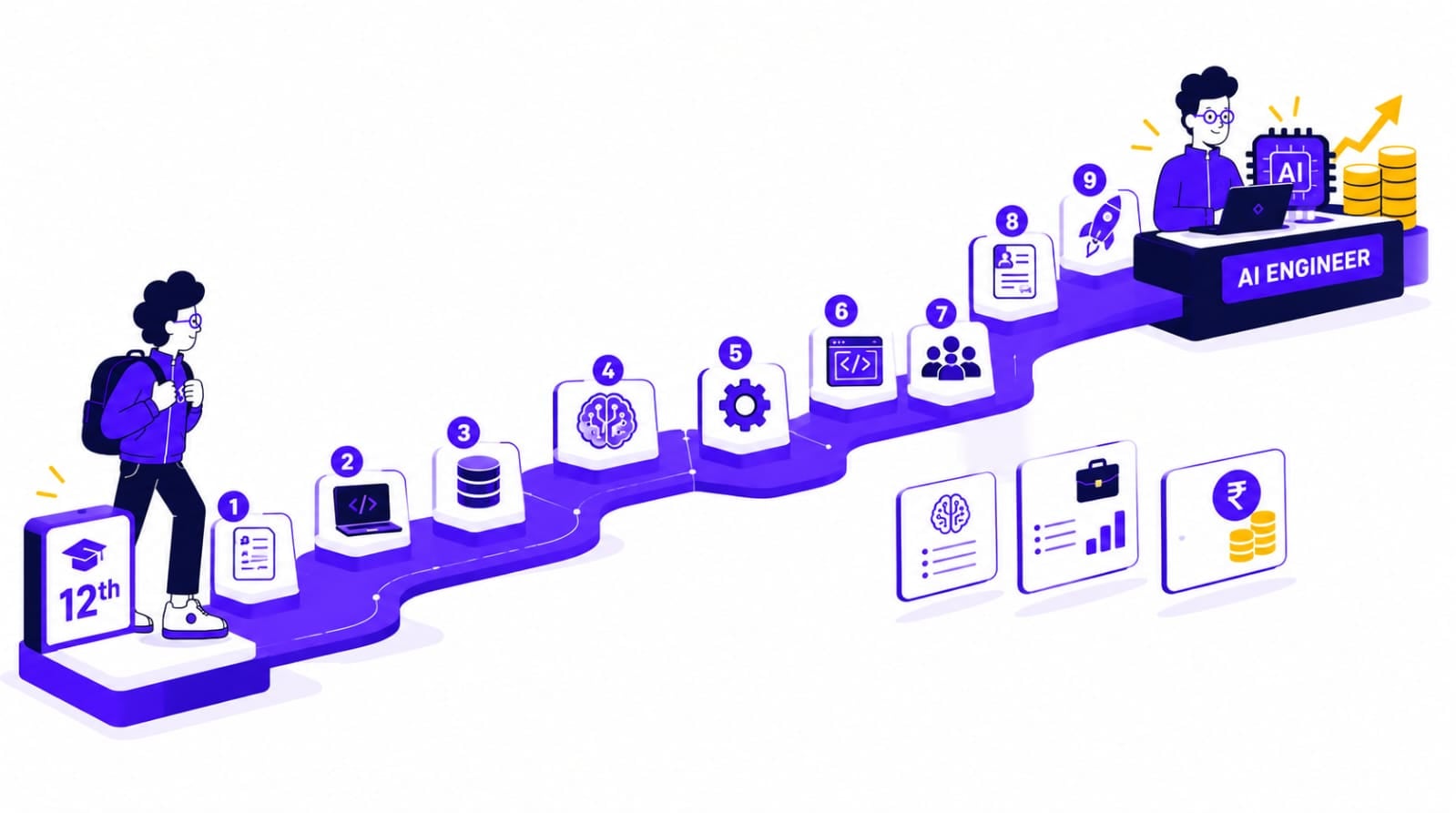
This guide explains in-depth how to become an AI Engineer after 12th in India in 2026, covering the education, skills, steps and career opportunities involved. If you’re planning to enter the field after school and want a clear understanding of the requirements and available pathways, read on for practical, detailed guidance.
What Does an AI Engineer Do?
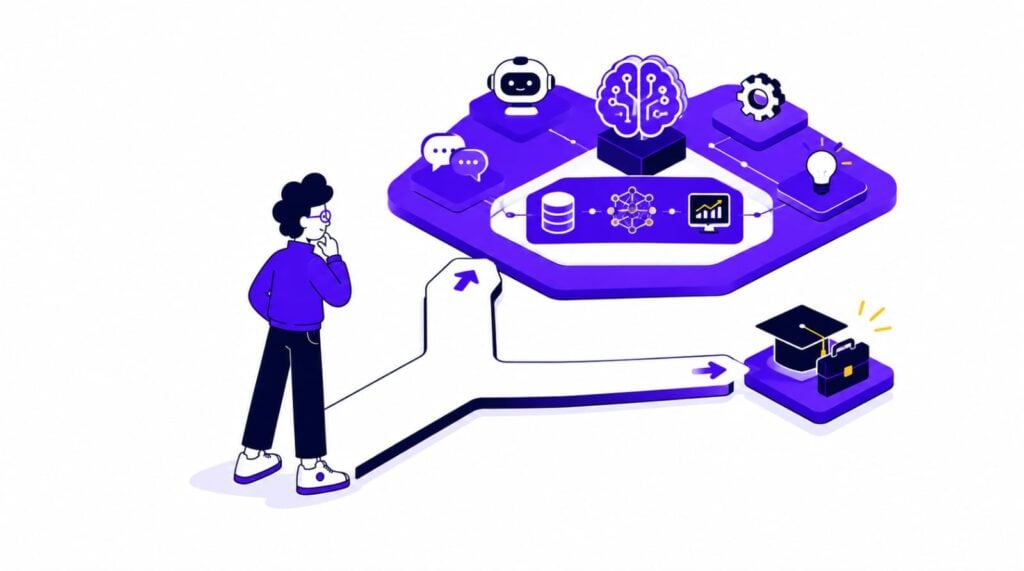
An AI Engineer is a professional who builds AI software using artificial intelligence and machine learning to solve real world problems. AI engineers develops tools, applications, AI software that can learn from data, process information, make decisions, generate content etc.
Key Roles and Responsibilities
- Develop AI models: Build AI models and applications to address certain issues.
- Data Processing: Collect, clean and transform data for model training.
- Development of AI applications: Integrate AI models, APIs and LLMs into software products and business systems.
- AI training: Training the model to predict outcomes, identify data patterns, or perform certain actions.
- Monitor AI systems: Track model performance, identify issues and update systems as data or requirements change.
- Improving AI models: Identifying issues, fixing them and improving models
Also Read: Artificial Intelligence Degree Courses in India
Step-by-Step Roadmap to Become an AI Engineer After 12th
Complete Class 12 with the Right Subjects
For most B.Tech/B.E. pathways, Physics, Chemistry and Mathematics (PCM) are required. Strong mathematics skills will also help with statistics, machine learning and algorithms.
Crack Entrance Exams for Top Colleges
After your 12th, you’ll need to crack entrance exams to secure admission to top AI or Computer Science engineering colleges:
- JEE Main – For NITs, IIITs, and other engineering colleges
- JEE Advanced – For IITs offering Computer Science, AI, and related programs
- BITSAT – For BITS Pilani and its other campuses
- VITEEE, SRMJEEE, LPUNEST – For private universities
- CUET – For B.Sc., BCA, and other undergraduate programs at participating universities
Choose a Relevant Undergraduate Degree
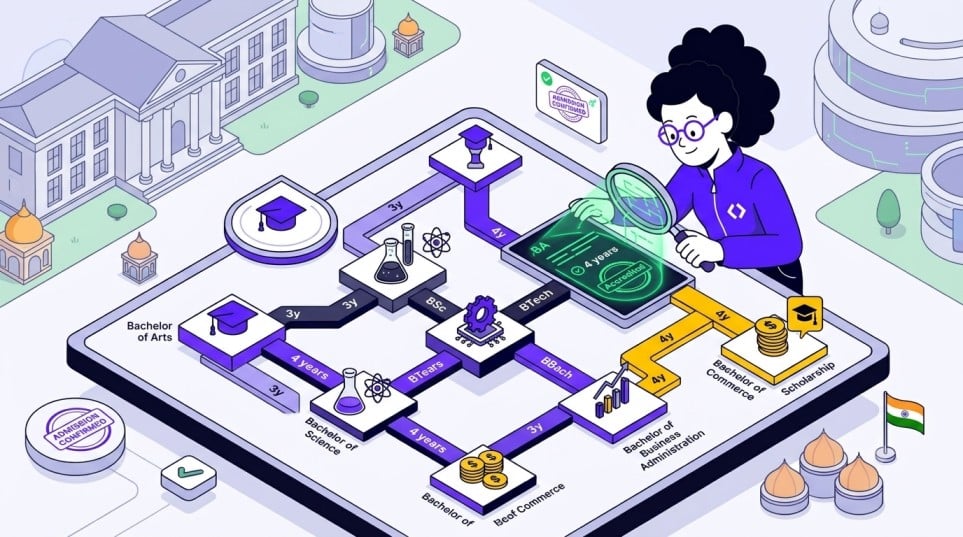
You can enter AI Engineering through:
- B.Tech/B.E. in Computer Science
- B.Tech in Artificial Intelligence & Machine Learning
- B.Tech in Data Science
- B.Sc. in Computer Science, AI or Data Science
- BCA in Artificial Intelligence, Machine Learning or Data Science
Focus on programs that provide strong foundations in programming, algorithms, mathematics and computer science.
Learn Programming and Core Computer Science
Start with Python, then develop your understanding of:
- Data Structures & Algorithms
- Object-Oriented Programming
- SQL & Databases
- Git & GitHub
- Software Development
Build Machine Learning Skills
Learn how models work before moving into advanced AI applications. Focus on:
- Supervised & Unsupervised Learning
- Statistics & Probability
- Feature Engineering
- Model Evaluation
- Deep Learning
Tools such as Scikit-learn, PyTorch and TensorFlow can help you apply these concepts.
Specialize in an AI Area
Once your fundamentals are strong, choose an area based on your career interests:
Generative AI · NLP · Computer Vision · Deep Learning · MLOps
For 2026, learning how to build applications with LLMs, RAG, APIs and AI agents can also complement your core AI skills.
Build Practical AI Projects
Move beyond courses by building projects that solve actual problems. Start with smaller projects such as prediction or classification, then progress to applications such as recommendation systems, RAG chatbots or AI-powered search.
Gain Industry Experience
Look for AI, ML, data science or software engineering internships. Relevant software experience can also provide a strong foundation for moving into AI Engineering.
Build a Job-Ready Portfolio
Showcase 2–4 strong projects on GitHub with clear documentation of the problem, technology, approach and results. Your portfolio should demonstrate that you can build, test and deploy AI solutions—not just complete courses.
Skills and Tools Every AI Engineer Needs in 2026
AI Engineers need a mix of programming, machine learning, software development and deployment skills to build and productionise AI systems.
| Skill Area | Key Skills | Tools & Technologies |
|---|---|---|
| Programming | Python, SQL, OOP, Data Structures & Algorithms | Python · SQL · Git · GitHub |
| Machine Learning | Supervised & unsupervised learning, model evaluation, feature engineering | Scikit-learn · XGBoost |
| Deep Learning | Neural networks, CNNs, Transformers, model training | PyTorch · TensorFlow |
| Generative AI | LLMs, prompt engineering, RAG, AI agents | Hugging Face · LangChain · LLM APIs |
| Data Handling | Data cleaning, preprocessing, analysis and pipelines | Pandas · NumPy · Spark |
| Databases | SQL, NoSQL and vector databases | PostgreSQL · MongoDB · FAISS |
| Cloud & Deployment | Cloud services, APIs, containers and deployment | AWS · Azure · Google Cloud · Docker |
| MLOps | Model deployment, monitoring, versioning and CI/CD | MLflow · Kubernetes · GitHub Actions |
| AI Application Development | REST APIs, backend integration and scalable applications | FastAPI · Flask · APIs |
| Responsible AI | Model evaluation, bias, privacy and AI safety | Model evaluation & monitoring frameworks |
AI Engineer Career Opportunities and Hiring Industries in India
AI Engineers can build careers across technology, finance, healthcare, automotive, e-commerce and other industries. As AI adoption grows, opportunities are expanding beyond traditional machine learning roles.
| Career Path | What You’ll Work On |
|---|---|
| AI Engineer | Build and deploy AI-powered applications and systems |
| Machine Learning Engineer | Develop, train and productionise ML models |
| Computer Vision Engineer | Build image and video recognition systems |
| MLOps Engineer | Deploy, monitor and scale ML models |
| Generative AI Engineer | Build LLM, RAG and AI-agent applications |
| NLP Engineer | Develop language and speech-based AI systems |
| AI Research Engineer | Develop and experiment with new AI and deep learning techniques |
| AI Product Engineer | Integrate AI capabilities into software products |
Industries Hiring AI Engineers
- IT & Software: AI platforms, automation, enterprise applications
- BFSI: Fraud detection, risk modelling, financial automation
- Healthcare: Medical imaging, diagnostics support, healthcare analytics
- Automotive: Autonomous driving, computer vision and smart mobility
- E-commerce & Retail: Recommendations, search, personalisation and forecasting
- Manufacturing: Robotics, predictive maintenance and industrial automation
- Startups & GCCs: GenAI, AI products, automation and applied AI solutions
Also Read: Best AI Colleges in India
AI Engineer Salary in India (2026): Fresher to Senior
| Experience Level | Salary Range |
|---|---|
| Fresher/ 0 – 1 Year | ₹12-18 LPA |
| 1 – 3 Years | ₹18-28 LPA |
| 3 – 5 Years | ₹28-40 LPA |
| 5+ Years | ₹40-70+ LPA |
Conclusion: Your AI Engineer Path After 12th
Becoming an AI Engineer after 12th is possible through multiple academic pathways. Whether you choose B.Tech, BCA or B.Sc., the key is to build a strong foundation in programming, mathematics and computer science, followed by skills in machine learning, deep learning, Generative AI and software development.
Your degree is only the starting point. Hands-on projects, internships and practical AI skills can help you turn your academic foundation into industry-ready experience. Choose a pathway that matches your eligibility and interests, start building relevant skills early and keep learning as AI continues to evolve.
Also Read: Best Career Options After 12th in India 2026: Complete Career Guide
Related Articles
- Artificial Intelligence Degree Courses in India
- Best AI Colleges in India
- AI Course Duration in India
- Data Science Courses After 12th in India
- Best Career Options After 12th in India 2026: Complete Career Guide
Compare programs on OLRight: see AI and technology programs with fees, duration and outcomes side by side.
Talk to a GradRight counselor free: get personalised guidance on choosing the right program for your goals and budget.
Compare education loans: check EMI and funding options before you enroll.
 Australia
 Canada
 France
 Germany
 India
 Ireland
 UAE
 United Kingdom
 United States