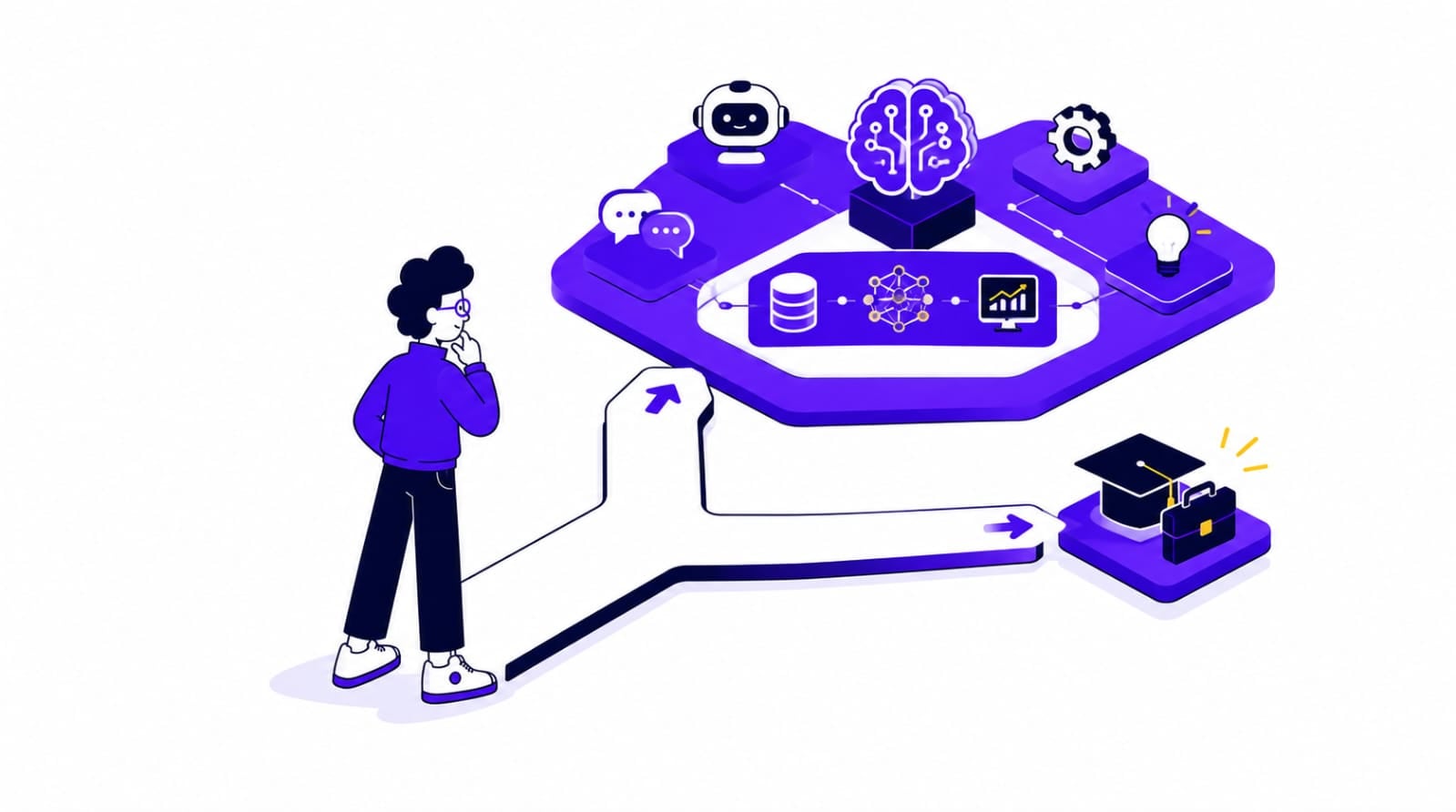
AI and Machine Learning are often used interchangeably, but they are not the same thing. Artificial Intelligence (AI) refers to the broader technology of creating machines and software that can understand information, make decisions, solve problems, or perform tasks with a degree of human-like intelligence. Machine Learning (ML) is a subset of AI that allows systems to identify patterns from data and improve their performance without being explicitly programmed for every task.
In this guide we will cover the definitions, key differences and which one to choose in 2026.
What Is Artificial Intelligence (AI)?
Artificial Intelligence is the broader concept. It is the technology of creating systems that can perform tasks that require human intelligence such as decision-making, speech recognition, problem-solving, language translation and content generation.
Examples include chatbots, voice assistants, recommendation systems and generative tools.
Types of AI
Artificial intelligence can be classified into different types based on its capabilities and functionality.
Types of AI by Capability
- Narrow AI (ANI): Designed to perform specific tasks. Almost all AI systems we use today fall into this category.
Examples: ChatGPT, recommendation systems, fraud detection and voice assistants. - General AI (AGI): A theoretical form of AI that could understand, learn and perform a wide range of intellectual tasks at a human-like level. AGI does not currently exist.
- Super AI (ASI): A hypothetical form of AI that would surpass human intelligence across virtually all areas. It remains theoretical.
Types of AI by Functionality
- Reactive AI: Responds to current inputs without retaining memories of past interactions.
- Limited Memory AI: Uses past data or experiences to make decisions. Most modern AI systems fit broadly into this category.
- Theory of Mind AI: A proposed system capable of understanding emotions, beliefs and intentions. It has not been achieved.
- Self-Aware AI: A hypothetical AI with consciousness and awareness of itself.
What Is Machine Learning (ML)?
Machine learning is a subset of Artificial Intelligence. It focuses on building algorithms and models that enable computers to learn from data and improve with experience without being explicitly programmed for every task.
Machine Learning is further classified into the following types :
- Supervised Learning: The model learns from labelled data, using known inputs and outputs to make predictions or classifications on new data.
- Unsupervised Learning: The model works with unlabelled data to identify patterns, groups or relationships without predefined answers.
- Semi-Supervised Learning: Combines a small amount of labelled data with a larger amount of unlabelled data to improve learning.
- Reinforcement Learning: The model learns by interacting with an environment, receiving rewards or penalties and improving its actions over time.
AI vs Machine Learning: Key Differences at a Glance
Feature Artificial Intelligence Machine Learning Definition Focuses on creating machines capable of human-like intelligence Enables machines to learn from data Scope Broad Narrow Objective Mimic human-like intelligence and enable decision-making Learn from data, make predictions and recognize patterns Approach Rule-based, logic-based and ML-based Data-driven, uses algorithms and statistical methods Data Dependency Not always dependent on data; can work with incomplete data Highly dependent on large amounts of quality data Types Narrow AI, AGI and ASI Supervised, Unsupervised, Semi-Supervised and Reinforcement Learning Applications Robotics, self-driving cars, virtual assistants, and GenAI Fraud detection, recommendations, forecasting, image classification Examples ChatGPT, AI-powered robots, Google Assistant Netflix recommendation engine, Gmail spam filter Also Read: AI-Safe Jobs and Degrees for 2026
AI and ML Career Options in India
Both AI and Machine Learning offer diverse career paths. While some roles overlap, AI-focused careers often involve building intelligent applications and systems, whereas ML-focused roles are more centered on data, model development, and prediction.
AI Career Options
Role
What You’ll Do
AI Engineer
Build and integrate AI-powered applications and intelligent systems
Generative AI Engineer
Develop applications using LLMs, RAG, AI agents and generative models
NLP Engineer
Build systems that understand and process human language
Computer Vision Engineer
Develop AI systems for image and video understanding
AI Product Manager
Define and manage products that use AI to solve user and business problems
AI Research Scientist
Research and develop new AI methods, models and applications
Machine Learning Career Options
Role
What You’ll Do
Machine Learning Engineer
Build, train and deploy machine learning models
Data Scientist
Analyse data and develop predictive models to solve business problems
ML Researcher
Develop and experiment with new machine learning algorithms and techniques
MLOps Engineer
Deploy, monitor and maintain ML models in production
Applied ML Engineer
Apply ML models to solve specific business and industry problems
ML Data Engineer
Build data pipelines and infrastructure required for machine learning systems
Note: These categories can overlap. For example, an AI Engineer may work extensively with ML, while an ML Engineer may work on AI-powered applications. The distinction mainly depends on the type of problems, technologies and systems each role focuses on.
Also Read: Artificial Intelligence Degree Courses in India
AI or ML: Which Should You Learn First in 2026?
With AI and ML becoming increasingly connected, choosing where to start can feel confusing. The good news is that both offer strong career opportunities in 2026, and learning one does not mean you have to leave the other behind. Since ML is a core part of modern AI, building ML skills can also give you a strong foundation for broader AI roles.
Your choice should depend on what you want to do, the skills you enjoy developing, and the career path you have in mind:
- Career goals: If you want to work with predictive models, data, and algorithms, ML can be a natural starting point. If you are interested in building intelligent applications across areas such as GenAI, robotics or NLP, AI offers a broader direction.
- Skills and interests: Choose ML if you enjoy statistics, programming, data analysis and model building. Choose AI if you want to explore a wider mix of technologies and applications that make systems more intelligent.
- Career growth: AI and ML skills are increasingly used together in modern technology roles. Learning ML first and then expanding into areas such as Generative AI, NLP, Computer Vision or MLOps can help you build a more versatile AI skill set.
There is no single right choice between AI and ML in 2026. Your ideal starting point depends on your career goals, interests and the kind of problems you want to solve.
Conclusion: Choosing Between AI and Machine Learning
AI and Machine Learning are closely connected, but they are not the same. AI is the broader field focused on building intelligent systems, while ML is a subset of AI that enables systems to learn from data. Understanding this difference can help you choose the right skills and career path.
If you enjoy data, statistics, and predictive modeling, ML can be a natural starting point. If you’re interested in building intelligent applications and exploring areas such as Generative AI, NLP, or Computer Vision, AI offers a broader direction. In 2026, learning ML can also provide a strong foundation for moving into specialized AI roles.
Also Read: Data Science vs Machine Learning
Related Articles
- Data Science vs Machine Learning
- Artificial Intelligence Degree Courses in India
- AI-Safe Jobs and Degrees for 2026
- Master’s (MS) in Artificial Intelligence
- The Rise of Data Science and Data Analytics Careers
Compare programs on OLRight: see AI and machine learning programs with fees, duration and outcomes side by side.
Talk to a GradRight counselor free: get personalised guidance on choosing the right program for your goals and budget.
Compare education loans: check EMI and funding options before you enroll.



 Australia
 Canada
 France
 Germany
 India
 Ireland
 UAE
 United Kingdom
 United States