





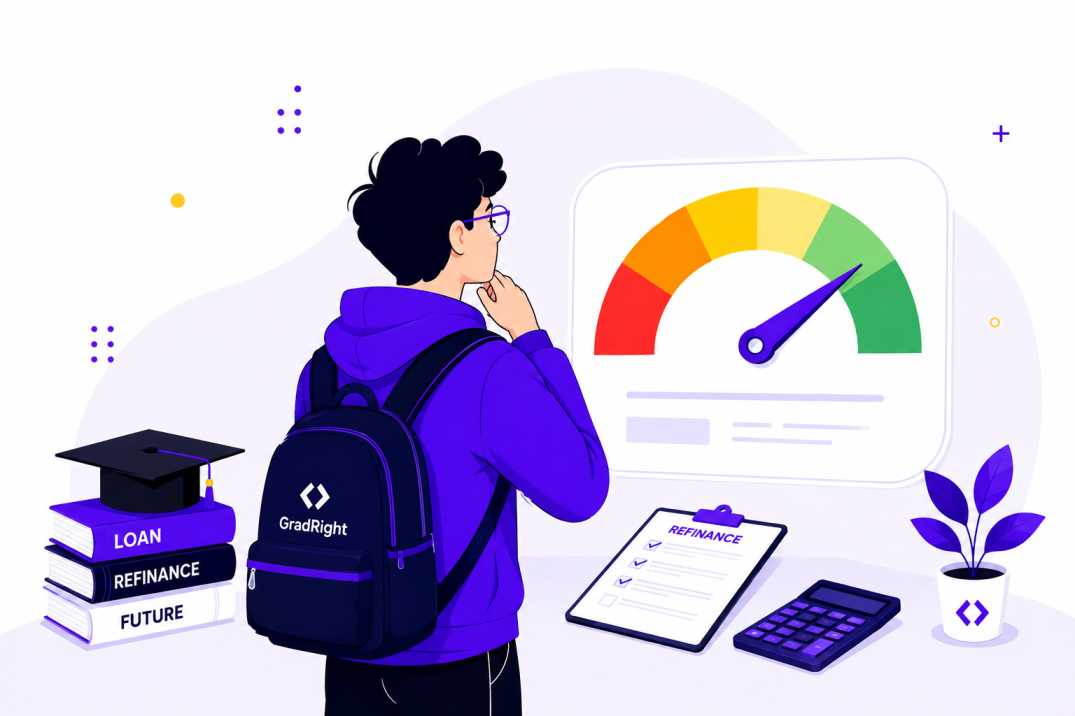
Before you refinance, it’s natural to wonder: does refinancing student loans hurt your credit? The short answer is that it can cause a small, temporary dip, but for most borrowers who make on-time payments, the long-term effect is neutral or even positive.
This guide breaks down exactly why your score moves, by how much, for how long, and what you can do to keep the impact as small as possible.
Does refinancing student loans hurt your credit in the short term?
Yes, briefly. When you apply, the new lender needs to evaluate your creditworthiness, and that process is what causes the temporary dip most borrowers notice.
The Hard Credit Inquiry
When you refinance your loans, the lender will perform a hard credit inquiry, and hard credit inquiries can cause your score to drop by a few points, though the impact isn’t long-lasting. Each hard inquiry can cause up to a five-point drop in your credit score, affecting your score for about a year. A hard inquiry will drop your score by five points or less, according to FICO.
Closing Your Old Loan Account
When you complete a refinance, the old loan is closed and a new loan appears on your credit report, which affects the average age of your credit accounts, a factor that makes up about 15% of your credit score. This is a separate, smaller effect from the hard inquiry itself.
The Prequalification Stage Doesn’t Count
Before you apply formally, most lenders let you check your rate through a soft credit pull. A soft credit inquiry doesn’t typically impact your credit score, and it’s only when you submit a formal application that a lender conducts a hard credit inquiry, which does affect your score. So does refinancing student loans hurt your credit at the shopping stage? No, only at the formal application stage.
Also Read: Student Loan Refinancing With Bad Credit: What Lenders Look For
Does refinancing student loans hurt your credit if you shop around?
This is where many borrowers get nervous, assuming that comparing five lenders means five separate credit hits. In reality, credit bureaus account for this.
If you apply within a typical window, usually 14 to 45 days, credit bureaus will lump all the inquiries together into a single hard inquiry, which means your score will only drop once. This is called the “rate shopping exception.” Applying with multiple lenders within a short timeframe is known as “rate shopping,” and credit bureaus generally count all those inquiries as one, letting you compare offers without taking a meaningful hit to your credit score.
The practical rule: compare all your offers within the same short window, ideally two weeks, rather than spacing out applications over several months.
Does refinancing student loans hurt your credit in the long run?
Usually not, and it can actually help. A refinance may initially lower credit scores, but in the long term, consolidating debt and securing lower interest rates can provide significant benefits.
Refinancing can benefit your credit score over time, since payment history is the single most influential factor in your overall score. If a lower interest rate makes your monthly payment more manageable, and that helps you make consistent, on-time payments, your score benefits more from that consistency than it was hurt by the initial inquiry.
When Refinancing Can Hurt Your Credit Long-Term
A student loan refinance can negatively impact your credit score long-term if you find that you’re still unable to make full, on-time monthly payments, and if your loan goes into default, that will adversely affect your score. The risk isn’t the refinance itself, it’s what happens if the new terms don’t actually fit your budget.
How much does refinancing student loans hurt your credit, exactly?
To put a number on it: expect a drop of five points or less from the hard inquiry itself, according to FICO, with the exact impact varying by individual credit profile. This is a temporary drop that resolves as your credit history continues to build. Most borrowers see their score stabilize within a few months.
How to minimize the credit impact when refinancing
If the question on your mind is “does refinancing student loans hurt your credit more than it needs to,” the answer usually comes down to how you approach the process.
Use Prequalification Tools First
Compare rates through soft-pull prequalification before submitting any full applications. This lets you narrow your lender list without any credit impact at all.
Apply Within A Short Window
Rarely is the impact of multiple inquiries significant if you apply within the recognized rate-shopping window, so keep all your formal applications close together.
Keep Paying Your Current Loan Until The Refinance Closes
Depending on the lender, the refinance process can take several weeks, so keep making payments on your current loan until the new loan is confirmed and active. A missed payment during the transition can do far more damage than the inquiry itself.
Set Up Autopay Immediately
Once your new loan is active, enroll in automatic payments right away. This protects your payment history, the single biggest factor in your score, and often earns you a small rate discount too.
Does refinancing student loans hurt credit for Indian students?
If you’re refinancing an Indian education loan into a US-dollar loan, the credit mechanics work the same way on the US side: a hard inquiry from the new lender, and possibly a thin US credit file if you’re new to the country.
Building US credit history early (through a secured card or your first loan payments) can meaningfully improve the rate you’re offered and soften the impact of that first hard inquiry.
Also Read: How to Get the Lowest Interest Rates for Refinancing Student Loans
How GradRight helps protect your credit score while refinancing
One of the biggest credit risks in refinancing comes from applying to multiple lenders separately and outside the rate-shopping window. GradRight removes that risk by letting you submit a single profile once, after which domestic and international lenders can bid on your profile without you needing to trigger a separate hard inquiry with each one.
This means you get to compare real offers, side by side, while keeping the credit impact to the minimum any refinance requires.






 Australia
  Canada
  France
  Germany
  India
India  Ireland
  UAE
UAE  United Kingdom
  United States
