


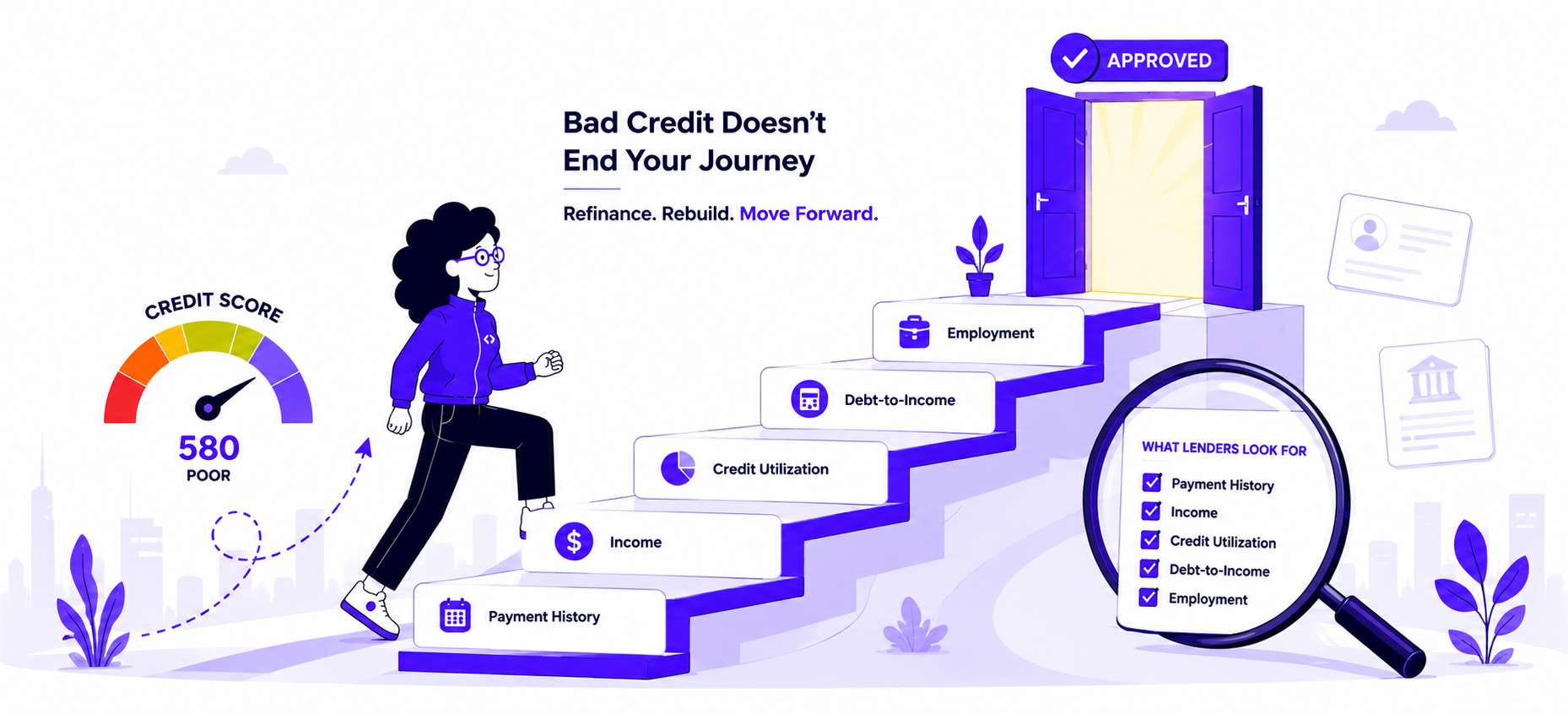
If your credit score isn’t where you’d like it to be, you’ve probably already run into a frustrating pattern: every “top lender” list assumes you have a 700+ score. But student loan refinancing with bad credit isn’t off the table; it’s just a different conversation. Lenders don’t make a single yes/no decision based on your score alone. They look at a combination of factors, and understanding what those are is the difference between getting rejected and getting an offer you can actually work with.
This guide breaks down exactly what refinancing lenders evaluate when your credit isn’t perfect, what scores actually count as “bad” in this context, and what you can do right now to improve your odds.
What counts as “bad credit” for student loan refinancing
Most refinancing lenders are looking for a FICO score somewhere in the high 600s to qualify for their best rates. Anything meaningfully below that, generally in the 580–639 range, is where you start being classified as subprime or “bad credit” territory for refinancing purposes.
Credit Score Ranges Lenders Use
Here’s roughly how private lenders tend to bucket scores when evaluating refinance applications:
| Score range | General classification | What it typically means for refinancing |
| 750+ | Excellent | Access to the lowest advertised rates and most flexible terms |
| 670–749 | Good | Approval is likely, rates are competitive but not top-tier |
| 620–669 | Fair | Some lenders will approve, but expect higher rates |
| 580–619 | Poor | Approval is difficult without a cosigner; few lenders will consider you |
| Below 580 | Bad | Very few, if any, lenders will approve without a strong cosigner |
These ranges aren’t universal; every lender sets its own cutoffs, but they reflect the general pattern seen across the refinancing market.
Why Your Score Alone Doesn’t Decide the Outcome
A credit score is a snapshot of past repayment behavior. It doesn’t capture your current income, how stable your job is, or how much of your monthly earnings already go toward debt. That’s exactly why lenders build a fuller financial picture before they decide whether, and at what rate, to approve you.
Can you refinance student loans with bad credit?
Yes. It’s possible to refinance both federal and private student loans with bad credit, but it’s harder to get approved, and if you are approved, expect a higher interest rate than someone with strong credit would receive. Some borrowers with weaker credit still refinance successfully by applying with a cosigner or by choosing a lender that weighs income and employment more heavily than score alone.
Also Read: How to Choose Among the Best Student Loan Refinancing Companies
What lenders actually look at beyond your credit score
Debt-to-Income Ratio
Your debt-to-income ratio, or DTI, compares your total monthly debt payments to your gross monthly income. A lower DTI signals that you have room in your budget to comfortably take on a new loan. Even with a lower credit score, a strong DTI can meaningfully improve your chances of approval, because it tells the lender you’re not financially overextended.
Income Stability and Employment History
Lenders want evidence that you can reliably make payments over the life of the loan. That usually means looking at your current salary, how long you’ve held your job, and whether your income source is steady (a full-time role, for instance, generally reads as lower risk than freelance or contract income). A higher, more stable income can sometimes offset a weaker credit score.
Payment History on Existing Loans
How you’ve handled your current student loans and other debts matters. A track record of on-time payments, even if your score is dragged down by something else, like limited credit history or a single past slip-up, works in your favor.
Cosigner Strength
If your own credit and income don’t clear a lender’s bar, applying with a creditworthy cosigner is one of the most effective ways to improve your approval odds and secure a lower rate. The lender will evaluate the cosigner’s credit and income alongside yours, and in many cases their profile can carry the application.
Some lenders only allow cosigners after an independent application has already been denied, so it’s worth checking each lender’s specific policy before you apply.
Loan Type and Remaining Balance
Some lenders have minimum and maximum loan balance requirements, and may treat federal loans differently from private loans in their underwriting. It’s worth checking a lender’s eligibility criteria before applying, since a mismatch here can result in an automatic decline regardless of your credit profile.
Minimum credit score requirements: what to expect
There’s no single, universal minimum credit score for student loan refinancing – each lender sets its own bar. That said, a general pattern holds across the market:
- Most mainstream lenders look for a score in the mid-600s at minimum.
- Lenders offering the most competitive, lowest advertised rates typically reserve them for borrowers closer to 670 and above.
- A smaller number of lenders will consider applicants with scores as low as the high 500s, usually only with a cosigner or added income verification.
Because eligibility criteria vary this much, prequalifying with more than one lender, most offer a soft credit check that won’t affect your score, is the most reliable way to see where you actually stand before you commit to a full application.
How to strengthen your application before you apply
Add a Creditworthy Cosigner
As covered above, a cosigner with strong credit and stable income can be the single biggest lever you have if your own profile is holding you back.
Improve Your Credit Score First
If you’re not in a rush, even a modest delay can help. Paying down revolving balances, correcting errors on your credit report, and making sure all accounts are current can move your score meaningfully within a few billing cycles. Keep in mind that lenders generally take 30 to 45 days to report account changes to the credit bureaus, so improvements don’t show up instantly.
Lower Your Debt-to-Income Ratio
Paying down other debts, or in some cases increasing your income, brings your DTI down and gives lenders more confidence that you can absorb a new monthly payment.
Compare Multiple Lenders Through Prequalification
Because every lender weighs credit score, income, and DTI differently, the same borrower can get a decline from one lender and an approval from another. Prequalifying, which typically uses a soft credit pull, lets you see estimated rates across several lenders without any impact on your score, so you can identify which one is actually a fit for your profile before submitting a full application.
Also Read: How to Get the Lowest Interest Rates for Refinancing Student Loans
Should you refinance now, or wait and rebuild your credit first?
If your credit is on the lower end, the honest answer depends on your timeline and what you’re refinancing away from. If you’re currently on a high fixed rate and a lender will approve you today, even at a rate that isn’t your dream number, it may still be a net improvement over what you’re paying now.
If your current rate is already reasonable, or if you can realistically raise your score by 40–50 points in the next few months, waiting and reapplying later, or adding a cosigner, will typically get you meaningfully better terms.
How GradRight helps you compare offers, even with a less-than-ideal credit profile
Instead of applying lender by lender and collecting separate credit pulls, GradRight’s platform lets you submit your loan and financial details once and see real offers from multiple lenders side by side – including fixed versus variable rates, tenure, and cosigner requirements. Because the platform is built as a decision layer rather than just a listing site, it’s designed to help you see where you actually qualify, rather than only surfacing the lowest advertised rate that a top-credit borrower would get.
If your credit isn’t where you want it yet, this side-by-side view makes it easier to identify which lenders are realistically worth applying to, so you’re not spending time on applications that were never going to clear.






 Australia
  Canada
  France
  Germany
  India
India  Ireland
  UAE
UAE  United Kingdom
  United States