




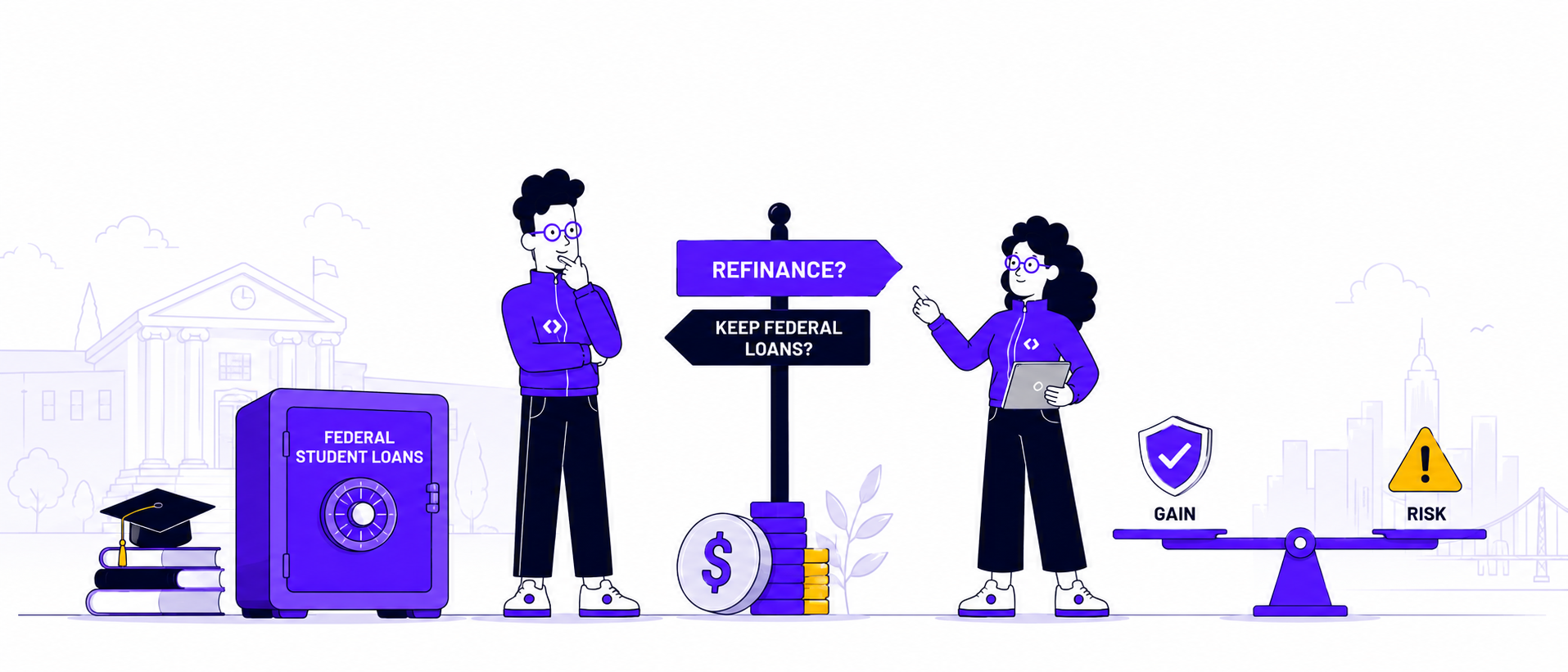
If you’re an Indian student or graduate researching how to lower your loan payments in the US, you’ve probably run into a wall of American financial jargon like “federal loans,” “PSLF,” “income-driven repayment” that doesn’t quite match your own situation. Most of what you’ll read online about refinancing federal student loans is written for US citizens with US Direct Loans. But your loan almost certainly didn’t come from the US Department of Education. It came from an Indian bank or NBFC, in rupees, with your parents as cosigners.
This guide untangles both threads. First, it explains what refinancing federal student loans actually means, and what you lose the moment you do it. Then it gets into the part that matters more for most Indian borrowers: refinancing your Indian education loan into a US-based loan, what you gain by doing it, and how the process actually works.
What does “refinancing federal student loans” mean?
Refinancing, in any context, means taking out a new loan to pay off an existing one, ideally with a lower interest rate, a different repayment tenure, or simpler terms. When the “existing loan” is a federal student loan (a Direct Loan issued by the US Department of Education), refinancing means a private lender pays off that federal balance and issues you a brand-new private loan in its place.
That single sentence hides a big trade-off: once a federal loan becomes a private loan, it stops being a federal loan. It’s a permanent, one-way conversion. There’s no reversing it later if your circumstances change.
Also Read: Student Loan Refinancing in 2026: Everything Indian Students in the USA Need to Know
Can you actually refinance federal student loans?
Technically, yes. Private lenders in the US will refinance federal student loans, and doing so can get you a lower interest rate if you have strong credit and stable income. But “can you” and “should you” are different questions, and the answer for most federal borrowers is that refinancing should only be considered if you’re fully confident you won’t need any federal protections again.
That’s because refinancing a federal loan into a private one permanently removes access to every federal benefit tied to that loan, including protections that were created specifically to help borrowers going through job loss, income drops, or long careers in public service.
What you lose when you refinance federal student loans
Public Service Loan Forgiveness (PSLF)
PSLF forgives the remaining balance on federal Direct Loans after 120 qualifying monthly payments while working for a government or qualifying nonprofit employer. Only federal Direct Loans are eligible; private lenders don’t offer anything equivalent. Refinance a federal loan into a private one, and any PSLF progress you’ve made is gone, along with future eligibility.
Income-Driven Repayment (IDR) Plans
Federal loans give you access to repayment plans that cap your monthly payment as a percentage of your income rather than a fixed amount tied to what you borrowed. As of 2026, the plan landscape itself is shifting – the SAVE plan has been discontinued, PAYE and ICR are being phased out by mid-2028, and a new plan called the Repayment Assistance Plan (RAP) now applies to loans disbursed after July 1, 2026, setting payments between 1% and 10% of adjusted gross income. IBR remains available for loans taken out before that date. None of these income-based options exist once your loan is refinanced privately; private lenders repay on fixed terms, regardless of what happens to your income.
Deferment, Forbearance, and Hardship Protections
Federal loans allow you to pause or reduce payments during unemployment, economic hardship, or medical situations, generally without those pauses damaging your credit the way a private default would. Private refinanced loans typically offer far more limited hardship options, set entirely by the private lender’s own policies.
Death and Disability Discharge
Federal loans are discharged if the borrower dies or becomes permanently and totally disabled, protecting the borrower’s family from the debt. This protection does not automatically carry over to a refinanced private loan.
Parent PLUS-Specific Changes
If a parent has taken out (or is considering) a Parent PLUS loan, the rules tightened further from July 1, 2026: new Parent PLUS loans taken out after that date lose access to income-driven repayment entirely, and only loans consolidated into a Direct Consolidation Loan before that date can still pursue PSLF.
What you gain when you refinance federal student loans
The trade-off exists because refinancing does offer real upside for the right borrower:
- A lower interest rate, if your credit score and income are strong enough to qualify for better terms than your federal rate.
- One single, predictable payment, replacing federal loan complexity with a straightforward private loan schedule.
- Flexibility to choose a shorter or longer term; a shorter term reduces total interest paid but raises the monthly payment; a longer term lowers the monthly payment but increases total interest over time.
The general advice from financial planners is blunt: refinancing federal loans makes sense only if you have no realistic path to forgiveness and don’t anticipate needing income-driven flexibility. If there’s any plausible chance you’ll need PSLF, IDR, or hardship protection later, refinancing a federal loan is very hard to undo.
Do Indian students actually have federal student loans?
This is the question most Indian students should be asking instead. US federal student loans are issued by the US Department of Education, and eligibility generally requires the borrower to be a US citizen or eligible noncitizen. International students on F-1 or similar visas, which covers the overwhelming majority of Indian students studying in the US, are not eligible for federal Direct Loans in the first place.
Instead, most Indian students finance their US education through:
- Education loans from Indian banks (like SBI or ICICI) or NBFCs (like Credila or Avanse), usually in rupees, often with a parent as cosigner and property or fixed deposits as collateral.
- Occasionally, private international lenders that serve students without a US cosigner or credit history.
So if you’re an Indian student, “refinancing federal student loans” mostly isn’t the decision in front of you; refinancing your Indian rupee education loan into a US dollar loan once you’re working in the US is.
The refinancing decision that actually matters for Indian students
Once you’re on OPT or an H-1B and earning a US salary, your Indian loan’s EMI, calculated in rupees, often at a higher interest rate than what’s available in the US, starts to feel disproportionately expensive relative to your dollar income. Refinancing lets you replace that INR loan with a single USD loan from a US lender, at what’s typically a lower, fixed interest rate.
What You Gain by Refinancing an Indian Education Loan into a US Loan
- Interest rate reduction. Many borrowers who start above 10% interest on their Indian loan have been able to bring that down to 7% or lower after refinancing.
- Removal of currency (INR) risk. Your income is in dollars; your loan is in dollars. No more EMI amounts fluctuating with the rupee’s movement against the dollar.
- Release of your cosigner and collateral. Refinancing pays off the Indian loan in full, which lets your parents’ cosigner obligation end and any pledged property or fixed deposits be released, with the lien removed from CIBIL records.
- Credit building in the US. A new US loan reported to US credit bureaus helps build a domestic credit history, useful for future needs like renting an apartment, buying a car, or eventually a home.
- A single, predictable payment. One US dollar EMI, on autopay, instead of managing a foreign currency loan from abroad.
What You Should Weigh Before Refinancing
- Whether you plan to stay in the US long-term or move back to India. This decision fundamentally shapes whether a US dollar refinance or an India-based refinance makes more sense for you.
- The 2% rule of thumb. A commonly used guideline suggests only refinancing if your new interest rate is at least 2 percentage points lower than your current one, though this is just a starting heuristic, not a hard rule, since it doesn’t account for loan tenure, currency risk, or income stability.
- Visa and income stability, since lenders assess these alongside your credit profile.
Eligibility for refinancing an Indian education loan in the US
Lenders generally evaluate:
- Visa status: Different lenders accept different visa categories (OPT, H-1B, and in some cases others), and this varies significantly by lender.
- A Social Security Number (SSN): Generally required by US refinance lenders, functioning much like an Aadhaar/UIDAI number does in India.
- Credit history and score: A thin or absent US credit file can be a hurdle, though some lenders specialize in serving borrowers with limited US credit.
- A cosigner, in some cases, having a permanent resident or US-based cosigner can significantly improve approval odds and rates, though it isn’t universally required.
- Stable income and employment, since this reassures lenders of repayment ability.
Documents You’ll Typically Need
- A payoff statement from your Indian lender (SBI, Credila, etc.) confirming the exact amount needed to close out your existing loan.
- Proof of visa status and employment.
- Details to support your US credit profile, where available.
Also Read: Student Loan Consolidation vs Refinancing: Key Differences Indian Students Must Know
How the refinancing process works, step by step
- Get your payoff statement from your current Indian lender.
- Compare offers across multiple lenders rather than accepting the first quote; rates, tenure, and terms vary meaningfully between lenders. GradRight lets you enter your details once and receive competing offers from 15+ domestic and international lenders instead of applying separately to each one.
- Choose the lender and terms that best fit your financial goals, factoring in interest rate, tenure, and prepayment terms.
- Complete the new loan application and allow the new lender to disburse funds to close your Indian loan.
- Close the Indian loan properly; collect the NOC, retrieve any pledged collateral documents, and confirm the lien is removed from your CIBIL record.
- Set up autopay on the new US loan immediately, linking a US checking account. Many lenders offer an additional 0.25 percentage point discount for enrolling in autopay.
The loan you actually have is the one worth refinancing
Here’s the quiet truth buried under all the PSLF and IDR jargon: the federal student loan system was never built with you in mind. It has forgiveness tracks for public servants, hardship plans for citizens, discharge clauses for permanent residents – an entire architecture of protection for a loan you were never eligible to take out in the first place.
What you do have is a rupee loan, a parent who cosigned it, and an EMI that hasn’t caught up to the fact that you now earn in dollars. That’s not a federal loan problem. That’s a GradRight problem, the specific, solvable kind.
Instead of opening fifteen tabs for multiple lenders and filling out the same form fifteen times, you fill it out once. Lenders bid for you, not the other way around. Your parents get their name off the cosigner line. Your EMI stops doing currency gymnastics every time the rupee moves.
Refinancing your loan just needs a single application, done right, on a platform that already knows exactly which lenders accept an Indian NOC and which ones don’t.





 Australia
  Canada
  France
  Germany
  India
India  Ireland
  UAE
UAE  United Kingdom
  United States