




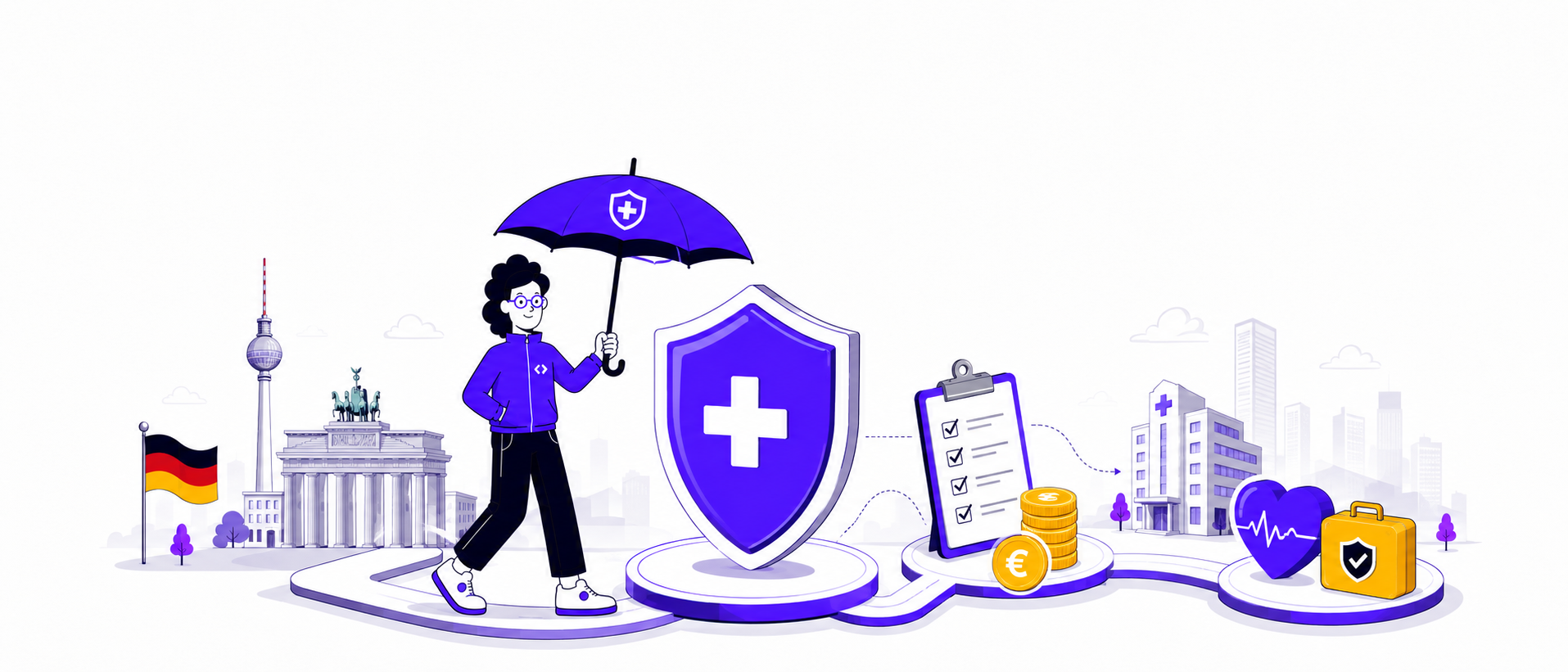
If you are heading to Germany for your degree, one of the biggest early decisions you face is the choice between public and private health insurance in Germany. Get it wrong, and you can be locked into a costly policy for the full length of your studies. For some students, private cover is the only legal option. For others, it is the smarter long-term choice in certain circumstances that require careful evaluation. This guide explains who can buy private health insurance in Germany, what it costs, what it covers, and when it makes the most medical and financial sense for you.
Who is eligible for private health insurance in Germany?
Before you compare options, it helps to know what you are choosing between.
Public health insurance, called Gesetzliche Krankenversicherung or GKV, is Germany’s government-regulated insurance system. Contributions are set by law, tied to a fixed student rate rather than your income, and benefits are identical across providers.
Private health insurance, called Private Krankenversicherung or PKV, is run by individual companies that set their own prices and coverage.
The choice between public versus private health insurance is far easier to make once you know what the public system actually offers, so use that as your baseline.
One quick note on terminology: many providers market private cover for international students as expat insurance, so if you see that label, it refers to the same private system discussed here.
Most international students assume that public health insurance in Germany is the default path for them. In practice, several student groups cannot access public health insurance at all. Many others have that option, but can be caught up in a situation where they would want to switch to private health insurance, but only have a narrow window to opt out of their current public insurance policy.
Also read: Planning to Study in Germany? These Requirements Surprise Most Students
Students Who Must Use Private Medical Insurance in Germany
You are required to take private health insurance in Germany if you fall into any of these groups:
- Students aged 30 and above. The discounted student rate for public medical insurance in Germany, known as KVdS, ends at the close of the semester in which you turn 30.
- Language course and Studienkolleg students. Preparatory programs are not counted as regular university study, so the public student scheme does not apply.
- PhD candidates without a university employment contract. If you are funded by research rather than employed as staff, you are not eligible for the public medical insurance tariff.
- Scholarship holders, freelancers, and guest researchers. Stipend recipients and self-employed students fall outside the public eligibility scope of public medical insurance tariff, which is why many turn to specialized expat insurance providers in Germany.
These groups drive much of the demand for expat/student medical insurance that Germany-based insurance providers serve each year.
Students Who Can Choose to Opt Out of Public Insurance in Favor of Private Medical Insurance
If you are under 30 and enrolled in a regular Bachelor’s or Master’s program, you start with public medical insurance by default. To choose private cover instead, you must apply for an exemption (Befreiung von der Versicherungspflicht) through a public insurer such as TK or AOK. You have three months from the start of your studies to file this request, and you can even complete it from abroad before you arrive. Once granted, the exemption is irrevocable for the full duration of your studies, so the choice deserves careful thought
How private medical insurance premiums are calculated
Premiums of public medical insurance policies in Germany depend on your income. Private health insurance in Germany works differently. Your premium reflects your personal risk profile (as judged by the insurer) and the coverage you choose.
Age, Health Status, and Entry Conditions
Insurers use medical underwriting to set your starting premium for your private medical insurance policy. The younger you are at entry, the lower your base rate. You must complete a health questionnaire to generate a quote for a private medical insurance policy. Also note that pre-existing conditions can become the cause of surcharges, exclusions, or a denied application.
Student Tariffs vs. Standard Tariffs
Private health insurers in Germany offer special student tariffs, and they are far cheaper than the regular adult plans that the same companies sell. The reason is a feature called aging reserves (Alterungsrückstellungen). In a standard adult plan, part of your monthly premium is set aside as a savings buffer that keeps your costs from spiking as you grow older. Student tariffs leave this buffer out, which is what makes them so affordable while you study. The trade-off arrives later. Once you finish your studies or pass the provider’s age limit, you move onto a regular adult tariff, the aging reserve gets built back into your premium, and the monthly cost rises sharply.
How Deductibles and Reimbursement Work
Most private health insurance plans are based on a reimbursement model. At a time when you need to avail of your insurance, you pay the doctor first, then claim the amount back through the insurer’s claims process. Many plans also carry a deductible of, say, €300 or €500. A higher deductible lowers your monthly premium, but it means you cover the first chunk of your yearly medical costs out of pocket before any reimbursement begins.
Also read: Choosing the Wrong Student Insurance Plan: Common Mistakes to Avoid
What private health insurance in Germany covers
Every private health insurance plan you can use for enrollment has to meet a legal minimum standard, or a German public insurer will not approve it for your university registration and residence permit. That baseline is the same across approved plans. What changes from one plan to the next is everything above the baseline, and here, the gap between budget and premium tiers is wide.
Core Medical Benefits Across Most Plans
Most private medical insurance plans for students cover GP and specialist consultations, hospital stays in shared rooms, prescription medication, ambulance services, and basic dental care. Outpatient bills are usually reimbursed up to 2.3 times the GOÄ rate. The GOÄ is Germany’s official fee schedule for doctors, and the multiplier is the ceiling your insurer will pay against it. If a specialist charges above that ceiling, you pay the gap yourself.
Additional Benefits in Higher-Tier Plans
Higher-tier private health insurance policies buy you comfort and unfettered access to medical facilities. These plans include coverage for treatment by the chief physician, private or semi-private hospital rooms, and reimbursement up to 3.5 times the GOÄ rate, which matters because top specialists often bill at that level. They also expand dental and vision benefits and, crucially, include recognized psychotherapy.
Top German private insurers for international students
A small set of providers dominates the international students’ health insurance market in Germany, each fitting a slightly different profile.
Care Concept – Care Student
Designed for degree students up to age 39. Premiums start around €102 per month for under-30s and cover psychotherapy at 70%. It also supports the M10 notification, the digital confirmation a German insurer sends straight to your university to prove your insurance status, so your enrollment clears without extra paperwork from you.
MAWISTA Student
Budget-friendly tariffs from around €44 for students aged 30 and above. Good for short-term and language-course students, but it typically excludes psychotherapy and preventive check-ups.
DR-WALTER – EDUCARE24 and Provisit Student
EDUCARE24 starts near €35 and suits language and Studienkolleg students. Provisit Student, at about €129, is the comprehensive option for students aged 38 and above, with psychotherapy covered at 75%.
ottonova – Study Secure Premium
A digital insurer with a fully English-language app. Rates begin around €126 for under-30s and rise to roughly €145 for ages 30 to 38, with concierge appointment booking and coverage for semi-private rooms included.
Note: For flexible expat/student health insurance plans in Germany, Feather is also worth a look, alongside traditional insurers like Allianz and AXA.
| Provider | Plan | Starting Monthly Cost | Best Suited For | Psychotherapy |
| Care Concept | Care Student | ~€102 | Degree students up to 39 | 70% covered |
| MAWISTA | Student Comfort | ~€44 (age 30+) | Language-course students and those with a focus on low-cost insurance | Excluded |
| DR-WALTER | EDUCARE24 | ~€35 | Preparatory students | Excluded |
| DR-WALTER | Provisit Student | ~€129 | Comprehensive (38+) | 75% covered |
| ottonova | Study Secure | ~€126 | Digital-first, premium | Comprehensive |
Private vs public insurance in Germany: the key differences
Students under 30 generally pay €140 to €151 monthly for public health insurance cover.
For students aged more than 30, the cost of voluntary public insurance jumps to roughly €240 to €275 per month, whereas they can get student-specific private health insurance policies with monthly costs of around €170.
Even healthy students under 30 in age can find budget private health insurance plans that cost from €32 to €80 per month.
The monthly premium of the insurance policy is only part of the picture. The two insurance systems are designed to handle billing, families, and health history in fundamentally different ways, and sometimes those differences can matter more for students than the monthly cost.
| Feature | Public (GKV) | Private (PKV) |
| Billing | Direct, no upfront payment | You pay first, claim later |
| Pre-existing conditions | Covered from day one | Typically excluded or surcharged |
| Family cover | Free for spouse and children | Separate paid contract per person |
| Service scope | Standardized by law | Depends on the tariff |
Hidden costs to watch out for with private insurance
A low headline premium on private health insurance in Germany can hide costs that surface only when you need care. Students are likely to fall into one or more of the three traps of private health insurance in Germany.
Benefit Caps, Co-Payments, and Annual Limits
Budget private health insurance plans cap benefits in ways that are easy to miss. Some limit medication reimbursement to as little as €250 a year. Many use a staged dental limit, the Zahnstaffel, which restricts dental cover heavily in the first two years, sometimes to a combined €1,800. Others charge a 10% to 20% co-payment on every outpatient or dental visit.
Rejected Policies and Coverage Gaps
A public insurer reviews your private policy before granting your exemption, and it can reject yours if the deductible exceeds €1,200 or if substantial services are missing. And as noted earlier, most budget plans drop psychotherapy entirely.
The Lock-In Problem
This is the cost students regret most. If your health declines while you hold a cheap plan, moving to a better private health insurance provider becomes nearly impossible, because fresh underwriting will exclude the new condition or price it beyond reach. There is a second hidden loss. Over the years, a private adult plan builds up aging reserves, the savings buffer that holds your premiums down as you get older. If you eventually return to public insurance, that buffer does not come with you. You forfeit it entirely, and for a long-term policyholder, it can be worth tens of thousands of euros.
Switching between public and private insurance in Germany
Movement between the two systems is tightly controlled and usually tied to a specific life event rather than personal preference.
Moving from Public to Private Health Insurance During Studies
During a degree program, the three-month exemption window is your only formal route into the private system. A second opportunity appears at age 30, when your mandatory student insurance ends. At that point, you can move to a private provider without filing an exemption, because you are no longer legally bound to the public student scheme.
Returning to Public Insurance
The usual way back is taking a job after graduation with a gross salary below the income threshold, currently €77,400 in 2026. Below that line, your employer automatically enrolls you in the public system. One rule is absolute: once you reach age 55, returning to the public system becomes effectively impossible, regardless of your income.
Is private health insurance in Germany worth it for Indian students
The answer depends on your age, your program type, and your long-term plans in Germany.
Weighing private vs public insurance in Germany plays out very differently for a student aged 25 and for one aged 32.
If you are under 30 in a regular Bachelor’s or Master’s program, public insurance is better. The subsidized rate, the free family co-coverage (known as Familienversicherung), and the convenience of direct billing give you a stable, low-risk base. That family benefit matters a great deal if you may bring a spouse or children to Germany later.
If you are 30 or older, in a Studienkolleg, or on a PhD scholarship, private health insurance in Germany usually becomes the better choice. You sidestep the steep €240 to €275 voluntary public rate, and providers like ottonova or Provisit deliver faster specialist access for noticeably less.
Eventually, the right choice between public and private health insurance in Germany is the one that fits both your budget today and your plans for the years ahead.
How GradRight simplifies your study-abroad planning for Germany
Choosing a health insurance plan for Germany is only one piece of a much larger puzzle. The bigger challenge is usually coordinating university shortlisting, financing, and paperwork without losing track of deadlines along the way.
GradRight is built to manage that entire financial side of studying abroad. The platform has served over 260,000 students, processed more than ₹36,000 crore in education loans, and lists upward of 18,000 programs for students to compare.
Our AI companion, Graddie, helps you compare universities, loans, and insurance without the usual confusion, and the Higher-Ed Hub lets you build a profile-fit shortlist of German universities in minutes.
That work has not gone unnoticed.
As The Economic Times reported, GradRight has quickly grown into a higher-education enablement platform that has processed $3 billion in loan requests and impacted 200,000 students. When the stakes are this high, a team with this track record is worth having on your side.






 Australia
  Canada
  France
  Germany
  India
India  Ireland
  UAE
UAE  United Kingdom
  United States