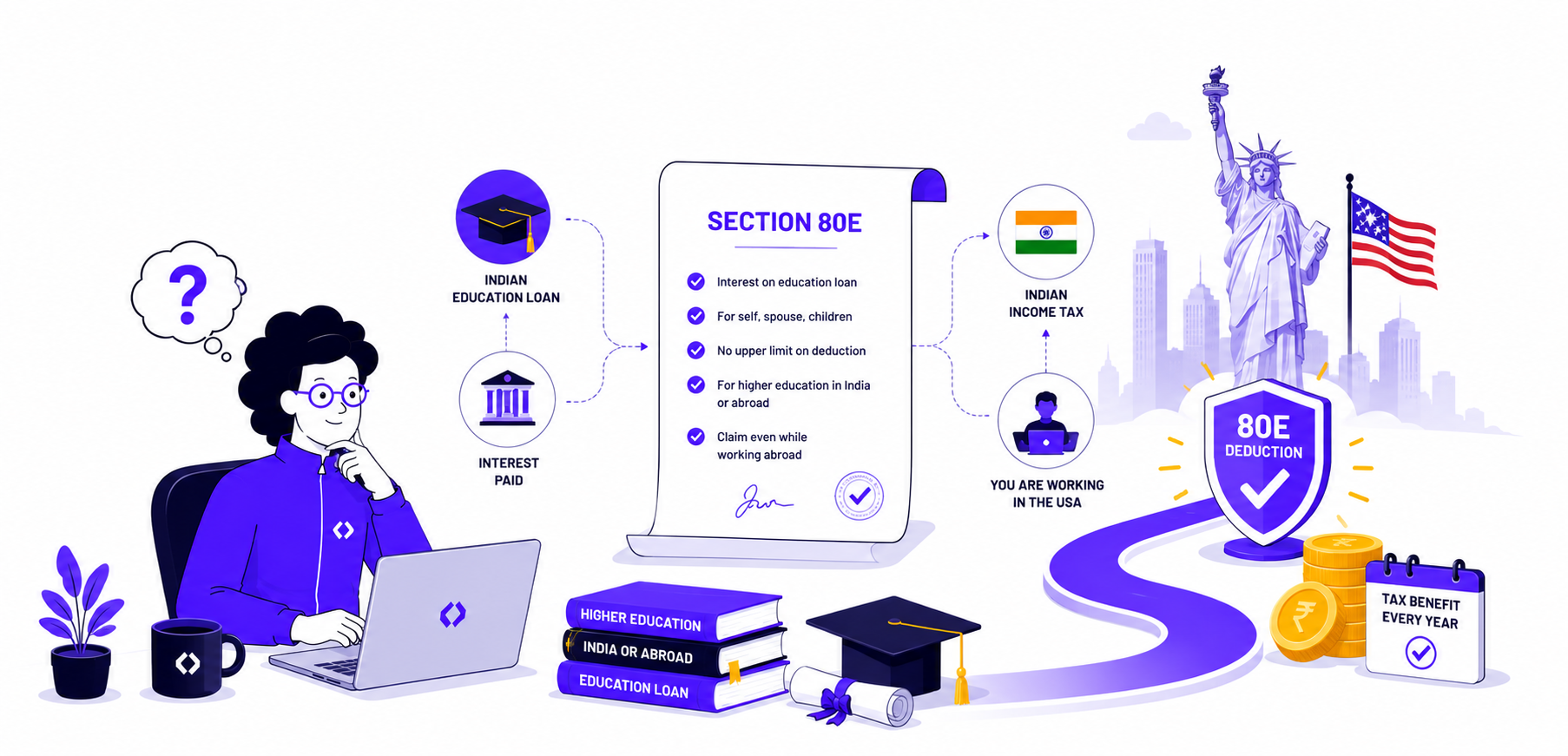
You graduated from a good university in India, took an education loan to make it happen, landed a job in the USA on an H-1B or OPT visa, and are now repaying that loan every month from your US salary. Somewhere along the way, someone mentioned you could still save tax in India on that loan.
But now you’re genuinely asking: can I claim the 80E deduction on an Indian education loan while working in the USA?
The short answer is yes, but only if you meet specific conditions. And the conditions matter a lot, especially for NRIs who have refinanced or are considering refinancing their loan. This guide breaks everything down so you know exactly what applies to you, what doesn’t, and how to protect your 80E eligibility through every stage of repayment.
What is the 80E deduction, and why does it matter?
Section 80E of the Income Tax Act, 1961 allows individuals to claim a deduction on the interest paid on education loans taken for higher education. The deduction applies only to the interest component of your EMI, not the principal.
What makes it genuinely attractive is that there is no upper limit on the amount you can claim. Every rupee of interest paid in a financial year is fully deductible from your Indian taxable income. For Indian students who went to the US for an MS, MBA, or any full-time postgraduate program using an Indian bank loan, this is a meaningful benefit worth understanding and protecting.
Can NRIs claim section 80E deduction while working in the USA?
Yes, but only if both conditions are met:
- Loan is from an eligible Indian lender: Indian bank, notified NBFC, or approved charitable institution. Loans from foreign lenders, employers, friends, or relatives don’t qualify. Refinancing with a foreign lender also removes 80E eligibility going forward.
- You have taxable income in India: 80E applies only to Indian taxable income (e.g., rent, interest, capital gains). If your only income is a US salary, you cannot use the deduction.
What counts as eligible Indian income?
Many Indian students working in the US still have income taxable in India. Common sources include:
- Interest on NRO fixed deposits or savings accounts
- Rental income from property in India
- Capital gains from selling Indian mutual funds, stocks, or property
- Dividends from Indian companies
If any of these push your Indian taxable income above the basic exemption limit (Rs. 2.5 lakh under the old regime, or Rs. 4 lakh under the new regime for FY 2025-26), you are required to file an Indian ITR. And if you’re filing, you can claim the 80E deduction on an education loan in the USA to reduce that liability.
Which education loans qualify for section 80E tax benefits?
Not every loan qualifies. The course must be a full-time higher education program pursued after completing Class 12, covering graduate, postgraduate, or professional degrees in fields like engineering, medicine, management, law, science, or arts, taken at a university or institution recognized by a competent authority in India or abroad.
If you took an Indian education loan for an MS in Computer Science or an MBA from a US university, the course qualifies. The limiting factor is only the lender, which makes it especially important to evaluate how any refinancing decision affects your eligibility before signing.
Who can claim section 80E on an education loan?
The 80E deduction on an education loan in the USA covers loans taken for yourself, your spouse, your children (including adopted children), or a student over whom you are the legal guardian. This means a parent still repaying an education loan they took for their child’s US degree can claim the deduction against their Indian income, as long as the loan is from an eligible Indian lender.
Only the person actually making the repayments can claim the deduction. If your parents are paying the EMIs, they claim it. If you are, you do.
Does refinancing reset the 8-year section 80E deduction window?
You can claim the deduction for a maximum of 8 consecutive assessment years, starting from the year in which you first begin repaying the loan. If the loan is fully repaid before 8 years, the benefit ends at the point of full repayment.
Example: if your repayment started in FY 2022-23, you can claim the 80E deduction on a USA education loan from AY 2023-24 through AY 2030-31, or until the interest is paid off, whichever comes first.
One thing worth knowing: refinancing with another eligible Indian lender does not reset this clock. The 8-year window continues from your original repayment start date. So if you refinance in year three with a qualified Indian lender to get a better rate, you still have five years of 80E eligibility remaining, and your new interest payments qualify just as the old ones did.
Section 80E under the old vs new tax regime: Which is better for NRIs?
Section 80E is available only under the old tax regime. If you opt for the new tax regime while filing your Indian ITR, you forgo all deductions including 80C, 80D, and 80E in exchange for lower slab rates.
For NRIs with significant taxable income in India and multiple deductions to claim, the old regime often makes more financial sense. But the right choice depends on your specific income profile, which is why running the numbers before filing matters.
Refinancing an Indian education loan: How to protect your 80E tax benefits
If you are currently repaying an Indian education loan and considering refinancing for a lower interest rate or simplified repayment, the lender you move to directly determines whether your 80E eligibility continues.
- Refinancing with an eligible Indian lender: 80E eligibility continues. The interest on the new loan qualifies, and the 8-year clock continues from your original start date.
- Refinancing with a foreign lender: 80E eligibility ends. Any interest paid post-refinancing does not qualify, regardless of what you claimed in earlier years.
If you are within your 8-year window and have Indian taxable income, this is a real financial trade-off worth calculating before deciding. At GradRight, we work with a network of Indian lenders and can help you compare refinancing options that offer better rates without sacrificing your tax benefits. It is worth exploring before you commit to a foreign refinance.
Documents required to claim section 80E deduction on an education loan in the USA
You do not need to attach documents when filing your ITR, but keep these on hand in case of scrutiny:
- Loan sanction letter from the bank or financial institution
- Annual interest certificate from the lender
- Repayment schedule showing the interest component of your EMIs
- Bank statements as supporting evidence
The ITR form applicable for most NRIs with investment or rental income is ITR-2. The filing deadline for NRIs for AY 2026-27 (FY 2025-26) is July 31, 2026, unless officially extended.
Can you claim section 80E and section 80C together?
Yes. Section 80E and Section 80C are independent and can both be claimed in the same year. Section 80C allows deductions up to Rs. 1.5 lakh for investments like ELSS, EPF, PPF, life insurance premiums, and tuition fees for up to two children. Section 80E covers education loan interest with no cap. Claiming both is completely valid and can significantly reduce your Indian tax liability.
Can you claim section 80E if you have no income in India?
If you have zero income taxable in India during a given financial year, the 80E deduction on a USA education loan gives you no benefit for that year. You cannot carry it forward, and you cannot use it to reduce your US taxes.
However, if your co-borrower, typically a parent, has taxable income in India and is repaying the loan, they can claim the deduction independently.
And if your Indian income picks up again in a later year, the 8-year window continues to count from when repayment started. If you started repayment in 2022 but had no Indian income until 2025, you can still claim for FY 2025-26 as long as you are within the window.
India-USA DTAA and section 80E: What NRIs need to know
The India-USA Double Taxation Avoidance Agreement ensures that the same income is not taxed in both countries. For NRIs working in the US, Indian-sourced income like rental earnings or NRO interest that has been taxed in India can be claimed as a credit when filing US taxes using IRS Form 1116.
This is separate from Section 80E. The 80E deduction on an education loan in the USA works on the Indian side of your tax obligation. DTAA ensures you are not doubly taxed on the same underlying income. Both mechanisms can work in your favor simultaneously.
Section 80E deduction checklist for NRIs working in the USA
- The loan was taken from an Indian bank, eligible NBFC, or approved charitable trust
- If refinanced, the new lender is also an eligible Indian institution
- The course was a full-time higher education program after Class 12
- You are the individual actually making the loan repayments
- You have taxable income in India this financial year
- You are filing under the old tax regime
- You have your interest certificate from the lender
- You are within the 8-year deduction window from the start of repayment
Smarter repayment decisions for global borrowers
Navigating education loans, refinancing decisions, and tax deductions across two countries is a lot to manage, especially when each decision compounds the others.
At GradRight, we work with Indian students throughout the study-abroad journey, including the repayment and refinancing phase. If you are looking to refinance your Indian education loan at a better rate, we can connect you with eligible Indian lenders whose loans continue to qualify under Section 80E.
That means you potentially save on both interest costs and taxes simultaneously, which is the outcome most NRI borrowers want but rarely know is achievable together.









 Australia
  Canada
  France
  Germany
  India
India  Ireland
  UAE
UAE  United Kingdom
  United States