




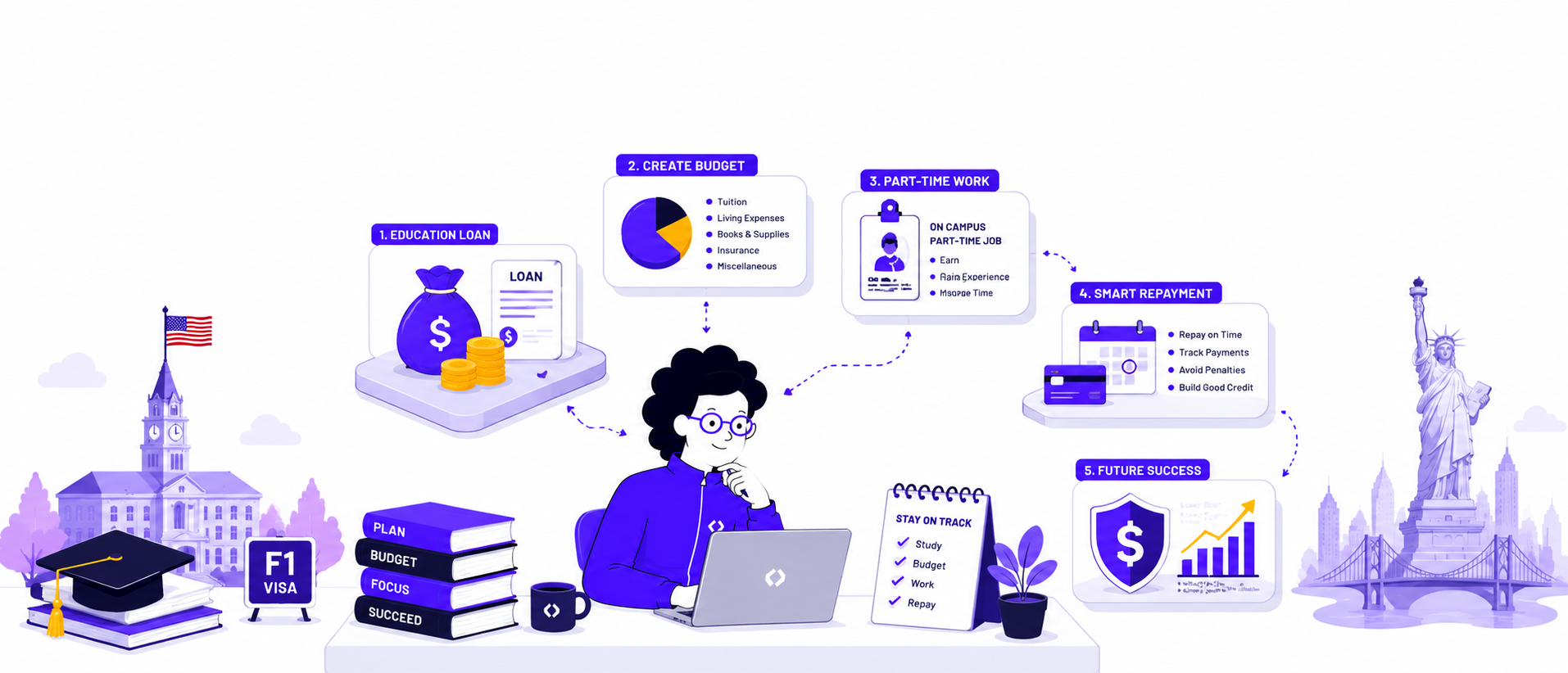
Learning how to manage an education loan while studying in the USA on an F1 visa starts with one fact: most Indian education loans give you a moratorium during your course, but interest is often still accruing in the background. The choices you make in these years, how much interest you pay down, whether you track your loan terms, and when you start planning a refinance, determine whether your EMI feels manageable or overwhelming once repayment begins.
In this guide, you’ll learn:
- What it actually means to manage education loan while studying in the USA
- How moratorium and interest accrual work, and why they matter now
- Practical budgeting steps for F1 students with limited on-campus income
- When refinancing makes sense, even before you’ve graduated
- How to track your loan and avoid the most common mistakes
- What to do if your visa or job situation changes mid-course
What does it mean to manage an education loan while studying in the USA?
Managing an education loan while studying in the USA means actively tracking your interest accrual, making payments where possible during the moratorium, and planning ahead for repayment and refinancing rather than waiting until your course ends to think about it.
Most Indian education loans for the US carry a moratorium equal to your course duration plus six months to a year. During this period, you are not required to pay EMIs, but interest, often in the 9% to 13% range depending on your lender, typically continues to accrue. Public sector banks compound this interest after the moratorium ends; NBFCs may require partial or full interest payments during the course itself. Either way, the loan is not sitting still just because you aren’t paying it yet.
This is the core reason students need a plan to manage education loans while studying in the USA from the first semester, not the last one.
Why This Matters More on F1 Status Specifically
F1 visa rules limit on-campus work to 20 hours a week during the semester, and off-campus work is generally restricted unless you qualify for CPT or OPT. That income ceiling makes it harder to pay down interest aggressively while studying, which is exactly why a clear plan to manage an education loan while studying in the USA needs to start with realistic expectations about what you can pay now versus what you’ll need to handle after graduation.
How to manage education loan while studying in the USA: Year by year
First Year: Understand Your Loan Terms Completely
Before you can manage an education loan while studying in the USA effectively, you need full clarity on your own loan. Pull out your sanction letter and confirm:
- Your exact interest rate and whether it’s fixed or linked to a benchmark like the repo rate
- Whether your moratorium requires partial interest payments or allows a full deferment
- Your total moratorium length, typically course duration plus six to twelve months
- Whether your loan is secured (collateral) or unsecured, and the co-applicant’s liability
- Whether you’re enrolled in any government interest subsidy scheme
Most students skip this step and only engage with their loan terms when the first EMI notice arrives. That delay is the single biggest obstacle to managing an education loan while studying in the USA successfully.
Second Year: Start Paying Down Interest If You Can
Even a small simple-interest payment during your course reduces what gets added to your principal later. On a Rs 40 lakh loan at 11%, the interest that accrues over a two-year master’s program, left untouched, can meaningfully inflate the loan balance you start repaying from. Paying even the interest portion through part-time campus income is one of the most effective ways to manage an education loan while studying in the USA on a tight F1 budget.
Final Year: Plan Your Repayment and Refinancing Strategy Before You Graduate
This is the stage where most students get wrong. They wait until they’ve graduated, and often until they’ve started a job, before thinking about how to manage an education loan while studying in the USA shifts into how to manage it after graduation. Start this conversation in your final semester instead.
If you’re on track for OPT or H1B and expect to earn in the US, ask your lender about USD-linked repayment options. If you anticipate returning to India, start researching refinancing lenders now, so you’re ready to act the moment you have an income to show.
Budgeting tips to manage education loan while studying in the USA
Managing day-to-day finances is just as important as understanding loan terms. A few practical habits make a real difference when you’re trying to manage education loan while studying in the USA without a large income:
- Track your disbursement schedule. Loans are typically released in installments tied to each semester’s tuition deadline, not as one lump sum. Knowing this prevents you from assuming you have more buffer than you do.
- Separate loan funds from living expenses. Mixing tuition disbursement with monthly spending money makes it harder to track how much interest is actually accruing.
- Use campus employment income for interest payments first. If you’re working 20 hours a week on campus, even Rs 5,000 to Rs 10,000 a month toward interest adds up over a two-year program.
- Avoid unnecessary parallel debt. Credit cards and personal loans on top of an education loan make it significantly harder to manage an education loan while studying in the USA without falling behind on multiple fronts.
- Set calendar reminders for moratorium milestones. Know exactly when your interest-only period ends and when full EMIs begin, so there are no surprises.
How refinancing fits into managing your loan while studying
Refinancing is usually discussed as something you do after returning to India or starting a US job, but the groundwork for it should start while you’re still in school. Part of learning to manage an education loan while studying in the USA is recognizing that your repayment habits now shape your refinancing options later. Lenders evaluate your repayment history, so a track record of consistent interest payments during your moratorium, even partial ones, makes you a stronger refinancing candidate later.
What a Future Refinance Could Look Like
| Original Loan Terms | After Refinancing | Why It Matters |
| 12% interest, public bank | 9% interest, NBFC refinance product | Lower total interest over the loan term |
| 10-year tenure, fixed EMI | 12–15 year tenure, restructured EMI | Lower monthly outflow matched to actual income |
| Secured loan, parent collateral | Partial refinance, smaller collateral exposure | Reduced family risk |
| Single lender, rigid terms | Consolidated loan across multiple lenders | Simpler repayment, fewer due dates to track |
Students who treat refinancing as part of the plan to manage an education loan while studying in the USA, rather than a separate decision made later, tend to qualify for better terms because their financial history is cleaner by the time they apply.
When You Should Start Looking at Refinancing Options
- During your final year, once you know whether you’re likely to stay in the US (OPT/H1B) or return to India
- Within the first three to six months after the moratorium ends, before any EMI is missed
- As soon as you have two to three months of consistent income, in USD or INR, to show a lender
Common mistakes that make it harder to manage education loan while studying in the USA
Most students don’t fail to manage their education loan while studying in the USA because of a single bad decision. It’s usually a pattern of small oversights that compound over two or more years:
- Ignoring the loan until repayment starts. Interest does not pause just because you’re not actively thinking about it.
- Assuming the moratorium means the loan is “free” for now. Compounding interest can add lakhs to your principal if left untouched for two or more years.
- Not telling co-applicants about loan status updates. Parents who co-signed deserve visibility into how the loan is progressing, especially if visa or income plans shift.
- Waiting until graduation to research refinancing. By then, you’ve lost the head start that early research and a clean repayment record would have given you.
- Mixing loan disbursements with personal spending. This makes it difficult to know your real interest burden at any given point.
What if your visa or job plans change mid-course?
If your post-graduation plans shift, whether OPT doesn’t come through, you change majors, or you decide to return to India early, your approach to managing your education loan while studying in the USA needs to shift too. The core skill of how to manage an education loan while studying in the USA is adaptability, not a fixed plan you set once and never revisit.
Contact your lender proactively rather than waiting for the moratorium to end on its own. Ask whether your moratorium can be extended given a change in circumstances, and start narrowing down refinancing lenders that work for your new likely income source, INR or USD, well before the first EMI is due.
Take control of your education loan
Managing an education loan while studying in the USA is not just about making payments when they are due. It’s about understanding how interest accrues, preparing for repayment early, and making informed decisions that can reduce your long-term borrowing costs.
At GradRight, we help students take a proactive approach to loan management by comparing refinancing opportunities across multiple lenders, evaluating repayment scenarios, and identifying options that align with future career plans in the US or India.
Whether you’re still in your first semester or approaching graduation, having a clear strategy today can make repayment significantly easier tomorrow.

 Australia
  Canada
  France
  Germany
  India
India  Ireland
  UAE
UAE  United Kingdom
  United States