




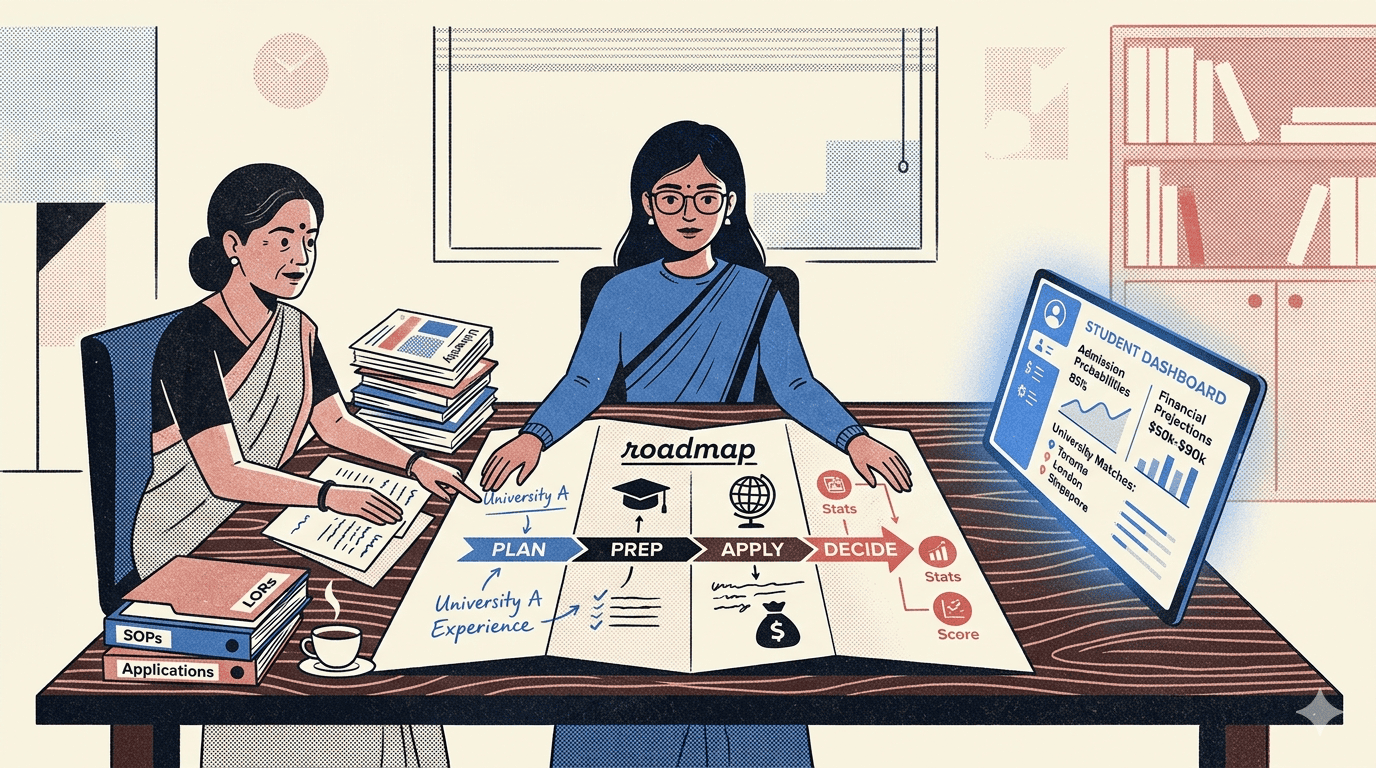
Every Indian student planning to study abroad eventually faces the same decision: choose AI counselling, traditional counselling, or navigate the process independently. In 2026, that decision matters more than ever because both the tools and the stakes have evolved significantly.
India’s traditional study abroad counselling industry is large, established, and highly varied. The best counsellors bring years of experience, strong university relationships, and deep knowledge of specific programs. At the same time, some consultants operate under a structural conflict of interest. Many traditional study abroad consultants earn commissions from partner universities, often amounting to 10 to 15 percent of a student’s first-year tuition. As a result, their financial incentives may not always align with a student’s academic and career goals.
AI-powered counselling platforms have entered the market with a different approach. They provide data-driven recommendations, round-the-clock access, and freedom from commission bias. However, they also have limitations, particularly in situations that require human judgment and emotional support.
This article compares both approaches across the factors that matter most to students. It highlights where AI performs better, where traditional counselling still adds value, and why a hybrid approach is emerging as the preferred model in 2026.
What Traditional Study Abroad Counselling Actually Involves
A traditional study abroad counsellor typically offers a package that includes profile evaluation, university shortlisting, SOP assistance, recommendation letter guidance, test preparation advice, visa support, and pre-departure orientation.
However, the quality of this service varies considerably. Some counsellors have direct relationships with university admissions teams and years of experience in specific markets. Others operate with limited expertise and rely heavily on partner university arrangements.
Large firms, established international consultancies, and specialised boutique agencies generally offer stronger support than smaller consultancies operating with limited resources.
The cost of traditional counselling in India ranges from ₹25,000 to ₹2.5 lakh, depending on the scope of services and the consultant’s reputation. For families investing ₹50 to ₹90 lakh in an international degree, the fee itself is rarely the main concern. Instead, students want to know whether recommendations genuinely reflect their interests or are influenced by commission structures.
Importantly, this conflict of interest is structural rather than personal. Many counsellors act in good faith. Nevertheless, students should understand how compensation models can influence recommendations before making major decisions.
What AI Study Abroad Counselling Actually Involves
AI counselling platforms use historical admissions data, predictive analytics, and automation to help students make informed decisions.
These platforms can generate university recommendations, estimate admission probabilities, automate application workflows, and answer questions instantly. As a result, students spend less time researching and managing applications.
Students using AI-powered dashboards report significant reductions in application-related effort. Predictive admission tools have also achieved strong satisfaction levels among users.
The most effective AI platforms in 2026 are trained on India-specific admissions outcomes. While general AI tools such as ChatGPT can assist with research and drafting SOPs, they do not have access to specialised admissions datasets. Consequently, they cannot provide the same level of predictive accuracy as platforms trained on millions of student outcomes.
This distinction is important. General AI offers guidance based on publicly available information. Dedicated study abroad AI platforms generate recommendations based on actual admissions patterns and outcomes.
Today, AI has already become the first stop for many students seeking guidance. The real question is not whether students use AI, but whether they use AI tools specifically designed for study abroad planning.
AI vs Traditional Counselling: A Direct Comparison
| Dimension | Traditional Counselling | AI Counselling | Winner |
|---|---|---|---|
| University Shortlisting | Based on experience and partner universities | Data-driven recommendations | AI |
| Admission Probability | Subjective estimates | Quantified predictions | AI |
| Availability | Limited office hours | 24/7 access | AI |
| SOP and Essay Support | Strong human feedback | Draft generation | Human |
| Conflict of Interest | Often commission-driven | No commission bias | AI |
| Cost | ₹25,000 to ₹2.5 lakh | Free to low-cost | AI |
| Complex Profiles | Strong for unusual cases | Limited by historical data | Human |
| Emotional Support | Strong | Limited | Human |
| Visa Interview Preparation | Realistic simulations | Improving but limited | Human |
| Waitlist and Appeals | Strong advocacy | Limited support | Human |
| Financial Planning | Often separate | Frequently integrated | AI |
| Response Speed | Hours or days | Seconds | AI |
The overall pattern is clear. AI performs exceptionally well when tasks involve data processing, scalability, speed, and objectivity. Human counsellors excel in areas that require communication, judgment, and emotional intelligence.
Rather than competing strengths, these capabilities complement each other.
Where Traditional Counselling Still Wins
Complex Academic Profiles
Students with low GPAs, career gaps, multiple academic transitions, or unconventional career journeys often need a nuanced application strategy.
For example, a student with a 6.2 GPA and strong startup experience may appear less competitive when evaluated purely against historical admissions data. However, an experienced counsellor can help build a compelling narrative that highlights strengths beyond academic performance.
This type of storytelling remains one of the areas where human expertise is difficult to replicate.
Waitlist Management and Rejection Appeals
Waitlist situations often require carefully written letters, strategic communication, and detailed knowledge of how specific programs evaluate candidates.
An experienced counsellor can guide students through these situations and help them present a stronger case. AI can assist with drafting content, but it cannot replace human advocacy.
Emotional Support During a Long Process
The study abroad journey often lasts six to twelve months. During that period, students deal with uncertainty, rejections, deadlines, and family expectations.
A good counsellor provides reassurance, perspective, and practical advice throughout the process. While AI can answer questions instantly, it cannot replicate the confidence that comes from speaking with someone who has guided hundreds of students through the same experience.
Where AI Counselling Wins Decisively
Unbiased University Shortlisting
Shortlisting is arguably the most important stage of the study abroad process.
A poor shortlist leads to wasted application fees, unrealistic expectations, and missed opportunities. Traditional counsellors who depend on commission relationships may unintentionally prioritise partner institutions.
AI platforms do not face this incentive structure. Instead, they generate recommendations using historical admissions data.
As a result, students receive suggestions based on profile compatibility rather than commercial partnerships.
Financial Planning Integration
Many traditional counsellors focus primarily on admissions. Financial planning often becomes a separate conversation that happens later.
This disconnect can lead students to apply for programs that may not make financial sense based on their expected outcomes.
Advanced AI platforms integrate loan comparison tools, ROI analysis, and EMI calculators directly into the decision-making process. Consequently, students can evaluate affordability and career outcomes before committing to applications.
24/7 Availability
Study abroad decisions often involve urgent questions and tight deadlines.
Students may need guidance late at night, on weekends, or during holidays. AI platforms provide instant support regardless of time zones or business hours.
This accessibility can be particularly valuable during critical application periods.
The GradRight App: Built for Indian Students
Data Built on Real Student Outcomes
Many students currently use general-purpose AI tools for study abroad planning. While these tools are useful, they were not designed specifically for international education decisions.
GradRight takes a different approach. The platform is trained on 8 million data points derived from Indian student admissions outcomes, loan applications, and career trajectories.
As a result, recommendations reflect real-world outcomes rather than generic rankings.
Academic and Financial Decisions in One Place
GradRight helps students identify programs where they have realistic admission chances. At the same time, it provides visibility into financing options based on actual lender behaviour.
Students can evaluate admission probability, loan availability, and financial feasibility within a single platform.
Furthermore, GradRight integrates its loan marketplace into the shortlisting process. More than 15 lenders compete for student profiles, allowing users to compare options while evaluating universities.
Why This Matters
Most students separate academic planning from financial planning. Unfortunately, that separation often leads to poor decisions.
By connecting admissions guidance with financing insights, GradRight enables students to evaluate the full picture before making commitments.
This integrated approach helps students avoid costly mistakes and make more informed decisions.
The Hybrid Approach: What Works Best for Most Students
The most effective strategy in 2026 is not choosing between AI and human counselling. Instead, it is combining both.
AI tools excel during data-intensive stages such as shortlisting, admission probability assessment, financial modelling, scholarship research, and day-to-day question answering.
Human counsellors provide the greatest value during high-touch stages such as profile positioning, SOP refinement, waitlist management, and emotional support.
Therefore, many successful applicants now use AI as their primary decision-making tool while seeking human guidance only where expertise adds measurable value.
This approach delivers better shortlists, stronger financial planning, and lower overall costs without sacrificing personalised support.
The Bottom Line
AI counselling and traditional counselling are not direct substitutes. Each serves a different purpose within the study abroad journey.
AI performs better in areas such as shortlisting, affordability analysis, speed, accessibility, and bias reduction. Human counsellors remain valuable for complex profiles, emotional support, and post-admission advocacy.
Students who combine both approaches often achieve the best outcomes.
Start with a data-driven platform for shortlisting and financial planning. Then use human expertise selectively where judgment and experience matter most.
If you’re planning to study abroad in 2026, that combination may be the smartest approach available.
 Australia
  Canada
  France
  Germany
  India
India  Ireland
  UAE
UAE  United Kingdom
  United States