




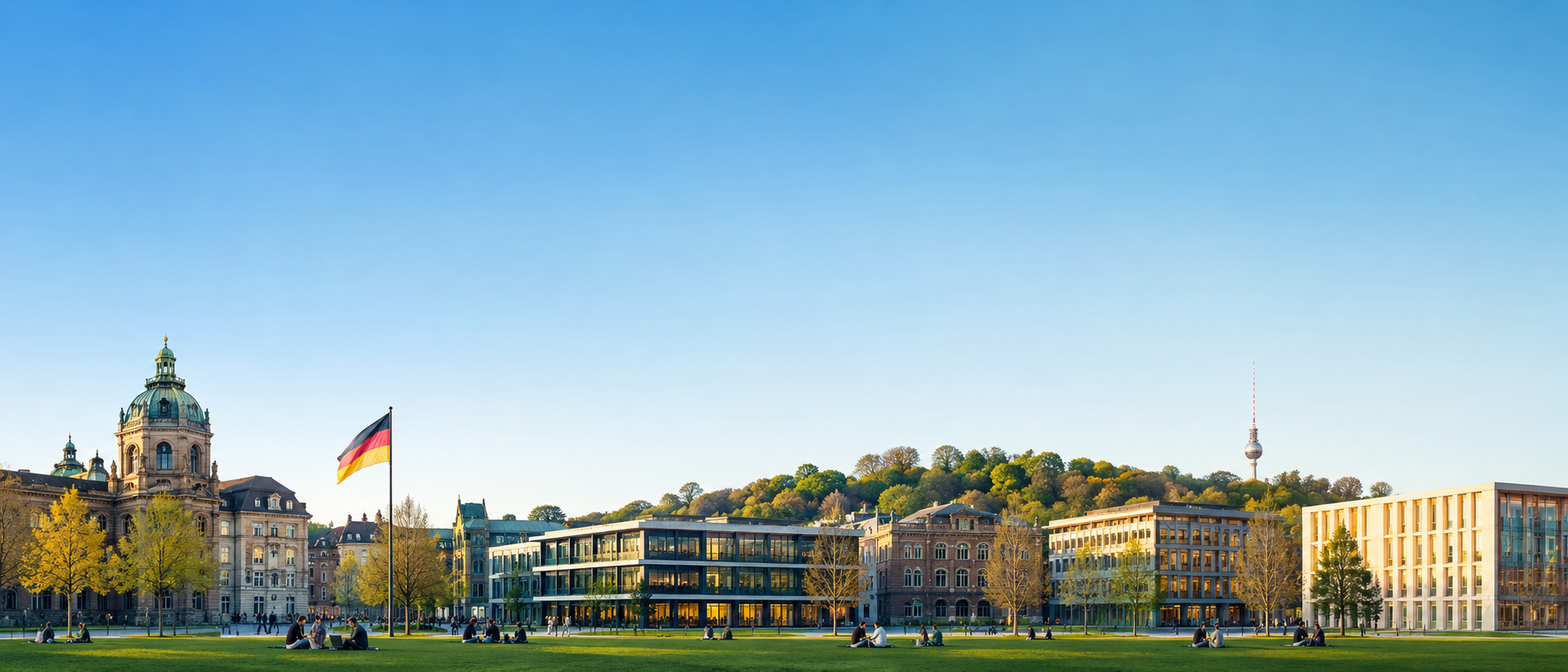
Germany has long held a reputation as a premier global study destination due to its world-class research and rich academic traditions. While tuition-free public institutions dominate the landscape, a growing number of students are now deliberately choosing to pay for their education at private universities in Germany.
This sector is gaining serious momentum. With over 113 private institutions and nearly 373,000 students enrolled, these universities meet a real demand for smaller class sizes, English-taught programs, flexible admissions, and direct tracks into major industries.
So if you have been wondering whether a private university in Germany could be the right move for you, you are in exactly the right place. We are going to walk you through the key differences, the top 10 picks, real fee numbers, and an honest look at whether it is all worth your time and money.
Public vs. private universities in Germany: What actually differs?
Understanding Germany’s higher education landscape requires comparing two distinct academic models that both lead to fully recognized degrees.
- Public Universities: State-funded and research-heavy. For most international students, tuition is free, requiring only a small semester contribution of €150 to €350. However, classes are often enormous, housing 100 to 500+ students per department.
- Private Universities: Independently operated and career-focused. They charge tuition fees but offer an intimate, community-driven campus experience with small cohorts (20 to 60 students) and flexible intake cycles.
Note on Degree Recognition: If a private university in Germany is state-accredited (Staatliche Anerkennung), its degrees carry the exact same legal and professional weight as a public university degree.
Also Read: Can Indian Students Study in Germany for Free?
Top 10 private universities in Germany: Detailed school profiles
Reputation in the private sector is shaped by program specialization, global accreditation, corporate standing, and graduate salary outcomes. The following 10 private universities in Germany are fully state-accredited and stand as top choices for international applicants.
1. WHU – Otto Beisheim School of Management (Vallendar/Düsseldorf)
WHU is widely considered Germany’s premier private business school. It holds rare triple accreditation from AACSB, EQUIS, and FIBAA. This distinction is shared by fewer than 1% of business schools worldwide. It ranks #1 in Germany and #22 globally in the Financial Times Masters in Management Rankings. Its highly active alumni network has co-founded over 2,400 companies.
- Popular Programs: B.Sc. International Business Administration, M.Sc. in Entrepreneurship, Full-Time MBA.
- Approx. Tuition: EUR 19,000 to 50,000 per year.
2. ESMT Berlin
Located in the heart of the capital, ESMT was founded by 25 leading European corporate giants, including Volkswagen, Bosch, and Deutsche Telekom. This German business school is consistently ranked in the top 10 in Europe by the Financial Times for its MBA program. Over 91% of the student body is international.
- Popular Programs: Full-Time MBA, M.Sc. in Management, Executive Education.
- Approx. Tuition: EUR 28,000 to 65,000 per year (MBA tracks).
3. Frankfurt School of Finance & Management
Situated in the financial capital of continental Europe, this triple-accredited institution places students next to the European Central Bank and major global investment firms. It offers unmatched corporate networking and internship access for finance-driven careers.
- Popular Programs: B.Sc. in Business Administration, M.Sc. Finance, MBA in International Finance.
- Approx. Tuition: EUR 10,000 to 45,000 per year.
4. Hertie School (Berlin)
Hertie School occupies a highly prestigious niche focused on public policy, governance, and international affairs. The international faculty includes former ambassadors and senior UN officials, attracting policy students from over 100 countries.
- Popular Programs: Master of Public Policy (MPP), Master of International Affairs (MIA), Data Science for Public Policy.
- Approx. Tuition: EUR 19,000 to 39,000 per year.
5. Munich Business School
As Bavaria’s first state-accredited private institution, this school leverages its location in a powerhouse economic hub to connect students directly with Munich-based employers like BMW, Siemens, and Allianz. Most degrees feature mandatory semester-abroad modules.
- Popular Programs: B.A. International Business, M.A. Innovation and Entrepreneurship, MBA General Management.
- Approx. Tuition: EUR 38,000–45,000 total (Bachelor’s); EUR 18,000–30,000/year (Master’s).
6. EBS University of Business and Law (Wiesbaden)
Established in 1971, EBS is the oldest private business university in the country. It offers a rigorous, specialized curriculum that blends traditional business administration with comprehensive corporate legal studies.
- Popular Programs: B.Sc. Business Administration, LL.B. Law, M.Sc. Management, Full-time MBA.
- Approx. Tuition: EUR 15,000 to 28,000 per year.
7. Constructor University (Bremen)
Formerly known as Jacobs University, this residential campus operates on a highly diverse international model hosting students from 110 countries. It scores exceptionally high in national CHE rankings for overall study conditions and student support.
- Popular Programs: B.Sc. Data Science, B.Sc. Electrical and Computer Engineering, M.Sc. Computer Science.
- Approx. Tuition: EUR 15,000 to 22,000 per year.
8. SRH University Heidelberg
Founded in 1969, SRH features a unique “CORE” learning model (Competence-Oriented Research and Education) that replaces traditional written exams with continuous, project-based real-world milestones.
- Popular Programs: B.Sc. Psychology, B.Sc. Business Administration, M.Sc. in Applied Data Science.
- Approx. Tuition: EUR 5,500 per semester (Undergrad); EUR 6,500 per semester (Master’s).
9. GISMA Business School (Berlin/Potsdam)
GISMA’s flagship Global MBA holds prestigious AMBA accreditation, an honor shared by only a tiny percentage of business faculties globally. It caters extensively to international professionals looking for flexible study formats and corporate switches.
- Popular Programs: Global MBA, Master in Management, M.Sc. International Marketing.
- Approx. Tuition: EUR 16,000 to 25,100 per year.
10. Bard College Berlin
A unique German-American institution operating on a dual-degree model. Students graduate with both an American and a German Bachelor of Arts. Classes are kept extremely small (10 to 15 students) to focus on critical reasoning, arts, and social thought.
- Popular Programs: B.A. in Humanities, the Arts, and Social Thought; B.A. in Economics, Politics, and Social Thought.
- Approx. Tuition: EUR 21,000 to 37,000 per year.
Side-by-side comparison of leading private institutions
| University | Primary Strength | Popular Fields | Approx. Annual Tuition |
| WHU – Otto Beisheim School of Management | Business, entrepreneurship, management | International Business, Entrepreneurship, MBA | EUR 19,000–50,000 |
| ESMT Berlin | MBA and executive education | Management, MBA, Leadership | EUR 28,000–65,000 |
| Frankfurt School of Finance & Management | Finance and banking | Finance, Business Administration, MBA | EUR 10,000–45,000 |
| Hertie School | Public policy and governance | Public Policy, International Affairs, Data Policy | EUR 19,000–39,000 |
| Munich Business School | International business | International Business, Innovation, MBA | EUR 18,000–30,000 |
| EBS University of Business and Law | Business and corporate law | Business Administration, Law, Management | EUR 15,000–28,000 |
| Constructor University | STEM and interdisciplinary learning | Computer Science, Data Science, Engineering | EUR 15,000–22,000 |
| SRH University Heidelberg | Applied and project-based learning | Psychology, Business, Data Science | EUR 11,000–13,000 |
| GISMA Business School | International business education | MBA, Management, Marketing | EUR 16,000–25,100 |
| Bard College Berlin | Humanities and liberal arts | Economics, Humanities, Social Thought | EUR 21,000–37,000 |
Understanding the financial ecosystem: Fees, costs, and aid
When mapping out your budget for a private university in Germany, it is vital to balance upfront tuition rates against local cost-offset mechanisms.
- Institutional Scholarships: Most private universities in Germany provide institutional scholarships or diversity reductions covering 10% to 50% of the baseline tuition. Always apply for funding alongside your primary admission application.
- Regional Living Costs: Expect an average of €800 to €1,200 per month for living expenses. High-demand hubs like Munich feature a steeper cost profile than academic cities like Berlin, Bremen, or Heidelberg.
- Part-Time Work Rights: International students can legally work up to 120 full days (or 240 half days) per year within Germany to self-fund day-to-day maintenance expenses.
Also Read: University of Applied Sciences in Germany
Are private universities in Germany worth the cost?
Private universities in Germany offer a compelling return on investment under specific circumstances. If you are an international student targeting high-finance, corporate consulting, or venture-backed startups and require immediate English-medium instruction without strict GPA limits (Numerus Clausus), the corporate pipelines of top private institutions are highly efficient.
Graduate employment data demonstrates this: WHU MBA alumni report competitive average post-graduation starting salaries of approximately €84,000 per year. Conversely, if you possess strong German language skills or want to enter deep scientific research, academic engineering, or traditional medical fields, the elite public university ecosystem remains the national gold standard.
Final thoughts
Choosing among private universities in Germany is not simply about picking a school with the right ranking or tuition fee. It is about finding the place that fits your ambitions, career goals, and future plans. But comparing universities, figuring out financing, understanding visa requirements, and making high-stakes decisions across countries can quickly become overwhelming.
That is where we come in. At GradRight, our AI-powered platform helps students plan their entire study-abroad journey, from finding the right colleges anywhere in the world to securing education loans, health insurance, refinancing, and more. Your dream university is only one decision. We help with all the ones that come after it.






 Australia
  Canada
  France
  Germany
  India
India  Ireland
  UAE
UAE  United Kingdom
  United States