




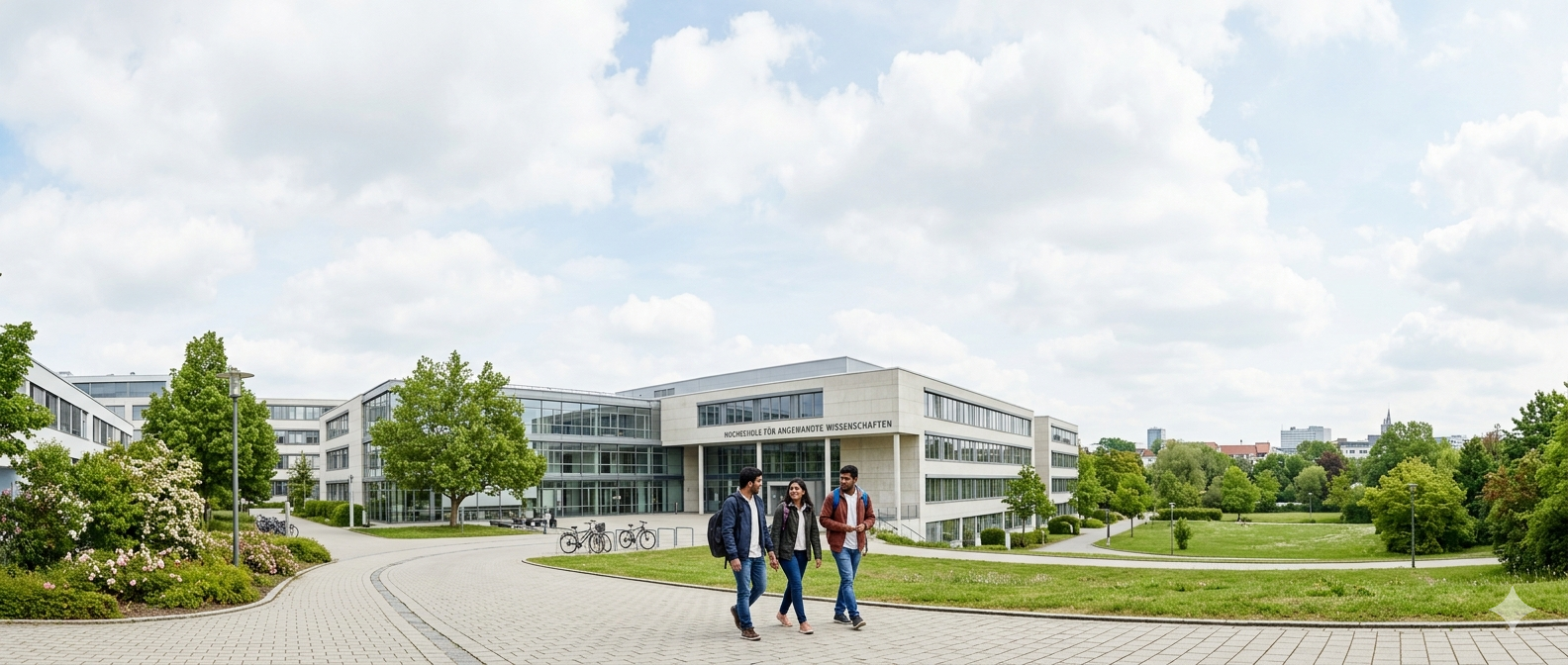
If you’ve been researching higher education in Germany, you’ve probably come across the term “University of Applied Sciences” more than once. Maybe you’ve seen it in scholarship listings, on German university websites, or in forum threads where Indian students swap tips about studying abroad. And maybe you’ve wondered: what exactly is it, and is it the right fit for me?
Here’s the short answer: a University of Applied Sciences in Germany is one of the most practical, career-focused, and internationally respected routes to a German degree. Thousands of Indian students choose this path every year, and for good reason. But like any major life decision, going in with the right information makes all the difference.
This guide breaks everything down for you, from what these universities actually are, to how you apply, what it costs, and what happens after you graduate. Let’s get into it.
What is a University of Applied Sciences in Germany (HAW/Fachhochschule)?
A University of Applied Sciences in Germany (Fachhochschule or HAW) is one of the two main types of higher education institutions, alongside traditional universities (Universität). It focuses on practical, application-oriented learning rather than theory-heavy or research-focused study.
Courses are designed to build job-ready skills and often include mandatory internships or industry placements. The aim is to prepare students for direct entry into the workforce from day one. These institutions are fully accredited and offer internationally recognized bachelor’s and master’s degrees.
In simple terms, traditional universities focus on theory and research, while Universities of Applied Sciences emphasize practical training and real-world application. Germany has over 200 such institutions across major cities like Berlin, Munich, Hamburg, and Cologne.
Before you commit to either path, it helps to understand exactly how these two types of institutions compare:
| Factor | University of Applied Sciences (HAW/FH) | Traditional University (Universität) |
| Focus | Practical, industry-oriented learning | Theory and research-focused |
| Teaching staff | Industry professionals + applied academics | Research-oriented professors |
| Curriculum | Structured with fixed modules | More flexible and academic |
| Internship | Mandatory practical semester (Praxissemester) | Usually optional |
| Class size | Smaller, more personal | Larger, lecture-based |
| PhD access | Limited, improving via joint programs | Direct and established path |
| Duration | ~3–3.5 years (Bachelor’s) | ~3–4 years (Bachelor’s) |
Neither path is superior. The right one depends entirely on what you want your career to look like.
Also Read: Why Study in Germany: Top Reasons To Pursue Higher Studies
Why Indian students prefer Universities of Applied Sciences in Germany
Walk into any Indian student community and you’ll notice a large share studying at a University of Applied Sciences in Germany. This is not accidental. Indian students prefer Universities of Applied Sciences in Germany due to following reasons:
Tuition-Free or Very Low Cost Education: Most public Universities of Applied Sciences in Germany charge no tuition fees for international students. Students typically pay a semester contribution of around €250–€350, which often includes a public transport pass. Compared to the UK, USA, or Australia, this is a major cost advantage.
Faster Path to a Job: The curriculum is industry-focused and designed for immediate employability, making it attractive for students seeking strong returns on education investment.
Internship Opportunities: The mandatory Praxissemester places students in German companies during their studies, often leading to full-time job offers.
Smaller, Supportive Environment: Smaller class sizes help students adapt more easily to a new academic and cultural setting.
English-Taught Programs: Many master’s programs are available in English, reducing language barriers.
Post-Study Work Visa: Graduates are eligible for an 18-month job search visa in Germany.
Find universities that accept your profile – including backlog history. 40,000+ programs, AI-powered. Explore on GradRight
Top Universities of Applied Sciences in Germany for Indian students
Germany has dozens of excellent applied sciences institutions, but some consistently stand out for their international reputation, English-taught programs, industry connections, and student support services.
| University | Key Strengths | Why It Stands Out |
| TH Köln (Technical University of Cologne) | Engineering, Business, Social Sciences | Large international student base + wide English-taught options |
| Hochschule München (Munich University of Applied Sciences) | Engineering, Business | Strong industry links in Munich’s tech + business hub |
| HAW Hamburg | Engineering, Media | Strong applied learning + international focus |
| Hochschule Mannheim | Engineering, Technology | Known for hands-on training + industry partnerships |
| Frankfurt UAS | Business, Engineering, Architecture | Location in financial hub improves career exposure |
| Hochschule RheinMain | Computer Science, Business Informatics | Popular for English-taught tech programs |
| Ostfalia University | Engineering, Logistics | Strong regional industry connections |
| Hochschule Heilbronn | Automotive Engineering | Direct links to Germany’s auto industry |
Eligibility criteria for Indian students
Understanding the entry requirements before you apply saves you from wasted effort and disappointment. Here’s a clear breakdown based on the level of study.
Bachelor’s Programs
You typically need strong Class 12 marks to apply. However, most Universities of Applied Sciences in Germany also require at least one year of undergraduate study in India, as Class 12 alone is usually not considered equivalent for direct admission. Students with 1–2 years of a bachelor’s degree may be eligible for direct entry or credit transfer into the first or second semester. Alternatively, you can complete a Studienkolleg (foundation course) in Germany if you are applying after Class 12.
Master’s Programs
You must hold a completed bachelor’s degree in a relevant field. Most universities expect a minimum of around 60–65% (or German GPA ~2.5), though this varies by program and institution.
Language Requirements
English-taught programs generally require IELTS 6.0–7.0 or TOEFL iBT 80–100. German-taught programs require TestDaF (TDN 4) or DSH-2.
Admission process for Universities of Applied Sciences in Germany
The application process might feel overwhelming at first, but it becomes much more manageable once you understand the sequence. Here’s what the typical journey looks like.
Step 1: APS Certificate
Required for Indian students. Submit academic transcripts and certificates for verification by APS (German Embassy, India). Processing usually takes 2–8 weeks, so it should be started early.
Step 2: Language Test
For German-taught programs, complete TestDaF or DSH. For English-taught programs, take IELTS or TOEFL. Scores are mandatory at the time of application for most universities.
Step 3: Shortlist Programs & Universities
Identify suitable Universities of Applied Sciences based on course content, intake (Winter/Summer), and language requirements. Not all programs are available in both intakes.
Step 4: Application Portal Selection
Apply either through Uni-Assist (used by many universities) or directly via the university’s official portal. Uni-Assist evaluates documents before forwarding applications.
Step 5: Prepare Documents
Typical requirements include APS certificate, academic transcripts, SOP, CV, passport copy, and language test scores. Some programs may also require LORs or portfolios (for design-related courses).
Step 6: Submit Application
Upload documents and apply before deadlines.
- Winter intake: May–July
- Summer intake: November–January (limited courses)
Step 7: Admission Decision
If selected, you receive a Zulassungsbescheid (official admission letter). Some universities may also conduct interviews or additional screening.
Step 8: Blocked Account Setup
Open a German blocked account (Sperrkonto) with €11,904 per year (the official 2026 requirement set by the German Federal Foreign Office, equivalent to €992 per month). This is a mandatory visa requirement. See GradRight’s complete blocked account guide for setup steps.
Step 9: Student Visa Application
Apply at the German Embassy/Consulate with admission letter, blocked account proof, APS certificate, language scores, and health insurance.
Step 10: Travel & Enrollment in Germany
After arrival, complete enrollment, pay semester contribution, register your address (Anmeldung), and open a German bank account.
Also Read: Masters in Finance in Germany 2026: Top Universities & Fees
Do you need German language for Universities of Applied Sciences?
It depends on the program. Many Universities of Applied Sciences in Germany offer English-taught master’s degrees, especially in fields like engineering, computer science, business, and data science, making it possible to study without German at this level.
At the bachelor’s level, most programs are still taught in German due to academic structure and integration into local systems, so German is usually required.
Even in English-taught programs, learning German is highly recommended. It improves part-time job options, internships, daily life, and employability. Most students aim for B1–B2 before arrival via Goethe-Institut or online platforms.
For German-taught programs, requirements include TestDaF (TDN 4), DSH-2, or Goethe C1.
Cost of studying at Universities of Applied Sciences in Germany
One of the most compelling reasons Indian students choose a University of Applied Sciences in Germany is the cost, or rather, the lack of it. Here’s a realistic picture of what studying in Germany actually costs.
Tuition Fees
Public Universities of Applied Sciences in Germany charge no tuition fees for most programs. This applies to international students too. The exception is the state of Baden-Württemberg, which charges non-EU international students a tuition fee of €1,500 per semester. Universities in this state include Hochschule Mannheim, Hochschule Heilbronn, and others in the region.
Semester Contribution
Every student pays a Semesterbeitrag of roughly €250 to €400 per semester. This covers administrative fees, student union services, and most importantly, the semester ticket for public transportation, which can be extremely valuable depending on the city.
Note for 2026: Germany launched the Deutschland-Semesterticket, a nationwide student travel card that allows unlimited travel on local and regional transport across Germany. The current price is €208.80 per semester (€34.80/month) for Winter Semester 2025/26, included as part of the semester contribution. This is a significant benefit for students who travel between cities.
Living Costs
This is where costs actually add up. Germany is more affordable than the UK or Australia, but living costs vary significantly by city.
Munich is the most expensive city in Germany. Expect to budget €1,000 to €1,200 per month for rent, food, transport, health insurance, and personal expenses. Berlin and Hamburg are somewhat more affordable at €800 to €1,000 per month. Smaller cities like Mannheim, Heilbronn, or Osnabrück can be even more budget-friendly, with monthly costs around €700 to €900.
Accommodation
Student dormitories (Studentenwohnheim) managed by the Studentenwerk are the most affordable option, with rents ranging from €250 to €500 per month. The waiting lists can be long, so apply as early as possible. Private rentals in shared apartments (WG or Wohngemeinschaft) typically cost €400 to €700 per month depending on the city.
Health Insurance
Health insurance is mandatory in Germany. Students under 30 are eligible for public health insurance (GKV), which costs approximately €110 to €130 per month through providers like TK (Techniker Krankenkasse) or AOK.
Part-Time Work
International students in Germany are allowed to work up to 20 hours per week during semester and full-time during semester breaks. This can meaningfully offset living costs.
As of January 1, 2026, Germany’s statutory minimum wage increased to €13.90 per hour (up from €12.82 in 2025). At 20 hours per week, this generates approximately €1,112 per month before taxes – enough to cover most of your living expenses outside Munich. A further increase to €14.60 per hour is planned for January 1, 2027.
Minijob limit 2026: If you earn up to €603 per month (increased from €538 in 2024), you are not required to pay full social security contributions. This makes mini-jobs especially attractive for students who want flexible, low-admin part-time work.
Source: studying-in-germany.org Jan 2026; playroll.com 2026
Overall, a realistic total budget for studying at a University of Applied Sciences in Germany is approximately €10,000 to €15,000 per year, depending on the city and your lifestyle. Compared to universities in the US, UK, Canada, or Australia, this is a fraction of the cost.
Also Read: Cost of Studying in Germany for Indian Students: Complete Guide
Job opportunities after studying at a University of Applied Sciences in Germany
Let’s talk about return on investment. You’ve invested time, money, and considerable effort into studying at a University of Applied Sciences in Germany. What can you realistically expect afterward?
Skilled Worker Demand: Germany faces a significant shortage of skilled professionals. Recent immigration reforms, including the Skilled Immigration Act (Fachkräfteeinwanderungsgesetz), have made it easier for international graduates to stay and work.
Post-Study Work Visa: Graduates can stay for 18 months after completion to search for a job. Once employed in a relevant role, this can be converted into a work permit.
Salary Expectations:
| Field | Salary range (EUR) | INR equivalent (1 EUR = Rs 95, mid-2026) |
| Engineering | €40,000–€55,000/year | approx. Rs 38L–Rs 52.3L/year |
| IT & CS | €45,000–€60,000/year | approx. Rs 42.8L–Rs 57L/year |
| Business | €35,000–€50,000/year | approx. Rs 33.3L–Rs 47.5L/year |
These are starting salaries for fresh graduates. Mid-career (5+ years) salaries in Germany typically range from €55,000 to €80,000+ depending on field and company.
High-Demand Fields: Mechanical engineering, automotive, software development, data science, supply chain, and health informatics are consistently in demand.
Career Advantage: A completed Praxissemester, German language skills, and a degree from a University of Applied Sciences in Germany significantly improve employability in the country’s job market.
Long-Term Settlement: Permanent residency is typically possible after 2–5 years of work. EU Blue Card holders may qualify faster depending on salary and language level.
The long-term calculus is clear. For Indian students willing to adapt, invest in German language, and put in the work, a degree from a University of Applied Sciences in Germany is a pathway to a stable, well-paying career and a potential long-term life in Europe.
Is a University of Applied Sciences right for you?
Studying at a University of Applied Sciences in Germany is not just a degree; it’s a career launch platform. The combination of tuition-free or very low-cost education, hands-on industry training, globally respected credentials, and access to one of Europe’s strongest job markets makes it a remarkable opportunity for Indian students who are ready to commit.
It does require preparation. The APS verification, language requirements, blocked account, and visa process are real steps that demand time and attention. But none of them are insurmountable, especially when you’re well-informed and have the right support.
At GradRight, we’ve helped thousands of Indian students navigate exactly this journey. From identifying the right university of applied sciences in Germany for your profile and goals, to reviewing your statement of purpose, to connecting you with a counselor who knows the German admissions process inside and out, we’re here to make the process less stressful and more strategic.
Germany is waiting. Your practical, affordable, internationally respected education is one well-planned application away.
Related Topics:
- Why an MBA in Germany is a Game-Changer for Your Career
- Top Reasons to Pursue Higher Studies in Germany
- Germany Study Visa for Indian Students
- Education Loan for Germany
- Cost of Studying in Germany
- Top Public Universities in Germany for Indian Students
- Highest Paying Jobs in Germany
- Top Exams Required to Study in Germany






 Australia
  Canada
  France
  Germany
  India
India  Ireland
  UAE
UAE  United Kingdom
  United States