
What Is a Backlog Certificate?
A backlog certificate is a document that attests to the number of backlogs you have till date cleared and uncleared.
In other words, it shows records of any exams that you have not passed in the first attempt.
To universities abroad, it serves as a supporting document for an academic transcript that is given out by your university or school.
What Are the Different Types of Backlog Certificates?
There are four main kinds of backlog certificates that universities/colleges issue:
|
Type |
Description |
|
Semester-Wise Certificate |
Lists backlogs semester by semester, detailing specific subjects failed and cleared in each semester. Ideal for tracking academic performance per term. |
|
Subject-Wise Certificate |
Focuses on specific subjects with backlogs, regardless of the semester. Lists all subjects where the student faced backlogs. |
|
Cumulative Certificate |
Provides a comprehensive summary of all backlogs across the entire course duration, often requested by universities during admissions. |
|
Attempt-Wise Certificate |
Highlights the number of attempts made to clear each subject. Often used by universities in countries where the number of attempts matters, such as Australia and Germany. |
Depending on the requirements laid out for your application, you may need one or more of the types listed above.
What Is the Difference between a Backlog Certificate and a Transcript?
|
Criteria |
Backlog Certificate |
Transcript |
|
Purpose |
Certifies the number of backlogs and attempts made to clear them. |
Provides a complete academic record, including all courses and grades. |
|
Content |
Lists only subjects where backlogs occurred, with details of attempts and status. |
Lists all courses taken, grades received, credit hours, and overall GPA. |
|
Issuing Authority |
Issued by the university’s examination department upon request. |
Typically issued by the university as part of standard documentation. |
|
Use Case |
Mainly required for university applications abroad to assess academic performance. |
Used for a wide range of applications, including job applications and academic transfers. |
|
Format |
Focuses on specifics such as subject names and attempts made to pass that subject. |
More general, covering all subjects and results. Transcripts usually take the best result of all attempts. |
Also Read: Australian Universities Accepting Backlogs 2026: Complete List
Why Is a Backlog Certificate Important for Studying Abroad?
A backlog certificate must be submitted with other application-supporting materials such as academic transcripts, LORs, SOPs, test results, your CV, etc.
- Most universities abroad do not accept students with active backlogs. This is especially true of STEM programs, which require all modules at the undergraduate level to have been cleared before admission to graduate programs.
- Your academic history and the status of your backlogs are verified by a backlog certificate.
- Clarifying the procedure for calculating backlogs is also helpful. The number of subjects is used by universities in the US, UK, and Canada to calculate backlogs. So, Number of Attempts ≠ Number of Backlogs. The number of attempts and backlogs are equal in Australia and Germany. So, if you had to re-attend the exam four times, the number of backlogs will also be counted as four.
- A backlog certificate aids universities in a fair assessment of a student’s academic progress.
- Certain universities may require a backlog certificate even if you have no backlogs. This is a common practice in the USA, Canada, and Australia. Here, a no-backlog certificate may even be part of mandatory admission requirements.
Canada 2026: The Student Direct Stream (SDS) was discontinued in November 2024. Apply through the regular study permit stream. Backlog requirements for Canadian universities remain unchanged.
Who Needs a Backlog Certificate?
- Students with Backlogs: If you failed subjects and later cleared them, you need a backlog certificate for university applications abroad.
- Applicants to Specific Universities: Some universities require a backlog certificate, especially those that accept students with a limited number of backlogs.
- Students Applying for Competitive Programs: For competitive programs, universities want full transparency of your academic record, including backlogs.
- Students with No Backlogs: Certain universities may ask for a ‘no-backlog certificate’ to confirm you passed all subjects on the first attempt.
- Applicants for Scholarships or Visas: Some scholarships and visa applications require proof of your academic history, including backlogs.
How to Use a Backlog Certificate?
Aside from the obvious use case, here are three ways you can use a backlog certificate (even with backlogs) to your advantage:
- Instead of focusing on the backlogs, highlight how you overcame challenges. Pair your backlog certificate with a strong statement in your SOP (Statement of Purpose) that emphasizes resilience and growth. For instance, explain how the experience taught you time management, discipline, or how you turned weaknesses into strengths.
- If you worked while clearing backlogs, use the certificate as proof that you successfully balanced your studies and work. This narrative shows that you can manage multiple responsibilities, a skill that universities and employers highly value.
- Some universities might offer conditional admission based on clearing specific backlogs. If you’ve already met these conditions, the backlog certificate becomes proof of your determination. Similarly, some scholarships look for candidates who have shown improvement over time.
Find universities that accept your profile – including backlog history. 40,000+ programs, AI-powered. Explore on GradRight
Procedure to Obtain Backlog Certificate
Simply put, you must submit a backlog certificate application to the university you graduated from.
To minimize any delays, make sure you provide accurate information while completing the backlog certificate application.
The majority of Indian universities give students backlog certificates and are aware of this criterion for admission to foreign universities. To get a backlog certificate or even a no-backlog certificate from the university, you need to submit a formal application.
In rare cases, the college might not know about this process. In that case, contact the university where you are applying and ask them to send a letter requesting a backlog/no-backlog certificate from your university.
If you are still in doubt, get in touch with peers and alumni and understand how they received their certificates. You can also get advice from GradRight advisors – alumni and current students who can provide guidance on the application process. Visit gradright.com.
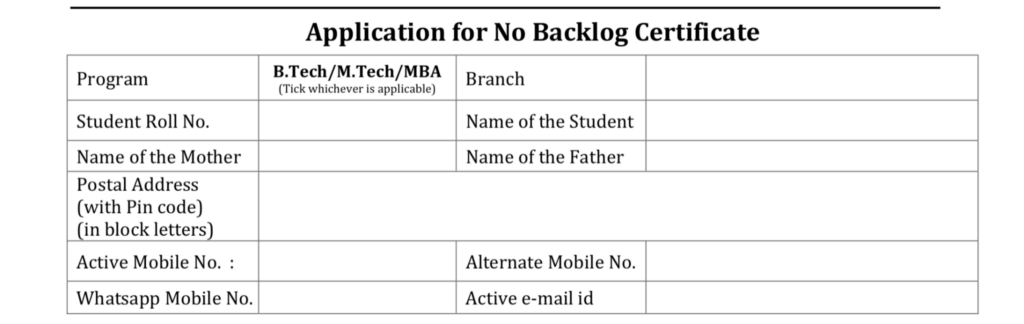
Backlog Certificate Application Format
Backlog Application Format:
Application for Backlog Certificate
The Principal/DeanName of UniversityAddress of the University
Subject: Application for Backlog Certificate
Respected Sir/Madam,
I am _____ (Name), s/o or d/o of _____ (Father’s Name), Roll No. ______, student of _____ (course name with batch) at your university. This is an application to request you to issue my backlog certificate as I require it for applying to a master’s degree. The details of my backlogs are mentioned in the table below:
|
Semester |
Expected Year |
Year of Passing |
No. of Backlogs |
No. of Attempts |
Subject Reappears |
|
Semester I |
|||||
|
Semester II |
|||||
|
Semester III |
|||||
|
Semester IV |
|||||
|
Semester V |
|||||
|
Semester VI |
Please issue my backlog certificate at the earliest possible. Thank you for your time and consideration.
Yours Sincerely,(Name)
No Backlog Application Format:
The Principal/DeanName of UniversityAddress of the University
Subject: Application for no-backlog certificate
Respected Sir/Madam,
I am _____ (Name), s/o or d/o of _____ (Father’s Name), Roll No. ______, student of _____ (course name with batch) at your university. This is an application to request you to issue my zero backlog certificate as I require it for applying to a master’s degree. I have cleared my bachelor’s degree with zero backlogs in any semester and therefore ask you to issue a certificate verifying the same.
Please issue my backlog certificate at the earliest possible. Thank you for your time and consideration.
Yours Sincerely,(Name)
Backlog Certificate Format
The backlog certificate format is straightforward and mainly contains information about the student, the institution, the course, and specifics about the courses and the total amount of backlogs.
Name of the UniversityBacklog Certificate
This is to certify that _____ (Name), s/o or d/o of _____ (Father’s Name), Roll No. ______, is a student of _____ (course name with batch) at _____ (University Name).
The student has successfully completed his/her Bachelor of _____. The backlog summary record is as follows:
This certificate has been issued on the request of the student and the information contained herein is verified.
________(Signature of the Principal/Dean)
Once you’ve obtained your backlog certificate, you’re ready to complete your application process. The next step is comparing education loan options.
GradRight simplifies the loan search by connecting you with over 18 top lenders, including public banks, private banks, and NBFCs. With just one profile, you can receive multiple competitive loan offers.
Here’s how GradRight’s loan platform works:
- Sign up and create your profile by entering your academic and financial details.
- Within just 2 days, receive competitive loan offers from a range of lenders.
- Use the platform’s tools and financial advisors to compare offers and select the best one.
- Upload your documents securely, avoiding the hassle of multiple submissions.
- Get your loan approved in as little as 10 days.
Compare education loans from 18+ lenders – free, from your home. Explore Loans on GradRight
Also Read: How to Secure an Education Loan for Study Abroad?
Top Universities and Number of Backlogs Accepted (USA)
Note: The list below reflects publicly available information and should be verified directly with each university before applying. University backlog policies change each admission cycle.
‘Golden State University’ listed in original – this institution does not appear in standard SEVP/DHS-certified university databases. Please verify and replace with a confirmed, accredited institution before publishing.
|
University |
Backlogs Accepted |
Location |
|
Wichita State University |
Up to 5 |
Wichita, Kansas |
|
Old Dominion University |
10-15 |
Norfolk, Virginia |
|
Pace University |
5-10 |
New York City, New York |
|
Illinois Institute of Technology |
5-10 |
Chicago, Illinois |
|
Florida Institute of Technology |
Up to 8 |
Melbourne, Florida |
|
Clarkson University |
Up to 5 |
Potsdam, New York |
|
Pittsburg State University |
10-15 |
Pittsburg, Kansas |
|
Midwestern State University |
Up to 8 |
Wichita Falls, Texas |
|
University of South Dakota |
5-10 |
Vermillion, South Dakota |
|
Marist College |
Up to 5 |
Poughkeepsie, New York |
|
Missouri State University |
5-10 |
Springfield, Missouri |
|
Kent State University |
Up to 5 |
Kent, Ohio |
|
Murray State University |
Up to 8 |
Murray, Kentucky |
|
Gannon University |
Up to 5 |
Erie, Pennsylvania |
|
California State University, San Bernardino |
5-10 |
San Bernardino, California |
|
Rowan University |
10-15 |
Glassboro, New Jersey |
Also Read: MS in USA with Backlogs: Universities and Requirements 2026
Also Read: UK Universities Accepting Backlogs 2026: Complete Guide




 Australia
  Canada
  France
  Germany
  India
India  Ireland
  UAE
UAE  United Kingdom
  United States