




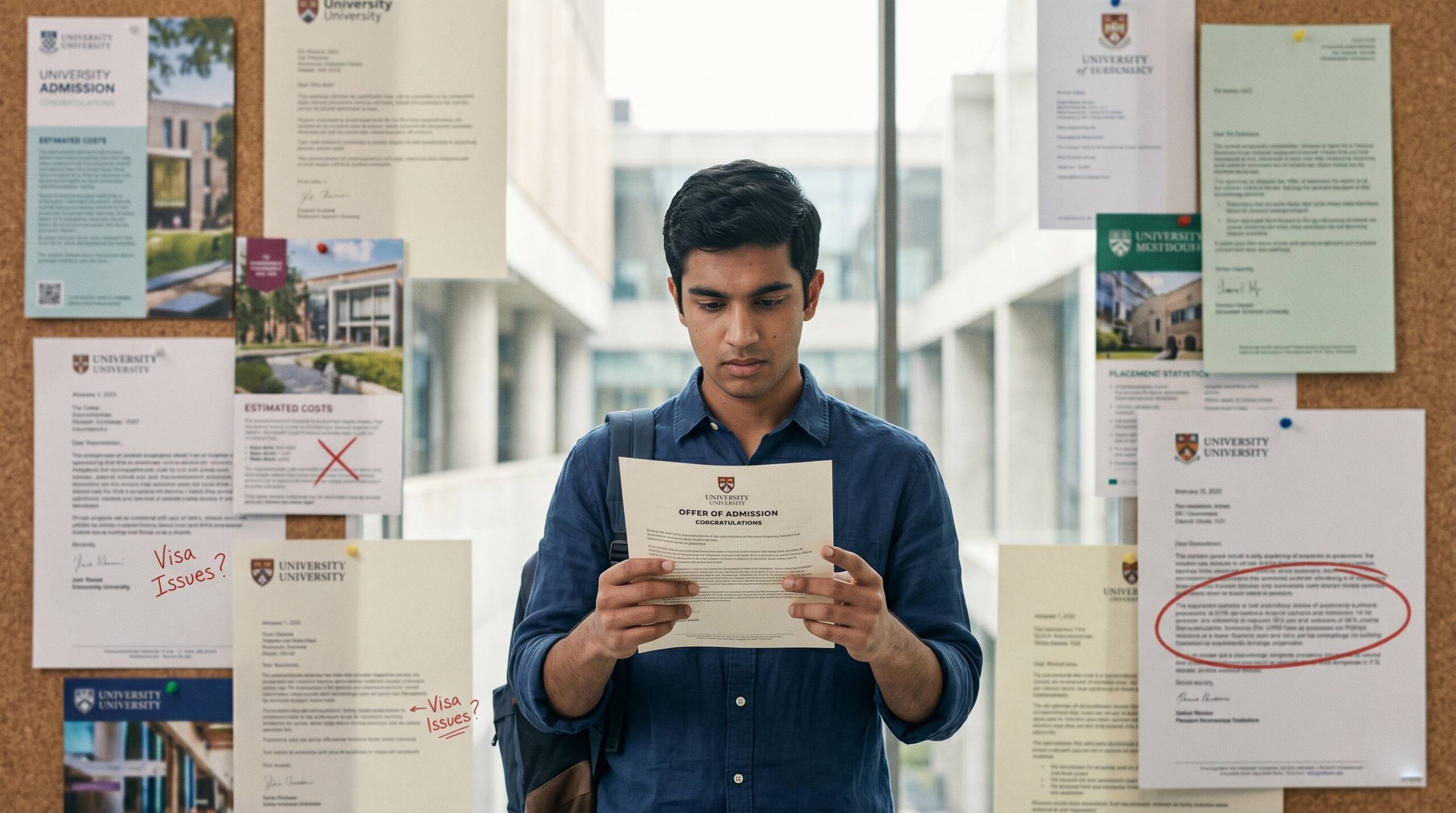
Here is an uncomfortable truth about the college selection process: most Indian students make this decision backwards.
They begin with a ranking table, work down to universities they have heard of, eliminate the ones that feel financially impossible, and call whatever remains a shortlist. That process is not entirely wrong, but it is missing the questions that actually determine whether a college will serve your goals, whether it is right for you, and whether it is worth the money you or your family is borrowing to get there.
Choosing the right college is one of the most financially consequential decisions a student will make before the age of 25. At ₹30 to ₹90 lakh per degree for a foreign Master’s, getting this wrong is not just a disappointment. It is a multi-year financial setback with compounding interest. Consequently, this blog covers seven signs that you are heading toward the wrong college, whether you are applying for undergraduate admission in India or a postgraduate program abroad, so you can course-correct before you accept an offer rather than after.
Why choosing the right college matters more than most students realise
The importance of choosing the right college goes well beyond prestige or rankings. The college you attend shapes your professional network, your access to internships, your salary trajectory in the first five years, and, for international students, your immigration options. Moreover, the wrong college at the right price is still the wrong college. A ₹40 lakh degree from an institution that does not deliver on its implicit promises costs more in the long run than a ₹60 lakh degree from one that does.
In 2026, the stakes are higher than they have ever been. Canada reduced its study permit approvals by over 40 percent. Australia tightened its Genuine Student assessment requirements. The US H-1B lottery sits at roughly 28 percent approval odds. Therefore, a college selection that ignores post-study employment reality, or that relies entirely on forum consensus rather than verifiable data, carries real financial risk.
The seven signs below are drawn from the patterns that consistently appear in the decisions of students who end up frustrated with their college choice, whether two months in or two years after graduation.
Sign 1: You chose it primarily because someone from your city or college went there
Social proof is one of the most powerful forces in any decision, and college selection is no exception. When a senior from your engineering college lands at a particular university in the US or Canada, word spreads fast. The university suddenly acquires an aura of achievability, of being the right fit for someone like you. However, this is correlation masquerading as evidence.
The fact that someone with a similar profile gained admission tells you one useful thing: that you are not obviously out of range. It tells you nothing about whether that university is the right match for your specific field, your career goals, your financial situation, or your post-graduation plans.
Furthermore, the college selection decision in Indian student communities is unusually susceptible to herd behaviour. Certain universities develop reputations in specific cities or communities that persist long after the actual quality-to-cost ratio changes. A university that was an excellent option for Indian CS students in 2019 may have significantly lower placement rates in 2026 because of changes in the US tech hiring market, without that information filtering through informal peer networks.
The correct use of peer information is this: let it generate names for your research list, not names for your final list. Then verify independently.
Sign 2: You have not checked the subject-specific ranking for your program
A university ranked 50th overall may rank 12th in your specific subject, and that is the number that matters for your program. This is one of the most consistently misunderstood aspects of university selection, and it leads students to both over-rate and under-rate institutions depending on which direction the mismatch runs.
Overall university rankings aggregate performance across every department, research output, employer surveys, and international diversity metrics. They are a useful starting point. However, they say very little about the specific department you will be spending two to four years inside.
The sign to watch for is this: if your entire shortlist is built from the same overall university ranking table, without a single subject-specific check, you are almost certainly missing options that would serve your goals better and including others that would not.
| Ranking Tool | Best Used For | Where to Access |
| QS World University Rankings by Subject 2026 | All disciplines, particularly CS, engineering, and business | topuniversities.com/subject-rankings |
| US News Best Graduate Schools | US programs in engineering, business, law, health | usnews.com/best-graduate-schools |
| CSRankings.org | Computer science and AI by faculty research output | csrankings.org |
| THE World University Rankings by Subject | Research-intensive programs globally | timeshighereducation.com |
| Financial Times MBA Ranking | Business and management programs globally | ft.com/rankings |
QS releases subject rankings annually, and the 2026 edition covers 55 subjects across 850 plus institutions, the broadest edition to date. Spending thirty minutes in these tables before finalising your shortlist is one of the most valuable thirty minutes in the entire application process.
Sign 3: You do not know what the actual total cost is, only the tuition
Tuition is the number universities advertise. Total cost is what you actually spend. The gap between these two figures is one of the most common sources of financial stress for Indian students abroad, and it is almost always foreseeable if the research is done properly.
Ranks do matter, but sometimes a comparatively lower-ranked university in a city with better job opportunities might set your career better than a prestigious name in a remote location. The same logic applies to cost. A university with slightly lower tuition in a high-cost city like London, New York, or Toronto can cost significantly more in total than one with higher tuition in a smaller, more affordable location.
| Cost Component | What Students Usually Account For | What They Often Miss |
| Tuition | Yes | Varies by program, not just university |
| Accommodation | Sometimes | On-campus vs off-campus price gap; seasonal fluctuations |
| Health insurance | Rarely | Mandatory at most US universities; ₹80,000 to ₹1.2 lakh per year |
| Transport | Rarely | City universities require daily commuting costs |
| Books and materials | Rarely | Engineering and medical programs can cost ₹40,000 to ₹80,000 annually |
| Visa and travel costs | Sometimes | Return flights, visa renewals, biometrics add ₹1.5 to ₹2.5 lakh |
| Income forgone | Almost never | Two years of salary not earned while studying full-time |
If you have built your financial plan around tuition alone, you are underestimating your total investment by anywhere from 30 to 60 percent. Consequently, the loan amount, the EMI, and the break-even timeline all need to be recalculated from total cost, not headline tuition.
Sign 4: You have not looked at what graduates from your specific program are actually doing
This is the one that stings, because it requires confronting the difference between a university’s marketing and its reality.
Every university publishes graduate employment rates. Very few of them publish program-specific employment data that tells you what graduates from your exact course are doing six to twelve months after graduation. The general university number is, in many cases, significantly higher than the program-specific number, particularly at institutions where strong placement in one department (law, medicine, finance) pulls up the average for weaker-performing departments.
The most reliable source of this information is not the university. It is LinkedIn.
Search for graduates of your target program who completed the degree in the last two to three years. See where they are working now. If a significant number of them are in roles that are directly related to the degree and are based in the country where they studied, that is a strong positive signal. If a large proportion of them have returned to India, are working in unrelated roles, or are still listed as job-seeking, that tells you something important that the admissions brochure never will.
In addition, look at the seniority and quality of employers on those alumni profiles. A program that places graduates at Google, McKinsey, or NHS Trust is telling you something different from one where the alumni are predominantly at small companies or in generalist roles.
One of the biggest mistakes students make is selecting a course based on peer pressure, trends, or family expectations without understanding its career scope. In 2026, industries demand specific skills, not just degrees. The LinkedIn audit takes about one hour and is the single most useful piece of research you will do in the entire shortlisting process.
Sign 5: The post-study work visa situation for your target country is unclear to you
Post-study work rights vary significantly from country to country. Picking a country based only on tuition fees or climate, without understanding its work visa rules and opportunities, is a very costly mistake, as it impacts your calculation of ROI.
This sign is particularly sharp for students applying to the UK, Canada, and Australia in 2026, all of which have made policy changes in the past twelve months that materially affect the post-graduation calculus.
What each country wants
In the UK, the Graduate Route visa is reducing from two years to 18 months for master’s graduates who apply from January 2027 onwards. Students whose programs complete in 2026 need to apply before 31 December to preserve the full two-year window. Moreover, switching from the Graduate Route to a Skilled Worker visa now requires B2-level English proficiency, up from B1, effective January 2026.
The mistake that students make in Canada is applying to colleges that are no longer eligible for the Post-Graduation Work Permit. Not every college in Canada qualifies for PGWP, and this list changes. A student who selects a Canadian institution on the basis of cost or admission probability without verifying current PGWP eligibility may graduate into a situation where their post-study work rights do not exist.
Similarly, in Australia, many Indian students are being rejected because their Statement of Purpose lacks a clear link between their past studies and their future career in India, as the 2026 Genuine Student assessment is considerably more rigorous than previous years.
| Country | Key 2026 Post-Study Work Change | What to Verify Before Applying |
| UK | Graduate Route reduces to 18 months from Jan 2027 | Is your university on the UKVI sponsor register? |
| Canada | PGWP only for DLI-approved institutions | Is your specific institution on the current DLI list? |
| Australia | AUD 29,710 in funds required; Genuine Student assessment | Does your SOP meet the new Genuine Student criteria? |
| Germany | Block account updated to €11,904 | Is your APS certificate obtained in advance for engineering? |
| USA | STEM-OPT depends on CIP code, not course name | Has the university confirmed your program’s CIP code? |
If you are choosing a college without being able to answer the question in the final column of this table, that is a sign you are not yet ready to make this decision.
Sign 6: You are applying to a program that is already oversaturated with Indian applicants in your target job market
This sign is harder to see because it is not about the college itself. It is about the intersection between your program, your destination, and the current state of the job market.
Certain combinations have become so heavily concentrated with Indian applicants that the hiring dynamics for international students have shifted. The most visible example is software engineering and data science in Canada. The tech hiring slowdown that began in late 2023 has not fully reversed, and Toronto and Vancouver job markets for recent STEM master’s graduates are significantly more competitive in 2026 than they were three years ago. Many Indian graduates in these fields are taking considerably longer to find roles aligned with their degrees.
This does not mean these programs are wrong choices. It means the decision requires a more honest assessment of the employment landscape than most shortlisting processes include. Furthermore, it means that students who differentiate through specific technical skills, internship experience, or less-saturated specialisations within the field consistently produce better employment outcomes than those who apply to the most popular program at the most popular institution in the most popular destination without this analysis.
The question to ask is not whether others are doing it. The question is whether the job market in your target country in your target field will be able to absorb another wave of graduates from your program in the year you complete.
Sign 7: You have not verified accreditation independently
This final sign is the most administrative, but it is also the one with the most irreversible consequences if ignored.
Accreditation is not a ranking. It is a floor. A degree from an unaccredited or provisionally accredited institution may not be recognised by employers, may not qualify for professional licences, and in some countries may not even satisfy the requirement for a skilled worker visa or PR application.
For Indian students applying to programs abroad, the relevant accreditation checks are program-specific, not institution-wide.
| Program Type | Key Accreditation to Verify | Where to Check |
| Engineering (USA) | ABET accreditation | abet.org |
| Business / MBA (global) | AACSB or EQUIS accreditation | aacsb.edu, efmdglobal.org |
| Healthcare Administration | CAHME (USA), CCHSA (Canada) | cahme.org |
| Law (UK) | Solicitors Regulation Authority | sra.org.uk |
| Pharmacy / Medicine | GMC (UK), MCI equivalent | gmc-uk.org |
| Any degree for Germany PR | anabin database recognition | anabin.kmk.org |
The anabin database check is particularly important for students targeting Germany or any EU country for post-graduation employment or PR. German authorities use the anabin database to assess whether a foreign degree qualifies for professional recognition. A degree from an institution listed as H- (not assessed) or with conditions in the anabin database may create complications in the immigration process that cannot be resolved after the fact.
Therefore, verifying accreditation independently, not relying on the university’s own claims about its accreditation status, is a college application tip that belongs at the very beginning of your shortlisting process, not at the end.
How to use these seven signs as a college selection checklist
Run through this table for every university on your shortlist before submitting an application. If you cannot answer yes to most of these checks, the college should move off the list until you can.
| Sign | Check | Status |
| 1. Herd behaviour | Is this choice based on independent research, not just peer consensus? | Yes / No |
| 2. Subject ranking | Have you checked the subject-specific rank for your exact program? | Yes / No |
| 3. Total cost | Do you know the total cost including accommodation, insurance, and living? | Yes / No |
| 4. Graduate outcomes | Have you checked LinkedIn alumni from this specific program? | Yes / No |
| 5. Post-study visa | Do you know the exact post-study work rights for this country in 2026? | Yes / No |
| 6. Market saturation | Have you assessed the employment landscape for your field in the target city? | Yes / No |
| 7. Accreditation | Have you verified program-specific accreditation independently? | Yes / No |
The bottom line
Choosing the right college is a research problem before it is an aspiration problem. Most students who end up in the wrong program or the wrong institution did not lack ambition. They lacked specific, verified information at the moment they needed it most.
The seven signs above are, consequently, also seven research tasks. Each one takes between one hour and two days to complete properly. Together, they reduce the probability of a decision you will regret significantly, whether you are choosing a domestic college in India or a postgraduate program abroad.
GradRight helps Indian students model their education loan options across 15 plus lenders, compare total cost of attendance across universities, and plan the financial side of their college selection decision with verified numbers. Start with a free GradRight profile to ensure the financial part of this decision is based on data rather than assumptions.








 Australia
  Canada
  France
  Germany
  India
India  Ireland
  UAE
UAE  United Kingdom
  United States