




Reviewed for factual accuracy and current lender information by GradRight’s financing team. Last updated: August 2026. Lender eligibility, rates, and refinancing policies change periodically – always confirm current terms directly with the lender before applying.
This article is for general informational purposes and isn’t personalized financial advice. Consider speaking with a licensed financial advisor before refinancing.
If you took out an education loan to fund your studies, you probably didn’t think too much about the interest rate or repayment terms at the time – the priority was covering tuition, accommodation, and other costs.
A few years later, the monthly EMI can start to feel like a real burden, or you may realize new borrowers are getting meaningfully better rates than you locked in.
This is where education loan refinancing comes in – replacing your current loan with a new one on better terms. It isn’t the right move for everyone, though. Done well, it can cut interest costs, reduce monthly payments, and simplify repayment. Done without enough research, it can mean hidden fees, lost benefits, or even a higher total cost.
This guide breaks down what to know before refinancing, in clear, practical steps.
What Is Education Loan Refinancing?
Education loan refinancing means taking a new loan to replace an existing one, on better terms. The goal is to reduce your cost of borrowing or make repayments more manageable.
As an illustrative example only (not a current offer or rate guarantee): if you took a loan at 11% interest a few years ago, and another lender today offers 8.5% for refinancing, switching could reduce both your total interest paid and your monthly EMI – the exact savings depend on your specific loan amount, remaining tenure, and the actual rate you’re offered.
Beyond a lower rate, you can also refinance to extend or shorten your loan tenure, which changes your EMI. The key question is whether refinancing actually benefits your specific situation – which depends on your current loan terms, the new offer, your financial stability, and your repayment plans.
Why Refinance: Key Benefits and Considerations
Refinancing only makes sense in specific situations – weigh the benefits against the potential downsides before applying.
Lower Interest Rates
Even a modest drop in rate can add up to meaningful savings over the life of a loan, though the exact amount depends entirely on your specific loan amount, rate difference, and remaining tenure – use an EMI calculator with your real numbers rather than relying on a generic example.
Run your own numbers with GradRight’s Education Loan Refinance Calculator.
Lower Monthly EMIs
A lower interest rate generally means a lower monthly EMI (assuming the same tenure), which can help if your current EMI is straining your budget alongside rent, savings, or other obligations.
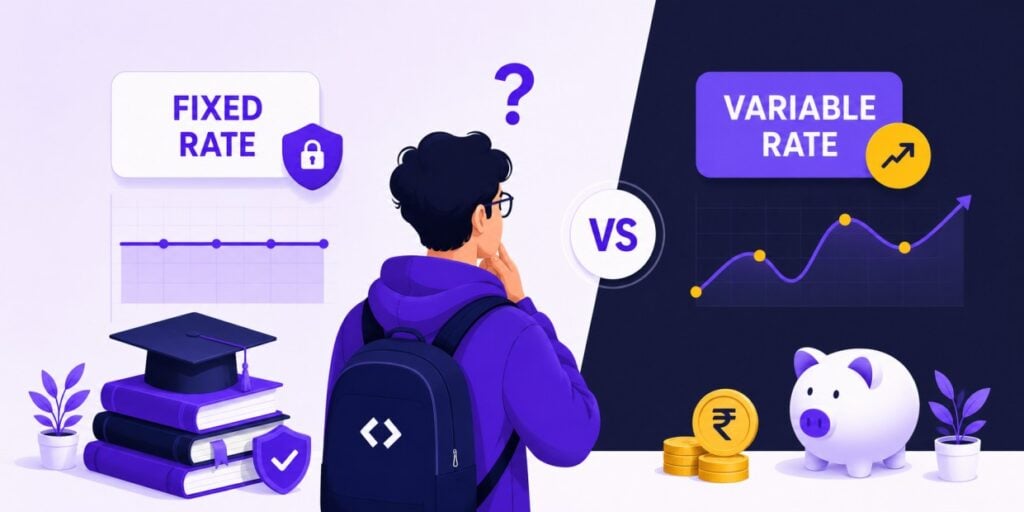
Switching from Floating to Fixed Rates
Many Indian education loans carry floating rates, meaning your EMI can rise if rates increase. Refinancing into a fixed-rate loan locks in a predictable EMI, which can make budgeting easier – though fixed rates sometimes start slightly higher than variable ones, so weigh the trade-off.
Flexible Loan Tenure
Refinancing lets you choose a longer or shorter repayment period based on your situation – a longer tenure lowers your EMI but generally increases total interest paid; a shorter tenure raises your EMI but can reduce total interest.
Also Read: Fixed vs Variable Rate Student Loan Refinancing: Which Is Better for Indian Students?
Also Read: Top Education Loan Providers in India [Best Banks & NBFCs]
Things to Consider Before Refinancing
Will You Actually Save Money?
Some loans carry foreclosure charges, processing fees, or other costs buried in the fine print. Calculate your actual net benefit after these costs – if the real savings are small, refinancing may not be worth the effort.
Are You Losing Any Benefits?
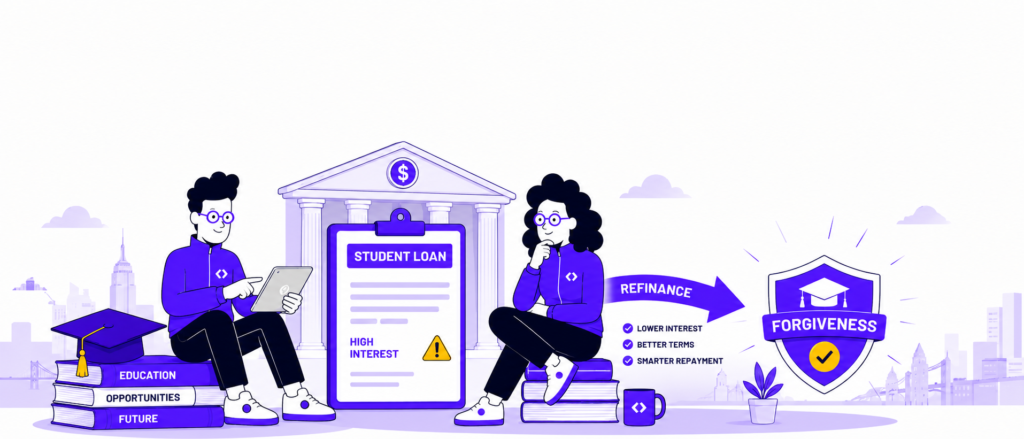
If you hold a US federal student loan and refinance it with a private lender, you generally lose access to federal-specific benefits like income-driven repayment plans and Public Service Loan Forgiveness. This specifically concerns US federal loans – it doesn’t apply to refinancing an Indian bank or NBFC education loan, which doesn’t carry these federal benefits to begin with. If you do hold a US federal loan and value these protections, refinancing may not be worth it for that specific loan.
Also Read: Refinanced Student Loans and Forgiveness: What Indian Graduates in the US Must Know
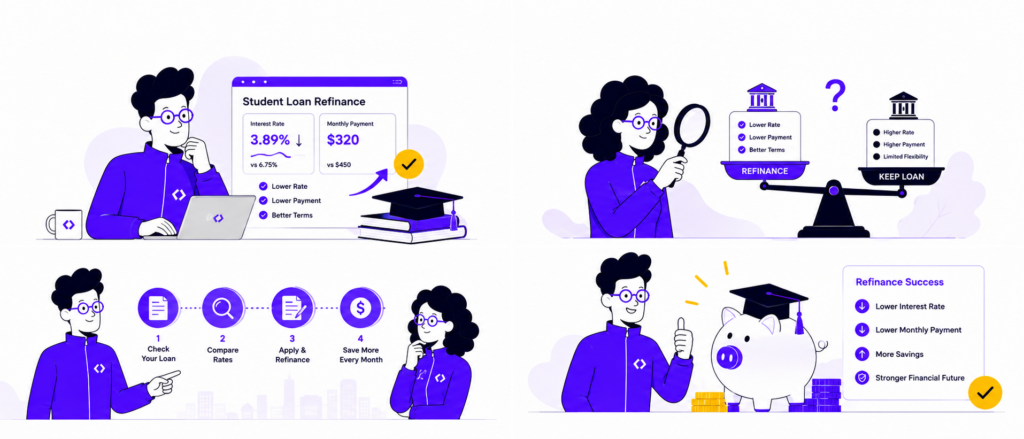
Step-by-Step Guide to Refinancing Your Education Loan
Step 1: Get Loan Details from Your Current Lender
Contact your lender and request your outstanding balance, current interest rate, remaining tenure, and any foreclosure charges. If foreclosure charges are high, refinancing may save less than you’d expect – factor this in before proceeding. Some lenders may also offer to lower your rate if you mention you’re considering refinancing elsewhere.
Step 2: Compare Refinancing Offers
Look for a meaningful reduction in interest rate relative to your current loan, check for processing fees, weigh tenure options (longer tenure means lower EMI but more total interest), and decide whether a fixed or variable rate suits your risk tolerance.
Step 3: Check Eligibility
Eligibility varies significantly by lender and country – the figures below are commonly cited general benchmarks, not universal requirements every lender applies:
– In India: lenders commonly look for a reasonably healthy credit score, a clean repayment history with no recent defaults, and often some minimum period of regular EMI payments already made on the existing loan.
– In the USA: requirements vary considerably by lender. Some mainstream lenders weigh a strong US credit score and citizenship/permanent residency status heavily. However, lenders designed specifically for international graduates – MPOWER Financing, for example, states it has a dedicated program for refinancing loans originally from Indian banks and NBFCs – may accept international students and visa holders (not just citizens or permanent residents) and weigh employment and income more heavily than an established US credit score. Don’t assume US citizenship or permanent residency is a universal requirement – check each specific lender.
Also Read: Can I Refinance My Indian Education Loan From the US?
Step 4: Gather Required Documents
Requirements vary by lender and country, but commonly include:
– Loan documents – sanction letter, repayment schedule, foreclosure letter
– Identity proof – PAN, Aadhaar, passport (India); SSN, passport, or driver’s license (USA, where applicable)
– Income proof – salary slips, tax returns, bank statements
– Academic proof – degree certificate, admission or graduation documents
Missing documents can delay approval, so confirm your specific lender’s checklist before applying.
Also Read: Study Abroad Loan Documents Checklist
Step 5: Prequalify With Multiple Lenders, Then Apply Formally to Your Top Choice
Where available, use prequalification or soft-check tools to compare estimated rates across several lenders without affecting your credit score – this lets you genuinely compare offers. Once you’ve identified your preferred option, submit a formal application to that lender. Submitting multiple full (hard-credit-check) applications at once can affect your credit score, so prequalify broadly, then apply formally to one lender at a time.
You can compare options in one place using GradRight’s refinance comparison platform.
Also Read: Does Refinancing Student Loans Hurt Your Credit Score? The Complete Answer
Step 6: Get Loan Approval and Start Repaying the New Loan
Once approved, the new lender pays off your existing loan, and you begin repaying under the new terms. Keep paying your old loan until you receive official closure confirmation from your original lender – don’t stop based on an assumption the transfer is complete.
Eligibility Criteria: General Benchmarks (Not Universal Rules)
Exact eligibility varies meaningfully by lender. The points below are commonly cited general benchmarks, not requirements that every lender applies identically.
Commonly Cited Factors in India
– Some regular EMI payment history on the existing loan before refinancing (exact minimum period varies by lender)
– A loan that’s fully disbursed, not still in staged disbursement
– A clean recent repayment history
– A reasonably healthy credit score, though the specific threshold varies by lender
– Steady income for you or a co-applicant
Commonly Cited Factors in the USA
– Graduation from an eligible institution, for most lenders
– Creditworthiness – assessed differently by different lenders; some weigh a strong US credit score heavily, while lenders designed for international graduates may weigh income, employment, and repayment history differently
– Debt-to-income ratio, commonly checked by mainstream lenders
– Citizenship/residency requirements vary by lender – some require US citizenship or permanent residency, while others (like MPOWER, for loans of Indian origin) are specifically designed for international students and visa holders
If you’re close to graduating without a job yet, some lenders may consider a signed job offer – confirm this directly with your target lender rather than assuming it’s universal.
Documents Checklist
India:
Sanction letter, repayment schedule, and foreclosure letter; Aadhaar, PAN, passport, or driver’s license; recent salary slips, ITRs, and bank statements; degree certificate and admission letter; offer/appointment letter.
USA:
Loan payoff statement and current loan details; SSN, driver’s license, or passport (requirements vary by lender); recent pay stubs and tax documents; graduation certificate and transcript; offer or employment verification letter. Self-employed applicants can typically provide business tax returns or bank statements instead.
Always confirm the specific lender’s current document checklist before applying, since requirements vary.
Transferring Your Loan: What Happens Behind the Scenes
– Request a foreclosure letter from your current lender, confirming the total outstanding amount and any applicable foreclosure charges.
– Submit your refinancing application to the new lender and continue making your usual EMI payments until the transfer is fully complete, to avoid late fees.
– Once approved, the new lender pays off your old loan directly, and your original lender should issue a loan closure certificate – get this in writing before you stop payments on the old loan.
A Note on Currency Risk (Indian Loan to USD Loan)
If you refinance an INR education loan into a USD loan, your repayment obligation shifts from rupees to dollars. For graduates earning in USD, this can reduce currency mismatch, since income and repayment are now in the same currency. But if you later return to India and earn primarily in INR, a USD loan exposes you to exchange-rate risk instead – your effective EMI in rupee terms could rise or fall with the exchange rate. Weigh your long-term location and expected income currency before refinancing across currencies.
Refinancing Checklist
– ☐ Understand your current loan’s balance, rate, tenure, and any foreclosure charges.
– ☐ Confirm which specific lenders can refinance your specific loan type (especially important if your loan originated with an Indian bank or NBFC and you’re exploring US lenders).
– ☐ Prequalify with multiple lenders to compare estimated rates without a hard credit check, where available.
– ☐ Gather all required documents in advance.
– ☐ Check for foreclosure, processing, or prepayment charges on both your old and new loan.
– ☐ Apply formally to your top-choice lender once you’ve compared offers.
– ☐ Review the new loan agreement in full before signing.
– ☐ Get written loan closure confirmation from your original lender before stopping old payments.
How GradRight Can Help
Comparing lenders individually is time-consuming. GradRight’s refinance comparison platform lets you share your loan and profile details once and see offers from participating lending partners in one place, with guidance available throughout the process. Disclosure: GradRight may earn a fee from lending partners when you use this platform – always compare against your own independent research too, and don’t treat this or any single platform as the only source for your decision.
Actual rate improvements depend entirely on your specific profile, current loan terms, and the offers you qualify for – there’s no guaranteed outcome, and any specific savings figures you see elsewhere should be treated as illustrative, not a promise.
Tips for Refinancing Efficiently
– Compare the total repayment amount across offers, not just the headline rate – include all fees.
– Some lenders may be willing to match a competing offer or improve terms if you ask – it’s worth a conversation.
– Check for hidden charges – processing fees, prepayment penalties, and foreclosure charges can meaningfully reduce your actual savings.
– Keep making EMI payments on your old loan until you have written confirmation of closure.
– Compare at least a few different offers using prequalification before formally applying anywhere – don’t assume the first offer you see is the best available to you.
Common Roadblocks and How to Handle Them
Lower Credit Score:
If your credit profile is on the weaker side, you may not qualify for the most competitive rates from mainstream lenders. Paying existing EMIs on time, reducing outstanding credit card balances, and avoiding new debt can help over time. If you’re newer to the US credit system specifically, also look into lenders designed for international graduates, which may weigh your profile differently.
High Foreclosure Fees:
Calculate your actual net savings after these fees before deciding whether refinancing still makes sense.
Missing Documents:
Many applications get delayed over incomplete paperwork – check your target lender’s document checklist thoroughly before applying.
Hidden Fees and Terms:
Some offers look attractive on the headline rate but carry additional costs in the fine print. Read the full agreement and ask for an itemized breakdown of all fees before committing.
Also Read: Earnest Student Loan Refinancing Review: Rates, Fees & Is It Worth It?
Related Articles
Can I Refinance My Indian Education Loan From the US?
Fixed vs Variable Rate Student Loan Refinancing
Does Refinancing Student Loans Hurt Your Credit Score?
Refinanced Student Loans and Forgiveness: What Indian Graduates Must Know
Top Education Loan Providers in India [Best Banks & NBFCs]
Conclusion
Refinancing is worth pursuing when it genuinely lowers your costs or makes repayment easier for your specific situation – it isn’t automatically the right move for everyone. The key is to plan ahead, compare real offers (not just headline rates), check for hidden fees, and confirm which lenders can actually refinance your specific loan type before you apply.





 Australia
  Canada
  France
  Germany
  India
India  Ireland
  UAE
UAE  United Kingdom
  United States