




You’ve filled out most of your US or Canada university application. Then you hit a box that asks for your GPA on a 4.0 scale – and you have a CGPA out of 10 or a percentage. Suddenly, everything feels confusing.
Don’t worry. This guide explains exactly what GPA means in the Indian context, how to calculate it from your marks, and how to convert it to the 4.0 scale that US and Canadian universities use.
GPA in India – Quick Reference
| Question | Answer |
| What scale does India use? | Most universities use percentage (0-100%) or CGPA on a 10-point scale. IITs/NITs use CGPA out of 10. |
| Formula: CGPA to 4.0 GPA | (Your CGPA / 10) x 4. Example: 8.0 CGPA = (8.0/10) x 4 = 3.2 GPA |
| Formula: Percentage to 4.0 GPA | (Your Percentage / 100) x 4. Example: 80% = (80/100) x 4 = 3.2 GPA |
| Minimum GPA for US MS/MBA | Most universities need 3.0 GPA (75%+). Top programs prefer 3.5+ (87.5%+). |
| Do you need to convert? | Usually no – most US/Canada universities accept your original transcript. WES or ECE does official conversion. |
What is GPA?
GPA stands for Grade Point Average. It is a number that summarizes your academic performance – how well you scored across all your courses on average.
In the US and Canada, universities use a 4.0 GPA scale. An A is 4.0, a B is 3.0, a C is 2.0, and so on. Your overall GPA is the average of all your course grades.
In India, you likely have one of three systems – a percentage out of 100, a CGPA out of 10, or SGPA for each semester with CGPA at the end. All three can be converted to the 4.0 scale.
Grading Systems Used in Indian Universities
India does not follow one national grading standard. Different institutions use different systems:
| System | Used by | Example |
| Percentage (0-100%) | Most state universities, DU, Mumbai University | 75% = First Class |
| CGPA out of 10 | IITs, NITs, VIT, Manipal, Anna University, most modern universities | 8.5/10 |
| CGPA out of 4 | Some private universities following US model | 3.5/4.0 |
| Letter grades (O, A+, A, B+, B…) | UGC grading framework, CBCS-following universities | O (Outstanding) = 10 points |
| SGPA + CGPA | Most universities using the Credit-Based Semester System (CBSS) | SGPA per semester, CGPA overall |
Historically, percentage-based grading was common in India. Over time, many universities shifted to CGPA as part of the UGC-mandated Choice Based Credit System (CBCS). Your institution may use one or a mix of these systems.
Also Read: What Are Academic Transcripts and How to Get Them?
How to Convert CGPA (10-point Scale) to 4.0 GPA
This is the most common conversion Indian students need. The formula is straightforward:
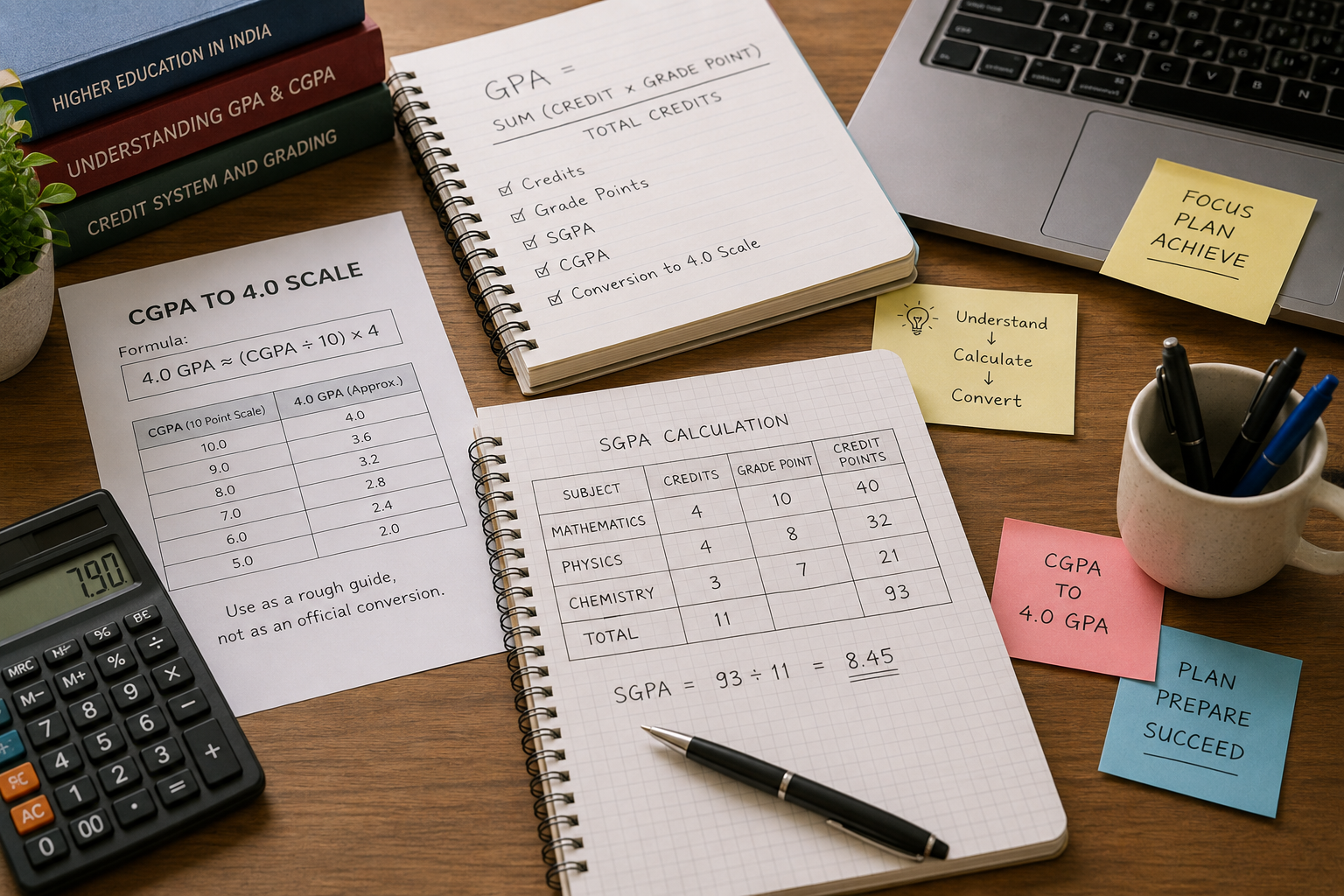
Formula: GPA (4.0) = (CGPA / 10) x 4
| Your CGPA (out of 10) | Approximate 4.0 GPA | Equivalent Percentage | Classification |
| 10.0 | 4.0 | 95%+ | Outstanding |
| 9.0 – 9.9 | 3.6 – 3.96 | 85-95% | Excellent |
| 8.0 – 8.9 | 3.2 – 3.56 | 75-85% | Very Good / First Class |
| 7.0 – 7.9 | 2.8 – 3.16 | 66-75% | Good |
| 6.0 – 6.9 | 2.4 – 2.76 | 57-66% | Average |
| 5.0 – 5.9 | 2.0 – 2.36 | 50-57% | Pass |
Step-by-Step Example
Say your CGPA is 7.9 out of 10.
- Step 1: Divide by 10 – 7.9 / 10 = 0.79
- Step 2: Multiply by 4 – 0.79 x 4 = 3.16
- Result: Your approximate 4.0 GPA is 3.16
Important: This is an estimation method, not an official conversion. The exact GPA on your official evaluation may differ slightly depending on the agency (WES, ECE, etc.) and the formula they use.
How to Convert Percentage to 4.0 GPA
If your marksheet shows a percentage instead of CGPA, use this formula:
Formula: GPA (4.0) = (Percentage / 100) x 4
| Your Percentage | Approximate 4.0 GPA | US Classification |
| 90%+ | 3.6+ | A / Excellent |
| 80-89% | 3.2 – 3.56 | B+ / Very Good |
| 75-79% | 3.0 – 3.16 | B / Good (meets most US minimums) |
| 70-74% | 2.8 – 2.96 | B- / Above Average |
| 60-69% | 2.4 – 2.76 | C+ / Average |
| Below 60% | Below 2.4 | May not meet minimum requirements |
Step-by-Step Example
Say you scored 82% in your B.Tech.
- Step 1: Divide by 100 – 82 / 100 = 0.82
- Step 2: Multiply by 4 – 0.82 x 4 = 3.28
- Result: Your approximate 4.0 GPA is 3.28
Also Read: WES Evaluation Guide – What It Is, Fees and Process for Indian Students
How to Calculate CGPA from SGPA
If your transcript shows SGPA for each semester but no final CGPA, you calculate the CGPA yourself.
Formula: CGPA = Sum of (SGPA x Credits for that semester) / Total Credits
Example: You have 4 semesters with the following SGPA and credits:
| Semester | SGPA | Credits | SGPA x Credits |
| Semester 1 | 8.2 | 24 | 196.8 |
| Semester 2 | 7.9 | 24 | 189.6 |
| Semester 3 | 8.5 | 26 | 221.0 |
| Semester 4 | 8.1 | 26 | 210.6 |
| Total | – | 100 | 818.0 |
CGPA = 818.0 / 100 = 8.18
Then convert: (8.18 / 10) x 4 = 3.27 on the 4.0 scale.
What GPA Do You Need for US and Canada Universities?
Before converting, it helps to know what score you’re aiming for. Here are the general benchmarks:
| University Tier | Minimum GPA (4.0) | Equivalent CGPA (10) | Equivalent % |
| Most US/Canada universities (MS/MBA) | 3.0 | 7.5 | 75% |
| Mid-tier competitive programs | 3.2 – 3.4 | 8.0 – 8.5 | 80-85% |
| Top programs (MIT, Stanford, CMU) | 3.5+ | 8.75+ | 87.5%+ |
| Ivy League / Top 10 | 3.7+ | 9.25+ | 92.5%+ |
These are general benchmarks. GPA is one part of your application – GRE/GMAT scores, research experience, internships, and your Statement of Purpose all matter too.
Also Read: Top Exams Required to Study in the USA
Do You Actually Need to Convert Your GPA?
Most US and Canadian universities accept your original Indian transcript directly. You do not need to convert your CGPA or percentage yourself before applying.
Admissions teams are familiar with the Indian grading system. They read your 8.5/10 CGPA directly – you do not need to write 3.4 GPA on the application form.
When you DO need a formal GPA conversion:
- Some universities ask you to self-report a GPA – use the formulas above as an estimate
- For Canada Express Entry immigration – WES ECA does the official conversion
- For professional licensing boards that explicitly ask for a 4.0 GPA evaluation
- When applying to programs that explicitly state “3.0 GPA minimum required”
For official evaluations, agencies like WES (World Education Services) or ECE (Educational Credential Evaluators) do the conversion as part of your credential evaluation. The formula-based estimate above is for your own planning purposes.
Confused about which universities match your GPA? Find programs that accept your profile from 40,000+ options. Explore Universities on GradRight
CBSE CGPA to Percentage – The Official Formula
If you completed your Class 12 under CBSE and want to convert your CGPA to a percentage:
Formula: Percentage = CGPA x 9.5 (CBSE official formula)
Example: CGPA of 9.2 = 9.2 x 9.5 = 87.4%
This formula is specific to CBSE Class 10 and 12. For university-level CGPA (on a 10-point scale), use the standard (CGPA / 10) x 100 approach, or check your university’s official conversion method.
Letter Grade to GPA – Indian University System
Many Indian universities now use letter grades under the UGC’s CBCS framework. Here is how they map to grade points and the 4.0 scale:
| Letter Grade | Grade Point (10-point) | Performance | Approximate 4.0 GPA |
| O (Outstanding) | 10 | Exceptional | 4.0 |
| A+ (Excellent) | 9 | Excellent | 3.6 |
| A (Very Good) | 8 | Very Good | 3.2 |
| B+ (Good) | 7 | Good | 2.8 |
| B (Above Average) | 6 | Above Average | 2.4 |
| C (Average) | 5 | Average | 2.0 |
| P (Pass) | 4 | Pass | 1.6 |
| F (Fail) | 0 | Fail | 0 |
Also Read: Study in USA – Complete Guide for Indian Students
Minimum GPA by Country for Indian Students
| Country | Typical Minimum GPA (4.0) | Equivalent Indian Score | Notes |
| USA (MS/MBA) | 3.0 | 7.5 CGPA / 75% | Top programs need 3.5+ |
| Canada (MS/MBA) | 3.0 | 7.5 CGPA / 75% | Some universities accept 2.7+ |
| UK (Masters) | 2.5 – 2.8 | 6.25-7.0 CGPA / 60-70% | Merit/Distinction need 70%+ |
| Germany (MS) | 2.4 – 2.8 | 60-70% | TUM, RWTH prefer 70%+ |
| Australia (Masters) | 2.8 – 3.0 | 7.0-7.5 CGPA / 70-75% | Varies by university |
| Ireland (Masters) | 2.8 | 7.0 CGPA / 70% | Second Class Honours or above |
Source: Study abroad guidelines from university websites and GradRight research, 2026.
Need help with education loans for your MS or MBA abroad? Compare offers from 18+ lenders in minutes. Compare Education Loans on GradRight








 Australia
  Canada
  France
  Germany
  India
India  Ireland
  UAE
UAE  United Kingdom
  United States