




If you’re thinking about pursuing a career in data science, it is natural for you to be interested in knowing the data science subjects you will study in during your degree/course. But there is no set answer to this question. The exact list of subjects that you will study depends on the type of course you choose and the institute you study at.
That said, the core subjects in a data science curriculum are often common. In this blog, I explain what the data science syllabus looks like, year by year, so you know what to expect during your course.
Also Read: Data Science Courses After 12th in India
Major course paths and data science subjects in India
The exact data science subjects you study in a course will vary based on your degree program and institution. The main data science degree options include:
| Course | Details |
|---|---|
| B.Tech/B.E. in Data Science | Engineering-focused 4 year course |
| B.Sc. Data Science | Statistics and analytics-focused 3 or 4-year degree |
| BCA in Data Science | Application-focused 3-year programme |
| UGC Honours or Honours with Research | 4-year programme with flexible structure and research project option |
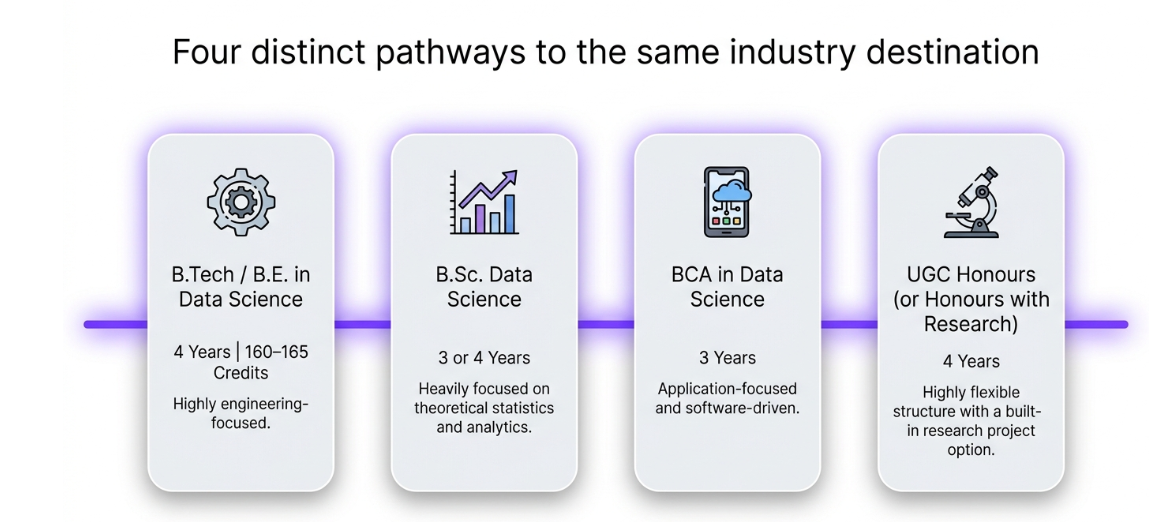
Note: Each of these data science courses cover similar data science syllabus (including subjects like mathematics, statistics, programming, databases, ML, and ethics). However, the depth and order in which these subjects are taught may differ. More importantly, these courses also lead to different types of career opportunities, so make sure you select carefully.
What is the year-wise data science syllabus in India?
Here are the subjects you are likely to study in a 3 or 4-year data science degree programme:
First Year Data Science Subjects
In the first year of your data science degree, you build the foundation everything else rests on.
| Semester | Subjects |
|---|---|
| Semester 1 | Engineering Mathematics I |
| Engineering Physics | |
| Programming Fundamentals | |
| Design Thinking | |
| Communication Skills | |
| Semester 2 | Engineering Mathematics II |
| Programming for Problem Solving | |
| Mathematical Foundations for Data Science | |
| Chemistry / Workshop |
Learning Outcome: Write basic Python programs, understand statistics, and solve simple programming problems.
Note: A lot of people get confused when they notice “Engineering Physics” as a part of the data science curriculum. But that’s because linear algebra powers the algorithms that are covered in Year 3 and Calculus is at the base of how ML models actually get trained. So these data science subjects are the bedrock of a successful career in the field.
Second Year Data Science Subjects
The second year is when you start studying specialised data science subjects.
| Semester | Subject |
|---|---|
| Semester 3 | Probability and Statistics |
| Data Structures and Algorithms | |
| Database Management Systems | |
| Object-Oriented Programming | |
| Semester 4 | Statistical Analysis and Computing |
| Introduction to Machine Learning | |
| Data Analytics and Visualization | |
| Introduction to Artificial Intelligence |
Learning outcome: Clean datasets, perform statistical analysis, and build basic ML models.
Third Year Data Science Subjects
In the third year, career-focused data science subjects are introduced.
| Semester | Subject |
|---|---|
| Semester 5 | Data Engineering |
| Big Data Analytics | |
| Deep Learning | |
| Data Warehousing and Mining | |
| Semester 6 | Advanced Machine Learning |
| Natural Language Processing | |
| Computer Vision | |
| Time Series Analysis |
Note: The third year also includes a summer internship (usually after the 5th semester) as a part of the data science curriculum.
Fourth Year Data Science Subjects
Your fourth year is when you get to choose data science subjects that help build deep subject matter expert and practical capability.
| Category | Subject |
|---|---|
| Core Requirements | Major Project or Dissertation |
| Research Methodology | |
| Final Viva Voce | |
| Professional Electives | Computer Vision |
| Generative AI | |
| Recommender Systems | |
| Graph Data Science | |
| Healthcare Analytics | |
| Financial Analytics | |
| Cybersecurity Analytics | |
| MLOps |
Learning Outcome: Take a real data problem, build a complete solution, evaluate it properly, and explain your findings to both technical and non-technical people.
Also Read: Data Science Eligibility in India
Core vs Elective Data Science Subjects: What’s Mandatory
Not all data science subjects are equally important. Core subjects form your foundation and electives let you specialize in certain skill areas.
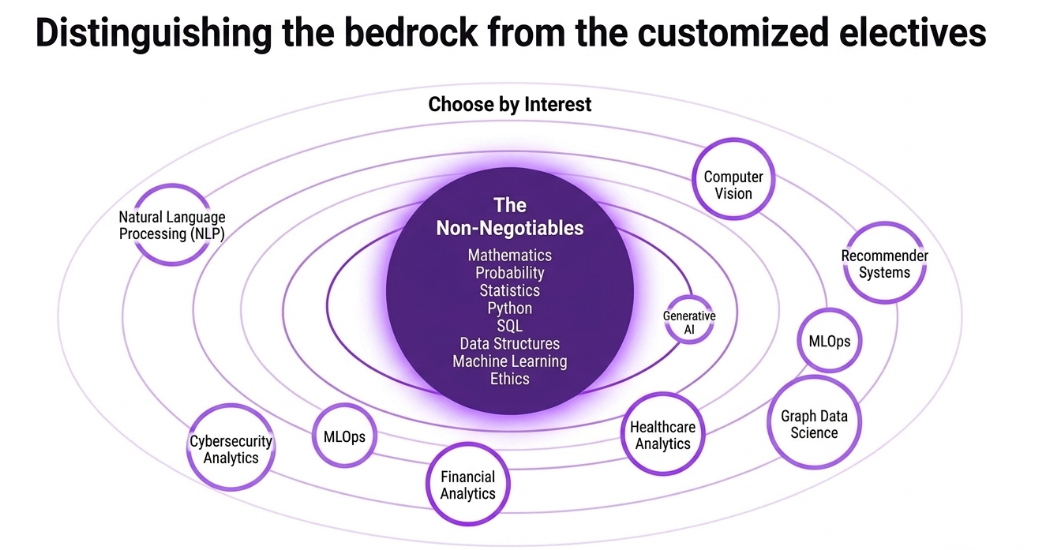
Core, non-negotiable subjects in a data science course include Mathematics, Probability, Statistics, Python, SQL, Data Structures, Machine Learning, and Ethics. Electives that you can pick based on interest include NLP, Computer Vision, Healthcare Analytics, Financial Analytics, Big Data, or Generative AI.
Practical labs and projects in data science syllabus
The data science curriculum is not just theoretical. It also includes practical lab work and hands-on projects which help you understand how data science actually works.
- In the 1st and 2nd year, lab work covers programming, building databases, and basic data-related work
- The internship, during the 3rd year is when you work on a real projects for 2-3 months
- The final capstone project in the 4th year is your own end-to-end project. A good project is the one that covers data collection, cleaning, analysis, baseline model, advanced model, evaluation, and ethical assessment. This capstone project also becomes a part of your portfolio that can help you land your first job.
Best books and resources for data science subjects
Going beyond your textbook will help you get ahead of the basic data science syllabus. Here are some solid resources that you may want to check out:
- “Hands-On Machine Learning with Scikit-Learn, Keras, and TensorFlow” by Aurélien Géron
- “Statistical Rethinking” by Richard McElreath
- “Deep Learning” by Goodfellow, Bengio, Courville
- “Python for Data Analysis” by Wes McKinney
Online resources like Coursera (IIT lectures), MIT OpenCourseWare, and Kaggle Learn are also helpful.
How data science subjects prepare you for industry careers
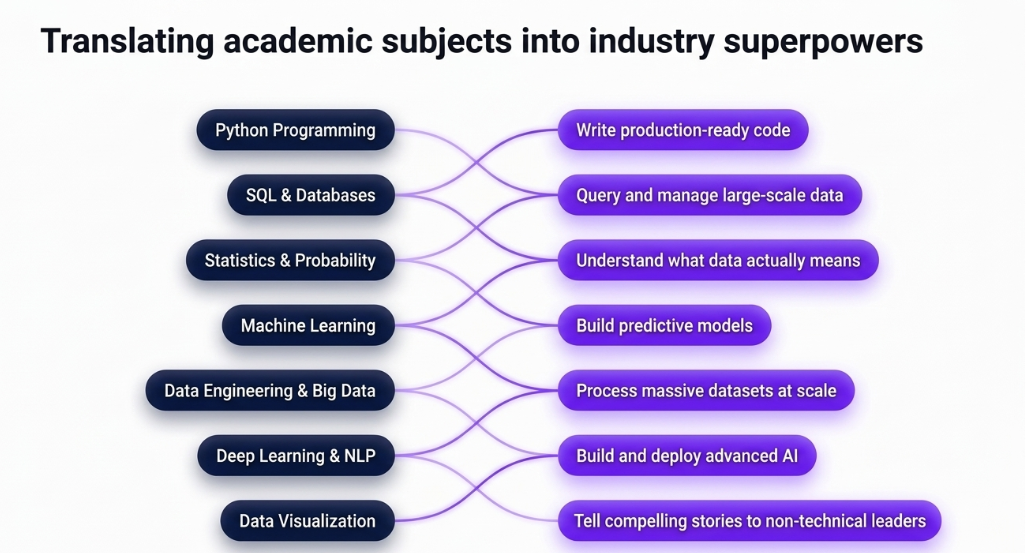
Every data science subject you take up teaches you something that employers look for. Here are the key subjects and which job-ready skill it teaches you.
| Data Science Subject | Job-Ready Skill |
|---|---|
| Python | Writing production-ready code |
| Databases | Query and manage data |
| Statistics and Probability | Understand what data means |
| Machine Learning | Build predictive models |
| Data Engineering | Process data at scale |
| Deep Learning and NLP | Work on advanced AI projects |
| Data visualisation | Tell stories with data |
| Big Data | Handle massive datasets |
Also Read: Data Science vs. Machine Learning in 2026
How GradRight helps you choose the right data science programme
Knowing and understanding the data science subjects is just one part of choosing a data science course. You also need to think about college reputation, placement outcomes, fees, location, and career outcomes.
That’s where we, at GradRight, can help you. We’ve helped 300,000+ students compare over 18,000+ higher education options and select the one that meets their needs. Also, with our mobile app, Graddie, you can get answers to questions like, ‘which data science subjects are taught in which course,’ ‘where data science graduates end up working,’ ‘what is the course fee structure,’ and more. Get the app from Google Play or the App Store for on-the-go guidance.
And if you are looking for education finance options, don’t run around chasing different lenders. Use our education loan marketplace to compare tailored loan offers from 15+ lenders side by side and pick what works for you.



 Australia
  Canada
  France
  Germany
  India
India  Ireland
  UAE
UAE  United Kingdom
  United States