

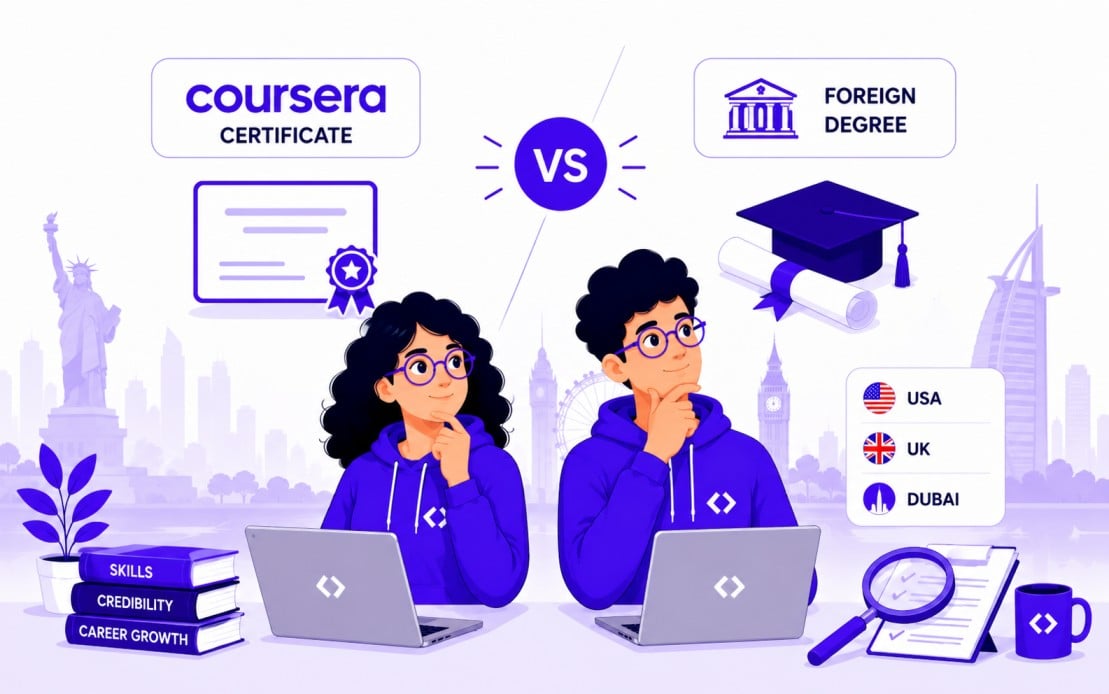
Summary: When it comes to Coursera certificate vs foreign degree, the honest answer is: it depends on where you’re applying. US tech employers increasingly accept certificates for entry-level roles. UK and UAE employers still require degrees for visa sponsorship and attestation, regardless of skill.
If you’ve spent any time on LinkedIn lately, you’ve probably seen the debate play out in real time: recruiters posting that “skills matter more than degrees” in one thread, and international students in another thread getting their visa applications rejected because their qualification didn’t meet a formal degree threshold. Both things are true at once, and that’s exactly why the Coursera certificate vs foreign degree question doesn’t have a one-line answer.
This isn’t a theoretical debate if you’re an Indian student weighing a two-year master’s abroad against a six-month Google certificate, or a working professional deciding whether an online credential can substitute for a full degree when you’re trying to move to Dubai or London. The stakes are real, the cost difference is enormous, and the answer genuinely varies by country, industry, and even by which government office is looking at your paperwork.
This guide breaks down what actually happens inside hiring pipelines and visa systems in the USA, UK, and UAE, so you can make a decision based on how employers behave, not on LinkedIn hot takes. If you’re weighing Coursera or LinkedIn Learning against a full degree, it helps to know exactly where each one holds up.
Why the Coursera certificate vs foreign degree debate keeps resurfacing
Three things are colliding at once. First, the cost of a foreign degree has climbed sharply, and families are questioning whether the ROI still holds. Second, platforms like Coursera and LinkedIn Learning have partnered with brands like Google, IBM, and Meta to produce certificates that look far more credible than the generic online courses of a decade ago. Third, several large employers, including IBM, Google, Delta Air Lines, Bank of America, and Accenture, have publicly dropped degree requirements for a meaningful share of their job postings, which understandably makes people ask whether the traditional degree is losing its grip.
At the same time, none of this happens in a vacuum. A job posting that doesn’t list a degree requirement is not the same as an immigration system that doesn’t require one, and that distinction is where most of the confusion in the Coursera certificate vs foreign degree conversation actually lives.
What recruiters in the USA actually check
The US labor market has moved further toward skills-based hiring than the UK or UAE, but “further” doesn’t mean “all the way.”
The data behind the shift
The National Association of Colleges and Employers’ Job Outlook 2024 survey found that 87.4% of US employers now accept online professional certificates as valid screening credentials, though acceptance jumps to roughly 94% for certificates issued by recognizable brands like Google, IBM, Meta, Microsoft, and AWS, and drops to around 62% for lesser-known issuers.
Indeed’s data shows only about 18% of US job postings still explicitly list a bachelor’s degree requirement, and formal education requirements have eased across the large majority of occupational sectors. ZipRecruiter’s marketplace data goes further, suggesting most entry-level postings in the US omit a degree requirement altogether.
That sounds like a clear win for certificates. But a joint study by Harvard Business School and the Burning Glass Institute found that many companies that publicly dropped degree requirements did so largely on paper, with the actual share of non-degree hires barely moving at many large firms. In other words, the policy changed faster than the practice.
What this means in a Coursera certificate vs foreign degree scenario
For US recruiters, a Coursera certificate works best as a signal of applied, current skills, not as a stand-in for a credential on your resume’s education line. Recruiters in tech, data, project management, and cybersecurity are the most receptive, especially when the certificate comes from Google, IBM, or Meta and is backed by a portfolio (a GitHub repo, a dashboard, a case study) rather than the certificate alone.
A foreign degree still carries more weight for roles that are regulated, client-facing, or senior, and it remains close to non-negotiable for graduate-level corporate hiring programs and for jobs where the employer needs to sponsor a work visa, since US visa categories like the H-1B are built around degree-based specialty occupation rules.
What recruiters in the UK actually check
The UK is where the Coursera certificate vs foreign degree question gets a harder edge, because the deciding factor often isn’t the recruiter’s opinion at all. It’s the visa system.
The RQF Level 6 rule
Since 22 July 2025, new Skilled Worker visa sponsorship in the UK requires the job itself to sit at RQF Level 6 or above, which is the Regulated Qualifications Framework’s bachelor’s-degree-equivalent skill level. This single change removed a large number of previously eligible occupations from sponsorship, and a small number of sub-degree roles remain temporarily eligible only through the Immigration Salary List or the Temporary Shortage List.
Here’s the nuance that trips people up: RQF Level 6 describes the skill level of the job, not necessarily a formal qualification the applicant must hold. In practice, though, employers overwhelmingly use a degree as the simplest way to evidence that a candidate meets the required skill level, especially for overseas hires where relevant experience is harder to verify at a distance.
For applicants with a three-year bachelor’s degree from countries including India, UK assessors may classify it as RQF Level 5 rather than Level 6, which is why many Indian graduates pursuing UK-sponsored roles complete a one-year postgraduate qualification to clear the bar, and why a NARIC (now Ecctis) Statement of Comparability is often recommended even though it isn’t always mandatory.
Where a Coursera certificate fits in the UK market
A Coursera certificate can still help you get shortlisted, particularly at UK employers in tech and digital roles that have adopted skills-based screening. But if the role requires visa sponsorship, the certificate does not solve the RQF Level 6 problem. This is one of the clearest cases in the Coursera certificate vs foreign degree debate where a credential can be well-regarded and still be functionally irrelevant to whether you can legally take the job.
What recruiters in Dubai and the UAE actually check
The UAE runs the most document-driven system of the three markets, and this is where the gap between “employers like your skills” and “the government will let you work” becomes most visible.
Degree attestation is a legal requirement, not a preference
For most UAE employment visas tied to degree-based roles, your foreign degree certificate must go through a formal attestation chain: verification in your home country, attestation by the UAE embassy or consulate, and final attestation by the UAE Ministry of Foreign Affairs (MOFA). For regulated professions such as engineering, teaching, medicine, and nursing, an additional Ministry of Education equivalency assessment is required, and healthcare roles typically need Dataflow primary source verification on top of that.
Laminated certificates are rejected outright because the plastic surface prevents the physical stamps attestation requires, and documents not in English or Arabic need translation by a UAE Ministry of Justice-approved translator, since online or unofficial translations are not accepted at any stage. None of this process has an equivalent for a Coursera or LinkedIn certificate, because attestation exists to verify accredited academic institutions, not individual online course providers.
What this means practically
If your UAE job offer is contingent on a degree-based visa category, a Coursera certificate cannot replace the attested foreign degree in the paperwork, no matter how strong your skills are.
Where a certificate genuinely helps in the UAE job market is at the hiring stage itself, in industries like digital marketing, IT, and data where employers are increasingly comfortable using certificates to differentiate candidates during shortlisting, before the visa and attestation process even begins. The certificate can get your resume noticed. It cannot get your visa approved on its own.
Coursera certificate vs foreign degree: A side-by-side comparison
| Factor | Coursera / LinkedIn Certificate | Foreign Degree |
| Cost | Typically $49 to $79/month or per certificate | Significantly higher, often USD 20,000 to 60,000+ total |
| Time to complete | Weeks to a few months | 1 to 4 years |
| US employer screening | Increasingly accepted for entry-level tech, data, and project roles | Still preferred for senior, regulated, or client-facing roles |
| US visa sponsorship (H-1B) | Not sufficient on its own | Generally required for specialty occupation classification |
| UK employer screening | Helpful for shortlisting in skills-forward sectors | Often still expected, especially for graduate schemes |
| UK Skilled Worker visa | Does not satisfy RQF Level 6 requirement | Usually required to evidence RQF Level 6 skill level |
| UAE employer screening | Can help at shortlisting stage in tech and digital roles | Expected for most degree-based, professional, and regulated roles |
| UAE visa / attestation | No attestation pathway exists for online certificates | Mandatory attestation through home country, embassy, and MOFA |
| Best used as | Supplementary evidence alongside a portfolio | Primary credential for regulated fields and visa-linked roles |
Common misconceptions in the Coursera certificate vs foreign degree conversation
- “Employers dropping degree requirements means degrees don’t matter anymore.” Research from Harvard Business School and the Burning Glass Institute found that many companies that removed degree requirements from job postings saw very little actual change in who they hired, because internal habits and manager preferences often didn’t shift alongside the policy.
- “If US tech companies accept certificates, every country will too.” Hiring practices and immigration law are two separate systems. A recruiter’s openness to a certificate has no bearing on whether an immigration authority will accept it as proof of qualification.
- “A certificate from any provider carries the same weight.” NACE survey data shows a sharp gap between certificates issued by recognizable brands like Google and IBM versus certificates from lesser-known issuers, and this gap widens further outside the tech sector.
- “Skills-based hiring means degree requirements are gone in regulated fields.” Medicine, law, engineering, teaching, and nursing remain governed by licensing bodies in the US, UK, and UAE that require accredited degrees, regardless of how the broader labor market is shifting.
So, foreign degree or Coursera certificate: How should you actually decide?
Think about it less as “which credential is better” and more as “which credential does this specific pathway require.”
- If your goal is a specific skill set for a role in a tech-forward US company, a well-chosen certificate paired with a real portfolio can genuinely move the needle, and it does so much faster and cheaper than a degree.
- If your goal involves visa sponsorship in the UK, US, or UAE, or a regulated profession anywhere, a foreign degree is not really optional. The certificate can strengthen your application around the degree, but it cannot replace it in the eyes of an immigration authority.
- If you’re choosing between programs or countries for a foreign degree itself, factors like program accreditation, post-study work rights, and how the qualification will be assessed by a receiving country’s immigration system (RQF-style equivalency in the UK, attestation in the UAE) matter as much as the subject you study.
This is exactly the kind of decision where a generic “certificates vs degrees” take online won’t account for your specific country pair, your target industry, or your visa route, and where getting it wrong can cost you months of delay or a rejected application.
Making the right call for your study abroad and career plan
The Coursera certificate vs foreign degree question rarely has a universal answer, because the honest response depends on your target country, your industry, and whether a visa is involved. What’s clear is that a foreign degree still does something a certificate structurally cannot: it satisfies the formal, legally recognized qualification requirements built into visa systems in the UK and UAE, and it remains the stronger signal for regulated and senior roles even in the more flexible US market.
This is the kind of decision GradRight was built to help with. Instead of guessing which university or program will actually hold up with employers and immigration systems in your target country, GradRight’s platform lets you compare universities and programs side by side, understand realistic loan and financing options, and get a clearer picture of return on investment before you commit.
If you’re weighing a foreign degree against faster, cheaper alternatives, it’s worth running the numbers on GradRight first, so the decision is based on your specific goals and destination country, not a general rule that may not apply to your situation.







 Australia
  Canada
  France
  Germany
  India
India  Ireland
  UAE
UAE  United Kingdom
  United States