





At 26, with 2-4 years of engineering experience, you are at the exact career stage where this decision has the most leverage and the least clarity. An AI course can deepen your technical trajectory. An MBA can shift you toward management, strategy, or a domain switch entirely. Both cost real money and 6 months to 2 years of your time. Most people make this decision based on which option a friend recently did, not on what the data says.
Here is what the data actually says, and more importantly, here is the question that should drive your decision: are you trying to go deeper into what you already do, or are you trying to change what you do?
With 22,200 monthly searches, this is one of the most common career dilemmas among Indian engineers in 2026. The honest answer is that “AI course vs MBA” is the wrong framing for most people. The right framing is “AI course vs MBA vs both, in what sequence, for what specific goal.”
The Real Comparison: What Each Path Actually Changes
| Factor | AI Course / Specialization | Online MBA |
| What it changes | Deepens technical capability. Moves you toward AI/ML/GenAI roles within or adjacent to engineering. | Adds management, strategy, and domain knowledge. Can pivot you toward consulting, BFSI, general management, or product leadership. |
| Typical duration | 3-6 months (certification) to 1 year (PG Diploma) | 2 years (degree-level UGC programs) |
| Typical cost | Free (NPTEL, Google) to Rs 2.5-3.5 lakh (BITS Pilani PG Diploma) | Rs 1.2-2.5 lakh (NMIMS, Symbiosis, Amity range) |
| Salary impact (fresher to 1 yr) | Rs 5-7 LPA fresher AI engineer. With internship: Rs 7-12 LPA. | Online MBA does not target freshers entering management from zero; most value is for those with 2+ years experience already. |
| Salary impact (4-6 years) | Rs 15-22 LPA mid-career AI engineer. Data engineers transitioning to AI: Rs 16-26 LPA. | Finance specialization: up to 30% salary growth on existing base. If at Rs 12 LPA, growth to Rs 15.6 LPA+. |
| Salary ceiling | Rs 25-40 LPA senior. Exceptional product company roles: Rs 50 LPA+. Google India ML average ~Rs 46 LPA. | Varies enormously by role post-MBA: management consulting, BFSI leadership, or general management can exceed Rs 25-40 LPA at senior levels. |
| Risk if you choose wrong | Lower financial risk (often free to low-cost). Risk is time spent on a specialization that does not align with available roles. | Higher financial commitment (Rs 1.2-2.5L) and 2-year time commitment. Risk is choosing wrong specialization or not leveraging it actively. |
Key Takeaways
- The decision depends on direction, not just numbers: AI course = go deeper technically. MBA = pivot toward management or a new domain. Comparing salary numbers alone misses the point if your actual goal is a role change, not a salary change.
- AI salary growth is steep but requires continuous skill currency: Rs 5-7 LPA to Rs 15-22 LPA in 4-6 years is a strong trajectory, but the field moves fast. GenAI, LLM engineering, and MLOps are the current premium skills; what is premium in 2026 may not be in 2029.
- MBA salary growth is more stable but slower per year: A 30% salary growth over an MBA program (2 years) on an existing Rs 12 LPA base is roughly 15% per year, comparable to or slightly above typical promotion-cycle growth, but it also opens role categories (management, strategy) that pure technical depth does not.
- Sequencing matters more than choosing one forever: AI certification first (cheap, fast, immediate skill signal) followed by MBA later (when management ambition is clearer and you have more experience to leverage in case studies and networking) is a commonly recommended sequence for engineers at 26.
- “AI engineer” salary figures vary widely by source: Reports range from Rs 10-15 LPA average to Rs 24.6 LPA average depending on methodology and role definition (ML engineer vs AI engineer vs AI/Data Scientist vary). Treat any single number as a range indicator, not a guarantee.
The AI course path: What 26-year-old engineers can expect
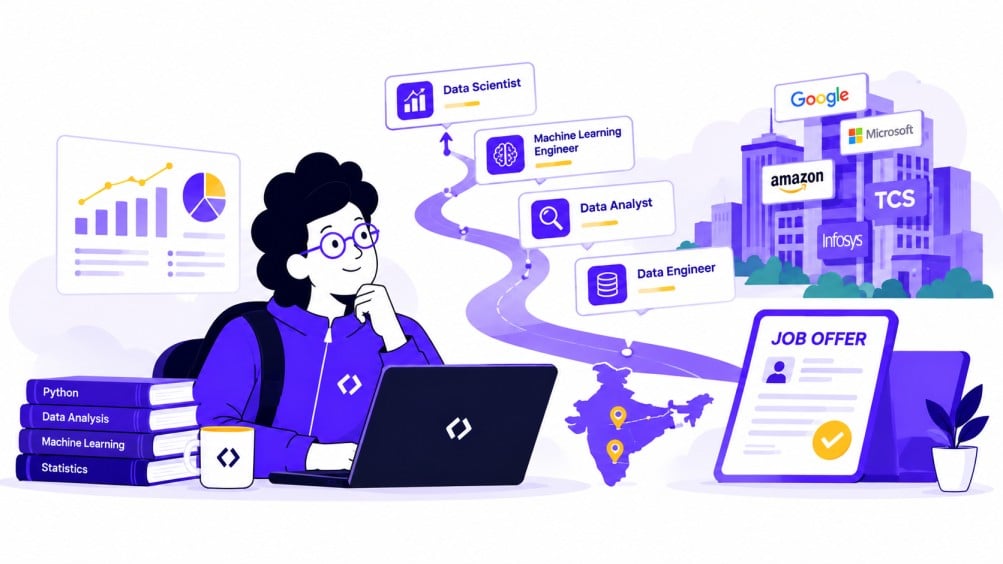
For an engineer with 2-4 years of experience, an AI specialization builds directly on existing technical foundations. The path typically looks like: foundational AI/ML course (NPTEL free, or Google/IBM certificates, 1-3 months), then a specialization in a high-demand area (GenAI, LLM engineering, MLOps, computer vision), then a portfolio project demonstrating production deployment.
- Salary trajectory: Fresher AI engineers earn Rs 5-7 LPA (upGrad 2025 report). With a 4-month paid internship providing production exposure, freshers can reach Rs 7-12 LPA. At 4-6 years, mid-career AI engineers earn Rs 15-22 LPA, with working data engineers transitioning into AI roles seeing Rs 16-26 LPA due to directly transferable pipeline experience.
- Highest-paying specialisations: Generative AI, LLM engineering, and MLOps currently show the largest salary premiums per LinkedIn Salary Insights India 2025-26. AI Product Manager and AI Business Analyst roles (non-coding-heavy, business-facing) pay Rs 10-32 LPA at mid-level and represent 38% of total AI hiring demand per NASSCOM 2025, higher than pure engineering roles.
- What it requires: Strong math fundamentals help at advanced levels but are not a strict gate for entry-level roles, especially business-facing AI roles. The learning curve is steeper than an MBA in terms of technical depth, but the cost and time investment (3-6 months for a focused certification) is significantly lower.
The MBA path: What 26-year-old engineers can expect
For an engineer considering an MBA at 26, the realistic outcomes depend heavily on specialization and whether the goal is depth in a new domain (finance, operations, general management) or a credential to support an existing trajectory (engineering manager, technical product manager).
- Salary trajectory: NMIMS finance specialization alumni report up to 30% salary growth post-program. If currently at Rs 10-12 LPA as a mid-level engineer, this represents a path to Rs 13-15.6 LPA within the 2-year program timeline, assuming the new role/domain materializes. The MBA itself does not guarantee the role; it provides the credential and network to compete for it.
- Best specializations for engineers: Operations and Business Analytics specializations leverage existing technical/analytical strengths. Finance specialization, if BFSI is the target, requires building new domain knowledge from scratch but has strong placement data (NMIMS, Symbiosis). General Management is the broadest option for engineers unsure of direction.
- What it requires: 2 years, Rs 1.2-2.5 lakh (UGC-recognized programs), and 8-12 hours/week of study while working. The bigger requirement is active positioning during the program: applying for stretch roles by semester 3, building a portfolio project that demonstrates the new domain capability, and networking deliberately.
Decision framework: 5 questions to answer first
- Do you enjoy the technical work you currently do, or are you doing it because it was the expected path? If you genuinely enjoy building and want to go deeper, AI specialization extends that. If you are looking for an exit from pure technical work, MBA is more aligned.
- Is your current company or industry actively building AI capability? If yes, an AI certification can be applied immediately within your current role, often the fastest path to a salary conversation without changing jobs.
- Do you have a specific management or domain target (consulting, BFSI, product)? A specific target makes MBA specialization choice straightforward. A vague “I want to do an MBA” without a target role often leads to underwhelming outcomes.
- What is your risk tolerance for the next 6-24 months? AI certification (3-6 months, often free to Rs 2.5L) is lower-risk and faster to test. MBA (2 years, Rs 1.2-2.5L) is a bigger commitment with a longer feedback loop.
- Could you do both, in sequence? AI certification first builds an immediate skill story and salary case. MBA later, with more seniority and a clearer management ambition, often produces a stronger application and outcome than doing it at 26 without direction.
The bottom line
For most 26-year-old engineers, the AI course path offers faster, lower-cost validation: 3-6 months, often free to Rs 2.5 lakh, with salary trajectories from Rs 5-7 LPA fresher to Rs 15-22 LPA at 4-6 years for those who build genuine deployment experience. The MBA path offers broader long-term optionality, particularly for management or domain pivots, at Rs 1.2-2.5 lakh over 2 years, with finance specialization showing up to 30% salary growth.
The sequencing that works best for most engineers at this stage: build an AI specialization now while it is cheap and fast, then revisit the MBA decision in 2-3 years when management ambition (if it exists) is concrete and your seniority makes the MBA application and outcomes stronger.
Explore both paths side by side, AI specializations and online MBA programs with verified fees and outcomes, on GradRight.




 Australia
  Canada
  France
  Germany
  India
India  Ireland
  UAE
UAE  United Kingdom
  United States