
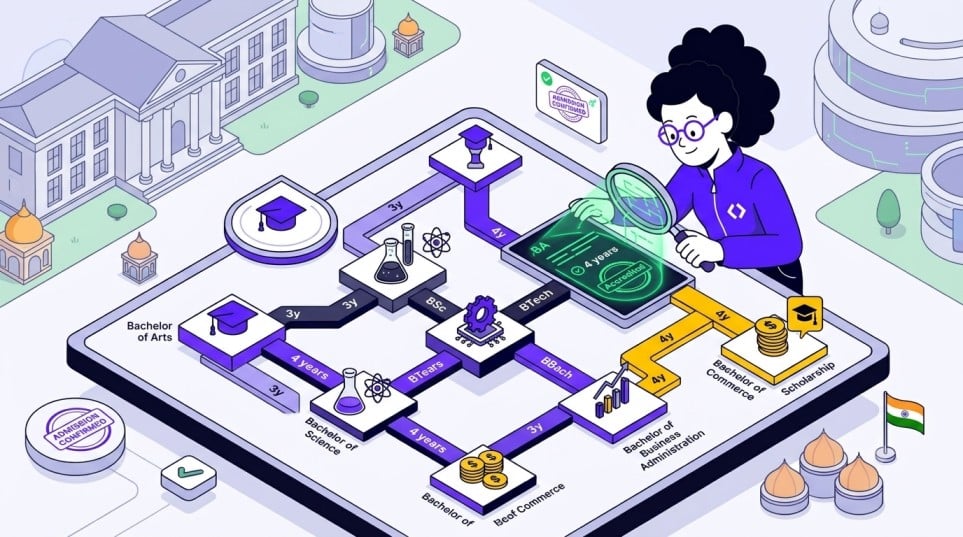
If you have just finished Class 12, you will hear one question again and again: which undergraduate degree are you planning to do? Before you answer, it helps to know exactly what the term covers, because words like undergraduate, graduate and postgraduate mean different things in India, the US and the UK.
This guide explains the undergraduate degree meaning in plain terms: what it is, how it differs from graduate and postgraduate degrees, the main types, how long it takes in India, and how it compares with studying abroad.
What is an undergraduate degree? UG degree definition
The simplest meaning of undergraduate degree is this: it is the first level of higher education you complete after school, and it leads to a bachelor’s degree.
The UG degree definition has three parts:
- It starts after Class 12 (10+2).
- It is taught at a college or university.
- It ends with a bachelor’s degree, such as a BA, BSc, BCom, BTech or BBA.
Students enrolled in such a program are called undergraduates. Once they finish, they are called graduates in the Indian sense of the word.
Undergraduate degree meaning: Is it the same as a bachelor’s degree?
In India, for practical purposes, yes. A bachelor’s degree is the most common undergraduate degree. Some countries also count shorter programs at this level. In the US, for example, a two-year associate degree is also an undergraduate qualification.
Why undergraduate education matters
Your first degree builds the foundation for a career or for postgraduate study. It shapes which jobs, entrance exams and master’s programs are open to you later, so understanding the meaning of the undergraduate degree is the first step before you choose a course.
Also Read: Best Career Options After 12th in India 2026: Complete Career Guide
Undergraduate vs graduate vs postgraduate: Key differences
The meaning of an undergraduate degree is easiest to see when you set it beside graduate and postgraduate study. This is also where most confusion starts, because the same word means different things in different countries.
| Term | In India | In the US |
|---|---|---|
| Undergraduate | A student or program at the bachelor’s level, taken after Class 12 | Same |
| Graduate | Someone who has completed a bachelor’s degree | A student or program at the master’s or doctoral level |
| Postgraduate | A student or program at the master’s level or above (MA, MSc, MCom, MTech, MBA) | Used less often; “graduate” is the standard term |
The entry requirement also changes at each level. Undergraduate programs generally ask for Class 12, while postgraduate programs ask for a completed bachelor’s degree.
Undergraduate vs graduate in India
In everyday Indian usage, “graduate” simply means someone who holds a bachelor’s degree. When a job posting asks for a “graduate”, it means a completed UG degree.
Undergraduate vs graduate in the US and abroad
In the US, “graduate school” means master’s and PhD programs. So the undergraduate vs graduate line sits between a bachelor’s and a master’s. The UK uses “postgraduate” for the same level. If a US university page says “graduate admissions”, it is talking about master’s and doctoral applicants, not students who have just finished school.
Types of undergraduate degrees in India: BA, BSc, BCom, BTech and BBA
In practice, the undergraduate degree shows up as a specific course name. Most fall into general streams (arts, science, commerce) or professional courses.
| Degree | Full form | Field | Typical duration | Common admission route |
|---|---|---|---|---|
| BA | Bachelor of Arts | Humanities, social sciences, languages | 3 years | Class 12 marks or CUET-UG, depending on the university |
| BSc | Bachelor of Science | Physics, chemistry, mathematics, biology, computer science and more | 3 years | Class 12 marks or CUET-UG, depending on the university |
| BCom | Bachelor of Commerce | Accounting, finance, taxation, business | 3 years | Class 12 marks or CUET-UG, depending on the university |
| BBA | Bachelor of Business Administration | Management | 3 years | Class 12 marks, CUET-UG or university-level tests |
| BTech / BE | Bachelor of Technology / Engineering | Engineering | 4 years | JEE Main, JEE Advanced (for IITs), state or university entrance exams |
| MBBS | Bachelor of Medicine, Bachelor of Surgery | Medicine | 5.5 years, including a one-year internship | NEET-UG |
| BArch | Bachelor of Architecture | Architecture | 5 years | NATA or JEE Main Paper 2 |
Arts, science and commerce degrees
BA, BSc and BCom are generally three-year degrees. Eligibility depends on the college. Many BSc programs expect specific Class 12 science subjects, while BCom is often, but not always, chosen by commerce students. Many universities also offer these as general (pass) or honours degrees, such as BCom (Hons), where you study one subject in greater depth.
Professional degrees
BTech, BBA, MBBS and BArch are career-focused. They have more fixed curriculums, and engineering and medicine usually require a national-level entrance exam.
Also Read: Professional Courses After 12th in India 2026: Complete List, Eligibility, Fees, and Career Scope
Undergraduate degree duration and structure in India
Duration is the part of the undergraduate degree that students ask about most, and it is changing in India.
The four-year undergraduate programme under NEP 2020
The National Education Policy 2020 introduced a four-year undergraduate program with multiple entry and exit options. Under the UGC framework, students can exit with a certificate after the first year, a diploma after the second year, or a bachelor’s degree after the third year. Those who complete a fourth year earn a bachelor’s degree with honours, or honours with research. Universities are adopting this at different speeds, so confirm with your chosen college whether it offers the three-year route, the four-year route, or both.
Semesters, credits and course structure
Many undergraduate programs run on a semester system, with two semesters a year, and assess you through internal assessments and end-semester exams. Under NEP, courses are credit-based and mix a major subject, minor subjects, multidisciplinary courses, and skill and ability enhancement courses. So the meaning of an undergraduate degree today is broader than three years in one subject.
Also Read: Best Courses After 12th Commerce in India 2026: Complete List & Career Guide
Undergraduate degree in India vs abroad
The meaning of undergraduate degree stays the same abroad: a first-level degree after school. What changes is the length, the structure and how you get in.
| Country | Typical bachelor’s duration |
|---|---|
| India | 3 years (BA, BSc, BCom, BBA), 4 years (BTech), 4 years under the NEP honours route |
| United States | 4 years |
| United Kingdom | 3 years in England, Wales and Northern Ireland, 4 years in Scotland |
| Canada | 3 to 4 years, depending on the province and program |
| Australia | 3 years, with honours typically adding a year |
| Germany | 6 to 8 semesters (3 to 4 years), depending on the course |
Curriculum and flexibility
US bachelor’s programs usually combine general education courses with a major, and many universities let students declare that major after the first or second year. In the UK and Australia, you generally study one subject from day one. Indian degrees have traditionally been subject-focused, and NEP 2020 adds more flexibility through minors and electives.
Admissions and eligibility
In India, admission often depends on Class 12 marks or a national entrance test. US universities review transcripts, essays, recommendation letters and activities, and their SAT or ACT policies vary by university. UK universities use the UCAS application system. International students are usually asked to show English proficiency through a test such as IELTS or TOEFL. Requirements differ by country and university, so check each one before you apply.
Does an Indian UG degree work for study abroad later?
Many universities abroad accept a three-year Indian bachelor’s degree for postgraduate admission, while some assess it case by case or prefer four years. Check each university’s published requirement.
Related Articles
- Degree Courses After 12th in India 2026: Streams, Eligibility, and Careers
- Best Courses After 12th Commerce in India 2026: Complete List & Career Guide
- Professional Courses After 12th in India 2026: Complete List, Eligibility, Fees, and Career Scope
- Steps to Study Abroad After 12th For Indian Students
- Best Career Options After 12th in India 2026: Complete Career Guide
Choosing your undergraduate degree with GradRight
Understanding what an undergraduate degree is is easy. Choosing the right course and college takes more thought.
The GradRight app helps you explore undergraduate programs, compare fees, outcomes and course duration, and shortlist colleges that fit your goals. You can also chat with Graddie, GradRight’s AI counsellor, to get personalized recommendations based on your interests and priorities.
Not sure whose advice to follow? Keep your research and recommendations in one place, and use Graddie to help you evaluate your options before making a decision.
Explore undergraduate programs with GradRight and find the right fit for you.






 Australia
 Canada
 France
 Germany
 India
 Ireland
 UAE
 United Kingdom
 United States