





Cloud has quietly become the default way software gets built and run, and hiring reflects it. India’s cloud job market keeps expanding as banks, e-commerce firms and startups shift workloads to AWS, Azure and Google Cloud, and certified professionals are reported to earn a real premium over uncertified peers in comparable roles. The catch is that “cloud computing course” covers everything from a free, three-week foundations course to a multi-year, ₹2.5 lakh postgraduate program, so picking the right one matters as much as picking the right platform.
This guide ranks 10 cloud computing courses by listed fee, compares AWS, Azure and GCP certification paths directly, and helps you match a course to your starting point. It also answers what learners ask most: which AWS certification course online is worth the money, whether an Azure certification for beginners exists, how GCP certification vs AWS actually compares, and whether a cloud computing course with placement is realistic.
The 10 best cloud computing courses in 2026, ranked
1. Introduction to Networking and Cloud Computing (Microsoft, Coursera)
Fee: ₹0
Duration: 3 weeks
Provider: Microsoft
The shortest program here. A quick primer on networking fundamentals alongside cloud basics, not a certification-track course on its own.
2. Cloud Computing Foundations (Duke University, Coursera)
Fee: ₹0
Duration: 4 weeks
Provider: Duke University
A university-backed free option that suits complete beginners testing their interest before committing money.
3. Cloud Computing Law (Queen Mary University of London, Coursera)
Fee: ₹0
Duration: 1 month
Provider: Queen Mary University of London
Not a technical or hands-on course, it covers the legal and regulatory side of cloud computing. Useful for compliance, legal or policy-adjacent roles rather than engineering ones.
4. Cloud Security & CCSP (COSMOSIQ)
Fee: ₹0.3L
Duration: 4 months
Provider: COSMOSIQ
The lowest listed fee among paid options, aimed at CCSP-aligned cloud security knowledge. A self-learning format, so it suits disciplined independent learners.
5. Professional Certification in Cloud Computing: AWS & Azure (COSMOSIQ)
Fee: ₹0.4L
Duration: 4 months
Provider: COSMOSIQ
One of the few programs here covering both AWS and Azure in a single course, useful if you’re still deciding which platform to specialize in.
6. Google Cloud Computing Foundations (Google Cloud, edX)
Fee: ₹0.5L
Duration: About 1 month
Provider: Google Cloud
A vendor-run foundations course direct from Google Cloud, ties with the Azure program below on fee but runs shorter.
7. Cloud Architect Accelerated Path for Azure Professionals (Google Cloud, edX)
Fee: ₹0.5L
Duration: 3 to 4 months
Provider: Google Cloud
Despite the Google Cloud branding, this is built for Azure professionals moving toward cloud architecture, worth double-checking the exact platform focus before enrolling.
8. Postgraduate Program in Multi-Cloud Architecture & DevOps (Vired)
Fee: ₹1.3L
Duration: 8 months
Provider: Vired
Covers multiple cloud platforms plus DevOps rather than a single vendor track, suited to learners who want breadth over deep specialization in one platform.
9. Advanced PG Certificate in AI Engineering on Cloud and AIOps (IIT Roorkee)
Fee: ₹1.3L
Duration: 9 months
Provider: IIT Roorkee
Ties with the Vired program on fee but pairs cloud with AI engineering and AIOps specifically, a narrower and more technical combination.
10. Introduction to Cloud Computing (Pragmatic AI Labs, edX)
Fee: ₹2.5L
Duration: 22 to 24 months
Provider: Pragmatic AI Labs
By far the highest listed fee and longest duration here.
Cloud computing courses compared: Fees and duration
| Program | Provider | Listed fee | Duration |
| Introduction to Networking and Cloud Computing | Microsoft | ₹0 | 3 weeks |
| Cloud Computing Foundations | Duke University | ₹0 | 4 weeks |
| Cloud Computing Law | Queen Mary University of London | ₹0 | 1 month |
| Cloud Security & CCSP | COSMOSIQ | ₹0.3L | 4 months |
| Professional Certification in Cloud Computing: AWS & Azure | COSMOSIQ | ₹0.4L | 4 months |
| Google Cloud Computing Foundations | Google Cloud | ₹0.5L | ~1 month |
| Cloud Architect Accelerated Path for Azure Professionals | Google Cloud | ₹0.5L | 3-4 months |
| Postgraduate Program in Multi-Cloud Architecture & DevOps | Vired | ₹1.3L | 8 months |
| Advanced PG Certificate in AI Engineering on Cloud and AIOps | IIT Roorkee | ₹1.3L | ~9 months |
| Introduction to Cloud Computing | Pragmatic AI Labs | ₹2.5L | 22-24 months |
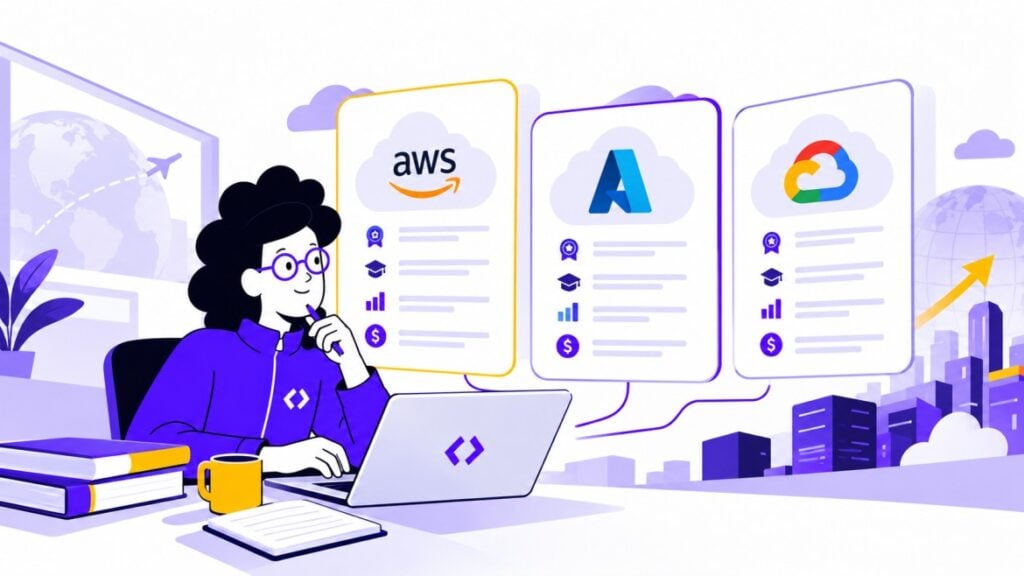
AWS certification course online vs. Azure certification for beginners vs. GCP certification vs. AWS
The three major cloud platforms aren’t interchangeable, and the right one depends on where you’re headed, not just which has the biggest name.
Market position: AWS holds roughly 30 to 31 percent of global cloud infrastructure market share as of 2026, still the largest, though its year-over-year growth (around 19 percent) trails both competitors. Azure sits around 23 to 25 percent share and is growing faster in absolute revenue, helped by its enterprise ecosystem and OpenAI partnership. GCP holds the smallest share, around 11 to 13 percent, but is growing the fastest percentage-wise, driven by AI and data workloads.
An AWS certification course online makes sense if you want the broadest job market. AWS’s service catalog is the largest of the three, and it remains the default choice for startups and cloud-native teams, meaning more entry-level and generalist roles ask for it by name.
Azure certification for beginners is often positioned as an accessible starting point because of Microsoft’s dominance in enterprise IT, companies already running Windows, Office 365 and on-premise Microsoft stacks tend to hire for Azure skills specifically, especially in traditional enterprises and BFSI.
GCP certification vs. AWS comes down to specialization. GCP’s strength is data analytics, machine learning and AI infrastructure, so a GCP certification is more valuable if you’re aiming at data engineering, ML or AI-adjacent cloud roles rather than general infrastructure work.
Multi-cloud reality: A large share of enterprises now run two or more cloud providers simultaneously, so a single-platform certification isn’t a ceiling. Many professionals start with one platform and add a second certification once they’re working, rather than trying to learn all three at once.
How to choose a cloud computing course by your experience level
If you’re completely new to cloud or IT
Start with a free foundations course, such as the Microsoft or Duke University options above, to confirm the field interests you before spending money. From there, move to a single-platform course rather than a multi-cloud one, since juggling three ecosystems as a beginner slows down real learning.
If you already work in IT, development or networking
A focused, single-platform certification course (AWS, Azure or GCP specifically) will get you job-market-ready faster than a broad multi-cloud program. Pick the platform your target employer or industry already uses.
If you’re aiming at cloud security specifically
Programs built around a security framework, such as the CCSP-aligned course above, are more targeted than general cloud foundations courses and speak directly to cloud security roles rather than general engineering ones.
If you want to future-proof toward AI-adjacent cloud work
Programs that pair cloud with AI engineering, AIOps or machine learning, like IIT Roorkee’s listing above, are worth the higher fee if your goal is a role at the intersection of cloud and AI, since that combination is reported to command a steep pay premium over standard cloud engineering roles.
Also read: Master’s in cloud computing: a step-by-step guide
What a cloud computing course means for your salary
Cloud salaries in India vary by platform, certification level and experience, and sources give different ranges.
Pay by Experience Level
- Entry level (0-2 years): Commonly cited between ₹4 lakh and ₹9 lakh, notably higher than the average IT fresher salary when a recognized certification is attached.
- Mid-level (3-6 years): Reported ranges of ₹8 lakh to ₹32 lakh, with product companies and GCCs/FAANG-type employers paying toward the higher end.
- Senior and architect level (7+ years): Figures range from ₹20 lakh up to ₹1.4-1.8 crore at senior cloud architect level in some reports, though such top-end figures apply to a small slice of very experienced professionals.
Platform-Specific and Specialization Patterns
AWS-certified professionals are reported to command salaries from roughly ₹8 lakh to ₹40 lakh depending on certification level, with advanced tracks like Solutions Architect: Professional and Security: Specialty cited among the highest-paying. GCP mid-level roles are reported in a similar ₹7 lakh to ₹16 lakh band to AWS.
Pairing cloud certifications with AI/ML skills is consistently cited as the steepest premium in 2026, reportedly 50 to 70 percent above standard cloud engineering pay.
Where a Course Fits In
A certification opens doors and can meaningfully lift starting pay, especially at entry level, but sustained salary growth comes from hands-on project experience and the specialization you build on top of the base credential.
Also read: Online MCA vs an MS in CS abroad: which route actually pays off
Also read: Study abroad vs an online course: what actually pays off for engineers
Choose your cloud computing course with GradRight
With options ranging from free three-week primers to ₹2.5 lakh, multi-year programs, the right cloud computing course depends on your current skill level, target platform and how much depth you actually need.
GradRight makes comparing these choices easier. On the GradRight app, you can browse online cloud computing courses side by side, compare fees and duration, and shortlist the program that matches your goals. Try the GradRight app today to compare your options with confidence.



 Australia
  Canada
  France
  Germany
  India
India  Ireland
  UAE
UAE  United Kingdom
  United States