




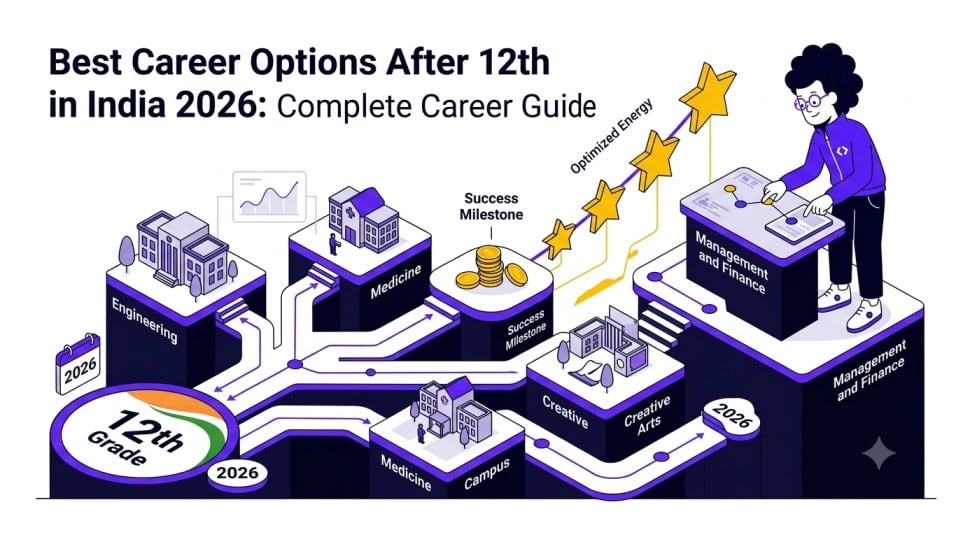
Finishing Class 12 is exciting, but it also brings the first big decision of your adult life: what comes next. With hundreds of degrees, diplomas, and entrance exams competing for attention, most students feel overwhelmed rather than excited. The good news is that you no longer have to pick between “safe” and “interesting.” In 2026, some of the best career options after 12th sit at the intersection of stable income and genuine growth, traditional paths like engineering and medicine, alongside newer fields like AI, UX design, and business analytics.
This guide breaks down the best career options after 12th by stream, shows what each path actually pays, flags alternate routes most students never hear about, and helps you figure out which direction suits your strengths.
Exploring the streams behind the best career options after 12th
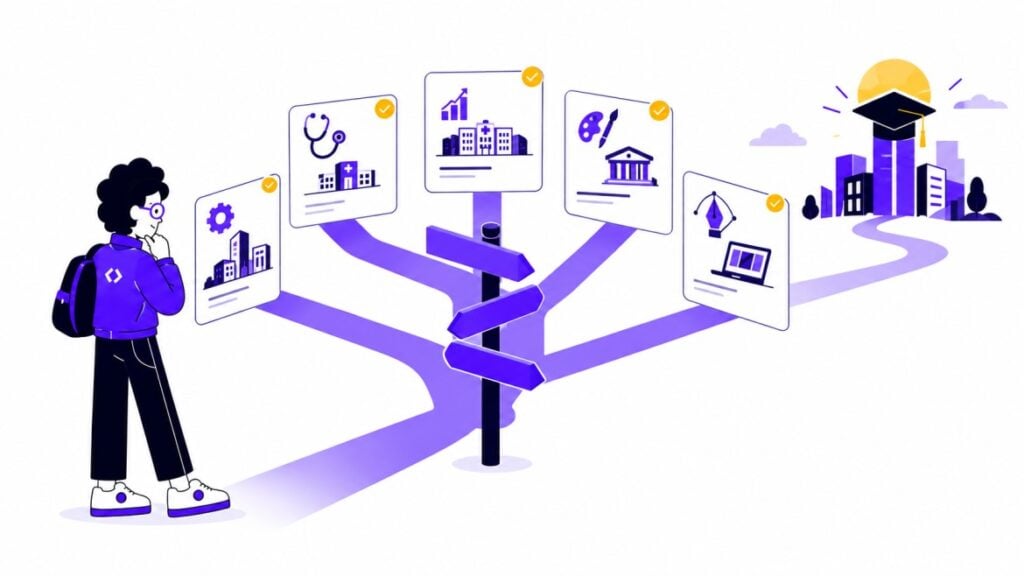
Career choice after Class 12 usually starts with your stream, though stream is no longer as limiting as it used to be thanks to bridge courses and skill-based certifications.
Science stream pathways
Science (PCM or PCB) opens the door to engineering, medicine, architecture, pure sciences, and most emerging tech fields. Entry typically runs through entrance exams: JEE Main and JEE Advanced for engineering (IITs, NITs, IIITs), NEET-UG for MBBS, BDS, BAMS, and BHMS, and NATA or JEE Main Paper 2 for architecture. CUET UG is also accepted by many central and state universities for BSc programs.
Commerce stream pathways
Commerce students have arguably the widest set of the best career options after 12th, ranging from Chartered Accountancy (CA) and Company Secretary (CS) to BBA, B.Com, and finance-focused degrees. Entry routes include the CA Foundation exam, the CSEET for CS, and university-level BBA/B.Com entrance tests, alongside CUET UG for central university admissions.
Also read: Best Courses After 12th Commerce in India: Complete List and Career Guide
Arts and humanities pathways
Arts is no longer the “leftover” stream; it feeds directly into law, design, psychology, mass communication, civil services, and the creator economy. CLAT is the primary gateway for 5-year integrated law programs at National Law Universities, while design institutes run their own entrance tests (NIFT, NID, UCEED) and many humanities programs now accept CUET UG scores.
Job roles and expected salaries for popular career options after 12th
Money isn’t everything, but it’s a fair starting point for comparison. Figures below are typical starting ranges in India and will vary by city, employer, and individual performance.
Engineering and core technology
Software Engineer, Systems Analyst, and Web Developer roles typically start between ₹6-12 LPA in tech hubs like Bengaluru, Hyderabad, Pune, and the NCR, with steep growth for strong performers.
Medicine and healthcare
A junior doctor’s package in India generally falls between ₹10-25 LPA once fully qualified, though this comes after a long MBBS-plus-internship timeline. Allied healthcare roles, nursing, pharmacy, physiotherapy, and lab technology, usually start lower, around ₹3-7 LPA, but offer faster entry into the workforce.
Finance and commerce roles
Chartered Accountants often start around ₹8-15 LPA in top firms, climbing well beyond that with experience. Company Secretaries and CFAs follow a similar trajectory, while B.Com and BBA graduates in banking or corporate roles typically start more modestly and scale with experience and certification.
Law and civil services
Fresh law graduates from top National Law Universities can start in the ₹10-15 LPA range at corporate firms, though litigation and smaller-firm salaries start lower. Civil services (UPSC, state PSCs) aren’t comparable on salary alone, since the real draw is long-term stability, pension, and public-sector authority.
Design, media, and digital roles
UX/UI Designers, Digital Marketing Analysts, and Content Strategists commonly start in the ₹3-8 LPA range, with several of these roles being remote-friendly and open to Tier-2 and Tier-3 city talent working for companies anywhere in India or abroad.
Lesser-known career options after 12th worth exploring
Beyond the well-trodden paths, there are several strong but underrated options among the best career options after 12th, ones that fewer students actively plan for.
Cybersecurity and ethical hacking
With most business activity now online, cybersecurity is a fast-growing field for students who enjoy problem-solving. Entry-level analysts with a certification like CEH often start around ₹3-6 LPA, moving higher with hands-on experience.
Data annotation and AI-adjacent roles
As AI adoption grows, so does demand for people who train, test, and fine-tune AI systems, data annotation, prompt writing, and quality evaluation. Many of these roles are remote and don’t require a traditional four-year degree to start.
Also read: Artificial Intelligence Degree Courses in India: Complete Guide
Aviation and hospitality management
Careers in cabin crew, ground staff, and hotel and hospitality management offer international exposure and steady demand, particularly as travel volumes recover and expand. Domestic starting packages generally range from ₹3-8 LPA, with higher potential abroad.
Skilled trades and vocational careers
Diplomas in fields like renewable energy technology, culinary arts, fashion design, and animation are shorter, often 1-3 years, and lead directly into employable, hands-on careers, a practical route for students who prefer doing over prolonged classroom study.
Higher study and specialization options after 12th
For students planning to go beyond a first degree, several of these paths naturally lead into postgraduate specialization, either in India or abroad.
Postgraduate degrees in India
An MBA, MTech, MS, or MD/MS after the relevant undergraduate degree remains the standard way to specialize and move into leadership or research roles across engineering, medicine, and management.
Studying abroad after an undergraduate degree
For students who complete their bachelor’s in India, pursuing a master’s abroad, in the US, UK, Canada, Germany, or Australia, can open up better research exposure and stronger starting salaries in some fields. This route requires planning around exams (GRE, GMAT, IELTS, TOEFL), budgeting, and education loans.
Certifications and micro-credentials
Short, focused certifications in data analytics, digital marketing, cloud computing, or financial modeling can supplement any degree and are increasingly weighed by recruiters alongside formal education.
Skills you need to succeed in these career paths
Across nearly every list like this one, a few skills show up again and again, regardless of stream.
Digital and AI literacy
Comfort with everyday digital tools, spreadsheets, and now basic AI productivity tools is becoming a baseline expectation, even in traditionally non-technical roles.
Communication and collaboration
Clear written and verbal communication remains one of the most consistently rewarded soft skills, especially in client-facing, managerial, or cross-functional roles.
Problem-solving and adaptability
Careers are changing faster than curricula. Being able to learn a new tool, process, or domain quickly matters more today than it did a decade ago.
Domain expertise
None of the above replaces deep knowledge in your chosen field, digital skills are a multiplier on expertise, not a substitute for it.
Which career path suits your interests and strengths
Not every option on this list will suit every student, and that’s the point of narrowing it down deliberately.
- If you enjoy structured problem-solving: Engineering, data science, and finance-related roles reward students who like working with numbers, systems, and logical processes.
- If you’re drawn to people and communication: Law, mass communication, psychology, teaching, and management-track roles suit students who enjoy working directly with people and ideas.
- If you want to help people directly: Medicine and allied healthcare fields are demanding but consistently among the best career options after 12th for students motivated by patient care and public health impact.
- If you want creative and flexible work: UX design, content strategy, digital marketing, and the broader creator economy suit students who want creative output with room to work independently or remotely.
- If you value stability above all: Government roles through UPSC, state PSCs, banking exams, and defence services remain strong choices for students prioritizing job security and pension benefits over early-career pay.
Planning your next step with GradRight
Choosing among the best career options after 12th is only the first decision, the next one is figuring out how and where to pursue it, especially if higher studies abroad are part of your longer-term plan. GradRight helps students and families compare universities, understand real costs, and access education financing with more clarity than most students get on their own.
If your path after 12th eventually leads to a master’s degree overseas, GradRight’s tools for university shortlisting and education loan comparison can help you plan that transition well before you need it, rather than scrambling for information when application deadlines are already close.




 Australia
  Canada
  France
  Germany
  India
India  Ireland
  UAE
UAE  United Kingdom
  United States