




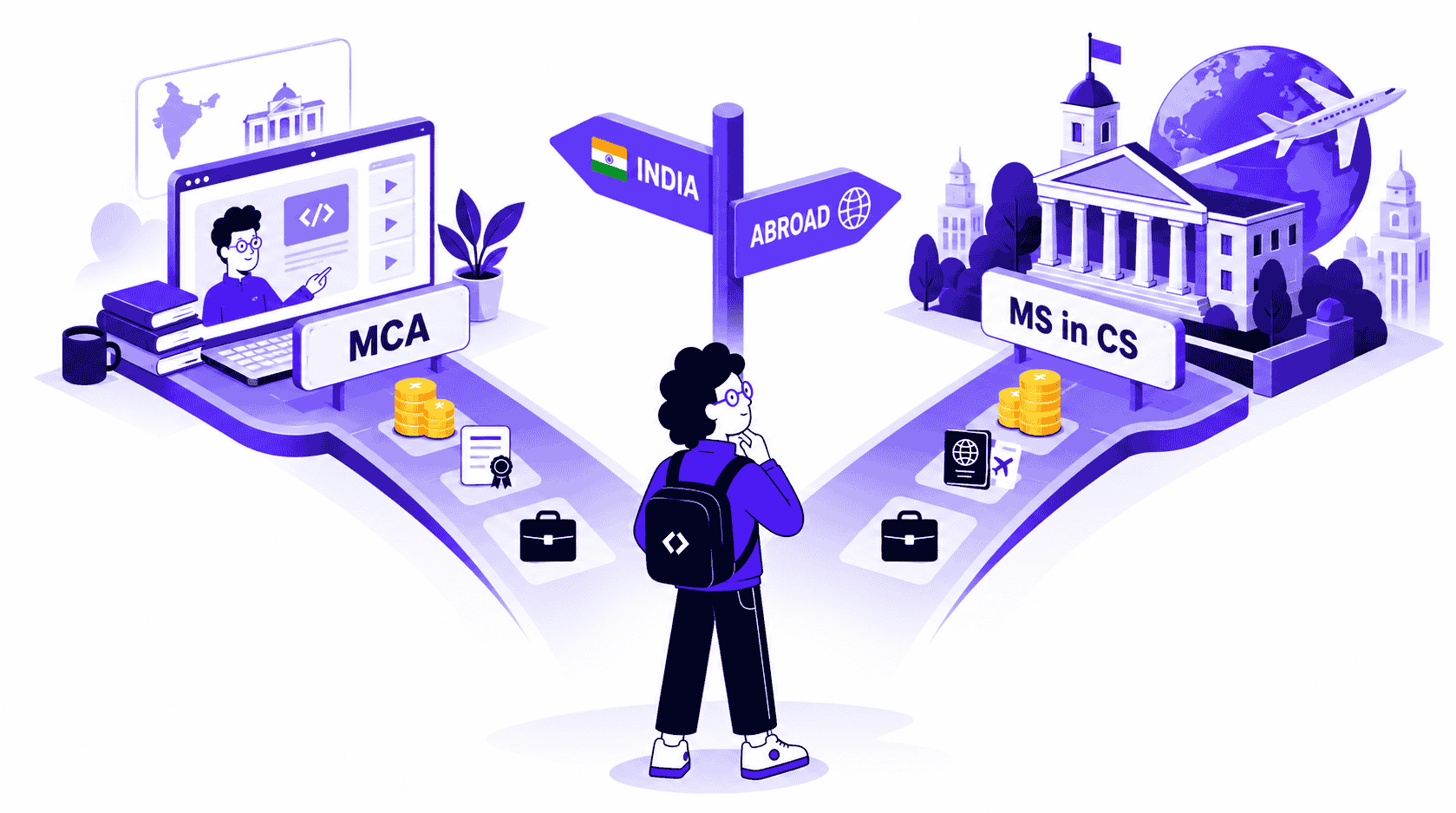
If you’re choosing between an online MCA and an MS in CS abroad, you’re really choosing between two very different life paths, not just two degrees. One lets you keep earning while you study from home. The other asks you to leave the country, take on real financial risk, and bet on a foreign job market. Neither choice is wrong, but the right one depends entirely on your finances, your risk appetite, and where you want to build your career.
This guide breaks down the online MCA vs MS CS abroad decision across every dimension that actually matters: fees, visa rules, post-study work rights, and realistic salary outcomes. No fluff, just the numbers and facts you need to decide.
Online MCA vs MS in CS abroad: the core difference
Before comparing numbers, it helps to be clear on what each degree actually is, because the two aren’t really competing for the same student.
An online MCA (Master of Computer Applications) is a UGC-DEB-approved postgraduate degree offered by Indian universities entirely over the internet. It’s typically a 2-year program built for working professionals or recent graduates who want a computer science-adjacent qualification without quitting their job or relocating.
An MS in CS abroad usually refers to an on-campus master’s in computer science at a foreign university, most commonly in the US, UK, Canada, or Germany. This is a full-time, in-person program that requires a student visa, physical relocation, and (in most countries) proof of funds well before you land.
There’s a third option that often gets confused with both: fully online MS in CS programs from foreign universities, like Georgia Tech’s OMSCS. These are real, ABET-accredited degrees from top-ranked universities, delivered 100% online, and dramatically cheaper than their on-campus equivalents. We’ll cover this separately because it changes the visa conversation completely.
Online MCA vs MS in CS abroad: fees compared
Cost is usually the first filter students apply when weighing an online MCA vs MS CS abroad, and the gap is significant.
| Factor | Online MCA (India) | MS in CS Abroad (On-Campus, e.g. US) | Online MS CS (e.g. Georgia Tech OMSCS) |
| Total tuition | ₹40,000 to ₹2,50,000 for the full 2-year program (some private universities go up to ₹4 lakh) | $40,000 to $60,000 in tuition alone, with total cost of attendance often running higher once living costs are added | Under $7,000 total for the complete degree |
| Living costs | None, you study from home | $10,000 to $20,000 per year additional | None, you study from home |
| Duration | 2 years | 1.5 to 2 years | Flexible, typically 2 to 6 years part-time |
| Can you earn while studying | Yes, fully | No (F-1 visa restricts off-campus work) | Yes, fully |
| Visa/relocation costs | None | SEVIS fee, visa fee, flights, health insurance | None |
A few things worth flagging plainly:
- Government universities are the cheapest online MCA route. IGNOU and Babasaheb Ambedkar Open University (BAOU) offer some of the lowest-cost online MCA programs, with BAOU’s course costing around ₹50,000. Private universities like Amity, Manipal, and Jain charge more but often include better placement support and industry certifications.
- On-campus MS CS abroad is genuinely expensive. Between tuition and cost of living, a 2-year US MS in CS commonly totals $80,000 to $120,000+ depending on the university and city. This is exactly the kind of cost that pushes students toward education loans, which is worth factoring into your decision early rather than after you’ve already accepted an offer.
- Fully online foreign MS programs break the cost logic entirely. OMSCS costs roughly the same as a mid-tier Indian online MCA, while conferring the exact same MS in Computer Science degree, with no distinction on the diploma between online and on-campus delivery, that an on-campus Georgia Tech student receives. But this route comes with a major trade-off we’ll cover in the visa section.
Visa and work rights: the factor most students underweight
This is where the online MCA vs MS CS abroad decision gets genuinely consequential, and where a lot of misinformation circulates.
Online MCA visa requirements
There aren’t any. You study from India, on Indian servers and Indian time zones, for an Indian degree. No I-20, no visa interview, no SEVIS fee, no proof of funds. This is the single biggest practical advantage of the online MCA route.
F-1 visa process for MS in CS abroad
If you choose an on-campus MS in CS abroad, particularly in the US, you’ll go through the F-1 student visa process:
- Get admitted and receive your I-20 from the university
- Pay the SEVIS fee and F-1 visa application fee
- Attend a visa interview at a US consulate
- Enter the US and maintain full-time enrollment to stay in status
OPT, STEM OPT, and post-study work
This is where an MS in CS abroad earns back some of its cost premium. Post-completion OPT gives you 12 months of work authorization after graduation, which you use while finding a sponsor and entering the H-1B lottery. Because computer science is a STEM-designated field, you can extend that by an additional 24 months through STEM OPT, for up to 36 months of total work authorization. That’s three separate H-1B lottery attempts instead of just one, which meaningfully improves your odds of eventually landing a work visa.
The $100,000 H-1B fee: what actually applies to students
A $100,000 supplemental fee now applies to H-1B petitions filed for candidates outside the US. But this fee does not apply to F-1 visa holders changing status to H-1B from inside the US, which is exactly the path most MS in CS graduates take. If you study in the US and move into H-1B from inside the country after graduation, you’re in a different lane entirely. Separately, a new wage-weighted lottery system now gives better odds to petitions tied to higher wage levels, which tends to favor candidates with a master’s degree over a bachelor’s.
The online MS CS visa trap
Here’s the misconception worth calling out directly: a fully online MS in CS from a foreign university does not make you eligible for a student visa, OPT, or H-1B sponsorship through the university. Programs like OMSCS are designed for students who are already authorized to live and work wherever they are, often US residents or professionals on existing visas. If your goal is a foreign degree specifically as a pathway to relocate and work abroad, the online MS CS route won’t get you there. This is the trade-off behind its low cost.
Job prospects and salary: online MCA vs MS CS abroad
Career outcomes with an online MCA
Online MCA graduates typically move into roles like software developer, system analyst, IT administrator, and QA/testing roles within Indian IT services and product companies. Companies like TCS, Infosys, Wipro, Accenture, and even global players like Amazon and Google actively hire MCA graduates for engineering and analyst roles, particularly when candidates pair the degree with relevant certifications in cloud, AI, or cybersecurity. Salaries vary widely by specialization, prior experience, and city, so treat any single figure with caution and benchmark against current listings for your specific target role before making assumptions.
Career outcomes with an MS CS abroad
Over 90% of MS in Computer Science graduates in the US secure employment within six months of graduation, and average starting salaries range from $80,000 to $120,000 annually. This is a meaningfully higher pay ceiling than most India-based roles, and it comes with exposure to global product companies, cutting-edge R&D work, and a currency advantage if you’re paying off an education loan. The catch, as covered above, is that this income stream isn’t guaranteed. It depends on securing OPT, then surviving the H-1B lottery, both of which involve real uncertainty.
Which one should you choose?
There’s no universally correct answer here, but a few patterns hold up consistently:
- Choose an online MCA if: you want to keep your current job and income, you’re cost-sensitive, you don’t have loan collateral or a co-signer lined up, or your career goals are centered on the Indian IT market.
- Choose an on-campus MS CS abroad if: you can afford the investment (or qualify for an education loan), you’re comfortable with visa and lottery uncertainty, and your goal is specifically to build a career in the US, UK, Canada, or another study destination.
- Choose an online MS CS abroad (like OMSCS) if: you want a globally recognized CS credential to boost your resume or transition careers, but you don’t need it to serve as a relocation or visa pathway.
Making the right call for your career
Whichever direction you’re leaning, the online MCA vs MS CS abroad decision ultimately comes down to matching the degree to your financial reality and career destination, not just picking the option with the bigger brand name. If a foreign degree is genuinely the right move for you, the financial planning around it matters just as much as the university you choose.
This is exactly where GradRight comes in. Its platform helps students compare universities and programs side by side, understand real scholarship and loan options across lenders, and build a financial plan before committing to an offer, so you’re not making a six-figure decision on gut feeling alone. Whether you’re weighing an online MCA against an MS in CS abroad or narrowing down specific universities, GradRight’s tools are built to help you decide with clarity, not guesswork.






 Australia
  Canada
  France
  Germany
  India
India  Ireland
  UAE
UAE  United Kingdom
  United States