




Quick Answer
An education loan for MBBS covers tuition, hostel, and living costs, secured or unsecured, from banks, NBFCs, or the government’s portals. The process involves checking eligibility, comparing lenders, submitting documents, and getting sanction before your admission deadline.
Getting into a medical program is only half the battle. The other half, for most Indian families, is figuring out how to pay for it. Between tuition, hostel fees, travel, insurance, and living costs, an MBBS degree (whether in India or abroad) can easily run into tens of lakhs of rupees, and very few families can pay that upfront in cash.
This is exactly where an education loan for MBBS comes in. Done right, it lets you fund the entire course, including tuition, accommodation, and other approved expenses, without draining your family’s savings. Done wrong (wrong lender, missing paperwork, unrealistic timelines), it can delay your admission or leave you scrambling right before your visa deadline.
This guide walks you through the complete education loan process for MBBS, from understanding what lenders actually look for, to the exact steps involved in how to apply for an education loan for MBBS, to the documents, interest rates, and repayment terms you should know before you sign anything.
Also Read: Education Loan for MBBS in India: Eligibility, Documents, Interest Rates, and How to Apply
Why an Education Loan for MBBS Is Often the Only Realistic Option
MBBS is one of the longest and most expensive courses a student can pursue. In India, a management quota seat at a private medical college can cost upward of Rs. 1 crore for the full course. Abroad, at NMC-recognized universities in countries like Russia, Georgia, Kyrgyzstan, Uzbekistan, the Philippines, and Bangladesh, the total cost (tuition plus living expenses for the full program) typically falls in the range of Rs. 20 lakh to Rs. 60 lakh, though this varies significantly by country, university, and currency fluctuations.
That is a large amount to arrange in one go, and it needs to be paid out across five to six years, not all at once. A structured education loan for MBBS spreads that cost over the course duration and, in most cases, gives you a moratorium period so you are not repaying anything while you are still studying.
There is also a practical reason loans matter more for MBBS than for most other courses: visa and admission authorities abroad often ask for proof of funds before they issue an admission letter or student visa. A sanctioned loan, or at least a strong in-principle approval, does double duty. It funds your education and it satisfies the financial documentation most universities and embassies require.
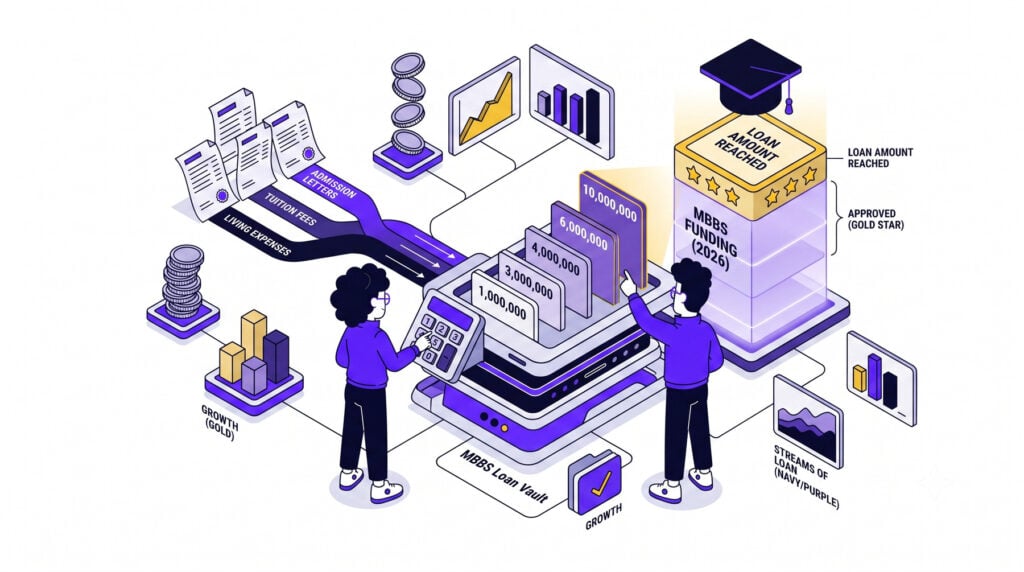
What an MBBS Education Loan Typically Covers
| Expense Head | Usually Covered? |
|---|---|
| Tuition fees | Yes |
| Hostel or accommodation fees | Yes |
| Exam and university registration fees | Yes |
| Books, equipment, and lab costs | Yes, usually with a cap |
| Travel (one-way or round-trip airfare) | Often, check with lender |
| Health insurance | Often, check with lender |
| Refundable caution deposit | Sometimes |
| Laptop or study material | Sometimes, with a cap |
Always confirm the exact list of covered expenses with your lender before finalizing, since this varies from bank to bank and scheme to scheme.
The Education Loan Process for MBBS: Step-by-Step
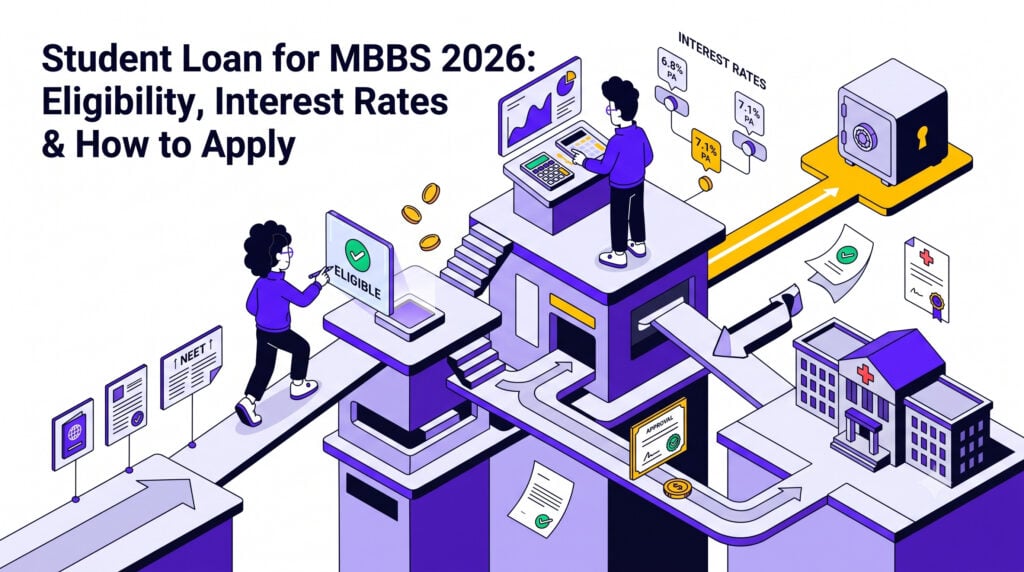
The education loan process for MBBS looks broadly similar whether you are applying for a domestic or overseas program, though the paperwork gets a bit heavier for international admissions. Here is how it typically plays out.
Step 1: Get Your Admission Offer in Place First
Almost every lender requires a confirmed admission letter (or at minimum a conditional offer) before they process a loan application. If you are still shortlisting universities, it is worth having a rough loan budget in mind so you don’t shortlist a program that’s financially out of reach.
Step 2: Check Your Eligibility and Shortlist Lenders
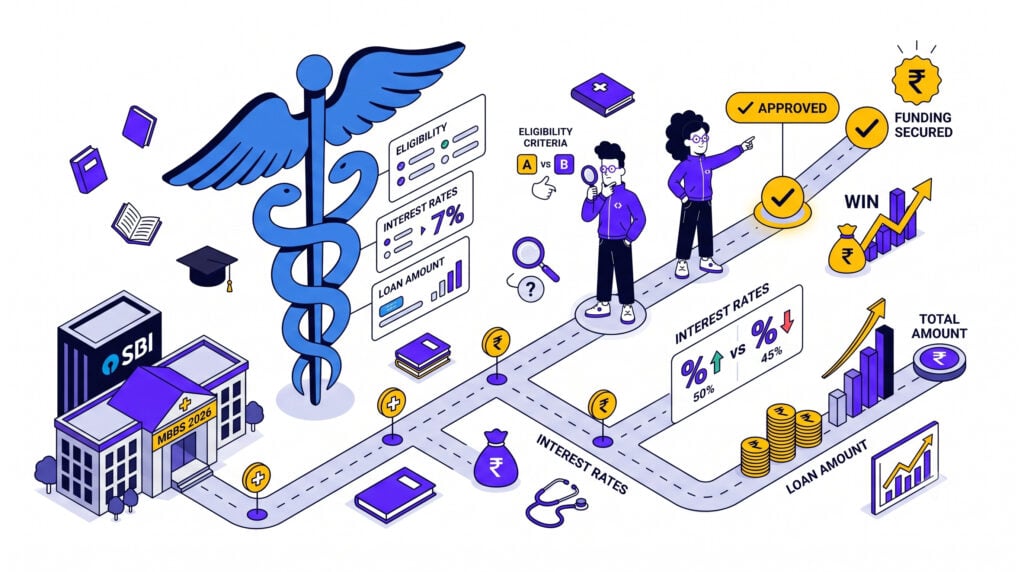
Before you figure out how to apply for an education loan for MBBS, check whether you and your co-applicant actually qualify. Most lenders look at:
– The student’s academic record, including NEET score for MBBS admissions
– Whether the target university is NMC-recognized (non-negotiable for MBBS abroad loans)
– The co-applicant’s income, employment stability, and credit score
– Whether the loan amount needs collateral, and whether your family has property to offer
Public sector banks (SBI, Bank of Baroda, Punjab National Bank), private banks (Axis, ICICI), and NBFCs (Credila, Avanse, Auxilo, InCred) all offer MBBS education loans, but their interest rates, processing speed, and collateral requirements differ. It’s worth shortlisting two or three lenders rather than betting everything on one application.
Also Read: MBBS Loan in India: Best Banks, Interest Rates, and Eligibility Compared
Step 3: Gather Your Documents
Documentation is where most delays happen. Get this ready in parallel with your university shortlisting, not after.
Step 4: Apply Through Our Platform
You can apply directly for an education loan through GradRight. This is often the most efficient way to compare offers without filling out separate forms everywhere.
Step 5: Loan Appraisal, Sanction, and Disbursement
Once submitted, the lender verifies your documents, may conduct a personal discussion or property valuation (for secured loans), and issues a sanction letter if approved. Disbursement is usually done in installments, tuition paid directly to the university, and living expense components released periodically or at the start of each academic term.
Processing time varies widely. NBFCs like Credila often move in two to three weeks, while public sector banks can take four to eight weeks, so build in a buffer before your visa or admission deadline.
Also Read: NEET Counselling to MBBS Loan Disbursement: A Timeline Guide
Documents Required for an MBBS Education Loan
Keeping this organized in two folders, student and co-applicant, makes the process considerably smoother.
Student’s documents:
– 10th and 12th mark sheets
– NEET scorecard (mandatory for MBBS loan applications)
– Passport and visa (for overseas admissions)
– University admission or offer letter
– Passport-size photographs
Co-applicant’s documents (usually a parent or guardian):
– PAN card and Aadhaar card
– Last six months’ bank statements
– Income proof: salary slips for salaried applicants, or ITRs for the last two to three years for self-employed or business-owner co-applicants
– Credit report or CIBIL score, if available
For secured loans (where collateral is offered):
– Property title deeds
– Latest property tax receipts
– Approved building plan or valuation certificate
Missing even one document from this list is one of the most common reasons applications sit in processing longer than expected, so it’s worth cross-checking with your specific lender’s checklist before submission.
Education Loan for MBBS: Collateral vs. No Collateral
Whether you need collateral depends mostly on the loan amount and the lender.
| Factor | Loans Without Collateral | Loans With Collateral |
|---|---|---|
| Typical loan amount | Up to Rs. 7.5 lakh-20 lakh, depending on lender and scheme | Rs. 20 lakh up to Rs. 1 crore or more |
| Approval basis | Co-applicant income, credit score, future earning potential | Property value plus co-applicant income |
| Interest rate | Usually slightly higher | Usually slightly lower |
| Processing time | Often faster, especially with NBFCs | Can take longer due to property valuation |
| Best suited for | Families without property to pledge, or lower loan requirements | Higher loan amounts for costlier MBBS programs abroad |
Since MBBS abroad programs frequently need Rs. 20 lakh or more for the full course, many families end up opting for a secured loan simply because the loan amount required exceeds most banks’ unsecured limits. That said, some NBFCs do offer unsecured loans up to fairly high amounts for applicants with a strong co-applicant profile, so it’s worth asking directly rather than assuming you need collateral.
Also Read: Collateral-Free Loan for MBBS in India: A Complete Guide
Comparing Lenders for an MBBS Education Loan
| Lender | Loan Type | Indicative Interest Rate | Processing Time |
|---|---|---|---|
| SBI (Global Ed-Vantage / Scholar Loan) | Secured and unsecured | Among the lowest of public banks | 4-8 weeks |
| Bank of Baroda | Secured, preferred processing for listed institutions | Moderate | 3-6 weeks |
| Punjab National Bank | Secured and unsecured | Moderate | Can be slower; follow up actively |
| Axis Bank | Secured and unsecured | Competitive, private-bank rates | 2-4 weeks |
| Credila (NBFC) | Secured and unsecured | Typically higher than PSU banks | 2-3 weeks, fastest among common options |
| Avanse / Auxilo / InCred (NBFCs) | Secured and unsecured | Varies by profile | Generally faster than PSU banks |
Exact current interest rates change frequently and vary by applicant profile, collateral, and university.
A useful rule of thumb: public sector banks tend to offer lower rates but slower processing, while NBFCs process faster and are more flexible on collateral, but usually at a higher interest cost. Which one is “better” really depends on how much time you have before your admission or visa deadline.
Interest Rates, Moratorium Period, and Repayment
Most MBBS education loans, whether for India or abroad, follow a similar repayment structure:
Moratorium period:
Typically the course duration plus a grace period of six months to one year after completion, during which you are not required to make full EMI payments. Some lenders require you to at least pay the interest during this period (simple interest), while others allow it to accrue.
Repayment tenure:
Usually ranges from 10 to 15 years after the moratorium ends, depending on the lender and loan amount.
Interest rate type:
Most education loans are on a floating rate, linked to the lender’s benchmark rate, so your EMI can change over the loan tenure.
Understanding this structure matters because it directly affects your total repayment burden. A slightly lower interest rate on a longer tenure can sometimes cost more in total interest than a slightly higher rate on a shorter one, so it’s worth asking your lender for a full amortization schedule rather than comparing rates alone.
Tax Benefits: Section 80E
One thing students and parents often miss when working out how to apply for an education loan for MBBS is the tax benefit available under Section 80E of the Income Tax Act. The interest portion (not the principal) paid on an education loan is deductible from taxable income, with no upper cap on the amount, for a maximum of 8 consecutive years or until the interest is fully repaid, whichever is earlier.
This benefit is available to whoever is repaying the loan, whether that’s the student or the co-applicant parent. It’s a meaningful saving over the life of a loan this size, so it’s worth factoring into your overall cost planning rather than treating it as an afterthought.
Making the Loan Decision Easier With GradRight
Figuring out how to take an education loan for MBBS is rarely just about picking a bank. It’s tied to which university you choose, what the total cost of attendance actually looks like over five or six years, and whether a slightly cheaper interest rate today is worth a longer repayment tenure later. These decisions are easier to get right when you’re looking at university selection, cost planning, and loan options together instead of one at a time.
This is where GradRight fits in. We help students compare universities and program costs, explore scholarship options, and evaluate education loan offers from multiple lenders side by side, so you’re not choosing a loan in isolation from the bigger financial picture. Whether you’re still shortlisting MBBS programs or ready to move on the loan process, it’s worth mapping out the full cost and financing plan before you commit, and that’s exactly the kind of planning GradRight is built to support.
Frequently Asked Questions
How much education loan can I get for MBBS?
This depends on the lender, whether you offer collateral, and your co-applicant’s profile. Unsecured loans typically go up to Rs. 7.5-20 lakh, while secured loans can go up to Rs. 1 crore or more for costlier MBBS programs abroad.
How long does the education loan process for MBBS usually take?
Anywhere from 2 to 8 weeks depending on the lender. NBFCs tend to be faster (2-3 weeks), while public sector banks can take longer (4-8 weeks), especially for secured loans requiring property valuation.
Do I need NEET to apply for an education loan for MBBS?
Yes, most lenders require a valid NEET scorecard as part of the student’s documentation, since it is a prerequisite for MBBS admission, whether in India or abroad.
Can I get an education loan for MBBS without collateral?
Yes, for loan amounts typically up to Rs. 7.5-20 lakh, depending on the lender and your co-applicant’s income and credit profile. Higher amounts generally require collateral.
Is the interest on an MBBS education loan tax-deductible?
Yes, under Section 80E of the Income Tax Act, the interest paid (not the principal) is deductible with no upper limit, for up to 8 years from the start of repayment.
When should I start the education loan process for MBBS?
Ideally as soon as you have a confirmed or conditional admission offer, and well before your visa deadline. Given that processing can take up to 6-8 weeks with some banks, starting early gives you room to compare lenders instead of accepting the first offer out of time pressure.



 Australia
  Canada
  France
  Germany
  India
India  Ireland
  UAE
UAE  United Kingdom
  United States