




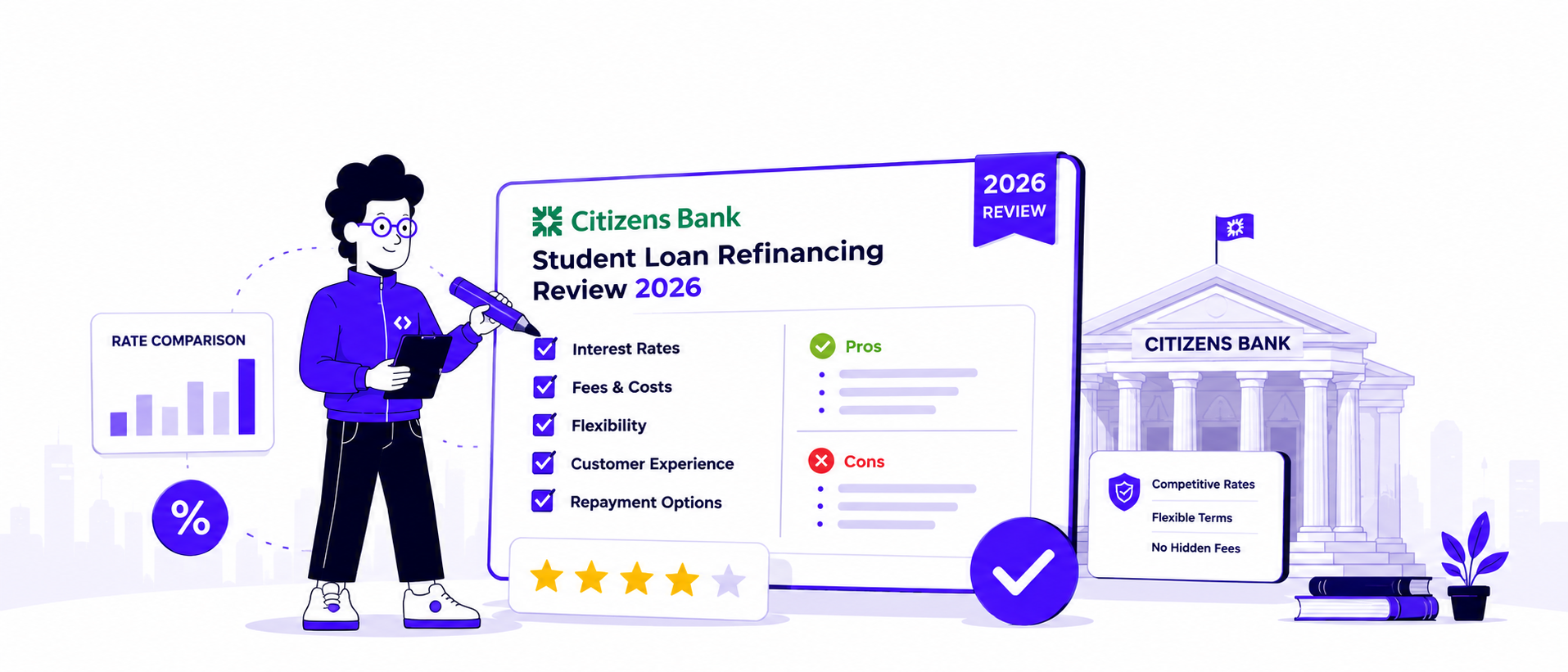
If you’re carrying student debt from multiple lenders and wondering whether one of the country’s oldest banks is worth switching to, this Citizens Bank student loan refinancing review breaks down exactly what you’re signing up for – the rates, the eligibility bar, the discounts, and where the fine print actually bites.
Citizens Bank has been in the student lending business for years and refinances both private and federal student loans into a single new loan. The pitch is simple: one payment, potentially a lower rate, and a repayment term you choose. Whether that pitch holds up for your situation depends on a few things this guide walks through in detail – your current interest rate, your credit profile, and whether you actually use any federal loan benefits worth protecting.
What is Citizens Bank student loan refinancing?
Citizens Bank student loan refinancing lets you pay off one or more existing student loans, private, federal, or a mix of both, with a brand-new loan from Citizens. That new loan comes with its own interest rate, term, and monthly payment, and it replaces everything you refinanced. You’re no longer paying your old servicer; you’re paying Citizens.
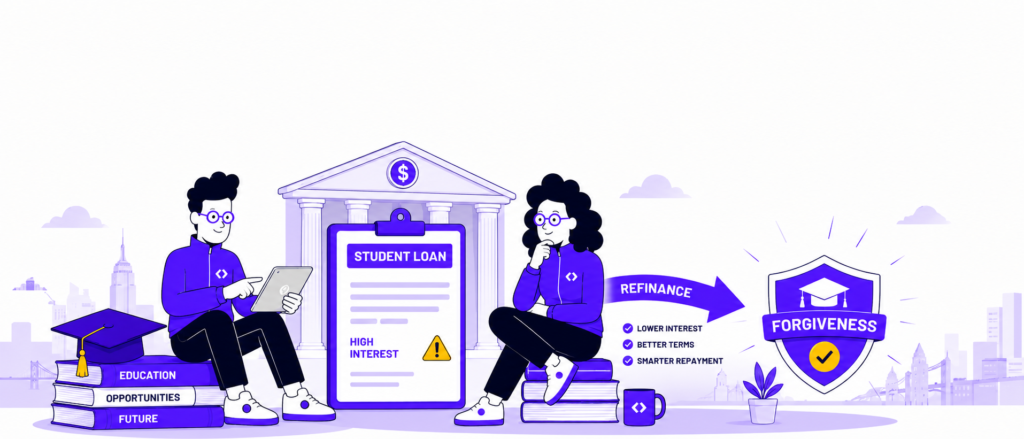
This is different from federal loan consolidation, which only combines federal loans into a Direct Consolidation Loan and doesn’t lower your interest rate. This program, by contrast, is a private refinance – the goal is a new rate based on your current credit and income, not just administrative simplification.
The one thing to internalize before going further: once you refinance a federal loan with Citizens, it becomes a private loan. There’s no converting it back.
How Citizens Bank student loan refinancing works
The process is fairly standard for private refinancing, but it’s worth knowing the sequence so nothing catches you off guard.
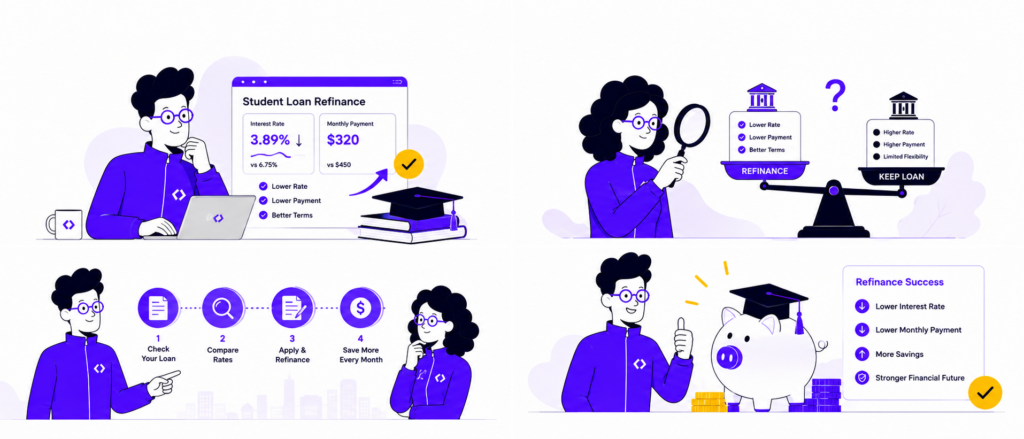
- Check your rate. Citizens lets you get a rate quote in about two minutes using a soft credit pull, which doesn’t affect your credit score. Your quoted rate is valid for 30 days.
- Submit your loan details. You’ll list out the loans you want to refinance and their current balances, across whichever lenders currently service them.
- Choose fixed or variable, and your term. Citizens offers 5, 7, 10, 15, and 20-year repayment terms.
- Complete the full application. This step involves a hard credit inquiry, which can have a small, temporary impact on your credit score.
- Citizens pays off your old loans. Keep making payments to your original servicers until you get confirmation the payoff is complete; don’t stop early just because you signed new paperwork.
- Start paying Citizens. Your new loan, new rate, and new monthly payment take over from here.
Citizens Bank student loan refinancing rates
Citizens Bank student loan refinancing offers both fixed-rate and variable-rate loans, and your actual APR depends on your credit score, income, debt-to-income ratio, loan term, and whether you qualify for any discounts.
Citizens publishes live rate ranges directly on its site rather than a single fixed number, since APRs shift with market conditions and applicant profiles. Borrowers can generally expect:
| Rate type | Typical range (with discounts) |
| Fixed APR | Roughly mid-single digits to mid-teens, depending on credit and term |
| Variable APR | Tied to 30-day SOFR, generally starting lower than fixed rates but able to rise over time |
| Loan amount | $10,000 minimum, up to $300,000 (bachelor’s), $500,000 (graduate), or $750,000 (professional degree) |
| Terms available | 5, 7, 10, 15, or 20 years |
Because these figures move frequently and vary by individual credit profile, the only fully reliable number is the one Citizens shows you after a soft credit pull on its site. Treat any published range, including the one above, as a starting point for comparison rather than a guarantee.
Fixed Rate Loans
With a fixed-rate loan through this program, your interest rate and monthly payment stay the same for the entire loan term. This is the safer, more predictable option if you’re budgeting tightly or expect rates to rise over your repayment period.
Variable Rate Loans
Variable-rate loans can start lower than fixed rates but change monthly based on an underlying benchmark (SOFR). Your payment can go up or down as that benchmark moves. Variable rates tend to make more sense on shorter terms, where there’s less time for rate swings to compound.
Rate discounts available
Your rate can drop by up to 0.50 percentage points through two stackable discounts:
- Loyalty Discount – for existing Citizens customers with a qualifying account
- Automatic Payment Discount – for enrolling in autopay from a bank account
Both are worth checking before you finalize your rate, since 0.50 points compounded over a 10- or 15-year term adds up.
Also Read: Can You Refinance Federal Student Loans? What Indian Students Lose (and Gain)
Eligibility requirements for Citizens Bank student loan refinancing
Not everyone qualifies for Citizens Bank student loan refinancing. Based on Citizens’ own disclosed criteria, you’ll generally need to:
- Have at least $10,000 in student loans to refinance
- Be a U.S. citizen, permanent resident, or resident alien with a valid Social Security number
- Hold a bachelor’s degree or higher
- Meet Citizens’ credit and income requirements (a stable income and reasonably strong credit history help significantly)
Additional requirements may apply depending on your loan type and state of residence, and Citizens does not currently offer these loans in every U.S. territory the same way — check your state’s eligibility before applying.
Pros of Citizens Bank student loan refinancing
- Potential for real savings. Citizens states its refinancing customers have saved an average of $4,104 a year, based on actual customer data. That’s a meaningful number if your existing rate is well above current market rates.
- Rate discounts that stack. The 0.50-point combined Loyalty and Autopay discount is a genuine reduction, not a marketing gesture, it applies directly to your APR.
- Flexible terms. Five options ranging from 5 to 20 years means you can prioritize either a lower monthly payment or paying less interest over time, depending on your goals.
- No prepayment penalty. You can pay more than your minimum or pay the loan off entirely early without being charged for it.
- High borrowing limits. Up to $750,000 for professional-degree holders makes this workable for law and medical school debt loads that other lenders cap much lower.
- Soft-pull rate checking. You can see your likely rate without a hard inquiry, so shopping around doesn’t cost you anything on your credit report until you’re ready to commit.
- Cosigner release option. If a cosigner helped you qualify for your original loans, Citizens allows a cosigner release application once you’ve entered full principal-and-interest repayment and meet its credit criteria.
Cons of Citizens Bank student loan refinancing
- You lose federal loan protections if you refinance federal debt. This is the big one. Income-driven repayment, Public Service Loan Forgiveness, generous deferment and forbearance windows, and federal default remedies all disappear the moment a federal loan becomes a Citizens private loan.
- $10,000 minimum balance. If your remaining debt is smaller than that, you’re not eligible to refinance it with Citizens.
- Bachelor’s degree requirement. Borrowers who didn’t complete a degree may not qualify, unlike some competitors that refinance loans for non-graduates.
- Variable rates carry uncertainty. A lower starting rate on a variable loan can climb over a 15- or 20-year term as SOFR moves, and there’s no cap that guarantees your worst-case payment stays comfortable.
- Rates depend heavily on credit. Borrowers with limited or damaged credit history may see quoted rates toward the higher end of the published range, or may need a cosigner to qualify at all.
- No guaranteed hardship forbearance program. Unlike federal loans, private refinance loans generally handle hardship requests case by case rather than through a standardized federal forbearance system.
Is Citizens Bank student loan refinancing right for you?
Citizens Bank student loan refinancing tends to make the most sense if:
- Your credit score has meaningfully improved since you took out your original loans
- You have stable income and don’t anticipate needing income-driven repayment
- You’re refinancing private loans, or federal loans you’re confident you won’t need forgiveness or IDR benefits on
- You want to consolidate multiple loan payments into one bill
- Your current interest rate is noticeably higher than what you’d likely qualify for now
It makes less sense if you work in public service and are pursuing forgiveness, if your income is unstable, or if you might need federal-style deferment options down the road. In those cases, a federal Direct Consolidation Loan preserves benefits that Citizens Bank student loan refinancing cannot offer once your loans convert to private debt.
Also Read: Student Loan Refinancing in 2026: Everything Indian Students in the USA Need to Know
The smarter way to decide: Compare before you commit
Citizens Bank’s refinancing offer is one option among several, and the only way to know if its quote is actually competitive is to see it next to what else you qualify for. That’s where GradRight comes in. Instead of running separate soft-pull checks with every lender yourself, GradRight’s decision engine lines up your Citizens offer against other refinance lenders, rate, term, and total interest, so you can see where it actually ranks before signing anything.
If Citizens turns out to be your best rate, great – you apply with confidence instead of a guess. If it isn’t, you’ve saved yourself a hard inquiry and a commitment to the wrong loan. Either way, the decision-layer step costs you nothing and takes a few minutes, which is a small trade for getting a 10- or 20-year financial decision right the first time.






 Australia
  Canada
  France
  Germany
  India
India  Ireland
  UAE
UAE  United Kingdom
  United States