





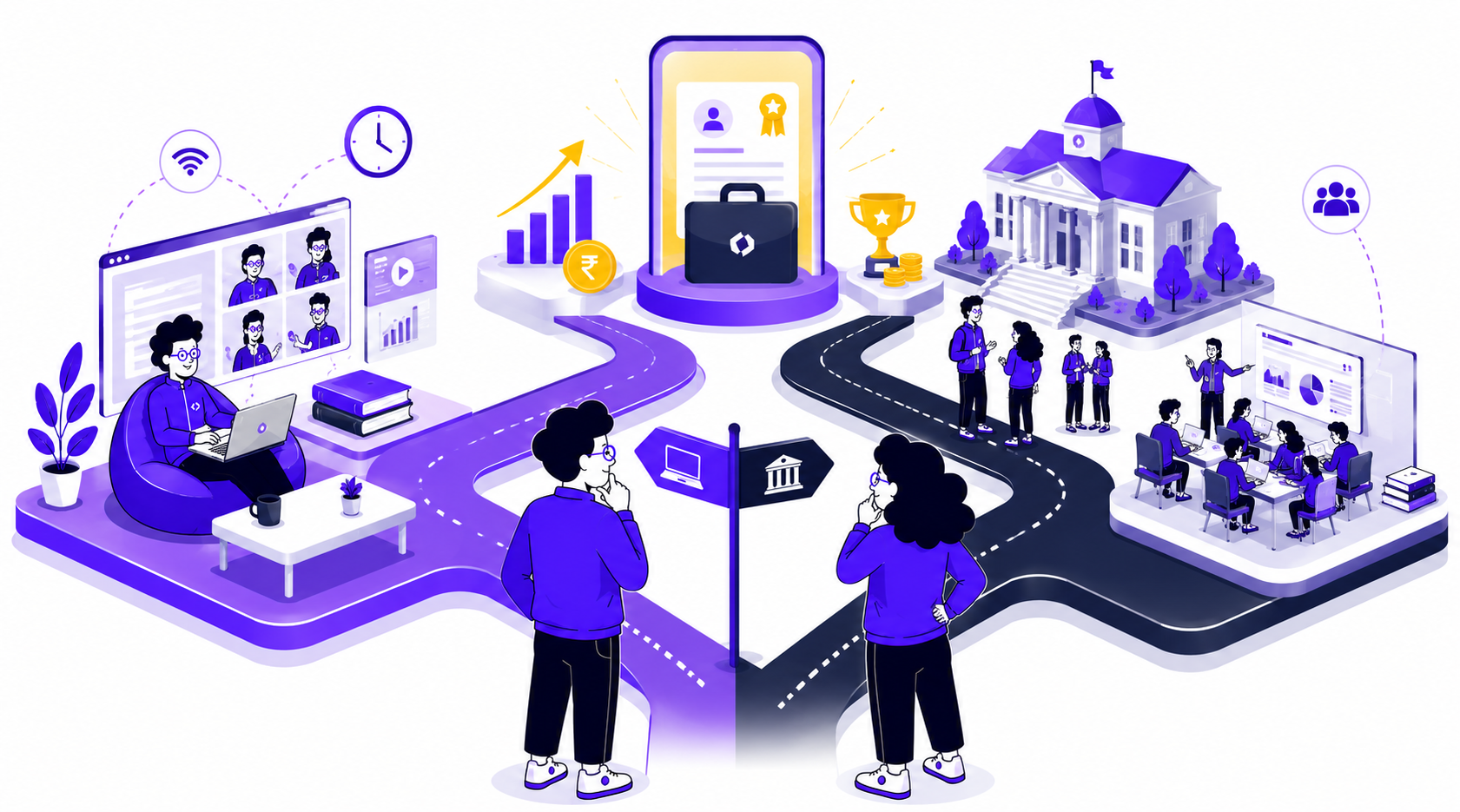
The legal answer to “is an online MBA the same as a regular MBA” is straightforward: if the issuing university holds UGC-DEB entitlement, the degree carries identical legal standing. Same title, same recognition, same eligibility for government jobs and further studies. That part is settled.
The hiring answer is more layered. A 2026 industry survey found that 78% of Indian IT companies treat online MBA degrees at par with regular MBA for hiring and promotions, provided UGC-DEB accreditation is in place. That is a real and significant shift from even 3-4 years ago. But “78% at par” also means roughly 1 in 5 companies, and specific sectors, still distinguish, and the distinction is sharpest in exactly the places where MBA outcomes are highest-stakes: investment banking, premium consulting, and campus-driven recruitment pipelines.
With 18,100 monthly searches, this is one of the most consequential decisions in Indian management education. Here is where the two formats are genuinely equivalent, and where they are not.
| Quick Answer
Online MBA vs regular MBA, which gets you hired? For most sectors in 2026, including technology, e-commerce, digital marketing, fintech, and general MNC roles, a UGC-DEB entitled online MBA is treated at par with a regular MBA: 78% of Indian IT companies report no distinction for hiring or promotions. For elite verticals, investment banking, premium strategy consulting (McKinsey, BCG, Bain), and roles that specifically recruit through campus placement drives at top B-schools, full-time MBA from a recognised institute retains a real edge because the hiring pipeline itself is built around campus recruitment, not because the online degree is “less valid.” If you are already employed and want a credential to support your current trajectory: online MBA. If you are a fresher or career switcher targeting campus-recruited roles at elite firms: full-time MBA is structurally different, not just academically different. |
Where They Are Genuinely Equivalent
| Dimension | Online MBA | Regular (Full-Time) MBA |
| Legal/UGC recognition | Identical, if UGC-DEB entitled. Same degree title, same regulatory standing. | Same legal standing. No difference for government jobs, PSU, NET, PhD eligibility. |
| Curriculum content | Same core curriculum mandated by UGC for MBA programs at the same institution. | Same core curriculum. Specialisation depth may vary by program design. |
| IT and tech sector hiring | 78% of Indian IT companies report treating online MBA at par for hiring and promotions (2026 survey data). | Standard acceptance. No additional advantage in most tech hiring specifically due to format. |
| E-commerce, digital marketing, fintech roles | Generally accepted at par. Skills and portfolio matter more than format in these sectors. | Same. Format matters less than demonstrated skills in these fast-moving sectors. |
| Working professional career progression | Strong fit. Most online MBA students are already employed; degree supports promotion or lateral move within existing trajectory. | Less common path. Full-time MBA usually means a 1-2 year career break, which working professionals rarely take. |
Source: Padhaao.com NASSCOM survey reference 2026; OnlineChitkarau May 2026; FindMyCollege April 2026.
Key Takeaways
|
Where the Real Difference Shows Up
- Campus Placement Pipeline
For fresh full-time MBA graduates, campus placement remains the primary route to employment in India. Companies visit campus, interview batches over a structured period, and make offers, often pre-placement offers (PPOs) from summer internships. This pipeline is built into the full-time MBA model.
Online MBA programs offer placement support, virtual drives, resume help, career counseling, job portal access, but this is structurally different from campus placement. It is not that online MBA placement support is “worse” in quality; it is that the entire campus recruitment ecosystem (PPOs, structured interview rounds, company visits) does not exist for online cohorts. (Source: Jaipuria Institute blog May 2026)
- Elite Verticals: Investment Banking and Premium Consulting
Investment banking, premium strategy consulting (McKinsey, BCG, Bain, and similar), and certain PE/VC roles recruit almost exclusively through campus drives at a defined set of top B-schools (IIMs, ISB, and a few others). This is true regardless of an online MBA’s legal validity or curriculum quality. If your specific goal is one of these roles, a full-time MBA at an institution within this recruiting circuit is close to a structural requirement, not a preference.
For BFSI more broadly (not investment banking specifically: retail banking, insurance, corporate banking, NBFC roles), online MBA from UGC-DEB entitled institutions with strong BFSI brand recognition (NMIMS, for instance) is well accepted.
- Networking and Peer Cohort
Full-time MBA programs offer 1-2 years of dense, in-person interaction with a peer cohort that often becomes a long-term professional network: co-founders, future executives, and cross-industry contacts built through shared physical experience. Online MBA cohorts are more geographically and professionally diverse but interaction is less frequent and intense by design.
This is a genuine difference, but its impact depends on your career goals. If your career path benefits from a tight alumni network at a specific institution (common in PE/VC, startups, certain consulting tracks), full-time MBA peer networks compound more visibly. If your career path is more meritocratic and skills-driven (most tech, most operational roles), the peer network difference matters less.
- International Exposure Programs
Many full-time MBA programs at strong institutes include structured international exposure: student exchange programs, immersion trips, faculty exchanges, and international guest lectures. These build cross-cultural professional experience that some recruiters, particularly for roles with international scope, value directly. Online MBA programs generally do not include this component, though some (Amity with WASC/QAA, for example) build international accreditation into the credential itself as a different form of international recognition.
| What this means in practice
“We get this question from two very different people, and the answer is different for each. A fresher with no work experience, asking whether to do an online MBA or wait and do a full-time MBA: if your target is campus-recruited roles at elite firms, the full-time path is structurally different and matters. A working professional with 2-5 years of experience, asking the same question: for you, an online MBA from a UGC-DEB entitled institution with strong brand recognition in your sector is very likely treated at par, and a 1-2 year career break for full-time MBA has a real opportunity cost that often outweighs the marginal brand difference.”, OLRight Counseling Team |
Cost and Time: The Other Half of the Decision
- Online MBA:Rs 1.2-3.5 lakh depending on university (NMIMS Rs 1.96L, Amity Rs 2.07L, Symbiosis Rs 1.6-3.15L). 2 years, while continuing to work and earn. UGC-DEB entitled programs are 60-80% cheaper than full-time MBA at comparable institutions.
- Full-time MBA:Rs 10-25 lakh+ at top institutes (IIMs, ISB, premier private B-schools). 1-2 years, no income during the program, plus opportunity cost of foregone salary. Jaipuria-type programs report highest CTC of 24.1 LPA for their best-placed graduates.
The cost and opportunity-cost gap is enormous. For the gap to be worth it, the full-time MBA needs to deliver either: access to the elite campus-recruitment pipeline (investment banking, premium consulting), or a career pivot significant enough that the Rs 8-23 lakh difference plus 1-2 years of foregone income pays back within a reasonable horizon.
The Bottom Line
For the large majority of MBA-relevant career paths in India in 2026, online MBA from a UGC-DEB entitled, NAAC-accredited institution is treated at par by employers, particularly in IT, tech, e-commerce, digital marketing, fintech, and general corporate roles, where 78% of companies report no hiring distinction.
The genuine difference concentrates in campus-pipeline-dependent hiring: investment banking, premium strategy consulting, and roles specifically recruited through campus drives at a small set of top B-schools. If this is your specific target, the format difference is structural, not reputational, and a full-time MBA at an institution within that recruiting circuit matters.
For working professionals, the cost and opportunity-cost calculus overwhelmingly favours online MBA from a strong UGC-DEB entitled institution. Compare NMIMS, Symbiosis, Amity, and Chandigarh University by fees, NIRF rank, and placement data on OLRight.





 Australia
  Canada
  France
  Germany
  India
India  Ireland
  UAE
UAE  United Kingdom
  United States
