





Quick Answer
International student health insurance in the USA is mandatory at most universities, since US healthcare is privately funded and a single hospital visit can run into thousands of dollars. You can use your university’s plan (usually $2,000-$7,000/year, bundled into tuition) or waive it for a private plan (often starting around $31-40/month) if it meets your university’s ACA-compliance requirements. Compare coverage limits, in-network hospitals near campus, and mental health coverage before choosing.
Medical emergencies are unpredictable, and they’re especially overwhelming when you’re studying abroad, away from home and your usual support network.
Facing an emergency in a foreign country, on top of the stress of handling a hefty medical bill, is genuinely daunting. That’s exactly why health insurance for international students in the USA matters – it’s your safety net, letting you get proper medical care without worrying about the size of the bill afterward.
This guide covers what international student health insurance is, why it’s necessary, the top providers, and how to actually apply for it.
What Is International Student Health Insurance?
International student health insurance is coverage designed specifically for students studying abroad. It typically includes doctor visits, hospital stays, emergency services, mental health care, and sometimes prescription medications. Coverage generally runs for your entire study period and can be extended if you stay longer.
Why It’s Necessary in the USA
Unlike many European countries, the UK, or Canada, healthcare in the USA isn’t publicly funded – it runs on a private system where medical services can be expensive fast. Doctor visits, hospital stays, surgeries, and even routine tests can add up to $3,000-$5,000 quickly, and something as common as a broken leg can run up to $7,500 or more.
If your insurance covers the treatment you need, you’ll pay next to nothing out of pocket instead. And it isn’t just recommended – most US universities require international students to carry health insurance as a condition of enrollment.
Also read: Top 5 Health Insurance for International Students in USA
Types of Health Insurance Plans
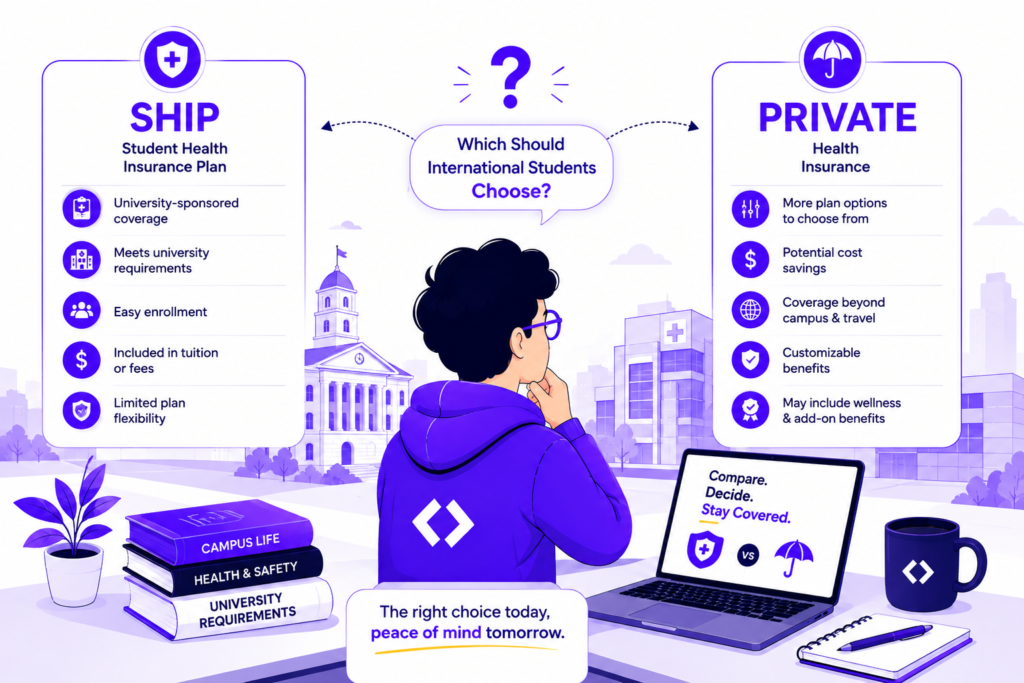
University-Sponsored Plans
Offered directly by the university and designed around international students’ needs, these plans typically offer comprehensive coverage. Carnegie Mellon University, for example, offers a university-sponsored plan through Highmark Blue Cross Blue Shield covering medical, dental, and vision care, running August 1 to July 31 to align with the academic year.
The cost is usually rolled into tuition, so you’re automatically enrolled – a setup known as a Mandatory Group Health Insurance Plan. Some universities instead offer a Group Health Insurance Plan with the option to waive, letting you opt for a private plan instead.
Also read: US University Health Insurance Waiver Guide
Private Health Insurance Plans
If the university plan isn’t the right fit, you can buy a private plan instead – provided it meets your university’s minimum criteria for a waiver. Private plans typically offer:
- A wider range of coverage levels, deductibles, and benefits to match your budget
- Additional coverage options for pre-existing conditions, maternity care, mental health, or sports injuries
- The ability to add F2 dependents in many cases
- Some plans include emergency medical evacuation or repatriation coverage
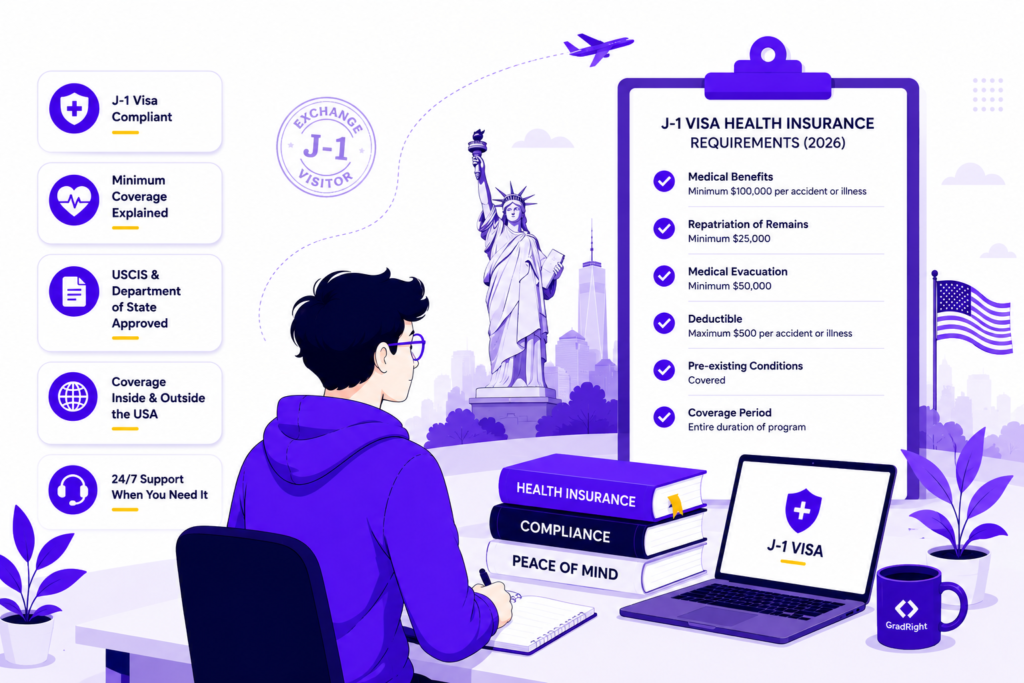
University plans (SHIP) are typically the more robust option – they generally cover pre-existing conditions, mental health support, and medical evacuation (mandatory for J-1 visa holders) without question. Private plans are usually more affordable, but the university will only grant a waiver if the private plan covers everything the university plan does – a high deductible or missing maternity cover can get a waiver request denied.
Benefits of Having Health Insurance
- Avoiding unexpected medical costs – insurance absorbs the financial shock of a sudden illness or injury.
- Access to preventative care – regular check-ups, vaccinations, and screenings are usually covered without extra cost, helping catch issues early.
- No yearly or lifetime limits – many student plans offer unlimited coverage, so you’re not capped on how much you can claim.
Best Health Insurance Providers for International Students
ISO Insurance
One of the more affordable options, with plans starting around $31/month and separate plans by visa type (F1, J1, J visa scholars, OPT, F2/J2 dependents).
| Feature | OPTima Basic | OPTima Enhanced |
|---|---|---|
| Monthly Cost | $39 | $79 |
| Annual Maximum | Unlimited | Unlimited |
| Per Injury/Sickness Maximum | $125,000 | $500,000 |
| Deductible | $400/event | $250/event |
| Pre-existing Conditions | Covered after 12 months | Covered after 12 months |
| Medical Evacuation | $50,000 | $60,000 |
| Provider Network | Aetna PPO | Aetna PPO |
ISO’s J1 Exchange plans (for J1 visa holders) run $39-58/month, and its F1 High School plans run $69-99/month – all figures should be reverified on ISO’s site since pricing is updated periodically.
International Student Insurance (Student Secure)
| Plan | Policy Max | Price/Month | Pre-existing Conditions |
|---|---|---|---|
| Smart | $200,000 | $32 | Acute onset up to $25,000; regular conditions excluded |
| Budget | $500,000 | $53 | Covered after 12 months |
| Select | $1,000,000 | $106 | Covered after 6 months |
| Elite | $5,000,000 | $181 | Covered after 6 months |
Allianz Care
| Plan Type | Max Plan Limit | Room Type | Maternity Option |
|---|---|---|---|
| Care | $675,000 | Semi-private | No |
| Care Plus | $1,518,750 | Private | Optional (10-month wait) |
| Care Pro | $3,037,500 | Private | No |
Cigna Global
| Plan | Annual Benefit Limit | Best For |
|---|---|---|
| Silver | Up to $1,000,000 | Quality core coverage |
| Gold | Up to $2,000,000 | Family or maternity cover |
| Platinum | Unlimited (paid in full) | Maximum protection |
Compare plan details directly on each provider’s site before purchasing – pricing and coverage terms are updated periodically and can shift by the time you enroll.
Understanding ACA Compliance
ACA compliance is the benchmark most universities expect from a private plan, even though the federal government doesn’t legally mandate it. An ACA-compliant plan must cover 10 essential benefits: emergency services, hospitalization, outpatient care, maternity and newborn care, mental health and substance use services, prescription drugs, rehabilitative services, lab services, preventive care, and pediatric care (including dental/vision for children). It also can’t deny pre-existing conditions and must fully cover vaccinations and annual wellness checkups.
Some states – California and Massachusetts among them – have their own laws requiring ACA-compliant coverage for students, and your private plan usually needs to be ACA-compliant to qualify for a university waiver in the first place.
Also read: Will Student Health Insurance in the US Cover Pre-Existing Conditions?
How to Apply
Step 1: Understand your requirements
Check your visa status – F1 visa holders are generally eligible for both university-sponsored and private plans; OPT visa holders typically need to look at private options.
Step 2: Research your options
Check whether your university offers a plan first. If not, or if you’re considering a private plan by choice, compare providers like ISO Insurance, Allianz Care, Student Secure, and Cigna Global.
Step 3: Compare plans
Focus on what’s actually covered – medical benefits, deductibles, and the out-of-pocket amount you’d pay before coverage kicks in.
Step 4: Apply for coverage
Fill out the insurer’s application with your personal details, program information, and – in some cases – proof of enrollment or an acceptance letter.
Step 5: Submit documentation
Provide proof of university enrollment and a copy of your visa to confirm your status as an international student.
Step 6: Pay the premium
Once your application is approved, pay your first premium to activate coverage.
Step 7: Get your insurance ID card
You’ll receive an ID card and policy document – keep the card on hand, since you’ll need to present it at hospitals and clinics, and review the policy for what is and isn’t covered.
Common Mistakes to Avoid
- Choosing the cheapest plan without reading the fine print – a low-cost plan the university later rejects for a waiver defeats the purpose.
- Ignoring in-network coverage – the USA is large, and an out-of-network hospital visit can be extremely costly; confirm there’s in-network coverage near your campus.
- Overlooking mental health coverage – being far from home, combined with coursework stress, makes ready access to a counselor genuinely important.
- Misunderstanding deductibles and copays – a deductible is what you pay out of pocket before insurance kicks in; a copay is a percentage split with the insurer. High deductibles and copays both mean more money out of your pocket per claim.
Also read: 5 Problems Students Face When Studying Abroad
What International Student Health Insurance Costs
University plans can be pricey – Stanford’s Student Health Insurance Plan (SHIP) cost $7,128 for 2025-26, while the University of Chicago’s ran $4,998. Private plans are typically far more budget-friendly: ISO Insurance, for instance, starts around $31/month, with broadly comparable benefits to many university plans at a fraction of the cost, and often more flexible enrollment windows.
Funding Your Studies Alongside Insurance
Insurance is one recurring cost among many – tuition and living expenses are the bigger piece, and most Indian students end up needing an education loan to cover them. GradRight simplifies the loan search by letting lenders compete for your profile: create a free profile, and 18 lending partners – Indian banks, NBFCs, and international lenders – respond with competitive offers within about two days. You can compare and shortlist with help from an independent financial expert, upload documents securely through a single portal, and get loan approval in as little as 10 days – some students have saved up to ₹23 lakh through better rate comparison alone.
Related Articles
Top 5 Health Insurance for International Students in USA
US University Health Insurance Waiver Guide
Will Student Health Insurance in the US Cover Pre-Existing Conditions?
Mental Health Coverage in Student Health Insurance Plans
ACA Compliant Insurance for International Students: Complete Guide







 Australia
  Canada
  France
  Germany
  India
India  Ireland
  UAE
UAE  United Kingdom
  United States