





Everything you need to know about studying a Master’s in Business Management
Thinking of building a career in business management?
Wondering how to get there?
Ever heard of the Master’s in Business Management program?
If your answer to all these questions is yes, the internet has landed you on the right page.
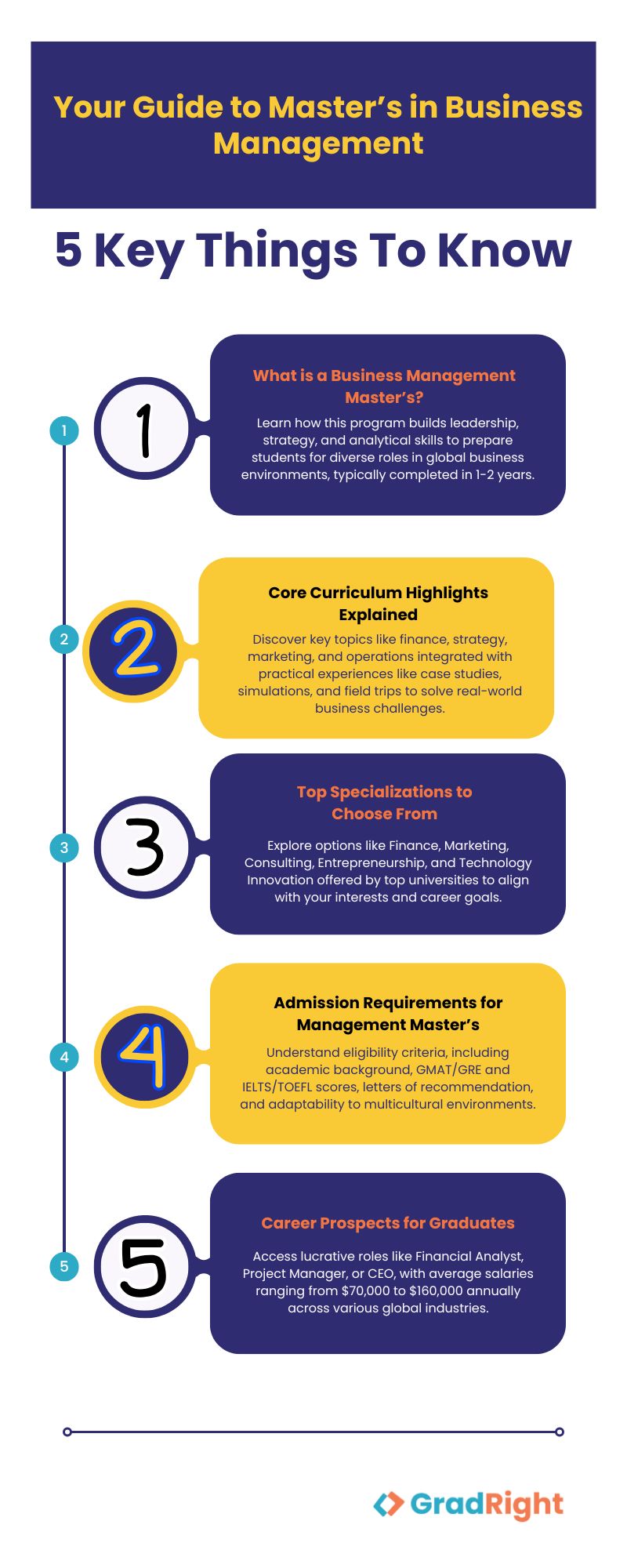
A Master’s in Business Management is a one-two year program that focuses on creating leaders and decision-makers of the future. If you are keen on entering this industry, you must learn more about the pathway and everything the world of business management has to offer.
Master’s in Business Management: an overview
Before diving deep into the field, let’s get to know the Master’s in Business Management program in brief. It is a professional degree program offering a multidisciplinary leadership approach. From business enterprise to operations to analytics to strategy, the program helps students excel in the business world.
Here’s an overview of the program:
| Aspects | Details |
| Program focus | Covers core business areas like finance, marketing, strategy, and operations management. |
| Program duration | Typically 1-2 years, depending on the country and institution. |
| Program objective | Offered by top universities worldwide, tailored for diverse industries and managerial roles. |
| Specializations | Common options include Marketing, Finance, Entrepreneurship, and Supply Chain Management. |
| Tuition Fee Range | Between $20,000 and $100,000 globally, depending on the university and location. |
| Eligibility Criteria | Bachelor’s degree (any discipline), GMAT/GRE scores, English proficiency tests (IELTS/TOEFL). |
| Skills Developed | Leadership, critical thinking, problem-solving, communication, and global business strategy. |
| Career Opportunities | Roles in management consulting, finance, marketing, operations, and technology sectors. |
What does a Master’s in Business Management involve today?
Most Master’s in Business Management universities have their own key topics in the curriculum. However, the program generally integrates practical learning experiences with core business disciplines.
Although the key topics at various universities may vary, the objectives remain somewhat similar. Most universities design courses like finance, strategy, marketing, and operations to enhance a student’s negotiation, analytical, and problem-solving skills. Students also work on case studies, consult on projects, and learn through simulations to solve real-world business challenges.
To understand everything involved in a Master’s in Business Management today, let’s check the Master in Management program’s curriculum at INSEAD. The program has five periods: core courses, electives, workshops, and practical work. Here’s a complete breakdown of the curriculum:
Period 1 (takes place in Fontainebleau):
| Core courses |
|
| Workshop | Corporate Communications |
| Launch Week |
|
| Practical | Leveraging data for marketing science |
Period 2 (takes place in Fontainebleau):
| Core courses |
|
| Workshop |
|
| Practical | Valuing innovation/ BBB deals |
Period 3 (takes place in Fontainebleau):
| Core courses |
|
| Workshop | Project Management |
| Field Trip (San Francisco or Abu Dhabi) |
|
| Practical | Sustainability and business model innovation |
Period 4 (takes place in Singapore):
| Core courses |
|
| Workshop | Project Management |
| Field Trip (China or Singapore) |
|
| Practical | Blue Ocean Strategy |
Period 5 (takes place in Singapore):
| Electives (6) |
|
Period 6 (worldwide):
The MIM program concludes with professional exposure, either through an internship or a full-time job for 4-6 months.
What specializations are available for a Master’s in Business Management program?
Just like the curriculum, specializations under a Master’s in Business Management program also vary for different universities. Here’s a list of the top business management universities in the world and their specializations:
| Top Universities | Master’s in Business Management Specializations Offered |
| Harvard Business School (HBS), USA | Leadership & Organizational Behavior, Strategy, Entrepreneurship, Marketing |
| INSEAD, France/Singapore | International Business, Consulting, Strategy, Marketing |
| Stanford Graduate School of Business, USA | Technology Innovation, Finance, Global Management, Operations |
| Wharton School, University of Pennsylvania, USA | Risk Management, Corporate Strategy, FinTech, Operations Management |
| London Business School (LBS), UK | Business Analytics, Finance, Marketing, Strategic Management |
| University of Chicago Booth, USA | Behavioral Science, Accounting, International Business, Decision Making |
| MIT Sloan School of Management, USA | Innovation, Supply Chain Management, Financial Engineering, Data Analytics |
| Columbia Business School, USA | Value Investing, Real Estate, Healthcare Management, Strategy |
| HEC Paris, France | Digital Transformation, Luxury Management, Sustainability, Finance |
| IE Business School, Spain | Technology and Innovation, Global Markets, Family Business, Finance |
These specializations cater to different interests. Some specializations are better suited for experienced professionals, while some help students kickstart their careers in business and management. Although the curriculum and subjects included in these specializations vary, the admission requirements remain the same. Let’s discuss the requirements in detail below.
What are the usual admission requirements for a Master’s in Business Management?
Here are the eligibility criteria you must meet for a Master’s in Business Management program:
Academic Background:
- You must hold a bachelor’s degree from a recognized university or college.
- General management programs don’t have any specific academic requirements in terms of the study area. However, STEM-designated programs may require you to hold a relevant UG degree.
Tests:
- Most universities, like Harvard and INSEAD, require you to submit your GMAT or GRE scores.
- You must also prove your English proficiency by submitting your IELTS or TOEFL scores.
Work Experience:
- The work experience requirement varies depending on the program and university.
- For instance, the MIM program at INSEAD requires no professional experience.
- On the other hand, the general and advanced management programs at Harvard University require students to have at least 10 years of professional experience.
International Motivation and Ability to Contribute:
- Many universities, like INSEAD, offer different semesters/parts of their programs in various parts of the world. This requires students to demonstrate flexibility to adapt to multicultural environments.
- Some universities also seek candidates who can contribute to the field and society.
Reference Letters/ Letters of Recommendation:
- Universities require applications to submit one or multiple letters of recommendation.
- These letters must be submitted by your manager/ seniors at work or in school.
- Depending on the university, you must submit 2-3 essays on given topics/ questions or a personal statement (SOP).
Why should you learn about business management?
Now that you have understood the Master’s in Business Management program, let’s learn how this degree will help you establish a career. Here’s why you should learn about business management before stepping into the workforce:
- A management degree teaches you to apply what you have learned in your classroom to real-world scenarios through projects and internships.
- These projects also teach you to identify problems and generate winning solutions for real businesses even before graduating.
- From formulating business strategy to accounting to financial management, this program covers everything you must know to run a team of experts or organizations.
- The program’s curriculum is designed to enhance your negotiation and analytical skills and help you capitalize on AI or digital transformation. These skills give you a competitive advantage in the real world by teaching you to build an innovative business culture.
- By learning about business management from some of the top institutions in the world, you can take your career global and be the decision-makers in the biggest industries.
What are the benefits of choosing a business management career?
In today’s dynamic and complex work environment, a career in business management is a lucrative option for young and experienced professionals. The BLS (Bureau of Labor Statistics) suggests that management-related jobs have the highest median wage among major occupational groups. As of 2021, the annual median salary of a management professional in the USA is $102,450. By 2031, the sector will grow by 10.6% after healthcare and food preparation.
Apart from the monetary compensation and future growth, the demand for management graduates is increasing daily. Organizations prefer leaders with management education to run businesses.
Choosing a career in business management also opens doors to entrepreneurship. The knowledge and experience gained equip one to develop and manage one’s own business successfully.
Note: This promising future in business management begins with getting admitted to a great MS in Business Management program. However, finding the right university isn’t as simple as it seems. Rankings alone don’t tell you everything—factors like alumni networks, placement rates, and ROI matter just as much.
This is where GradRight’s university-search platform becomes your best ally. It’s not about just choosing a good university; it’s about choosing the one that’s right for you. Here’s how GradRight makes it easy:
- Data-Driven Shortlisting: Using 8 million data points, it evaluates 40,000+ programs and 4,000+ universities worldwide.
- Personalized Recommendations: Get universities matched to your academic profile, career goals, and financial needs.
- Key Insights: Find value-added details like placement rates, alumni networks, and program ROI.
- Filter Easily: Narrow down options based on location, costs, and specialization preferences.
- Free and Unbiased: Access all this without any hidden charges or biases.
With GradRight, you can make an informed choice that sets the foundation for your business management career.
Now that you know how to find the right program, let’s look at the different functions an MBM graduate has to perform.
What are the different functions and processes involved in business management?
As a business management professional, you oversee operations, set targets and future goals, develop plans to increase efficiency, and more. This domain includes the following functions and processes to run an operation or organization effectively:
- A business management professional is responsible for structuring and coordinating teams and defining roles to achieve the overall objectives.
- Planning is one of a management professional’s most essential functions. They lay the foundation of a business by establishing and planning toward achieving organizational goals, developing timelines, and analyzing potential risks.
- A Master’s in Business Management leads to, as the name suggests, leadership and management positions. So, leading teams or organizations is another important function. From inspiring teams to communicating a vision to creating a positive culture, leadership roles require maintaining productivity and morale.
- A management professional’s crucial role is monitoring the company’s performance and setting new standards. They regularly measure different performance metrics and help organizations adapt to new changes.
- Staffing or building teams include professionals conducting interviews and onboarding new employees. They identify human resource requirements and hire the right people for the jobs.
Apart from these functions, a business management professional is also involved in the following processes:
- Operations management: Dealing with the day-to-day workings of an organization.
- Strategic management: Creating a long-term vision for the company.
- Marketing and sales: Researching the marketing and identifying the right audience for the brand or product.
- Risk management: Analyzing potential challenges and risks for the business and finding solutions to deal with them.
- Financial management: Managing the organization’s financial resources and cash flow.
- Project management: Working on projects from ideation to execution by delegating teams.
What are the top business management skills you are expected to develop for a career in this field?
According to Payscale, here’s a list of the top business management skills that affect your salaries:
- Financial modeling
- Process Involvement
- Business strategy
- Profit & Loss (P&L) Statements
- SQL
- Legal awareness
- Technology proficiency
- Consulting management
- Product development
- Business intelligence
- Strategic management
- Risk control
- Risk management
Apart from these technical skills, you must also have the following managerial and leadership skills:
- Strong communication skills
- Creativity
- Innovation
- Organizational skills
- Critical thinking
- Problem-solving
- Time management
- Negotiation
- Emotional intelligence
- Adaptability
What kind of career prospects can you find in business management?
With a strong curriculum and global exposure, a Master’s in Business Management degree offers lucrative career prospects to students. Here’s how much a business graduate earns in the USA:
| Job Title | Annual Salary Range | Average Annual Salary |
| Financial Analyst | $55k – $94k | $70,053 |
| Senior Financial Analyst | $76k – $111k | $93,116 |
| Human Resources (HR) Manager | $50k – $98k | $70,481 |
| Chief Financial Officer (CFO) | $101k – $246k | $159,557 |
| Director of Operations | $76k – $182k | $119,738 |
| Human Resources (HR) Generalist | $52k – $79k | $63,595 |
| Finance Manager | $70k – $125k | $99,451 |
| Project Manager, (Unspecified Type / General) | $65k – $135k | $94,674 |
| Financial Controller | $66k – $140k | $97,071 |
| Accounting Manager | $56k – $102k | $75,771 |
| Chief Executive Officer (CEO) | $84k – $334k | $167,195 |
| Operations Manager | $53k – $129k | $83,878 |
| Staff Accountant | $47k – $81k | $61,257 |
| Senior Business Analyst | $75k – $134k | $100,400 |
| Human Resources (HR) Director | $59k – $144k | $92,915 |
| Contract Specialist | $48k – $98k | $68,828 |
| Plant Manager, Manufacturing | $73k – $153k | $106,513 |
| Senior Marketing Manager | $86k – $155k | $118,377 |
| Chief Operating Officer (COO) | $88k – $255k | $158,419 |
| Business Development Manager | $49k – $120k | $77,774 |
| Finance Director | $74k – $168k | $119,645 |
Source: Payscale
Apart from the USA, the following are the salaries of a Master’s in Business Management graduate in the UK, Germany, Canada, and Australia:
| Country | Average Initial Salary* |
| The UK | £42,500 to £100,000 |
| Canada | CAD 66,400 |
| Germany | €40,000 to €55,000 |
| Australia | AUD 60,000 to AUD 90,000 |
*The data varies for different educational backgrounds, work experiences, skill sets, employers, etc.
Organizations like the Boston Consulting Group, The Big 4, and many Fortune 500 companies recruit business graduates from the top universities in the world. However, as high as the program’s ROI is, the course cost can still poke a hole in your pockets, especially if you aim for institutes like INSEAD, Harvard, and MIT.
So, if managing finances for your dream program worries you, let GradRight’s loan-search platform turn your issues into powerful solutions. With GradRight’s loan-search platform, you can get up to INR 2 crores of study abroad loans and save up to INR 23 lakhs during the process.
So, wait no more and begin your journey today and share your needs with the GradRight’s loan-search platform team today.
FAQs
1. What is a master’s in business management?
A master’s in Business Management is a one—to two-year professional degree program that prepares managers and leaders.
2. Is an MBA harder than a Master’s?
There are no clear distinctions in the difficulty levels of pursuing an MBA or a master’s. However, an MBA program may have a more rigorous selection process than a master’s program. You must check with the official websites of your intended universities to get more information.
3. What is the difference between a Master’s in Business Management and an MBA?
Typically, a Master’s in Business Management program targets early-career individuals, while an MBA targets experienced individuals by focusing on practical solutions and leadership. However, this may vary for different universities. For instance, the general and advanced management programs at Harvard University require students to have at least 10 years of professional experience.
4. How do you understand business management?
The role of a business management professional includes major decisions, from developing strategies to controlling various resources to achieve organizational goals. They ensure the efficiency and productivity of different departments across organizations.
5. What are the 4 steps of business management?
The four business management steps are planning, leading, organizing, and controlling.

 Australia
  Canada
  France
  Germany
  India
India  Ireland
  UAE
UAE  United Kingdom
  United States