





Every year, thousands of students head to foreign universities for their Master’s in Electrical Engineering. The program delivers technical training to students with a background in the engineering domain and helps them tap into opportunities in emerging areas – from semiconductor design and power systems to AI hardware and renewable energy.
According to the Bureau of Labor Statistics, employment of electrical and electronics engineers is projected to grow 9% from 2023 to 2033, with 17,800 new job openings expected in the USA every year. The median annual salary for electrical engineers in the USA is $109,010. Annual earnings can reach up to $111,000 and beyond at top employers.
MS in Electrical Engineering 2026 – Key Facts
| Feature | Details |
| Program duration | USA: 1.5-2 years; UK: 1-2 years; Germany: 2 years; Canada: 1.5-2 years; Australia: 1.5-2 years |
| BLS median salary (USA, 2023) | $109,010 per year ($52.41 per hour); up to $111,000+ at top employers |
| Glassdoor average (MS EE, 2026) | $157,927 per year (Glassdoor March 2026; includes experienced professionals) |
| Annual new jobs (USA) | Estimated 17,800 per year (BLS projection) |
| Employment growth (USA, 2023-2033) | 9% (BLS Occupational Outlook Handbook 2024) |
| STEM OPT extension (USA) | 36 months of OPT work authorization after graduation; MS EE is STEM-designated |
| Degree types | MS (research-oriented; thesis required); MEng (professionally-oriented; industry-focused; no thesis) |
| Top hiring industries | Semiconductor manufacturing, AI hardware, aerospace and defense, renewable energy, telecommunications, automotive |
| Top hiring companies | Apple, Google, Intel, NVIDIA, Qualcomm, Amazon, Tesla, Lockheed Martin, Boeing, Siemens, Texas Instruments |
| Specialisations | Control Systems, Signal Processing, Power Electronics, Embedded Systems, VLSI Design, Communications, Photonics, AI Hardware |
MS vs MEng in Electrical Engineering: Choose First
There are primarily two types of master’s degrees in electrical engineering. Choosing the right type is more important than choosing the university:
| Dimension | MS (Master of Science) | MEng (Master of Engineering) |
| Focus | Research-oriented | Professionally-oriented; practical skills focus |
| Thesis | Required (significant research project or thesis) | Not required |
| Duration | 1.5-2 years typically | 1-1.5 years typically (faster completion) |
| Best for | Students who want to pursue PhD or careers requiring deep research (R&D labs, academia, advanced engineering) | Students who want to enter industry directly after graduation |
| PhD pathway | Strong foundation for PhD admission | Not the standard PhD preparation route |
| Available at | MIT, Stanford, CMU, Georgia Tech, UC Berkeley (USA); Imperial, Cambridge (UK); TU Munich, RWTH (Germany) | Many US universities offer both; MEng more common at UK universities (integrated programs) |
| Source | GradRight original article |
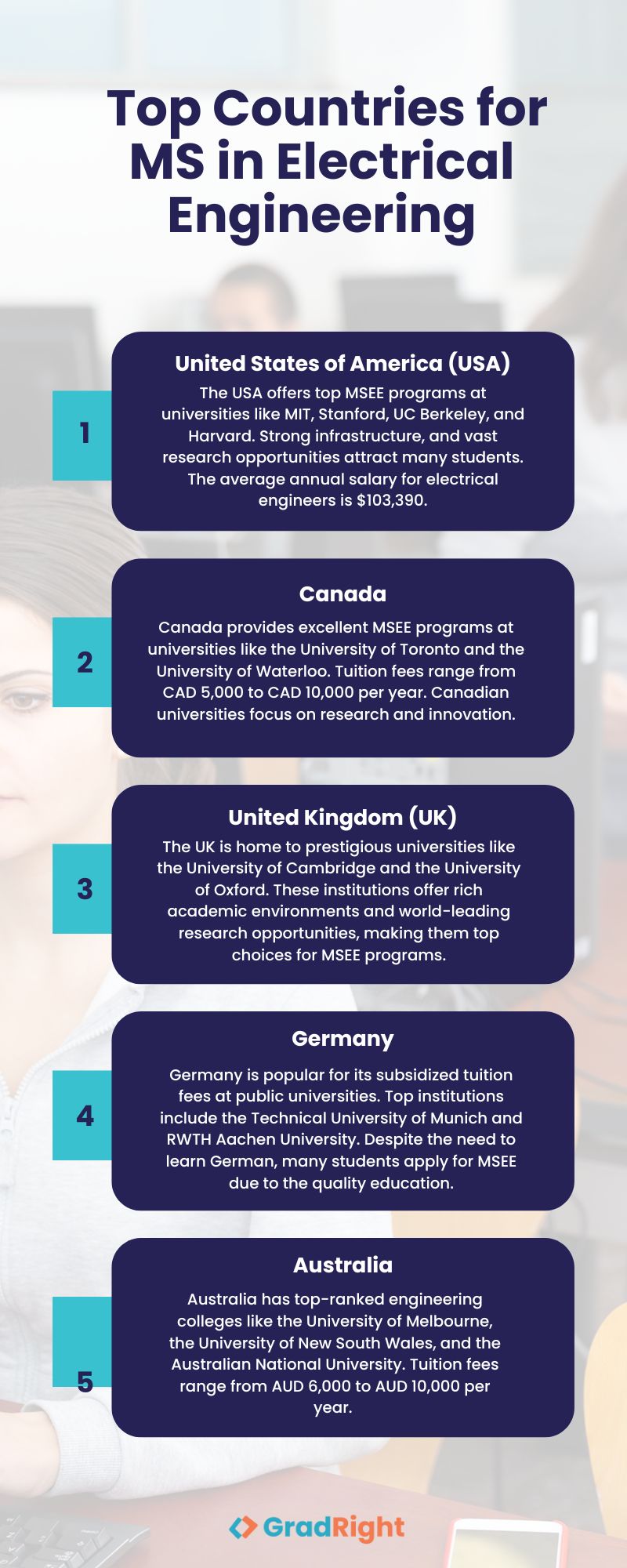
Top Countries for MS in Electrical Engineering
| Country | Why Choose It | Annual Tuition (approx.) | Post-Study Work |
| USA | World’s top EE universities; STEM OPT 36 months; Silicon Valley, semiconductor, AI hardware sectors; BLS median $109,010 | USD 25,000-70,000+ depending on public/private university | 36 months STEM OPT; then H-1B lottery or employer sponsorship |
| Germany | TU Munich, RWTH Aachen – globally top-ranked at near-zero tuition; automotive, industrial, semiconductor industry access | EUR 0 (public) + semester contribution EUR 100-300; non-EU may pay EUR 1,500/semester in some states | 18-month job seeker visa; EU Blue Card if employed |
| UK | Imperial College London, Cambridge, Edinburgh; 1-2 year programs; 2-year Graduate Route visa | GBP 22,000-35,000/year | 2-year Graduate Route post-study; 3 years for PhD graduates |
| Canada | University of Toronto, University of Waterloo; CAD 5,000-10,000/year – much lower than USA; PGWP 3 years | CAD 5,000-10,000/year (most affordable of top EE destinations) | PGWP up to 3 years; clear PR pathway via Express Entry |
| Australia | University of Melbourne, UNSW, University of Sydney; STEM-friendly; 2-4 year Subclass 485 visa | AUD 35,000-50,000/year | Subclass 485: 2-4 years; regional study qualifies for extended visa |
The USA is one of the best countries for MS in Electrical Engineering because of its strong infrastructure, high-quality education, and vast research opportunities. Canada is a more affordable option that does not compromise on quality – tuition fees range from CAD 5,000 to CAD 10,000 per year.
Top Universities for MS in Electrical Engineering Globally
| University | Country | EE Specialisation Strength | Annual Tuition (approx.) |
| MIT (EECS) | USA | AI hardware, signal processing, systems, power, photonics; #1 globally across most rankings | USD 57,000-60,000+ (verify mit.edu) |
| Stanford University | USA | Semiconductors, AI hardware, control systems, photonics, communications; Silicon Valley proximity | USD 60,000-66,000+ (verify stanford.edu) |
| UC Berkeley (EECS) | USA | EECS – combined EE and CS; power electronics, signal processing, communications | USD 29,000-44,000 (public rates; verify berkeley.edu) |
| California Institute of Technology (Caltech) | USA | Applied physics, electrical engineering, control systems, signal processing; small and intense | USD 60,000+ (verify caltech.edu) |
| Carnegie Mellon (ECE) | USA | Electrical and Computer Engineering; robotics, AI hardware, embedded systems | USD 50,000-55,000 (verify cmu.edu) |
| Georgia Tech | USA | Strong EE program; power electronics, signal processing; more affordable than private peers | USD 32,000-38,000 (verify gatech.edu) |
| University of Cambridge | UK | Electrical Engineering tripos; communications, power, electronics; strong research depth | GBP 35,000-38,000+ (verify eng.cam.ac.uk) |
| Imperial College London | UK | Electrical Engineering; power, communications, photonics, biomedical electronics | GBP 32,000-37,000+ (verify imperial.ac.uk) |
| TU Munich (EEI) | Germany | Electrical Engineering and Information Technology; automotive, power electronics, embedded systems; near-zero tuition | EUR 0 + semester contribution (verify tum.de) |
| RWTH Aachen University | Germany | Electrical Engineering; power, automation, communications; strong German industry connection | EUR 0 + semester contribution (verify rwth-aachen.de) |
| University of Toronto | Canada | ECE; power systems, communications, photonics; most affordable top-10 EE program globally | CAD 5,000-10,000 (verify utoronto.ca) |
| University of Waterloo | Canada | Electrical and Computer Engineering; strong co-op and tech industry links; Waterloo tech ecosystem | CAD 8,000-15,000 (verify uwaterloo.ca) |
| University of Melbourne | Australia | Electrical Engineering; power, signal processing, telecommunications; PGWP pathway | AUD 40,000-50,000 (verify unimelb.edu.au) |
Some of the renowned global universities that offer an MS in Electrical Engineering are MIT, Stanford, the University of Cambridge, the Technical University of Munich, and the University of Melbourne.
Also Read: Top Engineering Universities in the World
Popular Specialisations in MS Electrical Engineering
| Specialisation | What It Covers | Key Career Paths | Top Programs |
| Signal Processing | Digital signal processing, image processing, audio engineering, machine learning applications to signals | Signal Processing Engineer, DSP Engineer, Audio Engineer | MIT, Stanford, Georgia Tech, Imperial College |
| Control Systems | Design and management of control systems; robotics, autonomous vehicles, industrial automation | Controls Engineer, Robotics Engineer, Automation Specialist | MIT, Stanford, Caltech, TU Munich |
| Power Electronics and Energy Systems | Power conversion, renewable energy systems, grid systems, electric vehicles | Power Electronics Engineer, Energy Systems Engineer, EV Engineer | TU Munich, RWTH Aachen, UC Berkeley, Georgia Tech |
| Embedded Systems | Microcontroller programming, real-time systems, IoT hardware, firmware development | Embedded Systems Engineer, Firmware Engineer, IoT Developer | TU Munich, RWTH Aachen, CMU, Waterloo |
| VLSI Design / Semiconductor Engineering | Chip design, CMOS, integrated circuits, semiconductor fabrication | VLSI Design Engineer, Chip Designer, Semiconductor Engineer | MIT, Stanford, UC Berkeley (semiconductor hub proximity) |
| Communications and Networking | Wireless communications, 5G/6G, network protocols, photonics | Communications Engineer, RF Engineer, Network Architect | Stanford, Cambridge, University of Toronto |
| AI Hardware and Computing | AI accelerators, neural network hardware, GPU design, computer architecture | AI Hardware Engineer, Computer Architect, HW/ML Engineer | MIT, Stanford, CMU, Georgia Tech |
| Biomedical Electronics | Medical devices, neural interfaces, biosignal processing, imaging systems | Biomedical Engineer, Medical Device Designer | Imperial College London, Johns Hopkins, University of Melbourne |
Eligibility Requirements for MS in Electrical Engineering
| Requirement | Standard Expectation | Notes |
| Undergraduate degree | B.E./B.Tech in Electrical Engineering, Electronics and Communication, Computer Engineering, or Physics | Some programs accept strong quantitative backgrounds in related fields; verify per program |
| GPA | Minimum 7.0/10 or 70% (approx. 3.0/4.0 GPA) | Top programs (MIT, Stanford, Caltech) effectively require 3.5-3.9+ for competitive admission |
| GRE | Most USA programs require GRE; 155-165+ Quant recommended | Germany, UK, Canada: GRE generally not required. Verify per program. |
| IELTS | 6.5-7.0 for most programs; 7.0+ for Cambridge, Imperial, MIT | Required for all non-native English speakers including Indian applicants |
| TOEFL | 90-100+ iBT for most programs | Alternative to IELTS; accepted at all programs that accept IELTS |
| Statement of Purpose | 1,000-1,500 words; required at all programs | Should articulate specific research interests, sub-specialisation, and why this university/lab |
| Letters of Recommendation | 3 letters; 2+ from faculty who supervised research or projects | At top research programs, recommendations from faculty carry more weight than employer recommendations |
| Work experience | Not required; 1-2 years is an advantage for MEng programs | Research experience (undergraduate final year project, internship at R&D lab) is more valuable than industry work experience for research-track MS programs |
| Germany specific | APS (Academic Evaluation Centre) certificate for Indian applicants | Process takes 4-8 weeks; start early. Required at German universities. |
Career Paths and Salary After MS in Electrical Engineering
| Career Role | Avg. USA Salary | Key Industry | Specialisation Best Fit |
| Electrical Engineer (BLS median) | $109,010/year | All sectors | General EE |
| Signal Processing Engineer | $95,000-130,000 | Audio, defense, telecommunications | Signal Processing |
| Power Electronics Engineer | $90,000-130,000 | Renewable energy, automotive, industrial | Power Electronics |
| VLSI / Semiconductor Design Engineer | $110,000-150,000+ | Semiconductor (NVIDIA, Qualcomm, Intel, TSMC partners) | VLSI/Semiconductor |
| Embedded Systems Engineer | $95,000-130,000 | Automotive, IoT, consumer electronics | Embedded Systems |
| AI Hardware Engineer | $120,000-170,000+ | AI/ML companies, NVIDIA, AMD, Google TPU team | AI Hardware |
| RF/Communications Engineer | $95,000-135,000 | Telecommunications, 5G, defense | Communications |
| Biomedical Electronics Engineer | $99,550 (BLS median, biomedical) | Medical devices, pharma, hospitals | Biomedical Electronics |
| Aerospace/Defense Electrical Engineer | $126,880 (BLS aerospace median) | Boeing, Lockheed, Northrop, Raytheon | All EE specialisations |
| Semiconductor manufacturing engineer | $144,960 (BLS, semiconductor sector) | Intel, TSMC, Samsung Fab, Micron | VLSI, Semiconductor |
The highest-paying industries for MS EE graduates include technology companies, the semiconductor industry, renewable energy, AI hardware, and aerospace and defense. Source: GradRight original article; BLS Occupational Outlook Handbook (bls.gov); Glassdoor (March 2026).
Top Companies Recruiting MS Electrical Engineering Graduates
- Semiconductor and chip companies: NVIDIA, Qualcomm, Intel, AMD, Texas Instruments, Broadcom, TSMC-partnered design firms
- Technology companies: Apple (hardware engineering), Google (TPU team, hardware), Amazon (AWS hardware, Alexa devices), Microsoft
- Automotive and EV: Tesla, General Motors, Ford, Bosch, Continental, Aptiv
- Aerospace and defense: Lockheed Martin, Boeing, Northrop Grumman, Raytheon, L3Harris
- Telecommunications: Ericsson, Nokia, Qualcomm, Samsung, Verizon (research), AT&T Labs
- Renewable energy: Siemens Energy, GE Vernova, ABB, Schneider Electric
- Medical devices: Medtronic, Abbott, Boston Scientific, Philips Healthcare
STEM OPT: Why MS EE is Especially Valuable for International Students in the USA
MS in Electrical Engineering is a STEM-designated program. This means international students completing their MS EE in the USA can extend their Optional Practical Training (OPT) period to 36 months – compared to just 12 months for non-STEM graduates. This gives students 3 years of work authorization in the USA after graduation, significantly improving their chances of securing employer H-1B sponsorship. Source: GradRight original article.
GradRight SelectRight uses 8 million+ data points to match your EE profile to the right MS program for your specialisation and career goals. Free, personalised. Find Your MS EE Program on GradRight
Also Read: Best Colleges for MS in Computer Science Engineering
Need education loans for MS EE abroad? Students using GradRight App get up to 40% better loan rates. 15+ lenders, zero paperwork. Apply on GradRight FundRight
Related Guides
Top Engineering Universities in the World
Best Colleges for MS in Computer Science Engineering
Future of Higher Education: Emerging Disciplines
AI Safe Jobs and Degrees for 2026
Education Loan Eligibility Criteria Guide for Indian Students
Is Taking a Rs 25-40 Lakh Education Loan Worth It?
GradRight SelectRight – University Selection Platform







 Australia
  Canada
  France
  Germany
  India
India  Ireland
  UAE
UAE  United Kingdom
  United States