





Quick Answer
An MBBS loan typically carries interest between 9% and 14% in India, with SBI, Bank of Baroda, and Canara Bank offering the lowest rates. Collateral is usually needed above Rs. 7.5 lakh.
Medicine is one of the most expensive degrees you can pursue in India, and that’s before you even factor in a management quota seat or a university abroad. Government college fees are still relatively reasonable, but private medical colleges routinely charge anywhere between Rs. 15 lakh and Rs. 1 crore or more for the full course. For most families, that number simply isn’t sitting in a savings account. It’s why an MBBS loan has become less of a backup plan and more of a default part of the admission process for thousands of students every year.
Getting a bank loan for medical studies isn’t as simple as walking into the nearest branch, though. Interest rates vary by 5 percentage points or more between lenders, collateral rules change depending on the amount you borrow, and government colleges versus private colleges versus universities abroad all come with different lending logic.
This guide breaks down exactly how financing works, which lenders are worth comparing, what you’ll need to qualify, and how the process differs if you’re planning to study medicine overseas.
Also Read: Education Loan for MBBS in India: Eligibility, Documents, Interest Rates, and How to Apply
Why a Medical Education Loan Is Different From a Regular One
Loans for medicine are treated a little differently by banks compared to loans for, say, an MBA or an engineering degree. Two things make this category its own:
Course duration is longer.
MBBS runs 5.5 years in India (including internship) and up to 6 years abroad, which means banks are underwriting a longer moratorium period and a bigger cumulative amount before repayment even starts.
The fee structure is front-loaded and unpredictable.
Private colleges often have hostel, equipment, and “development” fees on top of tuition, and these can increase year over year. Lenders factor this in when deciding your sanctioned amount.
Banks are generally comfortable lending for medical studies because the eventual earning potential of a doctor is high and default rates in this segment tend to be low. That’s actually good news for applicants: most nationalized banks have dedicated medical education loan slabs with slightly better terms than their generic education loan schemes.
Can I Get a Loan for MBBS in India? Understanding Eligibility
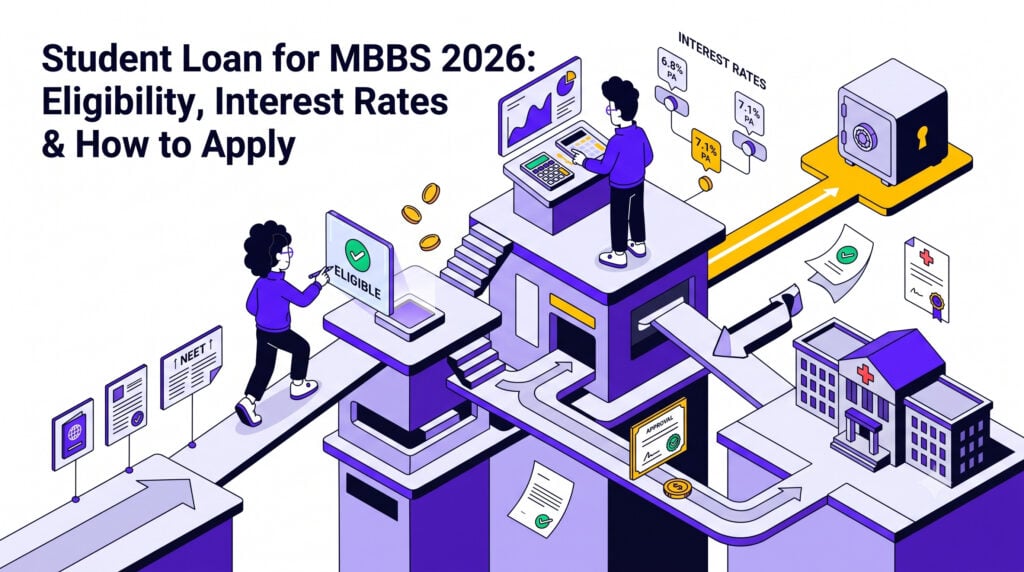
Yes, and this is one of the most common questions medical aspirants and their parents ask before they even start comparing lenders. If you’re wondering whether you can get a loan for MBBS in India, the honest answer is that almost every NEET-qualified student with a confirmed admission letter is eligible, though how much you get and at what rate depends on a few factors.
Basic Eligibility Criteria for a Bank Loan for MBBS
– You must be an Indian citizen with a confirmed admission to a recognized medical college or university (in India or abroad, subject to NMC guidelines for foreign degrees).
– You need a co-applicant, usually a parent or guardian, whose income and credit history the bank will also evaluate.
– Most banks expect NEET qualification as proof of merit-based admission, even for private colleges.
– Age limits are flexible for education loans, but most lenders prefer applicants under 35 at the time of loan maturity.
– A reasonably clean credit history for the co-applicant significantly improves approval odds and interest rate offers.
One misconception worth clearing up: getting into a management quota seat doesn’t disqualify you from financing. Banks will fund management quota admissions too, though the interest rate and collateral requirement are often slightly stricter than for merit seats.
Best Banks for MBBS Loans in India
Nationalized banks tend to offer the most competitive rates on medical education financing, largely because their pricing is linked to external benchmarks like the RBI repo rate rather than internal cost-of-funds calculations. Private banks and NBFCs price higher on average but can move faster and lend larger unsecured amounts in some cases.
| Bank / Lender | Indicative Interest Rate | Max Loan (India) | Collateral Threshold |
|---|---|---|---|
| State Bank of India (Scholar/Student Loan) | ~9.4% to 11.15% | Up to Rs. 30 lakh (India), higher abroad | Above Rs. 7.5 lakh |
| Bank of Baroda | ~10.05% | Up to Rs. 1.25 crore (secured) | Above Rs. 7.5 lakh |
| Canara Bank | ~9.75% | As per IBA model scheme | Above Rs. 7.5 lakh |
| Credila (NBFC) | ~10%-14% | Up to Rs. 1.5 crore | Case by case, higher amounts need collateral |
| Avanse Financial Services (NBFC) | ~11%-14% | Up to Rs. 60 lakh without collateral | Varies by profile |
Rates are indicative and change with RBI policy, your co-applicant’s credit profile, and the specific institute category the bank assigns your college. Always confirm current rates directly with the lender before applying.
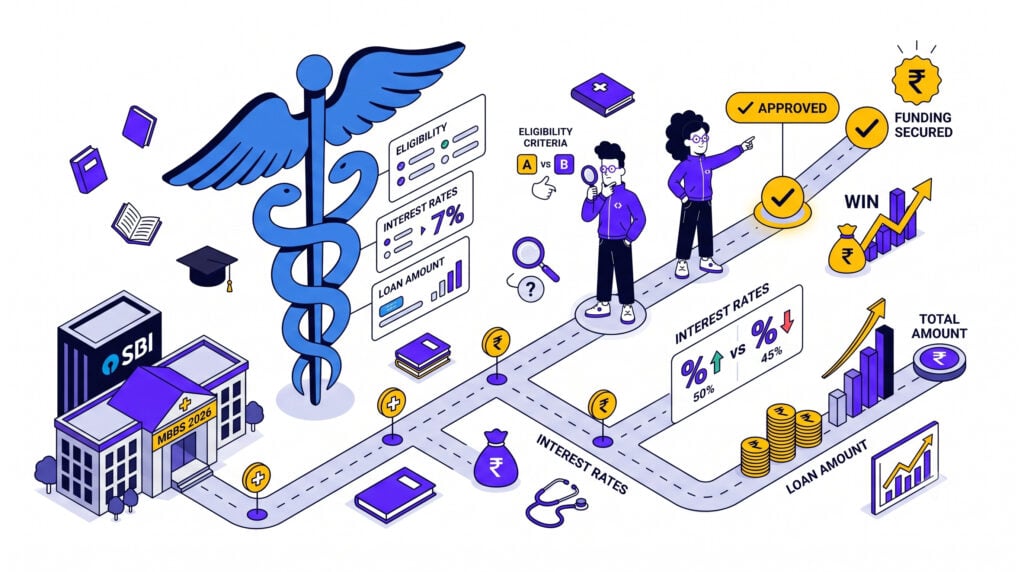
Also Read: SBI Education Loan for MBBS: Eligibility, Interest Rates, Loan Amount, and Application Process
Government Banks vs Private Lenders for Medical Financing
Government banks like SBI, Bank of Baroda, and Canara Bank generally win on interest rate and repayment flexibility, which is why most students start their search there. The trade-off is documentation and processing time; government banks can take a few weeks longer to sanction compared to NBFCs like Credila or Avanse, which specialize in education financing and often disburse faster with lighter paperwork. If your admission timeline is tight, a slightly higher rate from a private lender might be worth it for speed. If you have time on your side, a public sector loan is usually the cheaper route over the full tenure.
Interest Rates and How They’re Actually Calculated
Interest rates for medical studies aren’t one flat number; they depend on a mix of factors:
Institute category:
Public banks classify medical colleges into slabs (often labelled AA, A, B, C) based on ranking, placement record, and reputation. Higher-ranked colleges usually get you a lower rate.
Collateral vs unsecured:
Secured loans (backed by property, fixed deposits, or other assets) carry lower rates than unsecured ones because the bank’s risk is reduced.
Co-applicant’s credit score:
A CIBIL score above 750 for your co-applicant can meaningfully improve the rate you’re offered.
Gender-based concessions:
Most public banks, including SBI, offer a 0.5% interest concession for female students.
Loan amount:
Larger amounts sometimes come with marginally different pricing tiers depending on the bank’s internal policy.
Public sector banks typically price these loans between 9% and 11%, while private banks and NBFCs range from about 10% to 14%. The gap sounds small on paper, but over a 10 to 15 year repayment tenure on a Rs. 30-40 lakh loan, it adds up to lakhs of rupees in extra interest.
Collateral, Margin Money, and Moratorium on a Loan for MBBS
This is where a lot of families get confused, so let’s break it down simply.
Collateral:
For amounts up to Rs. 7.5 lakh, most public banks don’t ask for collateral, just a parent’s co-obligation. Beyond that threshold, banks typically require security, usually property, fixed deposits, or life insurance policies, worth around 1.25 to 1.5 times the loan amount. This applies whether you’re studying in India or funding a degree overseas.
Margin money:
For amounts above a certain threshold (commonly Rs. 4 lakh), banks may ask you to contribute a small percentage of the total cost upfront, usually 5% for domestic courses and slightly more for studies abroad. This isn’t universal across all schemes, so it’s worth confirming with your specific lender.
Moratorium period:
Almost every medical education loan comes with a moratorium, meaning you don’t have to start repaying the principal until your course ends plus a grace period (commonly 6 to 12 months). Interest may still accrue during this window unless you’re opting to service it, which is worth doing if you can afford it, since it reduces the total interest burden later.
A common myth is that financing becomes harder to secure once your course starts. That’s not accurate; most banks allow applications even mid-course, though it’s always easier and faster to apply before your first semester fee is due.
Also Read: Collateral-Free Loan for MBBS in India: A Complete Guide
Loan for MBBS Abroad: What Changes When You Study Overseas
Financing overseas medical education works on similar principles to a domestic loan for MBBS in India, but a few things shift meaningfully:
Higher loan ceilings:
Public banks can lend up to Rs. 1.5 crore for studies abroad with adequate collateral, while unsecured loans from select lenders can go up to roughly Rs. 2 crore for strong profiles.
Slightly higher interest rates:
Financing abroad typically carries rates around 10% to 13%, a touch higher than domestic rates, partly due to currency and country risk.
NMC recognition is non-negotiable:
Before you even think about financing, confirm the university is recognized under India’s National Medical Commission Foreign Medical Graduate Licentiate (FMGL) Regulations, 2021. Banks are increasingly cautious about lending for universities that don’t meet this bar, since an unrecognized degree can’t be used to practise in India.
Course duration matters:
NMC rules require a minimum 54-month clinical program abroad; banks structure moratorium periods around this, so a shorter, non-compliant course could actually complicate your eligibility.
Popular Destinations for an Abroad MBBS Loan
Russia, Georgia, Uzbekistan, Kazakhstan, and the Philippines remain the most common destinations Indian students choose when they need an abroad MBBS loan, largely because tuition costs are a fraction of Indian private college fees. Total costs (tuition plus living expenses) across a 6-year program in these countries generally range from Rs. 20 lakh to Rs. 35 lakh, compared to private colleges in India that can easily cross Rs. 60 lakh to Rs. 1 crore.
That said, cheaper tuition doesn’t always mean a smoother path; FMGE/NExT pass rates vary a lot by university, so it’s worth verifying academic outcomes, not just the fee sheet, before committing to a lender and a college simultaneously.
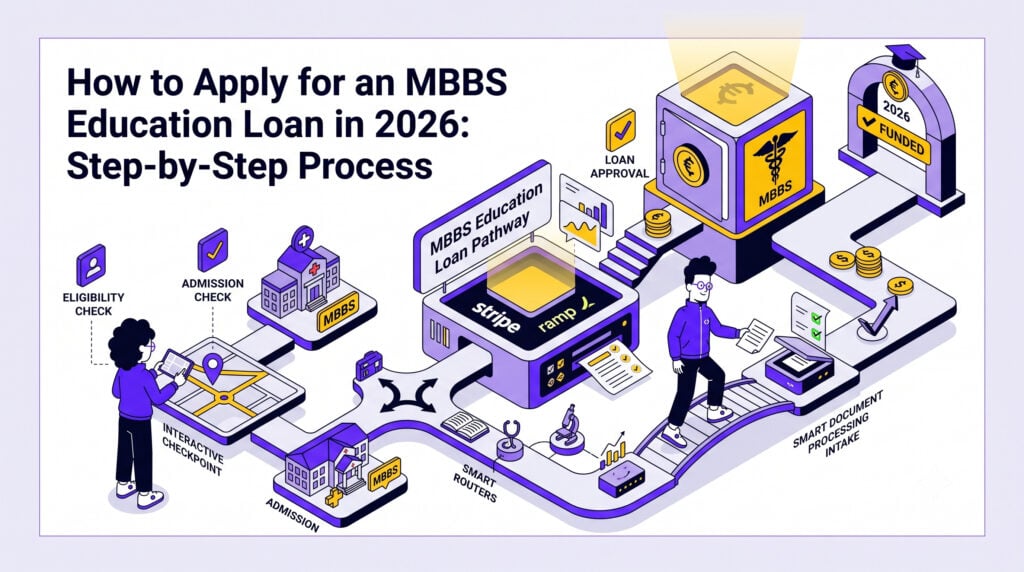
Documents You’ll Typically Need
Requirements vary slightly by bank, but most lenders ask for a similar core set:
– Admission or offer letter from the college or university
– Mark sheets for Class 10, 12, and NEET scorecard
– KYC documents (Aadhaar, PAN, passport) for both student and co-applicant
– Income proof and bank statements (last 6 months) for the co-applicant
– Collateral documents, if applicable (property papers, FD receipts)
– Passport-sized photographs and a filled application form
For studies abroad, add a valid passport, visa documentation, and sometimes a fee structure letter directly from the university’s finance office.
Tax Benefits on Your Loan Under Section 80E
Here’s something families often miss: the interest you pay on any education loan, including one taken for medicine, is fully deductible under Section 80E of the Income Tax Act, with no upper cap on the amount. This deduction is available for up to 8 years starting from the year you begin repayment, or until the interest is fully repaid, whichever comes first.
Only the interest component qualifies, not the principal, but over a 10 to 15 year tenure, this can meaningfully reduce the co-applicant’s tax outgo.
Common Mistakes Students and Parents Make
Applying to only one bank:
Rates and sanctioned amounts vary enough between lenders that comparing at least 3 to 4 options is worth the extra effort.
Ignoring the total cost of attendance:
Focusing only on tuition and forgetting hostel, equipment, insurance, and travel costs, especially for studies abroad, often leads to underborrowing.
Not checking NMC recognition before applying abroad:
Financing a non-compliant foreign university means spending money on a degree that may not be usable in India.
Skipping interest servicing during moratorium:
If you can afford even partial interest payments while studying, it meaningfully reduces the total repayment burden later.
Assuming private colleges automatically mean higher interest:
Rate depends more on institute ranking and collateral than purely public vs private status.
Making the Smarter Choice on Your MBBS Loan in India
Financing an MBBS degree, whether in India or abroad, is rarely a one-bank decision. Interest rates, collateral rules, and moratorium terms differ enough between lenders that comparing offers side by side genuinely changes what you end up paying over the life of the loan. This is exactly the kind of decision GradRight was built to simplify.
Through our platform students get competing offers from 15+ banks and NBFCs on a single profile instead of visiting branch after branch, alongside support on university selection, scholarships, and financial planning for the full study-abroad or medical-education journey. Compare your options through GradRight.
If you’re currently weighing your options for financing your medical degree, comparing real offers side by side is a good place to start before you sign anything.
Frequently Asked Questions
Can I get a loan for MBBS in India without collateral?
Yes, for amounts up to Rs. 7.5 lakh, most public banks don’t require collateral, just a parent or guardian as co-applicant.
Which bank offers the lowest interest rate for an MBBS loan in India?
State Bank of India and other public sector banks like Bank of Baroda and Canara Bank generally offer the most competitive rates, often in the 9% to 11% range, compared to 10% to 14% at private banks and NBFCs.
Is a separate loan needed to study MBBS abroad, or does the domestic scheme apply?
They’re technically different products. Financing for overseas medical studies usually falls under a bank’s “study abroad” or “global” education loan scheme, with different loan caps, documentation, and slightly higher interest rates than the domestic scheme.
How long is the repayment period for a medical education loan?
Most lenders offer 10 to 15 years for repayment after the moratorium period ends, though this varies by bank and loan amount.
Does NEET score affect my loan eligibility?
Indirectly, yes. Banks don’t set a NEET cutoff for lending, but your NEET qualification and college ranking influence which institute category you’re placed in, which in turn affects your interest rate.


 Australia
  Canada
  France
  Germany
  India
India  Ireland
  UAE
UAE  United Kingdom
  United States