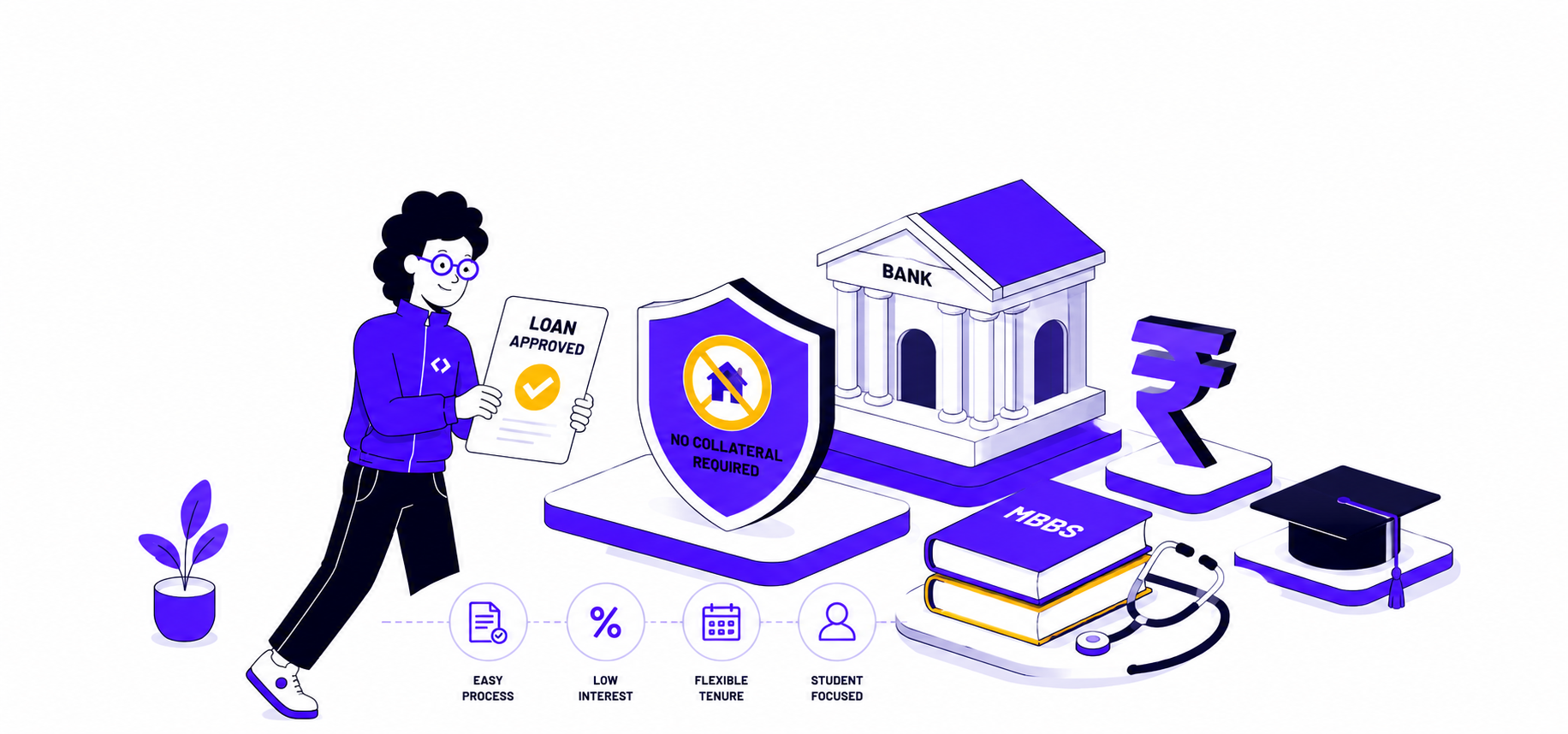
Quick Answer: Yes, you can get a loan for MBBS admission at a college in India without pledging any property. A leading government bank offers up to ₹50 lakh with no collateral, and you don’t have to pay anything back until 1 year after you finish your course. Most private medical college MBBS costs (₹40-50 lakh total) fit comfortably within this. Read on for how it works and what you’ll need.
Getting an MBBS seat at a college in India is only half the battle – arranging the fees without pledging property is the next hurdle for most Indian families. The good news: several government banks, private banks, and NBFCs in India offer collateral-free (unsecured) education loans specifically for MBBS students, some covering nearly the entire course cost. This guide breaks down how much you can borrow, which type of lender suits your situation, how repayment actually works during your course, and how tax benefits can lower the real cost of borrowing.
What is a collateral-free loan for MBBS?
A collateral-free (or unsecured) education loan is a loan sanctioned without the borrower pledging any property, fixed deposit, or other asset as security. Approval instead depends on the applicant’s NEET score, the university’s standing, and the co-applicant’s (usually a parent’s) income and repayment capacity. For MBBS students, most government banks, private banks, and NBFCs in India now offer unsecured loans up to a defined ceiling – typically between ₹50 lakh and ₹1 crore, depending on the lender and applicant profile. This guide covers loans for MBBS admissions within India.
How much loan can you get without collateral for MBBS?
| Lender Type | Unsecured Loan Ceiling | Notes |
| Government Bank | Up to ₹50 lakh | Requires the college to be on the bank’s approved list |
| Private Bank (Option A) | Up to ₹3 crore | Higher ceiling but starts from 9.50% |
| Private Bank (Option B) | Up to ₹1 crore | Self-employed co-applicants typically need secured loans |
| NBFC | Up to ₹1 crore in select cases | Case-by-case evaluation based on co-borrower income |
For most middle-income families, a government bank’s ₹50 lakh unsecured ceiling comfortably covers total MBBS course costs at many private and deemed universities, where total tuition and hostel fees over the course typically range from ₹40-50 lakh.
Which lenders offer complete moratorium during the course?
This is where lenders differ significantly, and it’s often the single biggest factor in whether a loan is actually affordable for a family – not just whether it’s approved.
Moratorium period refers to the duration during which a student is not required to make any loan repayments – typically the course duration plus a grace period after completion.
| Lender Type | Repayment During Study | What This Means Practically |
| Government Bank | Complete Moratorium (course duration + 1 year) | No payment required until 1 year after course completion |
| Private Bank (Option A) | Direct EMI from disbursement | Full EMI payments begin while still studying |
| Private Bank (Option B) | Simple Interest (SI) | Interest-only payments required during course |
| NBFC | SI (if parent/co-borrower is a doctor) or Direct EMI otherwise | Repayment structure depends on co-borrower profile |
Simple Interest (SI) repayment means the borrower pays only the interest accrued on the disbursed loan amount during the study period, while the principal remains untouched until repayment begins after course completion.
For families without a steady income buffer to absorb payments during the course, which describes most middle-class and lower-middle-class households – a complete moratorium loan (typically offered by government banks) is usually the only realistic option, since it removes repayment pressure entirely until after graduation.
How does a government bank’s collateral-free MBBS loan work?
Government banks are among the few lenders offering a genuinely repayment-free study period for MBBS students:
- Loan amount: Up to ₹50 lakh unsecured
- Interest rate: Starts at 7.95% (unsecured route)
- Moratorium: Course duration + 1 year. No EMI or interest payment required during this period
- Tenure: Up to 15 years for repayment after moratorium ends
- Processing fee: Nil (varies by bank)
- Requirement: A confirmed admission letter is mandatory — the loan application cannot be processed without it
Note: Some government banks offer a 0.50% interest concession for female students and a 1.00% concession for borrowers servicing Simple Interest but these typically apply only to secured loans for unlisted universities, not to the unsecured route described above. Always confirm with the specific bank whether your university and loan type qualifies.
Because government banks require a confirmed admission letter before processing, students typically apply for this loan only after seat confirmation through NEET counselling – not before.
When would a student need a private bank or NBFC instead of a government bank?
Government bank collateral-free loans aren’t always the right fit. Students and families typically look at private banks or NBFCs when:
- The loan amount needed exceeds ₹50 lakh – private banks and NBFCs offer higher unsecured ceilings (₹75 lakh-₹1 crore+)
- The university isn’t on the government bank’s approved list – government banks lend against a defined list of recognized institutions; private lenders often have broader or different eligibility criteria
- Faster processing is needed – private banks and NBFCs generally have shorter sanction timelines than government banks, which matters when fee deadlines are tight
- An admission letter isn’t available yet – unlike government banks, which require a confirmed admission letter before processing, private banks and NBFCs don’t require one upfront and instead assess eligibility based on NEET score and co-applicant income. It is useful for families who want to start the loan process earlier in the counselling timeline
- The family can comfortably absorb SI or EMI payments during the course – this requires stable, ITR-documented income, since repayment starts immediately rather than after graduation
Can tax benefits reduce the real cost of an MBBS loan?
If your family opts for the old tax regime while filing income tax, the parent paying the loan’s interest (the co-applicant) can deduct that entire interest amount from their taxable income under Section 80E – with no upper limit, for up to 8 years. This effectively brings down the real cost of the loan, though the exact saving depends on your family’s tax bracket. A tax advisor or the bank can help calculate the precise benefit for your situation.
Illustrative example – how tax bracket affects the real interest cost:
| Co-applicant’s Tax Bracket | Interest Paid in a Year | Effective Interest Paid After 80E Benefit |
| 20% | ₹4,00,000 | ₹3,16,800 |
| 30% | ₹4,00,000 | ₹2,75,200 |
(Illustrative figures based on standard old-regime slab rates + 4% cess; actual savings depend on the co-applicant’s total taxable income.)
One thing to check: Section 80E only applies under the old tax regime. The new regime doesn’t allow this deduction. It’s worth discussing with a tax advisor which regime works better overall for your family.
What documents are required for a collateral-free MBBS loan?
While requirements vary slightly by lender, most collateral-free MBBS loan applications require:
- NEET UG scorecard and admission/seat allotment letter (mandatory for government banks; not required upfront for most private banks or NBFCs, which assess based on NEET score and co-applicant income)
- Co-applicant’s (parent’s) income proof – salary slips or ITR for the last 2 years
- KYC documents (Aadhaar, PAN) for both applicant and co-applicant
- Academic records (Class 10 & 12 marksheets, NEET result)
- Bank statements of the co-applicant for the last 6 months
Comparing offers across lenders side by side – rather than approaching just one bank is usually the fastest way to find the right fit for your specific college and income situation. You can check your eligibility across multiple lenders and speak with a loan advisor for free on GradRight.





 Australia
  Canada
  France
  Germany
  India
India  Ireland
  UAE
UAE  United Kingdom
  United States