




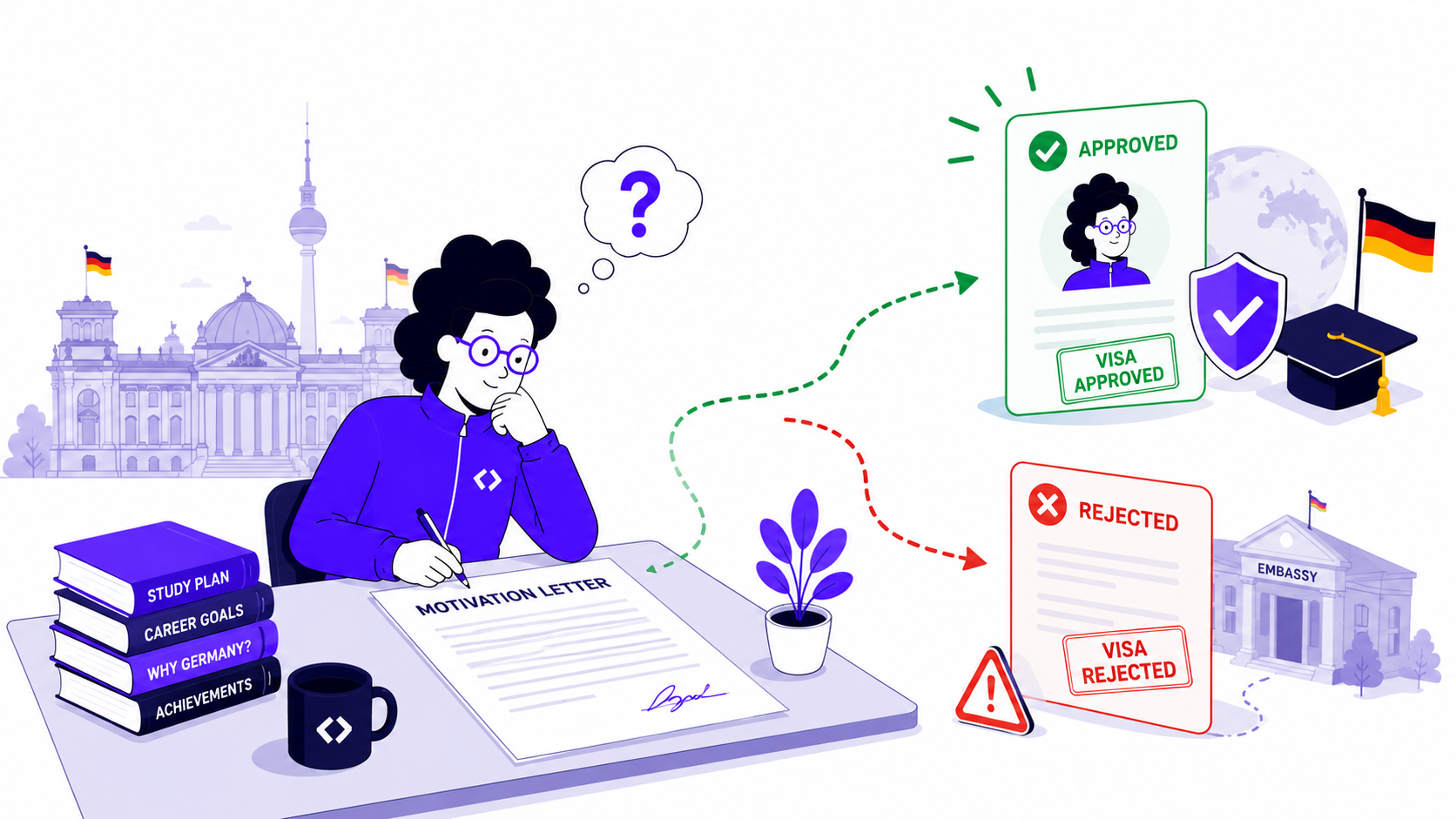
TL;DR: Your motivation letter for a German student visa can directly decide approval or rejection, especially after Germany ended remonstration in 2025. Visa officers assess genuine intent, financial clarity, and document consistency, not storytelling. Avoid generic or AI content, explain gaps clearly, and ensure a 500–700 word structured, factual, return-focused letter aligned with all supporting documents.
You spent months researching programs, shortlisted universities, wrote applications, and finally got that admission letter. Now there is just one more document standing between you and your flight to Germany: the motivation letter for German student visa.
And if you thought the hard part was over, here is the truth: this single letter can get your visa approved or rejected. No appeals, no second chances under the current rules. Since July 1, 2025, Germany abolished the free remonstration process that used to let rejected applicants request an informal review from the same embassy.
Previously, about 40% of refusals were resolved through this route. That safety net no longer exists. A rejection today means reapplying from scratch, delaying your semester by 6 to 12 months, and potentially losing your university offer along with it.
So yes, your student visa letter for Germany deserves every bit of attention you can give it. This guide walks you through exactly what visa officers look for, why applications get rejected, and how to write a letter that holds up.
What visa officers actually look for
Here is something that surprises many applicants: the person reading your motivation letter for German student visa is not an academic. They are not evaluating how passionate you are about molecular biology or how beautifully you write. They are a visa officer, and they have one primary job: to determine whether you are a genuine student who will comply with visa conditions and return home after your studies.
That framing changes everything about how you should write this letter.
The embassy motivation letter and the university Motivationsschreiben are two completely separate documents meant for two completely different audiences. Many students make the costly mistake of submitting their university admission letter to the embassy. The university letter discusses research interests, academic fit, and intellectual curiosity. The embassy letter needs to answer a different set of questions: Why Germany? Why this program? How will you fund yourself? Where will you live? And critically: what will you do after you graduate?
Your Germany visa SOP should answer those practical questions directly and factually. Visa officers are trained to look for specificity. Vague phrases like “Germany has excellent universities” or “I want to broaden my horizons” do nothing to establish genuine intent. What works instead is naming your university, citing your program’s specific relevance to your career path, referencing your blocked account or scholarship, and mentioning your accommodation plan.
Think of it less like a personal essay and more like a well-organized case you are building in your own favor.
Also Read: DAAD Scholarship for Indian Students in 2026
Why document consistency matters more than you think
Your motivation letter for a German student visa does not exist in isolation. Visa officers read it alongside your CV, your academic transcripts, your financial documents, and your admission letter. If any of these tell a different story, it raises a flag.
This is one of the most underestimated rejection triggers. A student might describe five years of work experience in their cover letter but only list three in the CV. Another might mention a research internship in the motivation letter that never appears in their supporting documents. Even minor date mismatches between the CV and letter can plant doubt in a visa officer’s mind.
Your Germany visa SOP and CV should function as a single coherent narrative. Read them back to back before submitting. Every institution, every role, every time period mentioned in the letter should be verifiable in the documents you submit alongside it.
If you are working with a German visa motivation letter sample you found online, be especially careful here. Generic templates often suggest content that has no connection to your personal story, which means your letter and your documents can contradict each other without you even realizing it.
Common reasons motivation letters get rejected
Let us be direct about the patterns that visa officers see repeatedly.
- Generic, copy-pasted content: The DAAD estimates that approximately 90% of motivation letter samples found online would be rejected by German embassies. This is not an exaggeration. Officers read hundreds of letters and can spot a template within a few sentences. If your letter could apply to any student at any German university, it is not doing its job.
- AI-generated text: German embassies have become increasingly adept at identifying AI-generated content. The German Embassy in Armenia explicitly warns applicants against it. Fintiba, one of the most recognized resources for German visa guidance, lists AI-generated text among its top nine mistakes in student visa applications. Using AI as a drafting tool and then deeply personalizing the letter is one thing. Submitting an AI-generated letter unchanged is a serious risk in 2026.
- Expressing intent to stay in Germany permanently: This is known as the return intent paradox, and it trips up a lot of applicants. You should never write that you plan to settle in Germany, build a life there, or stay after graduation. The visa you are applying for is premised on your genuine intention to return home. Your student visa letter to Germany should mention your plans after graduation and ideally connect them to how your German education will benefit you back in your home country or in your career.
- Financial inconsistencies: If your motivation letter claims you have a scholarship but your financial documents show a blocked account, or vice versa, the officer will notice. Similarly, mentioning a blocked account without providing the correct amount (currently set at EUR 11,904 per year as of 2026, equivalent to EUR 992 per month) weakens your credibility.
- Vague academic rationale: Saying you chose a university because it is “one of the best” is not enough. Why this program? Why now? How does it connect to your undergraduate studies or professional background? These are the questions your letter must answer.
Explaining gaps or career changes
One of the trickier situations a student can face when writing a motivation letter for a German student visa is having an academic gap or switching fields entirely.
Say you completed a bachelor’s degree in computer engineering three years ago and are now applying for a master’s in data science. That is a reasonable, explainable transition. Your letter should connect the dots explicitly: what did you do during those years, what did you learn, and why does this specific program follow logically from that experience?
Career changes are more complex. If you are applying for a program that is completely unrelated to your undergraduate field, visa officers may question whether you have the foundation to succeed. A student moving from a humanities background into engineering, for example, should use the letter to highlight relevant work experience, certifications, or coursework that demonstrates the ability to handle the new field.
What you should never do is leave the gap or transition unexplained and hope the officer does not notice. They will. And silence in the face of an obvious inconsistency reads as an attempt to hide something.
Your Germany visa SOP is the right place to address these issues head-on, with a confident and factual explanation.
Format and tone: Getting the basics right
The recommended length for a motivation letter for a German student visa is 500 to 700 words, which works out to roughly one to one and a half pages. Format it in a standard font like Times New Roman or Arial at 11 to 12 point size, with 2.5 cm margins and 1.5 line spacing.
Beyond the formatting specs, the tone matters a great deal. This is not a university admissions essay, so it should not read like one. It is a formal document, but it should also sound like you wrote it. Clear, direct, and professional. No flowery language, no overly emotional appeals, and no political or religious references.
Many applicants who try to use a German visa motivation letter sample as a base end up with a letter that sounds polished but hollow. The most effective letters use simple, precise language that answers the officer’s practical questions efficiently.
One more thing: the letter must be signed by you personally. The German Embassy in Armenia specifically notes that if someone else has clearly written the letter for an applicant, the embassy will take appropriate action. The letter needs to sound like you.
What to include and what to avoid
Here is a practical breakdown.
Include:
- A brief introduction of your academic and professional background
- Your chosen university and program, and why you selected them specifically
- How this program connects to your career goals
- Your financial plan (blocked account, scholarship, or family support with details)
- Your accommodation arrangements in Germany
- Your intention to return to your home country after completing your studies
- Your language proficiency relevant to the program
Avoid:
- Vague statements that could apply to any applicant
- Any mention of wanting to stay in Germany permanently or seek employment beyond your visa conditions
- Emotional appeals, political opinions, or religious references
- Copying from any German visa motivation letter sample without thoroughly personalizing it
- AI-generated text submitted without deep editing and personalization
- Anything that contradicts information in your CV or other documents
Final review checklist before submitting
Before you seal that application, run through this list.
- Does your motivation letter for German student visa answer why you chose Germany, this university, and this program specifically?
- Is the financial information in the letter consistent with your financial documents?
- Does your CV match all dates, institutions, and roles mentioned in the letter?
- Have you addressed any academic gaps or career changes with a clear explanation?
- Is the letter between 500 and 700 words?
- Is it formatted in the correct font, size, and margin settings?
- Is it signed by you?
- Does it mention your return plans after graduation?
- Does it sound like your own voice, not a template or AI output?
- Have you had someone who understands the German visa process review it?
If you can answer yes to all of these, your student visa letter for Germany is in strong shape.
Also Read: Cost of Studying in Germany: Fees, Living Costs, Visa Cost & More
Need help with your Germany student visa SOP?
At GradRight, we work with thousands of students planning to study abroad, and Germany is consistently one of the top destinations we help students navigate. Beyond helping you find the right university and securing education loans through our platform, we understand that the visa application process, including documents like the motivation letter for German student visa, is where a lot of well-prepared students still stumble.
We have seen firsthand what separates approved applications from rejected ones, and it often comes down to the quality, consistency, and specificity of the letter. If you are looking for guidance on your Germany visa SOP or want to ensure your full application package is on track, we are here to help you work through it with the clarity and confidence you need.








 Australia
  Canada
  France
  Germany
  India
India  Ireland
  UAE
UAE  United Kingdom
  United States