





TL;DR: When choosing the best international student health insurance in 2026, students should compare coverage limits, deductibles, mental health benefits, pre-existing condition coverage, and country-specific requirements. This guide explains how study abroad insurance plans work in destinations like the US, UK, Germany, Canada, and Australia, helping students find affordable coverage that meets university and visa requirements.
You’ve got your acceptance letter. Your visa appointment is booked. Your bags are half-packed, and your head is full of everything you need to figure out before you board that plane. Health insurance probably feels like just another box on an endless checklist, but hear this: it is one of the few things on that list that can genuinely make or break your time abroad.
Medical emergencies don’t care about your semester schedule. A single hospital visit in the United States, Germany, or the UK can cost thousands of dollars without proper coverage. Choosing the best international student health insurance is not about finding the most expensive plan or blindly going with whatever your university recommends. It is about finding coverage that actually protects you, fits your budget, and meets the requirements of your host country.
This guide walks you through everything you need to know about picking the best international student health insurance in 2026, from understanding what coverage you actually need to avoiding the classic traps that cost students extra money.
Start with the right questions
Before you start comparing study abroad insurance plans, take a few minutes to think through your specific situation. The best plan for your classmate may be a terrible fit for you.
Ask yourself these questions first:
- Where are you studying? Country-specific insurance requirements vary dramatically. Germany mandates public statutory health insurance (gesetzliche Krankenversicherung) for most enrolled students. The US requires international students to either use the university’s insurance plan or waive out with comparable private coverage. The UK’s National Health Service (NHS) covers most international students who pay the Immigration Health Surcharge (IHS) with their visa application.
- How long will you be abroad? A five-month exchange semester calls for a different approach than a two-year master’s degree. Longer stays make it worth investing time in understanding your options rather than just defaulting to the easiest route.
- Do you have any pre-existing conditions? Not all study abroad insurance plans cover pre-existing conditions, and those that do often have waiting periods or coverage caps.
- What is your actual risk tolerance? Are you someone who visits the doctor regularly, or do you mostly need a safety net for serious emergencies?
These answers will shape everything else.
Understanding coverage levels: What you actually need
International student health insurance is not one-size-fits-all. Plans range from bare-bones emergency coverage to comprehensive policies that include mental health support, dental, vision, and wellness visits. Here is a breakdown of what the different coverage tiers typically include.
- Basic or emergency-only plans cover hospitalization and emergency room visits. They tend to be the cheapest student insurance abroad, with monthly premiums that can start as low as $20 to $40. The catch is that they typically do not cover routine check-ups, specialist visits, mental health services, or prescriptions. If you are young, healthy, and studying in a country with good public healthcare access, this might work for a short stint.
- Mid-tier comprehensive plans cover everything in the basic tier plus outpatient visits, prescription medications, and sometimes mental health services. These are what most students actually need and what most universities consider “comparable coverage” for waiver purposes.
- Premium or full-coverage plans include all of the above, plus dental, vision, maternity care, and sometimes medical evacuation. These tend to be significantly pricier but may be worth it if you have ongoing health needs.
A practical tip: do not pay for coverage you genuinely do not need. Paying for a premium plan with dental and vision coverage in a country where you plan to use public healthcare for most things is likely overkill.
Country-specific insurance requirements you cannot ignore
One of the most important and frequently misunderstood aspects of international student health insurance is that it is rarely optional, and the rules are different depending on where you are going.
- Germany is particularly strict. Students under 30 enrolling in a recognized German university are generally required to have German public health insurance through a statutory provider (Krankenkasse) like TK (Techniker Krankenkasse), AOK, or Barmer. As of 2026, the standard student contribution is approximately €120 to €130 per month. Students over 30 or those in certain private university programs must take out private international health insurance instead. If you arrive in Germany with a foreign travel insurance policy and try to enroll at a university, you will almost certainly be turned away.
- United States universities require health insurance as a condition of enrollment. Most schools offer their own Student Health Insurance Plan (SHIP), which can cost anywhere from $1,500 to $3,500 per year depending on the institution. Students can waive out of the SHIP if they show proof of comparable private coverage, but the waiver requirements are often quite specific and demanding.
- Canada has a patchwork system where coverage depends heavily on which province you are studying in. British Columbia and Ontario have provincial health plans that international students can access under certain conditions. Other provinces may require separate private coverage. Always verify what applies to your specific situation.
- Australia requires international students to hold Overseas Student Health Cover (OSHC) for the full duration of their visa. This is a non-negotiable requirement, and most universities arrange this as part of the enrollment process.
The bottom line: always check official government and university sources for the country you are heading to. Do not rely on secondhand advice from someone who studied there two years ago.
Also Read: Best International Student Health Insurance Providers in the USA
How to actually compare study abroad insurance plans
Once you know what your host country requires, you can start comparing. Most students make the mistake of comparing only premiums (the monthly cost), but that is only one piece of the picture.
Here are the factors that matter most when evaluating study abroad insurance plans:
- The deductible: This is what you pay out of pocket before insurance kicks in. A plan with a $50/month premium and a $5,000 deductible is very different from a plan with a $120/month premium and a $250 deductible. For routine users of healthcare, the low-deductible plan will almost certainly cost less overall.
- The coverage maximum: What is the upper limit the plan will pay? For serious medical events, you want at least $100,000 in coverage per incident, ideally more. Do not skimp here.
- In-network vs. out-of-network: US-based plans especially have strong distinctions between providers who are in-network (cheaper for you) and those who are not. Going out of network can leave you responsible for a significant chunk of the bill.
- Mental health coverage: Mental health services are increasingly important for international students navigating a new culture, language, and academic environment. Check if therapy or counseling is covered and how many sessions are included.
- Pre-existing condition clauses: Read the fine print carefully. Some top insurance companies for students exclude all pre-existing conditions; others cover them after a waiting period.
- Medical evacuation and repatriation: If something serious happens, can the plan get you back home or to a better-equipped medical facility? This matters more than people realize.
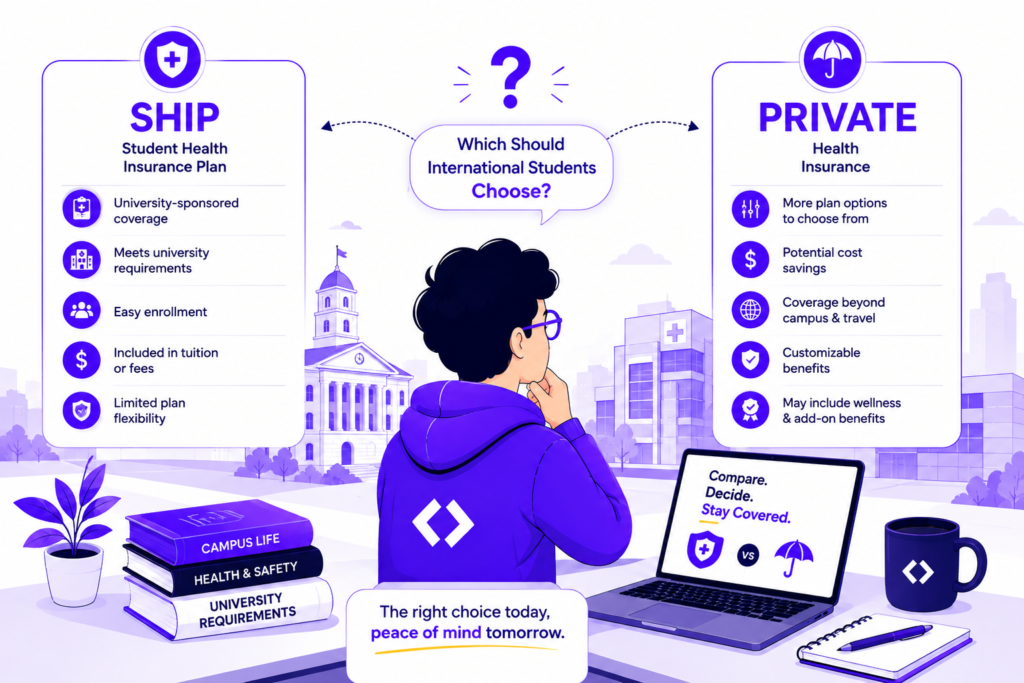
University insurance vs. private plans: Which should you choose?
This is one of the most common dilemmas for international students, and the honest answer is: it depends.
| Factor | University-Sponsored Plan | Private/Independent Plan |
| Convenience | Automatically available and requires minimal paperwork. | Requires research, comparison, and enrollment on your own. |
| Compliance | Guaranteed to meet university and local insurance requirements. | Must meet all waiver and coverage requirements set by the university. |
| Cost | Often more expensive due to bundled services and group pricing structures. | Can be more affordable if you find a comparable plan. |
| Coverage | May include access to campus health centers and additional student services. | Coverage varies by insurer and plan; you can tailor it to your needs. |
| Flexibility | Limited choice; you typically accept the plan offered. | Greater flexibility to choose coverage levels, providers, and premiums. |
| Risk of Rejection | None, since it is university-approved. | Higher if the plan does not satisfy waiver requirements. |
| Best For | Students who prioritize simplicity and guaranteed compliance. | Students willing to compare options and potentially save money. |
A general rule of thumb: if you are studying in the US and your university offers a SHIP, compare it against three to four private options before making a decision. If you are studying in Germany and you are under 30, you will likely have to go with a German public statutory provider regardless of what you planned.
How to read an insurance policy without getting confused
Insurance documents are notorious for being impenetrable. Here is how to cut through the noise.
- Go straight to the Summary of Benefits and Coverage (SBC) document if one is available. It is a standardized breakdown of what is and is not covered, written in plain language.
- Look for the exclusions section specifically. This tells you what the plan will not pay for, and it is often buried. Common exclusions include injuries from adventure sports, treatments for conditions diagnosed before enrollment, mental health services above a certain annual limit, and out-of-network emergency care in non-emergency situations.
- Pay attention to the claims process. Some plans require pre-authorization before certain treatments. If you skip this step, your claim could be denied even for a covered service.
- Check whether the plan uses a cashless or reimbursement model. Cashless plans pay the provider directly, which is far less stressful. Reimbursement plans require you to pay upfront and file for repayment later. If you are going to a country where medical costs are high, this distinction matters.
Smart ways to save money on international student health insurance
Nobody wants to overpay, and there are legitimate ways to keep costs down without sacrificing protection.
- Use your home country’s coverage strategically. Some Indian health insurance policies, for example, include a limited international travel component. While these are almost never sufficient as your sole coverage abroad, knowing what is already active could help you avoid buying redundant plans.
- Compare before committing. Do not accept the first quote or default to your university plan without checking alternatives. Platforms and tools that aggregate student insurance options can save you hours of research.
- Adjust your deductible consciously. If you are healthy and have some emergency savings, opting for a slightly higher deductible in exchange for lower premiums can make financial sense over a full academic year.
- Look for alumni or student group discounts. Some top insurance companies for students offer reduced rates through university partnerships or student associations.
- Time your coverage correctly. If your classes end in May but your visa is valid until July, check whether you need to extend coverage or if there is a grace period.
Also Read: Cheapest International Student Health Insurance Plans in USA in 2026
Conclusion
Finding the best international student health insurance in 2026 does not have to be overwhelming. It starts with understanding your destination’s requirements, identifying the coverage you actually need, and comparing plans on more than just price.
A good plan should protect you when something goes wrong, meet your university’s requirements, and fit comfortably within your budget. Those goals are not mutually exclusive.
At GradRight, we regularly help students navigate these decisions as part of their broader study abroad journey. We’ve seen how the right insurance choice can prevent unexpected expenses, compliance issues, and last-minute stress. If you’re unsure which plan is right for your destination, university, or budget, don’t leave it to chance.
Ask questions, compare options carefully, and seek guidance early. Your health coverage deserves the same attention as every other major study abroad decision.








 Australia
  Canada
  France
  Germany
  India
India  Ireland
  UAE
UAE  United Kingdom
  United States