



Last month, a student sent me a spreadsheet. 23 universities. Color-coded by ranking, tuition, and location. She’d spent three weeks building it.
When I asked her which one she was leaning toward, she said: “Whichever is ranked highest as per my modelling, and then subject to what I can afford.”
I hear some version of this every single day. I work with students who’ve already decided to study abroad. They feel that the hard part is done. But when it comes to picking where, most people default to the same thing: rankings.
And I get it. When you’re sitting in Pune or Hyderabad trying to evaluate a university in St. Louis or New Jersey that you’ve never visited, what other option do you have? A number feels safe and objective.
But it’s not.
Rankings don’t tell you what you actually need to know
Here’s what a ranking won’t tell you.
What’s the job placement rate for international students in your specific program (not the university average, but your specific program)?
What percentage of graduates get hired within six months?
Does the university help with OPT and H1B sponsorship, or are you on your own after graduation?
Rankings won’t be able to tell you whether the ₹50 lakhs you’re about to borrow is a smart bet or a terrible one.
I’ve seen students turn down a school ranked #20 for one ranked #50, because the #50 school had a better placement record, lower living costs, and a scholarship that cut their loan in half. Two years later, they’re earning well and almost done repaying.
So rankings are definitely not the answer.
Think about ROI before you think about reputation
When I say ROI, I don’t mean it in some abstract business sense. I mean: will this degree pay for itself, and if so, in how many years?
Here’s the real math most students unfortunately skip. The total cost of your master’s isn’t just tuition. It’s tuition plus living expenses plus 1-2 years of potential salary you’re giving up.
For most Indian students doing an MS in the US, that cost is somewhere around ₹50 lakhs. Almost always borrowed.
Now flip it. What’s the average starting salary after this specific program?
How long will it take you to repay your education loan?
Does the university have strong industry connections in your field?
Is there a co-op or internship built into the program?
When you evaluate colleges through this lens, the list looks completely different from what the rankings suggest.
A well-placed program at a lesser-known university with a $20,000 scholarship might be a dramatically better investment than a famous name with average outcomes and no financial aid.
The even bigger problem: you can’t evaluate what you can’t experience
Here’s the thing though. Even if you know all this, how do you actually evaluate a university from India?
Ideally, you’d visit the campus. Sit in on a class. Talk to current students, especially Indian students who’ve been through this process. Ask the career services team real questions. Meet a professor.
But let’s be honest. You can’t fly to five American universities for campus visits. So instead, you watch YouTube vlogs, attend webinars that are basically marketing presentations, and ask strangers on Reddit.
The people who actually decide admissions, who run the programs, who could tell you whether you’d be a good fit — you never meet them; not until you’ve already paid your deposit.
The entire process is front-loaded with spending and back-loaded with information.
This is exactly the gap Masters of the Universe (MOTF) was built to close.
What MOTF gives you that no webinar can
Masters of the Future isn’t just a competition. For someone trying to pick the right college, it’s the most direct access you’ll get to US university admissions teams without buying a plane ticket.
MOTF’s partner universities (WashU Olin, Rutgers Business School, Lehigh, Tulane, University of San Diego, University of South Dakota) aren’t just logos on a poster. Their admissions teams are actively involved over the two-day championship.
They watch you solve problems. They see how you think. You interact with them directly. An application form does not allow any of that.
And it goes both ways.
You get to evaluate them. How does their team engage? What do they value? What kind of student are they looking for? You’re not just being selected; you’re also selecting.
On top of all that, there’s a ₹5 Crore scholarship pool from these partner universities.
If you’re thinking about ROI, a scholarship from MOTF could completely change which university makes financial sense for you.
If you’re still figuring out which university fits, this is worth your time.
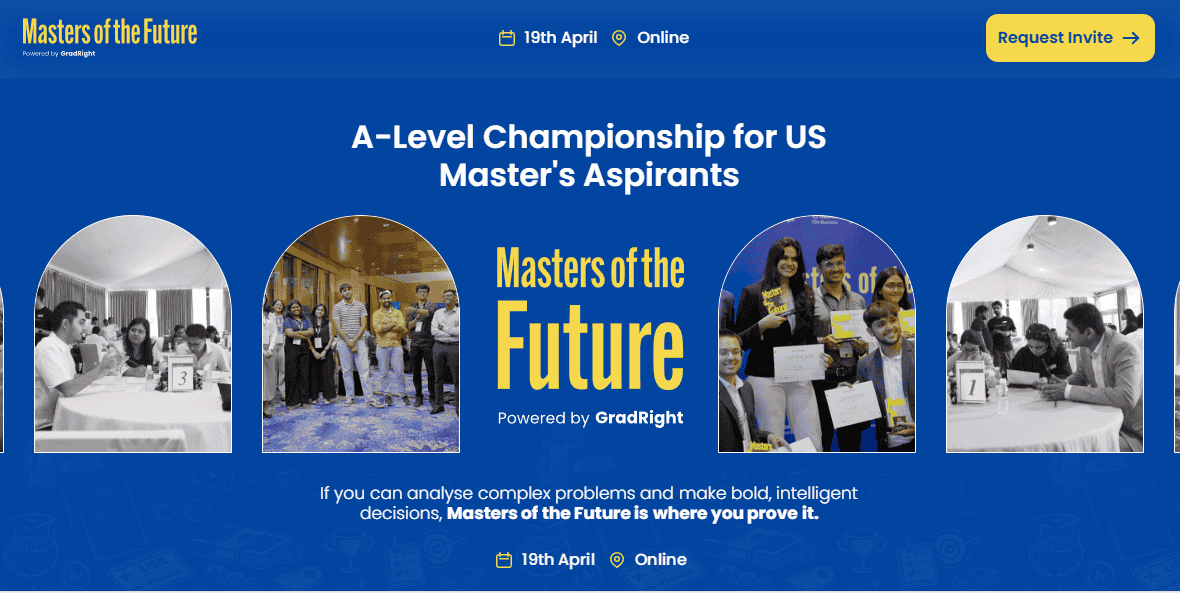
The universities at the table in MOTF
Let me give you a quick and honest picture of each partner university, based on what I’ve seen working with students headed to these programs.
Washington University in St. Louis (Olin Business School) — One of the strongest finance and analytics programs in the US. Highly selective, very quantitative. If you have a strong numbers background and want to work in financial services or consulting, this is worth a serious look into.
Rutgers Business School — Excellent industry connections in the US Northeast, with easy access to New York City’s job market. Good balance between brand recognition and practical career outcomes. Prof. John Lungo from Rutgers said after attending the first MOTF that the talent he saw was exceptional, and that Rutgers looks forward to welcoming those students.
Lehigh University — Smaller, more intimate. Strong in engineering and business. If you want a campus where professors know your name and the alumni network is tight-knit, Lehigh is that kind of place.
Tulane University — Based in New Orleans. Strong in finance, energy, and entrepreneurship. If you’re interested in niche industries or want a campus culture that feels different from the typical big-university experience, Tulane stands out.
University of San Diego (Knauss School of Business + School of Engineering) — Two schools participating, which is unusual. West coast, California exposure, but with a smaller-school feel. Good for students who want the California network without getting lost in a massive program.
University of South Dakota — The smartest ROI play on this list. More affordable tuition, strong value proposition. If your priority is minimizing debt and maximizing return, USD deserves a spot on your spreadsheet.
Want to see what it actually looks like? Watch the highlights from MOTF 2025.

Stop guessing. Start testing.
MOTF is free to register. It’s online. Going through the process will teach you more about what you’re looking for than any ranking website.
And if you want to start building your university shortlist based on ROI right now, download the GradRight app. It’s an AI-powered study abroad and education finance platform that helps you discover the right programs, universities, scholarships, loans, and more.
The best college for you isn’t the one ranked highest. It’s the one where the people in charge of admissions have actually seen what you can do.
And if you’re figuring out the bigger picture like which universities, which loans, what scholarships, download the GradRight app from Google Play Store or Apple App Store. It’s an AI-powered study abroad and education finance platform that helps you discover the right programs, universities, scholarships, loans, and everything else you need, all in one place.









 Australia
  Canada
  France
  Germany
  India
India  Ireland
  UAE
UAE  United Kingdom
  United States