



Accommodation is typically the largest single monthly expense for Indian students studying abroad – making up 35-45% of your total monthly budget. Getting clear on how to fund it before you arrive is one of the most important financial decisions of your study abroad journey.
The good news: most students combine two or three of the five funding methods below, and that combination makes accommodation genuinely manageable without running out of money mid-year.
Student Accommodation Costs Abroad – 2026 Benchmarks
|
Country / City |
University Dorms/month |
Shared Flat (per person)/month |
INR Equivalent (shared) |
Deposit Required |
|
USA (major cities) |
USD 800-1,500 |
USD 600-900 |
Rs 50,400 – 75,600 |
1-2 months rent |
|
UK (London) |
GBP 800-1,400 |
GBP 700-1,000 |
Rs 74,550 – 1,06,500 |
4-6 weeks rent |
|
UK (outside London) |
GBP 500-900 |
GBP 400-650 |
Rs 42,600 – 69,225 |
4-6 weeks rent |
|
Germany |
EUR 250-500 (subsidized) |
EUR 350-550 |
Rs 31,500 – 49,500 |
2-3 months rent |
|
Canada (major cities) |
CAD 700-1,200 |
CAD 600-900 |
Rs 37,200 – 55,800 |
1-2 months rent |
|
Australia (Sydney) |
AUD 900-1,500 |
AUD 700-1,000 |
Rs 38,500 – 55,000 |
4-6 weeks rent (bond) |
|
Ireland (Dublin) |
EUR 900-1,400 |
EUR 700-1,000 |
Rs 63,000 – 90,000 |
2 months rent |
Source: GradRight research, university accommodation office data, 2026. INR conversions at mid-2026 rates (USD 1 = Rs 84, GBP 1 = Rs 106.5, EUR 1 = Rs 90, CAD 1 = Rs 62, AUD 1 = Rs 55). Costs vary by city, location within city, and accommodation type. Always verify with your specific university before finalizing your budget.
Types of Student Accommodation Abroad
Before deciding how to pay, understand what you are choosing from. Your accommodation type directly affects your monthly cost:
|
Type |
Cost Level |
What is Included |
Best For |
|
University dorms / halls of residence |
Moderate (subsidized) |
Usually includes utilities, internet, sometimes meals |
First-year students – safer, easier, closer to campus |
|
Shared private flat (2-3 students) |
Lower per person |
Rent only – utilities and internet extra |
Students who want more freedom and lower per-person cost |
|
Purpose-Built Student Accommodation (PBSA) |
Moderate-High |
Utilities, gym, common areas usually included |
Students who want private room with all-in pricing |
|
Homestay (living with local family) |
Moderate |
Room + meals usually included |
First year students wanting cultural immersion + meals |
|
Solo studio / one-bedroom |
Highest |
Rent only |
Not recommended for most students – cost-inefficient |
Most Indian students in their first year choose university dorms or PBSA because they are easier to arrange from India and have all-inclusive pricing. From the second year, many move to shared private flats which reduce per-person cost significantly.
Also Read: How to Save Money Studying Abroad – 12 Practical Tips
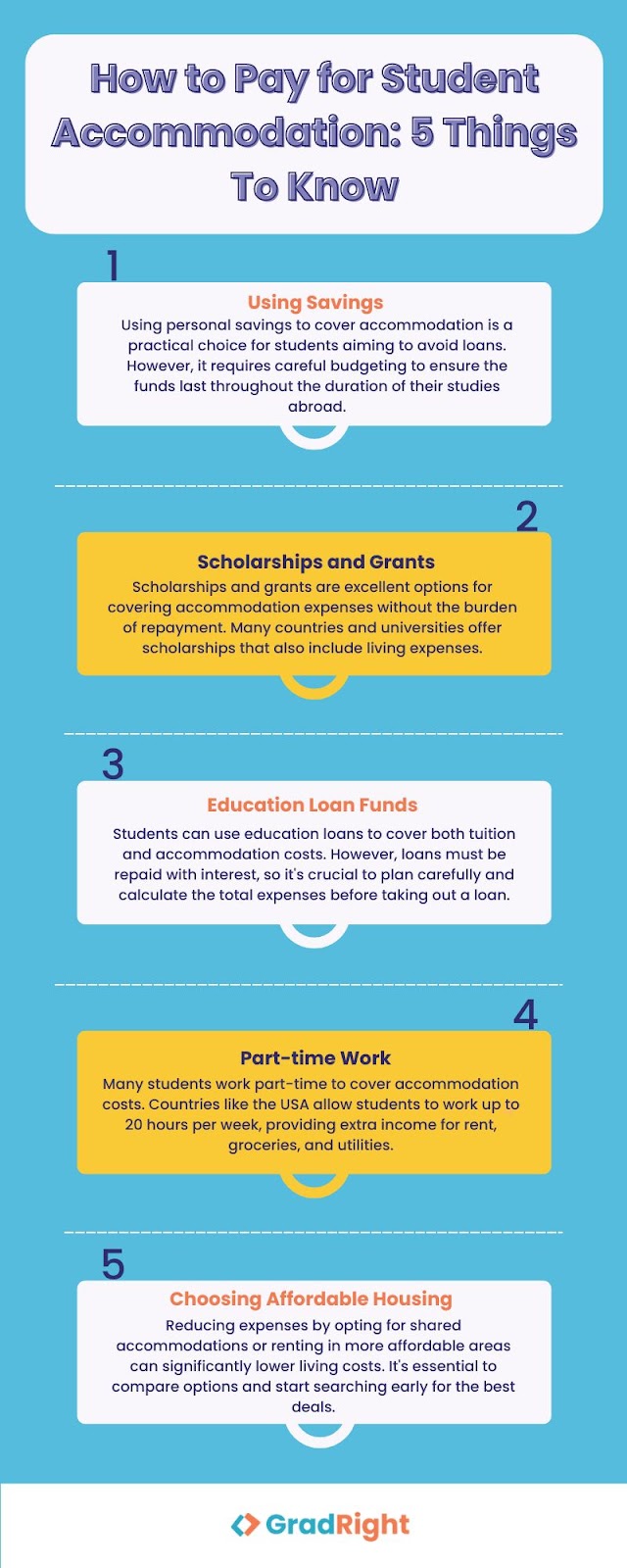
The 5 Ways to Pay for Student Accommodation Abroad
Way 1: Education Loan (Most Common and Most Practical)
Education loans for study abroad cover more than just tuition. Most Indian lenders include living expenses – including accommodation – in the loan amount. This is how the majority of Indian students fund their housing abroad.
|
What the loan covers |
What it does not cover |
|
Tuition fees |
Deposits in some cases (may need upfront cash) |
|
Accommodation costs |
Personal expenses like clothing and entertainment |
|
Food and groceries (monthly living) |
Travel costs (sometimes excluded) |
|
Transport |
Pre-departure costs like visa fees (usually self-funded) |
|
Books and academic materials |
|
|
Health insurance |
Key calculation: Before applying for your loan, add up 12 months of accommodation costs and include this in your total loan amount. A common mistake is underestimating accommodation costs and then struggling to fund them separately mid-year.
Even a 0.5% difference in interest rate can save Rs 3-5 lakh over the full repayment period. Never take the first loan offer from one bank without comparing.
Compare education loans from 18+ lenders and make sure your loan covers accommodation costs. Starting from 8.33% per annum. Compare Education Loans on GradRight
Way 2: Part-Time Work Income (Most Flexible Ongoing Source)
Part-time work is the most common ongoing source of income that Indian students use to cover monthly accommodation costs. Most student visas allow part-time work during term time.
|
Country |
Work Hours Allowed |
Min. Wage (2026) |
Monthly Earnings (10-15 hrs/week) |
Covers approx. |
|
USA (F1) |
20 hrs/week on-campus |
Varies by state (avg $15-18/hr) |
USD 600-1,080/month |
60-100% of shared accommodation |
|
UK |
20 hrs/week |
GBP 11.44/hr |
GBP 457-686/month |
50-100% of accommodation outside London |
|
Canada |
24 hrs/week |
CAD 15-17/hr |
CAD 900-1,224/month |
100%+ of shared accommodation |
|
Germany |
120 full days/year |
EUR 12.41/hr |
EUR 400-600/month |
70-100% of shared accommodation |
|
Australia |
48 hrs/fortnight |
AUD 24.10/hr |
AUD 1,157/fortnight |
100%+ of shared accommodation |
Practical note: Part-time income should supplement your accommodation funding, not be the primary source. Your visa and academic schedule must come first. Find on-campus jobs first (library assistant, teaching assistant, campus dining) – they are easier to schedule around classes.
Also Read: How to Calculate Cost of Living for Study Abroad Students
Way 3: Personal Savings (Supplement, Not Primary)
Savings work best as a supplement to education loans or as a buffer for upfront costs that loans may not cover immediately – particularly the accommodation deposit and first-month setup costs.
- Accommodation deposits are typically 1-2 months rent in USA/Canada, 4-6 weeks in UK, 2-3 months in Germany. For a London flat at GBP 800/month, the deposit alone can be GBP 3,200-4,800 (Rs 3.4-5.1 lakh).
- First-month setup costs (bedding, kitchenware, initial groceries) typically add another Rs 25,000-50,000 on top of rent.
- Education loan disbursals sometimes take 2-4 weeks to reach your account after arrival. Having savings bridges this gap.
- Keep a minimum emergency buffer of USD 500-1,000 / GBP 400-800 in savings throughout your program – never spend this unless essential.
How much savings should you carry? Roughly 3 months of accommodation cost as a liquid buffer. This covers deposits, setup, and any delay in loan disbursement or part-time work starting.
Way 4: Scholarships and Grants (Reduces Overall Borrowing)
Scholarships that cover living expenses directly reduce how much you need to borrow or earn. Many scholarships specifically include stipends for accommodation.
|
Scholarship |
Country |
Accommodation Support |
For Indian Students? |
|
Germany |
Monthly stipend (EUR 861-1,200/month) covers rent + living |
Yes – multiple programs |
|
|
Chevening Scholarship |
UK |
Covers tuition + living expenses including accommodation |
Yes – highly competitive |
|
Eiffel Scholarship |
France |
EUR 1,181/month stipend covers accommodation |
Yes |
|
Fulbright-Nehru Fellowship |
USA |
Monthly stipend + travel grant |
India-specific program |
|
University merit scholarships |
Various |
Usually tuition reduction only, not living |
Varies – check each university |
|
TA/RA Assistantships |
USA |
Stipend USD 1,200-2,000/month + tuition waiver |
Yes if admitted to PhD/MS programs with funding |
Apply for scholarships in parallel with your university applications – not after. Most scholarship deadlines align with or precede university deadlines. Even a partial scholarship of EUR 5,000 covers 4-6 months of accommodation in Germany.
Also Read: Top Scholarships for Indian Students Studying Abroad
Way 5: Choosing Affordable Accommodation (Reduces the Problem)
The most underrated way to manage accommodation costs is simply to choose a more affordable option from the start. The difference between accommodation choices can be larger than any funding method.
|
Choice |
Typical Monthly Saving |
Trade-off |
|
University dorms vs private PBSA (UK) |
GBP 200-400/month (Rs 21,300-42,600) |
Less independence, more structured environment |
|
Shared flat with 3 people vs 2 people |
15-25% less per person |
Less personal space, more coordination needed |
|
Living 20-30 min outside city centre vs central |
GBP/USD/EUR 200-400/month |
Longer commute – offset by transport pass |
|
Cooking at home vs homestay with meals |
Variable – sometimes homestay cheaper total |
Time for cooking vs cultural experience |
|
Living near a smaller campus vs main city |
Often 30-50% cheaper |
Less city amenities, quieter environment |
The single biggest financial decision in your study abroad journey is not which loan to take – it is where to live. A student in Manchester vs London saves approximately GBP 300-600/month (Rs 32,000-64,000) on accommodation alone. Over a 12-month program, that is Rs 3.8-7.7 lakh in savings.
How to Choose the Right Accommodation Before You Arrive
Apply for accommodation before your visa is approved – many universities require proof of accommodation for the visa application itself. Here is the timeline that works:
- Check your university’s accommodation office website the day you receive your offer letter. Apply immediately – university dorms and the best-value private options fill up fast.
- Search country-specific platforms: Rightmove and Zoopla (UK), Immobilienscout24 and WG-Gesucht (Germany), Domain and Flatmates (Australia), Kijiji and Facebook groups (Canada).
- Ask your university’s international student forum or WhatsApp groups for seniors. They know which areas are affordable, safe, and well-connected to campus.
- Compare total monthly cost – not just rent. Add utilities (electricity, gas, internet) if not included. A flat at GBP 600 with all bills included can be cheaper than GBP 500 with GBP 200 in bills.
- Read the tenancy agreement carefully before signing. Note: notice period, deposit return conditions, what happens if you need to leave early.
GradRight’s accommodation service helps Indian students find affordable housing across USA, UK, Ireland, Australia and more. Find Accommodation on GradRight
Related Finance and Accommodation Guides
How to Save Money Studying Abroad
How to Calculate Cost of Living Abroad
Hidden Costs of Studying Abroad
Education Loan for USA
Education Loan for UK
Education Loan Without Collateral
DAAD Scholarship for Indian Students
Scholarships for Indian Students
Cost of Studying in UK
Cost of Studying in Germany







 Australia
  Canada
  France
  Germany
  India
India  Ireland
  UAE
UAE  United Kingdom
  United States