
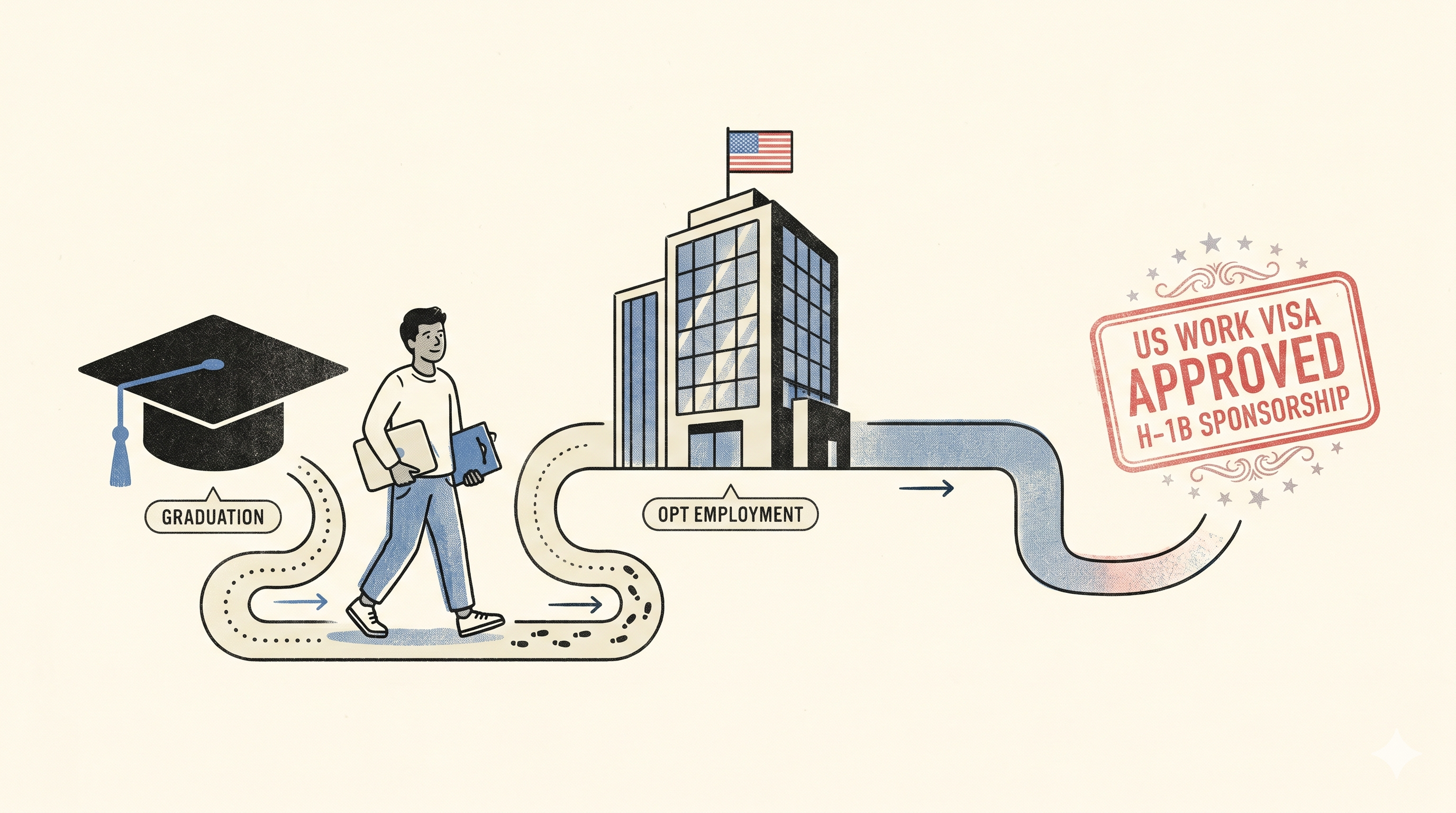
Every Indian student who accepts a US university offer eventually faces the same question: what happens after graduation? The degree gets you in the door, but a work authorization called OPT keeps you in the country long enough to actually build a career there.
OPT in the USA is the most important immigration tool available to F-1 students, and in 2026, the rules around it have changed significantly. USCIS raised the Form I-765 filing fee, updated its biometric collection policy, and introduced a new wage-weighted H-1B lottery system that directly affects how OPT holders should strategize their path to long-term work authorization. Students who plan around 2022-era rules are walking into a different landscape than they expect.
This guide covers everything Indian students need to know about OPT in 2026 — what it is, who qualifies, how long it lasts, how the STEM extension works, and exactly how it connects to the H-1B pathway.
What is OPT in the USA?
OPT provides up to 12 months of work authorization for F-1 students in roles related to their degree. It remains one of the most flexible work options for international graduates. It does not require employer sponsorship, which reduces hiring barriers.
In practical terms, OPT is the bridge between your F-1 student visa and a long-term work visa. After graduation, students can work full-time for any US employer in a role that relates to their field of study, without the employer needing to sponsor a visa upfront. This flexibility is what makes OPT so valuable, and it is also what makes the transition from OPT to H-1B so critical to plan carefully.
OPT comes in two forms: pre-completion OPT, which students use during their degree, and post-completion OPT, which begins after graduation. For most Indian students targeting a US career, post-completion OPT is the relevant type. The discussion below focuses entirely on post-completion OPT.
Key OPT Facts at a Glance
| Feature | Details |
| Who qualifies | F-1 visa students who have been enrolled full-time for at least one academic year |
| Work authorization type | Employment Authorization Document (EAD card) |
| Duration | 12 months standard; 36 months total with STEM extension |
| Employer sponsorship required | No — any US employer in your field qualifies |
| Application form | Form I-765, filed with USCIS |
| Filing fee (2026) | $1,780 (increased from $1,685 in 2025) |
| Application window | Up to 90 days before graduation; no later than 60 days after |
How long is OPT valid in the USA?
Students with qualifying STEM degrees may apply for an additional 24 months of work authorization, creating a total of 36 months of employment eligibility through the STEM OPT extension.
For non-STEM graduates, OPT lasts 12 months. That is the only window they get. For STEM graduates, the 24-month extension brings the total to 36 months, which covers three H-1B lottery cycles and dramatically improves the odds of transitioning to a long-term work visa before OPT expires.
The 90-day unemployment rule applies throughout the OPT period. Students cannot accumulate more than 90 days of unemployment during standard OPT. Applying early reduces delays that may affect start dates. Most DSOs recommend filing Form I-765 no later than 90 days before your graduation date to avoid gaps between graduation and work authorization start.
Standard vs STEM OPT: Duration Comparison
| OPT Type | Duration | Lottery Attempts Possible | Best For |
| Standard OPT (non-STEM) | 12 months | 1 H-1B lottery attempt | Non-STEM degrees |
| Standard OPT (STEM-eligible) | 12 months | 1 lottery attempt (then apply for STEM extension) | STEM graduates |
| STEM OPT extension | 24 months additional | 2 more lottery attempts | STEM graduates |
| Total STEM OPT | 36 months | Up to 3 lottery attempts | STEM graduates |
STEM OPT holders get three lottery attempts over 36 months, dramatically improving their odds compared to non-STEM graduates who typically have only one chance. For Indian students specifically, this distinction is one of the most financially significant factors in the entire study abroad decision. A STEM Master’s in the US is not just an academic credential. It is a three-year work authorization window with three H-1B lottery attempts built in.
STEM OPT extension: eligibility and how to apply
Certain F-1 students who receive science, technology, engineering, and mathematics (STEM) degrees may apply for a 24-month extension of their post-completion OPT. Students must have earned a bachelor’s, Master’s, or doctoral degree from a school that is accredited by a US Department of Education-recognized accrediting agency and is certified by SEVP at the time they submit their STEM OPT extension application.
Eligibility Requirements for STEM OPT
STEM OPT gives eligible F-1 students a 24-month work authorization extension beyond the initial 12-month OPT. The employer must be E-Verify enrolled, the student needs a STEM-designated degree, and the student must file Form I-983 with their DSO before applying.
Specifically, students must meet all of the following conditions to qualify:
| Requirement | Details |
| Degree type | Bachelor’s, Master’s, or doctoral degree in a STEM-designated field |
| CIP code | Degree’s CIP code must appear on the DHS STEM Designated Degree Program List |
| School certification | Degree-granting institution must be SEVP-certified and accredited |
| OPT status | Student must be in an active period of post-completion OPT when applying |
| Employer requirement | Employer must be enrolled in E-Verify — no exceptions |
| Form I-983 | Training plan must be completed with employer before filing with USCIS |
One important nuance that many students miss: students may be eligible to use a prior STEM degree to qualify for their STEM OPT extension. To use a prior degree, the student must have received their prior qualifying STEM degree at the bachelor’s level or higher within 10 years of applying for the STEM OPT extension with USCIS. This means a student completing a non-STEM Master’s who holds a STEM bachelor’s from a US institution may still qualify for the 24-month extension, provided the prior degree is within the 10-year window.
2026 Application Updates
USCIS raised the filing fee for Form I-765 — the application used for both initial OPT and STEM OPT extensions. The fee increased from $1,685 to $1,780 as of 2026. USCIS will reject applications submitted with incorrect fees, and a rejection during the narrow 30-day window can have serious status implications.
Additionally, USCIS updated its biometric collection policy. Students who apply for OPT or STEM OPT after mid-December 2025 may now be required to appear in person for biometrics collection as part of the application process. Factor this step into your application timeline, particularly if you are filing close to the 90-day pre-graduation window.
Automatic 180-Day Extension While Application Is Pending
If a student files the STEM OPT extension application on time and the OPT period expires while the extension application is pending, USCIS will automatically extend employment authorization for 180 days. This automatic 180-day extension ceases once USCIS adjudicates the STEM OPT extension application.
This automatic extension is valuable, but it only activates when the student files before their current OPT expires. Filing late eliminates this protection. File early, file correctly, and file with the exact $1,780 fee.
The 90-day unemployment rule: what it means in practice
The 90-day unemployment rule is one of the most consequential and least-understood aspects of OPT, and it catches students off guard regularly.
During the 12-month standard OPT period, students cannot spend more than 90 days without qualifying employment. During the STEM extension, an additional 60-day buffer applies, meaning a student on 36 months of total OPT cannot exceed 150 days total of unemployment across the full period.
Unemployment days accumulate from the OPT start date, not from graduation. Students who experience delays in finding a job, or who change employers and have a gap between positions, need to track these days actively. Exceeding the unemployment threshold automatically terminates F-1 status, which creates serious immigration complications that are difficult to reverse.
| OPT Phase | Unemployment Allowed | What Triggers the Clock |
| Standard OPT (12 months) | 90 days maximum | Any day without qualifying employment |
| STEM OPT extension (24 months) | 60 additional days | Days without qualifying STEM-related employment |
| Total across full 36 months | 150 days maximum | Combined across both phases |
What is the difference between H-1B and OPT?
This is the question most students ask when they begin understanding the US immigration pathway, and the answer clarifies why the sequence matters so much.
OPT is student-based work authorization. The F-1 visa grants it automatically to eligible graduates, the employer does not need to petition for it, and it requires no government approval beyond the EAD card. It functions as temporary post-graduation work permission that exists specifically to give graduates time to gain experience and transition to a long-term work visa.
H-1B is employer-sponsored work authorization. The employer petitions USCIS on the student’s behalf, the annual cap limits how many visas USCIS grants each fiscal year, and selection happens through a lottery. H-1B status allows the holder to work in a specialty occupation for a specific employer for up to six years initially, and it provides a viable pathway toward permanent residency through employer-sponsored green card petitions.
| Feature | OPT | H-1B |
| Who initiates | Student (through DSO and USCIS) | Employer (through USCIS petition) |
| Employer sponsorship | Not required | Required |
| Annual cap | None | 85,000 per year (65,000 regular + 20,000 master’s cap) |
| Duration | 12 months (36 months STEM) | Up to 6 years initially |
| Lottery required | No | Yes — annual cap-subject lottery |
| PR pathway | No direct pathway | Yes — employer can sponsor I-140 |
| Restrictions | Must work in field related to degree | Must work in specialty occupation for sponsoring employer |
| Transferable between employers | Yes — any qualifying employer | Requires new petition or transfer process |
The sequence almost every Indian student on a STEM Master’s follows is: OPT (12 months) → STEM OPT extension (24 months) → H-1B lottery. STEM OPT holders have a significant strategic advantage. With up to 36 months of total OPT work authorization, STEM graduates can participate in two or three consecutive H-1B lotteries, dramatically improving their overall selection odds compared to non-STEM graduates who typically have only one chance.
The H-1B lottery in 2026: what changed and what it means for OPT holders
The H-1B lottery underwent its most significant change in nearly two decades in early 2026. Understanding this change is critical for any Indian student currently on OPT or planning to transition to OPT after graduation.
The New Wage-Weighted Selection System
The US Department of Homeland Security finalized the Weighted Selection Process for H-1B Registrations on December 29, 2025. The rule took effect February 27, 2026, and applies for the first time to the FY2027 cap season.
Under the old system, every registration had equal odds of selection. Under the new system, registrations receive multiple entries based on the prevailing wage level — Level 4 positions may have approximately 61% selection probability, while Level 1 positions drop to just 15%, compared to the prior equal-chance selection model averaging approximately 29.59%.
For Indian students in entry-level (Level I) roles, the shift is sharp: annual selection odds fall from approximately 30% to approximately 15%, effectively halving their chances in any single lottery year.
Consequently, Indian students on OPT now need to think strategically about their wage level when negotiating job offers, not just their total compensation. Entering the job market at a higher prevailing wage level directly improves H-1B lottery odds under the new system. Students in AI/ML, semiconductor engineering, and data science may actually benefit from the weighted system, as their compensation often corresponds to Level III or IV.
The Cap-Gap Rule: How OPT Stays Valid While H-1B Is Pending
If OPT expires between April 1 and September 30, and the employer files an H-1B petition for October 1, the cap-gap provision automatically extends OPT work authorization until September 30. The student can continue working without interruption. The DSO updates the I-20 to reflect the cap-gap extension, and the student does not need to apply for anything separately.
The January 2025 rule extends cap-gap employment authorization from October 1 to April 1, ensuring continuous work while the H-1B petition is adjudicated. This extended cap-gap is a genuine improvement for OPT holders. Previously, students whose H-1B petitions remained pending after October 1 faced a gap in work authorization. The extended cap-gap through April 1 closes that window.
One critical warning: students should not travel internationally during the cap-gap period. If a student leaves the US while their H-1B change-of-status petition is pending, USCIS considers the petition abandoned. The student would need to wait abroad for an H-1B visa stamp and re-enter after October 1.
Three-Year OPT and Cumulative H-1B Odds
Master’s degree holders have approximately 46% cumulative selection probability versus 26% for bachelor’s holders under the previous system. Under the new wage-weighted system, a Master’s degree STEM graduate’s three-year cumulative win rate drops marginally from approximately 70% to approximately 66%. For most STEM Master’s graduates, therefore, the new system does not dramatically change their long-term odds. The students most affected are those in entry-level roles, for whom the annual rate drops from 30% to 15%.
Step-by-step OPT application timeline
Most application errors happen because students misread the filing window. Here is the exact sequence to follow.
| Step | When | Action |
| 1. Apply to DSO for I-20 update | 90 days before graduation | Request OPT recommendation from your Designated School Official |
| 2. File Form I-765 with USCIS | Up to 90 days before graduation | Submit application, $1,780 fee, and supporting documents |
| 3. Receive EAD card | Allow 3 to 5 months processing | USCIS mails EAD to your US address |
| 4. Begin OPT employment | On or after EAD start date | Start date on EAD card — do not begin work before this date |
| 5. Apply for STEM extension | No later than 90 days before OPT expires | File new I-765 with I-983 training plan; employer must be E-Verify enrolled |
| 6. Enter H-1B lottery (first attempt) | March of your first OPT year | Employer registers you in USCIS lottery system |
| 7. If not selected, apply STEM extension | Before OPT expires | Triggers 180-day automatic extension while pending |
| 8. Enter H-1B lottery (second attempt) | March of STEM OPT year 1 | Second lottery attempt for FY2027+ under new wage-weighted system |
| 9. Enter H-1B lottery (third attempt) | March of STEM OPT year 2 | Final lottery attempt within 36-month OPT window |
What to do if you do not get selected in the H-1B lottery
Not every OPT holder gets selected in the H-1B lottery, even with three attempts over 36 months. The OPT to H-1B path is competitive and involves real risk, but it is manageable if you plan early, pick the right employer, and understand the rules fully.
Students who exhaust their OPT period without H-1B selection have several options. Some employers sponsor an L-1 visa for employees who transfer to an overseas office and return to the US after a qualifying period. Canada’s Global Talent Stream offers a faster alternative path for tech workers. Some students pursue a second US degree, resetting their OPT eligibility clock. Others return to India with 3 years of US work experience and enter GCC roles at 20 to 35% salary premiums above standard IT compensation.
The STEM OPT period is not just about lottery attempts. It is also the window to build the work experience, professional networks, and compensation history that improves outcomes through any of these pathways.
The bottom line
OPT in the USA remains the most accessible work authorization pathway for Indian F-1 graduates, and the STEM extension gives STEM Master’s students a three-year window and three H-1B lottery attempts to transition to long-term status. However, the 2026 changes — the wage-weighted H-1B lottery, the increased filing fee, the updated biometric policy, and the extended cap-gap rule — mean that students who plan around outdated information face real risks.
The financial stakes of this decision are also significant. A US STEM Master’s costs between $70 lakh and $1 crore in total. Whether that investment returns what it promises depends largely on how well a student navigates the OPT and H-1B pathway, not just how well they performed academically.
GradRight helps Indian students compare education loan options across 15 plus lenders and model their total repayment timelines before committing to a US program. Start with a free GradRight profil









 Australia
  Canada
  France
  Germany
  India
India  Ireland
  UAE
UAE  United Kingdom
  United States