




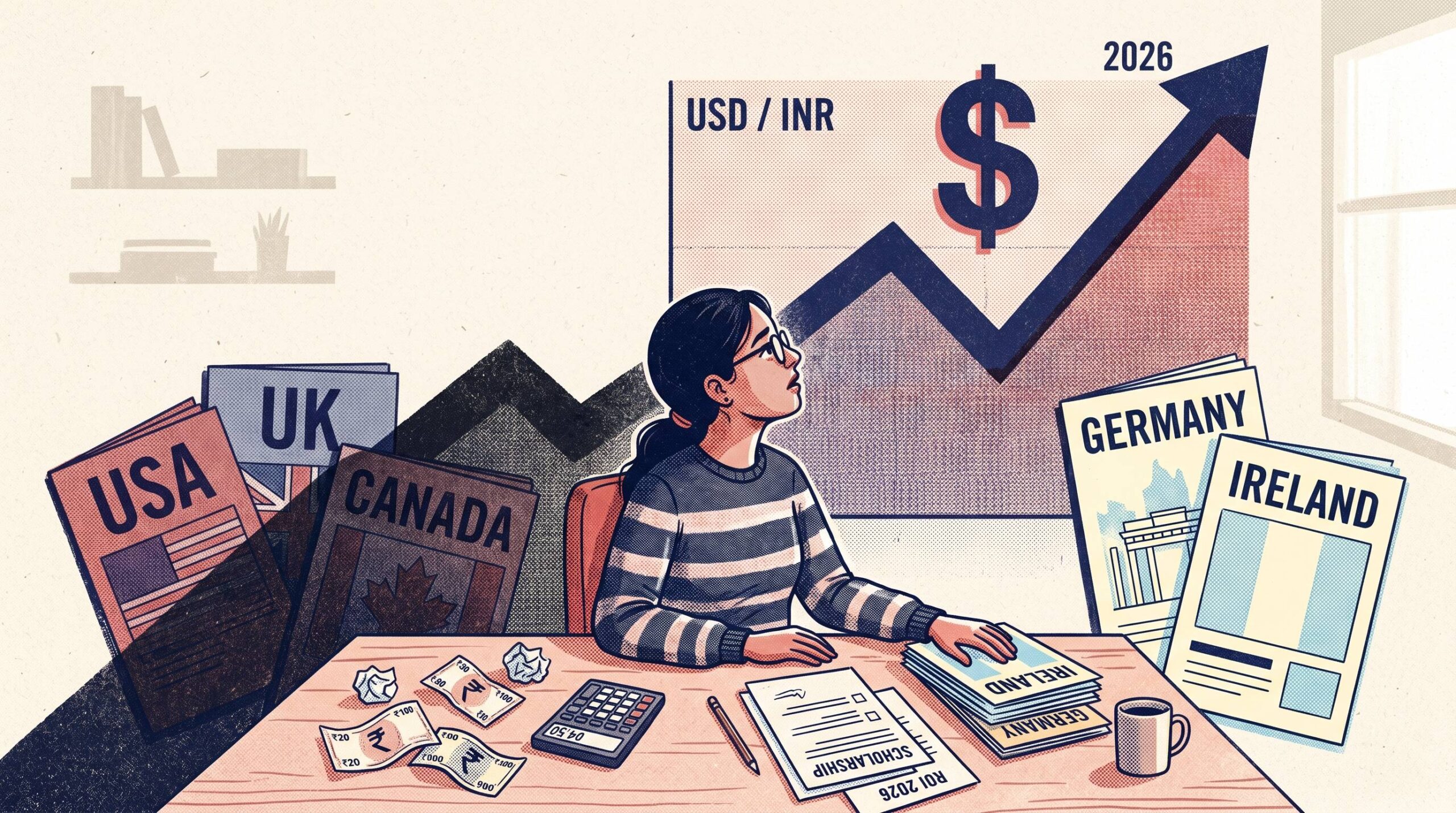
Something quiet has been happening to study abroad plans across India. Students are deferring semesters. Families are converting currency months in advance. And the destinations at the top of the list look very different from a year ago.
The rupee has weakened from the mid-to-high 80s to the mid-to-high 90s per US dollar over the past year with similar depreciation against the pound and euro. The effective cost of studying abroad for Indian students has increased by roughly 10-12 per cent in that period, driven not just by currency movement but by visa fee hikes, higher living costs, and accommodation inflation compounding simultaneously.
The pressure is sharpest at traditional destinations. Australia’s student visa fee has jumped from A$710 to A$2,000. US students now typically pay a $185 visa fee plus a $350 SEVIS fee before classes even begin. For families already stretching budgets, these are no longer minor line items.
Where students are going instead
Platform data from GradRight tells a clear story. Germany has emerged as the strongest gainer, with student preference rising 73 per cent between January-May 2025 and January-May 2026. Canada fell 33 per cent. The UK dropped 15 per cent. The US fell 18 per cent.
“Germany saves Indian students ₹52 lakh-92 lakh in upfront costs compared to the US,” said Lovish Rawal, founding member at GradRight. “The US is increasingly becoming an aspirational second choice rather than a committed Plan A.”
Germany, Ireland, France and New Zealand are gaining ground seen increasingly as offering a better cost-to-outcome balance for Indian students weighing the full financial picture.
The ROI filter in action
The shift is also visible in course choices. Between January-May 2025 and January-May 2026, preferences for Finance fell 82 per cent, Business Administration 86 per cent, Supply Chain 88 per cent and Engineering Management 92 per cent, according to GradRight data.
“These are predominantly US-tied programmes, the most rupee-sensitive choices a student can make at ₹95 per dollar,” Rawal said. “Such courses have seen a near-collapse in interest.”
In contrast, Data Science surged 170 per cent. Computer Science remained relatively resilient. Fields linked to AI, cybersecurity, semiconductors and quantitative finance continue to attract interest because the salary payoff justifies the rupee cost.
“Rupee depreciation is acting as a ruthless ROI filter,” Rawal said.
What students are actually doing
A 23-year-old admitted to a business school in France converted money into euros months in advance to lock in a university deposit and is now preparing for a scholarship test in June to reduce the cost burden further.
A Delhi-based aspirant applying for a Master’s in marketing shifted focus entirely from Canada to Germany and the Netherlands. “My budgeting is changing every month as the rupee continues to dip,” she said. “Scholarships have become a necessity, not a bonus.”
The rupee didn’t just make studying abroad more expensive. It made students more strategic about where, and why.
Source: Business Standard




 Australia
  Canada
  France
  Germany
  India
India  Ireland
  UAE
UAE  United Kingdom
  United States