





MBA in India vs MBA from Abroad: Which one is better?
Good managers are essential for the success of a business. They provide leadership, set goals, and guide other employees toward achieving business objectives. A Master of Business Administration degree or MBA, is the first step towards becoming a successful business manager.
But is it better to get an MBA degree in India or a degree abroad? Choosing between an MBA in India or abroad is a significant decision and one that can shape your future.
In this article, we explore the differences between an MBA in India and an MBA from abroad to help you make an informed decision.
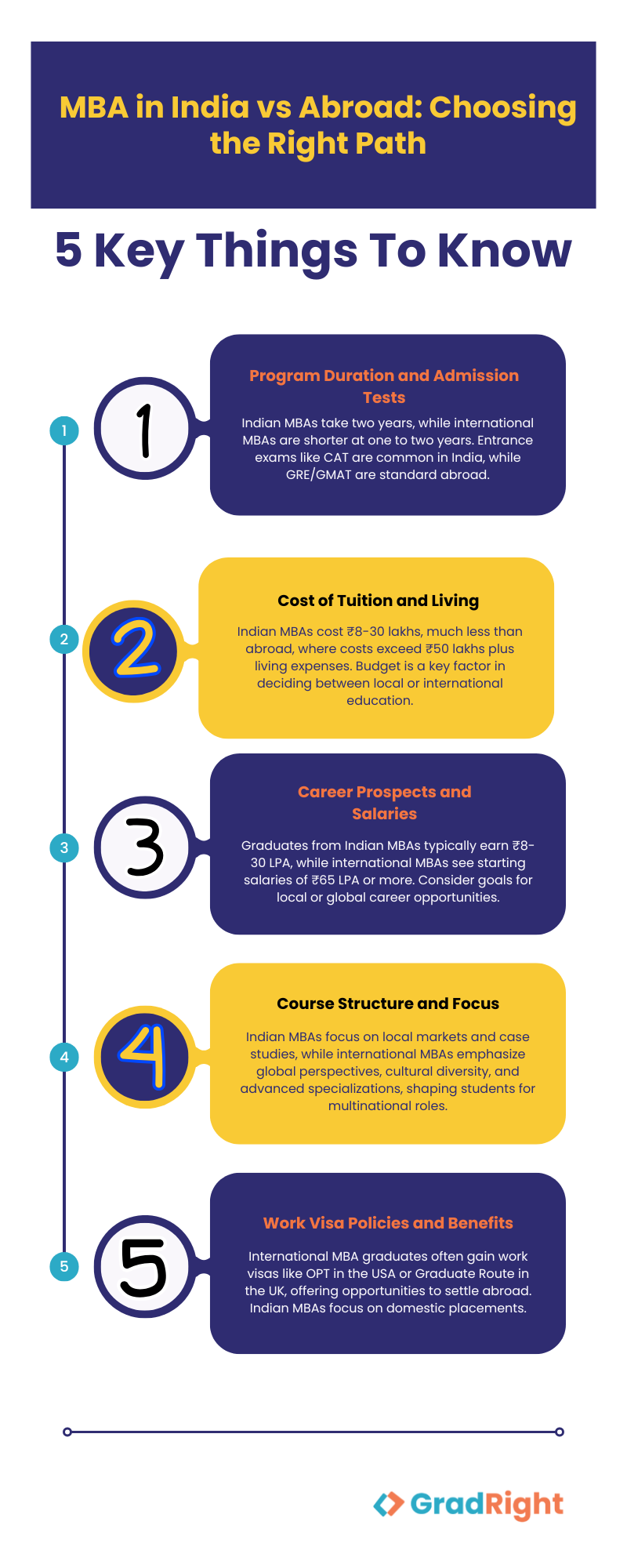
Understanding the differences between an MBA in India and an MBA from Abroad
An MBA degree in India usually focuses on the regional business environment. There is theoretical learning and discussion with the help of case studies relevant to the Indian market. MBA programs at top Indian institutes like IIMs or ISB are widely respected because of their rigorous coursework.
An MBA degree from abroad, on the other hand, lays greater stress on global business practices. This international focus is particularly suitable if you aim to work in multinational companies or industries demanding global perspectives.
Let’s compare the key differences between doing an MBA in India and abroad in the form of a table.
| MBA in India | MBA from Abroad | |
| Program Length | Generally spans 2 years | Typically completed in 1-2 years |
| Admission Tests | CAT, XAT, SNAP, NMAT, CMAT, IIFT, MAT, MAH CET, and IBSAT | GMAT, GRE, along with TOEFL or IELTS for language proficiency |
| Tuition Costs | Approximately ₹6 lakh to over ₹30 lakh | Costs above ₹50 lakh |
| Living Costs | Around ₹3 lakh per year | Estimated at ₹10 lakh annually |
| Expected Salaries | ₹8-30 lakh per annum starting salary | $80,000 – $125,000 or ₹65 lakhs to ₹1.05 crores after graduation |
| Education Approach | Focuses on regional industries and practices | Provides international exposure and advanced specializations |
| Job Prospects | Strong placements in domestic industries | Access to global career opportunities and high-paying roles |
| Cultural Insights | Immersion in India’s business landscape | Interaction with international business environments |
MBA in India vs MBA from Abroad: Cost of Studying
When comparing the cost of an MBA, studying in India is significantly cheaper than pursuing an MBA abroad, with top Indian B-schools like IIMs charging around ₹20-25 lakhs, while a foreign MBA can cost upwards of ₹50 lakhs and even exceed ₹1 crore, depending on the institution and country. This is mainly due to higher tuition fees and living expenses abroad.
Cost Comparison
An MBA in India typically costs between ₹8 – ₹25 lakhs.
| Type of Institution | MBA Fees (₹) |
| IIMs (Ahmedabad, Bangalore, and Calcutta) | 24 lakh to 27 lakh |
| IIMs (Newer at Bodh Gaya and Sirmaur) | 17 lakh to 21 lakh |
| Mid-Tier Colleges | 6 lakh to 15 lakh |
| Public Universities | 50,000 to 4 lakh per annum |
| Private Colleges | 8 lakh to 20 lakh for the entire course |
Note, these are the cost of the entire course but not living expenses.
An MBA abroad can range from ₹50 – ₹80 lakh, with top universities in countries like the US or UK often exceeding this range.
Here’s a list of the top MBA colleges in the US, UK, and Australia, along with their estimated costs.
| Institution | Country | Estimated Cost (US$) | Estimated Cost (₹) | |
| 1 | Stanford University | USA | $84,000 | ₹70,56,000 |
| 2 | University of Pennsylvania (Wharton) | USA | $84,830 | ₹71,13,720 |
| 3 | Harvard University | USA | $84,900 | ₹70,86,600 |
| 4 | Massachusetts Institute of Technology (MIT) | USA | $80,000 | ₹67,20,000 |
| 5 | Columbia University | USA | $84,000 | ₹70,56,000 |
| 6 | London Business School | UK | $70,000 | ₹58,80,000 |
| 7 | University of Cambridge | UK | $66,000 | ₹54,44,000 |
| 8 | University of Oxford | UK | $66,000 | ₹54,44,000 |
| 9 | Melbourne Business School | Australia | $60,000 | ₹50,40,000 |
| 10 | Australian Graduate School of Management (AGSM) | Australia | $55,000 | ₹46,20,000 |
Note, that these are per-year tuition costs, and most foreign courses last 18 months. Living costs and rest expenses e.g. medical insurance are not included in the above.
MBA in India vs MBA from Abroad: Entrance Exams
There are many business schools in India and many of them conduct their own tests. Besides, there are tests conducted by AICTE and other professional bodies.
Here’s a brief overview of some of the most prominent exams:
| Entrance Exam | Conducted By | Frequency | Institutes Accepting Scores |
| CAT | IIMs (Indian Institutes of Management) | Annually | All IIMs and many other top B-schools in India. |
| XAT | XLRI (Xavier School of Management) | Annually (January) | XLRI, S P Jain, GIM, Department of Management Studies, IIT – Madras, Loyola Institute of Management, Great Lakes Institute of Management, and others. |
| MAT | AIMA (All India Management Association) | Four times a year | Christ University, Galgotias Business School, NIILM Centre of Management Studies, MITCON Institute of Management, Alliance Business Academy, Jagan Institute of Management Studies, and ITM (Navi Mumbai). |
| SNAP | Symbiosis International University | Annually (December) | Symbiosis Group of Institutions. |
| NMAT | Narsee Monjee Institute of Management | October to December | NMIMS (Mumbai, Bangalore, Hyderabad), ICFAI, Alliance University, and others. |
| CMAT | AICTE (All India Council for Technical Education) | Annually (April) | Jamnalal Bajaj Institute, Great Lakes Institute of Management, Welingkar Institute of Management, Goa Institute of Management, Birla Institute of Technology – Mesra, K J Somaiya Institute of Management, Xavier Institute of Management and Entrepreneurship, Bangalore, etc. |
| IIFT | Indian Institute of Foreign Trade | Annually (December) | IIFT Delhi, Kakinada, and Kolkata campuses. |
| MH-CET | Government of Maharashtra | Annually (March) | Jamnalal Bajaj Institute, K J Somaiya Institute, N L Dalmia Institute, Indira Institute of Management, PUMBA, and other MBA colleges in Maharashtra. |
| TISSNET | Tata Institute of Social Sciences | Annually | Tata Institute of Social Sciences for various postgraduate programs. |
| TANCET | Anna University | Annually | Various colleges in Tamil Nadu offering MBA programs. |
| IBSAT | ICFAI Foundation for Higher Education | Annually | All ICFAI Business Schools; accept GMAT, CAT, and NMAT scores in addition to IBSAT scores. |
| KMAT | AICTE-accredited B-schools in Karnataka | Annually | Various B-schools affiliated with universities in Karnataka. |
| PGCET | Karnataka Examination Authority | Annually | Various colleges in Karnataka offering MBA programs. |
| ATMA | AIMS (Association of Indian Management Schools) | 4-5 times a year | Over 200 top-ranking institutions in India including IIMs, ICFAI, Xavier Institutes, NMIMS ISB, and Welingkar among others. |
To pursue an MBA abroad, candidates typically need to take standardized tests and English proficiency tests. Here is a table detailing the key standardized and English proficiency tests required for MBA programs abroad.
| Test Type | Test Name | Purpose |
| Standardized Tests | GMAT (Graduate Management Admission Test) | Required for admission to most global MBA programs and many Indian B-schools. |
| GRE (Graduate Record Examinations) | Alternative to the GMAT for candidates applying to certain MBA programs. | |
| English Proficiency Tests | TOEFL (Test of English as a Foreign Language) | Required for non-native English speakers applying to universities in English-speaking countries. |
| IELTS (International English Language Testing System) | Commonly required by universities in the UK, Australia, Canada, and other countries. | |
| PTE Academic (Pearson Test of English Academic) | Accepted by various universities as proof of English proficiency for non-native speakers. |
MBA in India vs MBA from abroad: eligibility criteria and admission requirements
MBA programs in India typically require the Common Admission Test (CAT) or similar test.
International management study programs often demand the Graduate Management Admission Council (GMAT). Generally, overseas programs prioritize more work experience compared to Indian ones. Both require a bachelor’s degree as a base requirement.
Some top Indian B-schools may prefer a few years of work experience. However, it is not a mandatory requirement at any business school in India, barring fast-track executive programs. However top international universities usually prefer work experience for admission.
MBA in India vs MBA from abroad: course structure
When comparing an MBA in India to one abroad, the key difference in course structure is in the focus on local versus global business practices. Here are the main differences:
- Curricula Focus
Indian MBA programs primarily analyze the Indian market, including regulations, industry trends, and emerging sectors. This makes the graduates ideally skilled for careers within the domestic economy.
International programs offer a wider lens and cover global business dynamics and diverse market scenarios on various continents.
- Teaching Methodologies
Indian programs rely heavily on theoretical concepts and case studies, with a strong quantitative focus.
International programs use experiential learning like simulations, company visits, and global internships, and lay stress on practical application.
- Specialization Variety
While Indian programs offer core specializations like finance, marketing, and operations, international programs often have a broader range of niche areas. These include areas like sustainability management, luxury brand management, and global supply chain.
Top B-Schools in India vs Top B-Schools Abroad
Indian B-schools provide a strong foundation in local business practices at a significantly lower cost. While programs from top-tier schools abroad have a greater name recognition.
Top B-Schools in India
- Indian Institute of Management Calcutta (IIM Calcutta)
- Xavier Labour Relations Institute (XLRI), Jamshedpur
- Faculty of Management Studies (FMS), University of Delhi
- Indian Institute of Management Bangalore (IIM Bangalore)
- Indian School of Business (ISB), Hyderabad
Top B-Schools Abroad
- Harvard Business School in Boston, Massachusetts.
- Stanford Graduate School of Business in Stanford, California
- Wharton School of Business in Philadelphia, Pennsylvania
- London Business School in Regent’s Park, London.
- INSEAD at Fontainebleau near Paris.
MBA from India vs MBA from abroad: career prospects
An MBA from a top-ranked international business school generally offers wider global career opportunities and higher salaries. For those who graduate from the top 10 global business schools a starting salary of $100,000 is not an outlier.
In India though salaries are a lot less with starting salaries ranging from ₹20 lakhs to ₹50 lakhs. However, some students do receive placements at the best MNCs and consultancies and receive higher packages.
MBA from India vs MBA from abroad: work visa policies
If you study abroad, obtaining a work visa generally depends on the country where you complete your studies. Below is a table summarizing the post-study work visa options available in several developed nations.
| Country | Visa Type | Duration | Key Features |
| United Kingdom | Graduate Route Visa | 2 years (3 years for doctoral graduates) | • No prior job offer required.
• No minimum salary threshold. • Flexible employment options. |
| Canada | Post-Graduation Work Permit (PGWP) | Up to 3 years | • Must have completed at least 2 years of study.
• Apply before the study permit expires. |
| Australia | Temporary Graduate Visa (subclass 485) | 2 to 4 years depending on degree level | • Must meet English proficiency requirements.
• Allows work, study, or travel. |
| Germany | 18-Month Residence Permit | 18 months | • Allows graduates to search for jobs in their field.
• Work any job to support themselves. |
| New Zealand | Post-Study Work Visa | Up to 3 years | • Duration depends on study program length and location.
• Flexible work opportunities available. |
| United States | Optional Practical Training (OPT) | Up to 12 months (24-month extension for STEM) | • Must secure employment related to the field of study.
• Application must be made before graduation. |
Keep in mind, since an MBA recruit is a top-tier employee, it would not be difficult for any global employer to sponsor you and place you in any country where they operate.
MBA in India vs MBA from abroad: pros and cons explained
Choosing between an MBA in India and an MBA abroad primarily depends on your career goals and budget, with Indian programs being more affordable. Here is a look at the pros and cons:
Pros of an MBA in India
Lower Cost
Tuition fees and living expenses are significantly lower compared to most international programs, making it a more cost-effective option.
Strong Domestic Network
Access to a large pool of Indian companies and established business connections within the local market.
High Placement Rates
Top Indian B-schools boast excellent placement records with renowned Indian companies.
Relevant Curriculum
Programs often tailor their curriculum to address specific challenges and trends within the Indian business landscape.
Cons of an MBA in India
Limited Global Exposure
May lack exposure to international business practices and diverse perspectives compared to an overseas program.
Competitive Admissions
Gaining admission to top Indian B-schools can be highly competitive.
Potential Salary Ceiling
Salaries in India are lower than those offered by multinational companies to graduates from top international programs.
Pros of an MBA Abroad
Global Network
Access to a wider network of international alumni and business contacts across different industries.
Diverse Perspective
Exposure to different cultures and business practices from around the world, enhancing global understanding.
Higher Potential Earnings
Graduates from top international B-schools get higher salaries due to their global reputation.
Cutting-Edge Curriculum
Many international programs offer specialized and innovative courses with a focus on emerging trends.
Cons of an MBA Abroad
High Cost
Tuition fees and living expenses abroad are far higher, requiring significant financial investment.
Visa Challenges
Obtaining a study visa and navigating immigration processes can be complex for some.
Competition for Jobs Abroad
Securing a job abroad might be challenging depending on your chosen specialization and experience.
MBA in India or MBA from abroad: which one is right for you?
Choosing between an MBA in India and an MBA abroad depends largely on your career aspirations. If you aim for a global career with multinational companies, an MBA abroad is preferable due to the wider exposure and international network it provides.
An MBA in India might be better if you plan to work primarily within the Indian market and value strong local connections and understanding of the domestic business landscape. But an MBA from India doesn’t mean you will be stuck in Bangalore or Pune.
Many IIM graduates work for global consultants such as McKinsey, BCG, and Bain & Company. Indra Nooyi, the legendary CEO of PepsiCo, who retired in 2018, is an alumnus of IIM, Calcutta.
If you want to settle abroad and work there, it is better if you choose to pursue an MBA degree from abroad.
There are multiple universities and institutions both in India and abroad that teach top-rated management programs. If you want to make the right decision, from choosing the right B-school to choosing a specialization, GradRight’s university-search platform is the perfect way to find an institution that exactly matches your preferences. With its data-driven approach, the platform creates a curated shortlist of the best global and Indian business schools that are perfectly suited for you.
Since MBA degrees are quite expensive you might want to explore education loans. Simply share your details on GradRight’s loan-search platform and 15+ lenders will respond with matchless loan offers. All you have to do is choose the one which is best for you.
SelectRight and FundRight together can make your admission to a business school easy and stress-free.
FAQs
1. Which MBA is better in India or abroad?
Generally, an MBA from abroad is considered better than one from India if you are aiming for a global career, as it offers wider international exposure.
2. Does an MBA from abroad have value in India?
Yes, an MBA from abroad has significant value in India, but only if it’s from a highly respected international university. It can provide a competitive edge with global exposure and lead to higher salary opportunities.
3. What is the salary of an MBA in India vs abroad?
The starting salary of an MBA graduate from India is between ₹10 lakhs and ₹50 lakhs. Some exceptional graduates of IIMs receive high-paying jobs abroad.
A graduate from a foreign business school generally starts with a salary between $90,000 and $120,000.
4. Is an MBA from India recognized abroad?
Yes, it is. Unlike accountancy, medicine, or law – management graduates from India can work anywhere without problem.
5. In which country is an MBA best?
The USA leads the world in management schools. Stanford Graduate School of Business and Harvard Business School are marquee names.
6. What are the disadvantages of an MBA?
There are no disadvantages to doing an MBA. A management graduate is highly employable and can work in any sector that requires administration.