




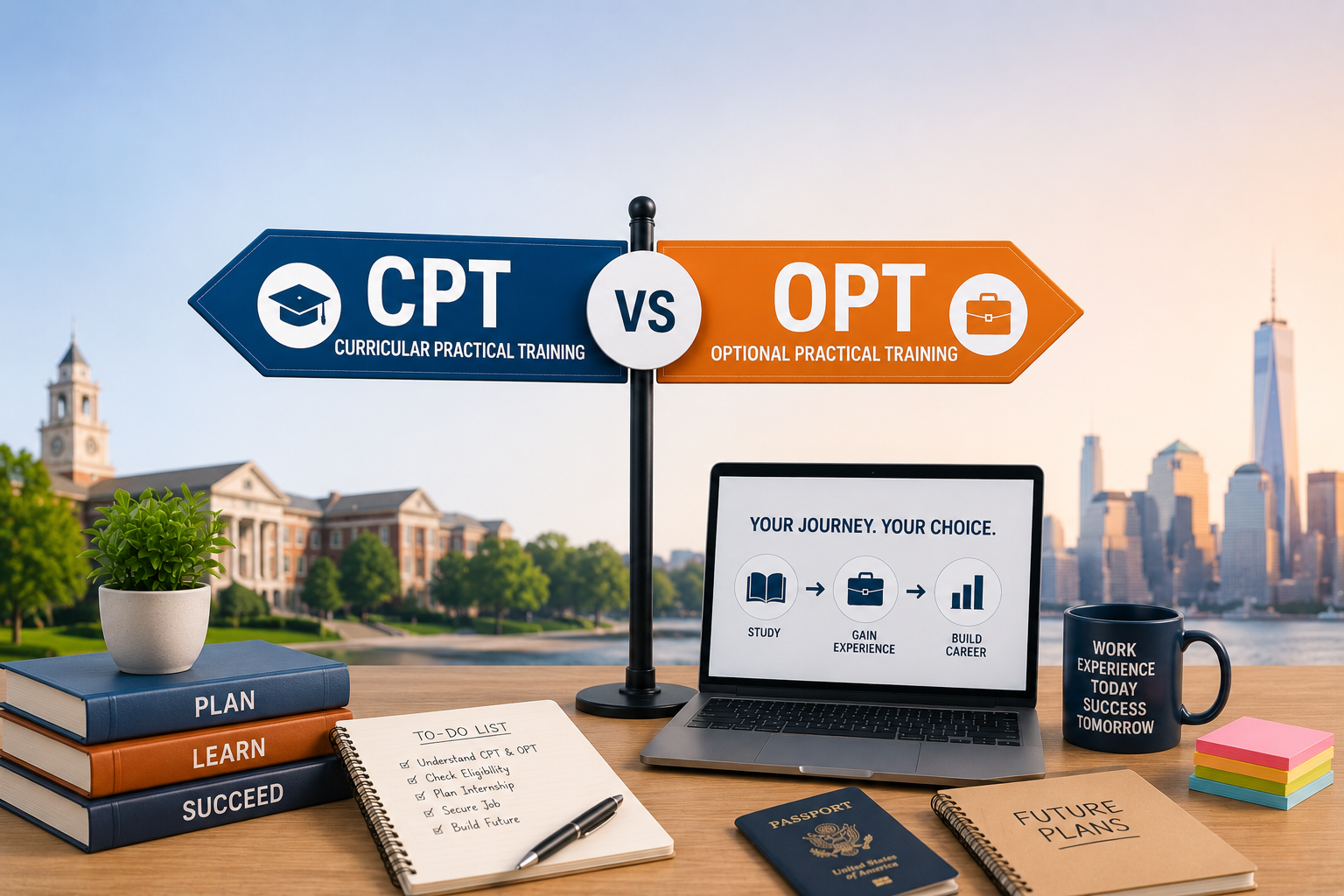
You’ve landed your admit, sorted your I-20, cleared your visa interview, and made it to the USA. At some point, maybe during orientation or while scrolling through LinkedIn job listings, you’ll come across two terms that every Indian student in the USA needs to understand: OPT and CPT.
They sound similar. They’re often mentioned in the same breath. But they work very differently. Most importantly, choosing the wrong one at the wrong time can cost you far more than just a job opportunity. It can affect your entire post-graduation immigration path.
This blog breaks down what OPT and CPT mean, how they differ, when to use each, and the key risks you need to understand.
What is CPT and OPT?
Understanding CPT and OPT is the first step to navigating work opportunities as an international student in the USA.
What is CPT?
CPT (Curricular Practical Training) is work authorization that is directly tied to your academic curriculum. It is meant for internships, co-ops, or training programs that are a required part of your degree. You must have a job offer in hand, and your university approves it through your Designated School Official (DSO).
What is OPT?
OPT (Optional Practical Training), on the other hand, is broader and more flexible. It allows you to work in roles related to your field of study, either during or after your program. Most students rely on post-completion OPT, which allows up to 12 months of work, or up to 36 months for STEM graduates.
In simple terms, OPT and CPT for international students serve different purposes: one is curriculum-driven, the other is career-driven.
Why are OPT and CPT important?
The importance of OPT vs CPT goes far beyond just internships or first jobs. These authorizations shape your financial stability, career trajectory, and even long-term stay in the USA.
For many Indian students, education loans are a reality. OPT becomes the bridge that allows you to start earning in dollars, manage EMIs, and reduce financial pressure on your family. CPT, meanwhile, helps you gain early work experience and build a strong resume before graduation.
Then comes the bigger picture. Your OPT period is often your gateway to securing an H-1B visa, which plays a key role in long-term US residency plans.
But here’s where many students go wrong.
The pressure to repay loans or “just get any job” can push students into roles that are not aligned with their course. That’s risky. Both OPT and CPT require your work to be directly related to your field of study. CPT must even be a required part of your program.
This is where it helps to step back and look at the root cause.
In many cases, this pressure doesn’t begin during OPT or CPT. It starts much earlier, at the stage of planning how to finance your education.
At GradRight, we hope to nip that pressure in the bud. By enabling students to compare and secure the best education loan offers (and even access lesser known scholarships) we help reduce the urgency to accept the wrong opportunity just for money.
As the co-founder of GradRight, Mr. Aman Singh, says,
“To do away with the prevailing information asymmetry, GradRight aims to partner with students, universities, and financial institutions… to soothe palpable anxiety and uncertainty regarding the vital decision of choosing a college and subsequently financing partners.”
When financial pressure is managed early, students have the freedom to make smarter, more aligned choices during CPT and OPT, without compromising their long-term goals.
OPT vs CPT: Quick comparison
| Feature | CPT | OPT |
| When you can use it | During your program only | Before or after graduation |
| Who approves it | Your DSO | USCIS (via DSO recommendation) |
| Job offer required? | Yes | No |
| Duration | No strict cap (but has consequences) | 12 months (up to 36 for STEM) |
| Type | Part-time or full-time | Mostly full-time post graduation |
| Fee | No | USD 410 |
| Academic requirement | Must be part of curriculum | Must be related to major |
5 key differences between OPT and CPT
1. Timing and Usage
CPT is limited to your time as a student. You can only use it while you are actively enrolled, and it needs to tie directly into your coursework.
OPT is more flexible. You can use it either before graduation (pre-completion) or after you finish your degree (post-completion). This is where the two really start to differ. One supports your time in university, while the other helps you step into the workforce.
2. Approval Process
The way these are approved is very different and it matters more than most students expect.
CPT is handled internally by your university through your DSO, which usually makes it quicker and more straightforward.
OPT, on the other hand, goes through USCIS. That means more paperwork, longer timelines, and the need to plan ahead. You will also need your Employment Authorization Document (EAD) before you can start working.
3. Job Offer Requirement
This is one of the most practical differences. For CPT, you need a job offer before you even apply. It is tied to a specific employer and role, and it must align with your academic program.
OPT gives you more breathing room. You can apply without having a job in hand and continue your job search after receiving your EAD. For most students, this flexibility makes a big difference during the post-graduation phase.
4. Duration and Flexibility
CPT does not come with a strict time cap, but that does not mean unlimited usage without consequences.
OPT, in contrast, is clearly defined. Most students get 12 months, while STEM graduates can extend this up to 36 months. Because of this, OPT becomes the main window to build work experience in the USA after graduation, so it needs to be used carefully.
5. Impact on Future Opportunities
This is the part many students overlook and it can cost them later. If you use 12 months or more of full-time CPT at the same degree level, you lose your OPT eligibility entirely. That means no standard OPT period and no STEM extension.
Part-time CPT, however, does not affect OPT eligibility. That is why many students choose to limit how much full-time CPT they use and stay on the safer side.
Final thoughts
OPT and CPT are not interchangeable, and treating them like they are can lead to mistakes that are hard to undo later. Each serves a different purpose at a different stage of your journey.
Think of CPT as a way to build momentum while you are still studying. And think of OPT as your runway after graduation: the time where your efforts start turning into real career progress.
The key is to stay intentional. Not every opportunity is the right one, and not every short-term win is worth the long-term trade-off. When you understand how these options work, you give yourself the space to make decisions that actually support where you want to go. As Rohit, a GradRight-supported student, shares about his future plans,
“By utilizing the knowledge I will earn through the international exposure and world-class curriculum, I wish to help others move up the social and economic ladder through my entrepreneurship skills.”
That’s the real advantage we aim to offer: opportunities, not compromise.
And if you are planning ahead and want a clearer path, from funding your education to making the most of your time in the USA, you can always reach out at hello@gradright.com.





 Australia
  Canada
  France
  Germany
  India
India  Ireland
  UAE
UAE  United Kingdom
  United States