





Shaving just one percentage point off a ₹50-lakh education loan can keep well over ₹3 lakh in your pocket across a 10-year term. So, every basis point really does matter.
The good news: sub-5% fixed refinance offers have finally surfaced for borrowers with strong US credit profiles.
Right now, headline fixed APRs start at 4.99% with SoFi when you switch on autopay. Laurel Road’s five-year terms open around 5.24% and dip further if you route your salary through its linked checking account.
Independent trackers confirm the trend. They even list multiple lenders with fixed quotes between roughly 4.9% and 9.9% for top-tier applicants.
Variable deals ride the 30-day SOFR average (≈4.37%) plus a lender margin. A “5.99% variable” quote today translates to about a 1.6% spread over the benchmark.
If SOFR drifts sideways, a low-margin variable loan can undercut fixed offers. However, the moment the index climbs, your payment follows.
For Indian graduates working in the US with credit scores above 740, debt-to-income ratios under 35%, and a willingness to enroll in autopay, the sweet spot now sits in the low-5% band, and occasionally, the high-4s.
Providers leading the charge include SoFi, Laurel Road, ELFI, and the Splash and Credible marketplaces, where partner lenders occasionally undercut direct-lender boards.
In short, if you are looking for the lowest student loan rates for refinance, they are available. And with GradRight’s help, they can be well within your reach.
Best lenders and marketplaces for locking the lowest refinance rate
Before you fill out a single application, it helps to know who even posts sub-5% quotes for international graduates. And what strings are attached.
For Indian borrowers on OPT, STEM-OPT, or the first years of an H-1B, two details swing the final APR more than anything else:
- Visa or co-signer rules
Some lenders (e.g., SoFi) accept certain work visas outright, while others (Citizens, Earnest, ELFI) insist on a U.S.-citizen or green-card co-signer.
If you don’t clear that bar, an international-only option like MPOWER steps in, though at a higher fixed rate.
- Built-in discounts
Almost every lender shaves 0.25% off for autopay. Laurel Road goes further: open its “Linked Checking” and you can slice up to another 0.55% off the headline APR.
Relationship perks like these can push a 5.2% quote down into the high-4s if your profile is strong.
Think of the table below as a cheat sheet. Find out who’s cheapest on paper, which visas they’ll work with, and what kind of borrower they’re really built for.
| Lender / Marketplace | Fixed APR range* | Variable APR range* | Autopay / Relationship perks | Visa / Co-signer note | Best fit |
| SoFi | 4.99% – 9.99% | 5.99% – 9.99% | –0.25% autopay (extra –0.125% for SoFi Plus) | Accepts H-1B, J-1, E-2/E-3, O-1, L-1 without cosigner | Top-tier credit for those who want broad member perks |
| Laurel Road (KeyBank) | 5.24% – 8.75% (5-year term) | 5.65% – 8.85% (7-year term)** | –0.25% autopay
Up to –0.55% with Linked Checking |
Requires a valid SSN
Non-citizens often need a US cosigner |
W-2 earners who are happy to direct-deposit their salary |
| Earnest | 4.75% (lowest listed) | Starts ≈5.24% | –0.25 % autopay | International borrowers must add a US citizen/PR cosigner | Flexible term picker + cosigner advantage |
| Citizens | 5.73% – 10.30% | ≈6.01%+ (varies) | –0.25% autopay | Resident-alien applicants must apply with a US citizen/PR co-signer | Long-term visa holders who can tap a family/friend as a cosigner |
| ELFI | 4.88% – 8.44% | 4.86% – 8.24% | –0.25 % autopay | Cosigner required for non-citizens/permanent residents | Larger balances (up to ₹4 cr) and quick processing |
| Splash Financial (marketplace) | 4.45% – 10.24% | 4.86% – 10.24% | Per-lender
Most include –0.25% autopay |
Visa rules depend on the partner
H-1B visas are accepted by several |
One-stop shop to see bids from multiple banks |
| Credible (marketplace) | 3.99% – 9.99% | 4.35% – 11.38% | Per-lender
Autopay is baked into the lowest quotes |
Mix of visa-friendly lenders
Filter for cosigner-free |
Fast “soft-pull” comparison without credit hit |
| MPOWER Refi | 9.99% after 0.25% autopay discount (10.24% base) | N/A (fixed only) | –0.25% autopay | No co-signer
Open to F-1 OPT, H-1B & more |
Thin-credit international who can’t add a cosigner |
*All ranges are as of early September 2025 and already include any autopay discount, unless noted.
Focus on the left column if you want payment certainty. Check the margin over SOFR if you’re tempted by a variable starter rate. Also, if your current status isn’t listed under “accepts,” assume you’ll need a U.S. co-signer or look at MPOWER.
Marketplace sites pre-qualify you (soft pull) and surface partner-lender offers. That saves you from filling out five different forms. You are also likely to get the best student loan rates for a refinance this way.
Fixed vs variable: which one gets you the lowest cost now
After short-listing the lenders that welcome Indian internationals, the next fork in the road is rate type. Every quote you receive will be either:
- Fixed APR – one number that never changes.
- Variable APR – today’s 30-day SOFR benchmark (≈4.37% on 12 Sep 2025) plus the lender’s margin.
Because the benchmark moves and margins differ, the cheaper option isn’t always obvious. Here’s how to decide.
When a Variable Offer Can Undercut Today’s Fixed Deals
A variable loan wins only if the margin is slim and you plan to clear the balance quickly. Take SoFi’s starter quote of SOFR +1.6% (5.99% APR at today’s index).
If SOFR drifts sideways for three years and you pay off a ₹50-lakh balance on schedule, that 5.99% variable rate beats a 5.50% fixed by roughly ₹55,000 in total interest.
When Locking a Fixed Rate is Safer and Usually Cheaper Over Time
If you’ll need more than five years, one Fed hiking cycle could lift SOFR by a full percentage point. A 6.99% variable then overtakes a 5.50% fixed in less than 24 months and keeps climbing.
Fixed also shields your monthly EMI. It’s handy when you’re budgeting visa fees, family remittances, or rent in a high-cost US city.
A Quick Rule of Thumb
| Repayment horizon | Margin over SOFR | Likely winner |
| ≤3 years | ≤1.75% | Variable |
| 3 – 5 years | 1.75% – 2.25% | Run the math both ways |
| >5 years | Any margin | Fixed |
Think of the current student loan refinance rates you saw in the lender table as your baseline.
The variable quote has to beat that fixed number after you model at least a one-point rise in SOFR. Otherwise, take the certainty and sleep soundly.
How to compare refinance offers the right way
You’ve narrowed the field to a handful of lenders. Now, it’s time to check student loan refinance rates side-by-side and choose the cheapest, safest option.
Because every lender structures its quotes a little differently, a quick glance at the headline APR can be misleading. Use the three checkpoints below to line everything up on equal footing before you lock in.
1. Match Identical Terms and Use the Net APR
A five-year fixed at 5.25% is not automatically better than a seven-year fixed at 5.35%. The shorter term usually wins on total interest, even at a slightly higher rate. Always:
- Select the same repayment term (e.g., 5, 7, or 10 years) on every quote.
- Apply all automatic discounts. Most lenders shave 0.25% for autopay. Laurel Road can knock off up to 0.55% more with its Linked Checking account.
- Compare the APR, not just the interest rate. That’s because APR bakes in any required fees (a few reputable lenders charge origination fees, but check the fine print).
2. Decode Variable Quotes: Index + Margin
Variable offers look tempting when SOFR is calm, but the real number to watch is the margin the lender adds to the benchmark:
- Write down the equation on each offer—e.g., SOFR (4.37%) + 1.60% = 5.97% today. Many lenders display only the combined figure. Dig for the breakdown.
- Stress-test a one-point rise in SOFR. If the loan jumps past your best fixed offer with that single move, the fixed rate is safer.
- Some lenders cap variable APRs (SoFi at 13.95%; Laurel Road similar), but the cap is usually so high that it offers little day-to-day protection.
3. Look Beyond Price: Fees, Protections, and Exit Flexibility
A rock-bottom rate loses its shine if the loan is restrictive.
- Prepayment penalties: Quality refinance lenders—SoFi, Laurel Road, Earnest—charge none. Federal law bans them on private student loans.
- Hardship or unemployment forbearance: SoFi offers up to 12 months in three-month chunks. Earnest allows tailored plans. If your job outlook is shaky, weigh these perks.
- Relationship requirements: Make sure any checking-account or deposit rule that unlocks a discount is realistic for you. Closing that account later can bump the rate back up.
- Refi-again freedom: Confirm there’s no fee to refinance later if rates drop further (most lenders allow fee-free repricing).
Follow these checkpoints, and you’ll compare offers apples to apples. That will make sure that the lowest student refinance rates you see are truly the lowest once the dust settles.
How to get the lowest student loan refinance rates: a step-by-step action plan
Comparing quotes is only half the battle. The rest is optimising your own profile so lenders slot you into their cheapest pricing tier.
Think of it as tuning up your credit engine before race day. A few weeks of prep can slice 50–75 basis points off your final offer. That can be worth ₹1–1.5 lakh on a ₹50-lakh balance.
Use the playbook below to land the lowest student loan rates refinance deals now on the market.
1. Tune Your Credit Profile before You Click “Apply”
Small fixes deliver outsized savings because every 20-point jump in a FICO score can unlock a lower band.
- Pay down revolving balances to push utilisation below 30% (below 10% is ideal).
- Clear or dispute any late-payment marks. Even a single 30-day delinquency in the past year can lift your APR by half a point.
- Collect proof of stable income. Two recent pay-slips or an offer letter if you’ve just switched jobs; lenders want to see consistency.
2. Stack All the Discounts You Can—Only the Ones You’ll Keep
Once your credit is ready, squeeze the margin further with automatic perks.
- Pick the shortest term you can comfortably afford. Five-year loans are almost always priced lower than seven or ten-year options.
- Enrol in autopay from day one to pocket the built-in 0.25% rate cut every lender offers.
- Add relationship accounts only if they make sense. Laurel Road’s Linked Checking can shave another 0.25%–0.55%. However, don’t tie up cash you’ll need for visa renewals or relocation.
3. Leverage People and Timing to Seal the Deal
Even a perfect solo application can be better with strategic extras.
Bring a credit-worthy U.S. co-signer (FICO ≥760) if your visa status limits lender choice. Citizens and Earnest drop pricing bands dramatically when a strong cosigner appears.
Re-shop after any credit or rate shift. Soft-pull marketplaces like Credible and Splash let you refresh quotes without a hard inquiry. That’s handy if SOFR dips or your score jumps.
Confirm zero prepayment penalty so you can refinance again if rates slide. Reputable lenders charge none, but always read the note in the promissory agreement.
Follow this three-part playbook and you’ll move from “good” to the best student loan rates for refinance territory. Turn every lender’s lowest headline number into your personal reality.
How GradRight helps you find the lowest refinance rates
After you’ve polished your credit and lined up a short-list of lenders, you still face a slog: separate applications, repeated KYC uploads, and long email chains with five different loan officers.
GradRight collapses that grind into a single dashboard, and, more importantly, makes lenders compete for your business. Here’s how it works:
-
One Profile, Many Bidders:
Fill out a short questionnaire with your loan balance, US income, visa status, and credit score.
GradRight’s engine pushes that data to a network of domestic and international lenders. Then, the platform pipes the live quotes back to you side-by-side.
-
Clear Savings Math Up Front:
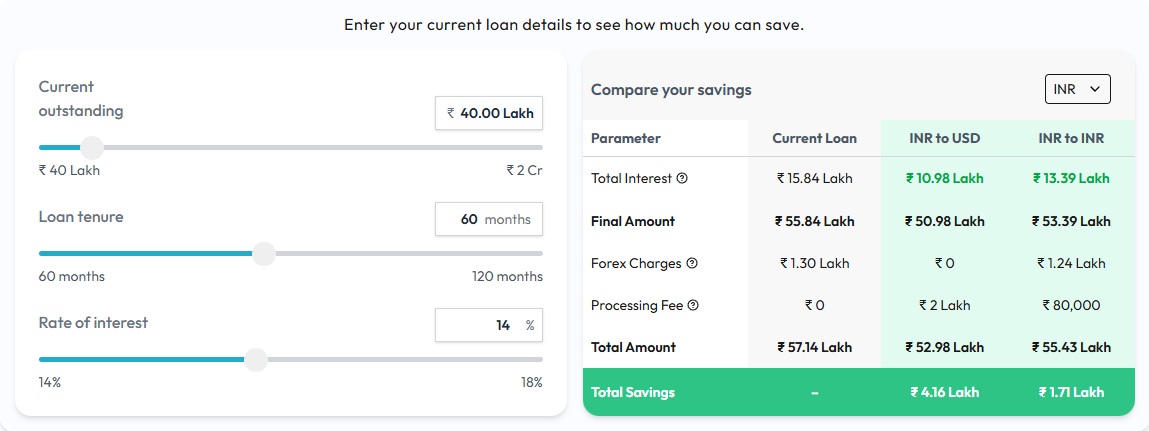
The built-in calculator shows rupee-for-rupee savings before you move a single document. Converting a ₹50-lakh, 11% INR loan to a 6% fixed USD loan trims roughly ₹8 lakh in total interest.
-
Step-by-Step Refinance Flow:
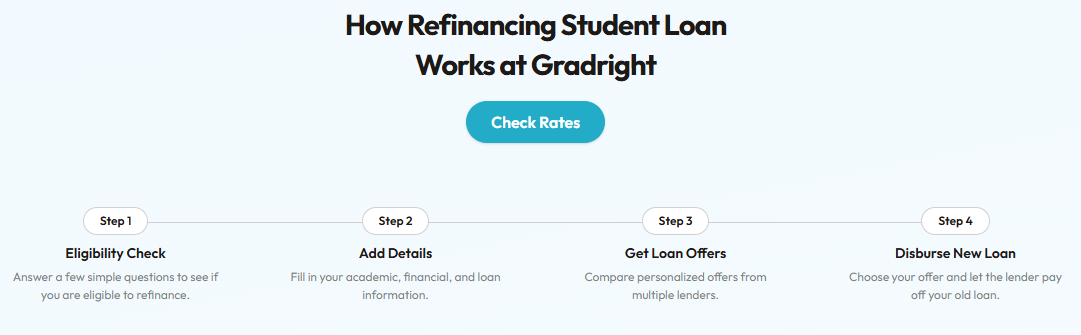
First, run an eligibility check. Then, add academic and financial details. Now, it’s time to compare offers and finalize a deal. Finally, your chosen lender pays off the old loan.
Throughout, GradRight staff handle payoff letters, NOC follow-ups with Indian banks, and any forex paperwork if you’re moving from INR to USD.
Both INR to USD and INR to INR Refinancing are Covered
Working in the U.S.? Shift the loan to a stateside lender and kill forex charges. Staying in India? Swap to a lower-rate domestic bank. Two refinance tracks, one interface.
Why This Matters for Those Looking for The Lowest Deals
- Live head-to-head pricing means you don’t wonder whether a lower quote is hiding elsewhere. If it exists in the network, you see it.
- Speed: bids typically land within days, not weeks. That cuts the lock-period anxiety that can derail the lowest student loan rates refinance search.
- Proof in numbers: GradRight has assisted 200,000+ students and processed ₹16,300 crore in loan requests. Leverage that to pull deeper discounts from partner lenders.
In short, GradRight gives Indian graduates the leverage of a bulk buyer. Lenders fight for your ₹50-lakh payoff, paperwork is centralised, and you walk away with the truly lowest offer
Wrapping up
The market finally rewards preparation. Polish your credit, line up the right lenders, and trigger a bidding war, whether through GradRight or a disciplined round of rate-shopping.
With the right approach, you can trade double-digit rupee debt for a single-digit fixed US rate that saves you lakhs. The next move is yours; make it count.