



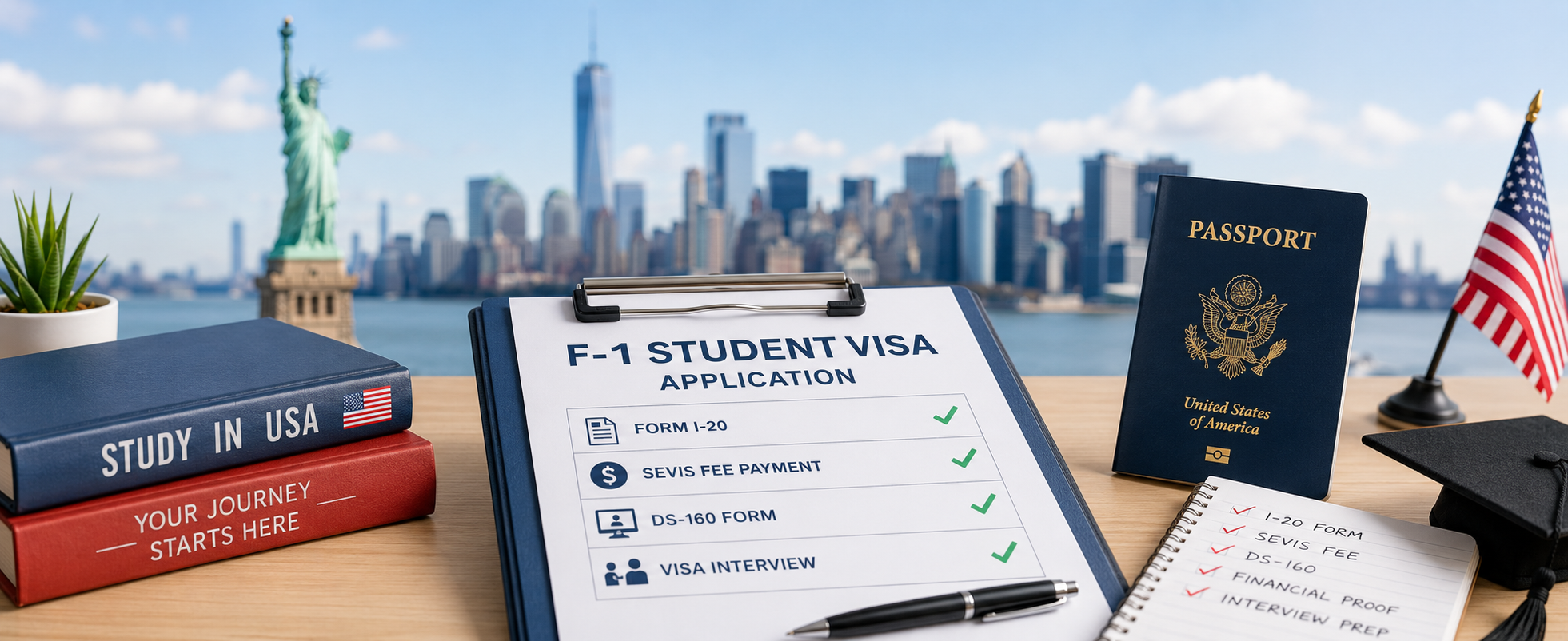
International enrollment to the USA from India is at an all-time high. Over 3.6 lakh Indian students studied in the United States in 2024/25, a 10% jump year-on-year and the highest on record. And every one of them cleared the Form I-20 before showing up at the embassy.
The Form I-20 is your certificate of eligibility, issued by your university and recognized by the United States government. Without its SEVIS number, you cannot pay the $350 I-901 fee, complete the DS-160, or schedule a visa interview appointment.
So, if you’re targeting a Fall 2026 intake, before you start the F-1 student visa application process, you will need to get your Form I-20. This helps you schedule everything else including SEVIS payment and interview slot.
Student (F and M) visas for new students can be issued up to 365 days before the start date of a course of study.
Let’s look into how you can get your I-20 Form and start a USA student visa application soon for the Fall 2026 intake.
How do you request and receive the I-20 from your university for the 2026 intake?
Form I-20 is a government form that your school issues as an eligibility document. It opens up the rest of your USA student visa workflow.
Schools issue the I-20 through their Designated School Official (DSO) only after they are satisfied that you’re a genuine full-time student and you can fund the program as budgeted.
You need:
- Confirmed admission
- Intent to enroll full-time
- Proof you can cover costs without unauthorized work
Universities commonly ask international students to upload some documents by the university, for I-20 issuance. These include:
- Passport ID page
- Proof of funds for Year 1 (as per the school’s published I-20 cost estimate). This includes bank statements, sponsor letter, sponsor bank proof, sanctioned loan letter, scholarship award, etc.
- Financial sponsor affidavit/letter (if parents/relatives are sponsoring).
- Admission/offer confirmation.
Names, dates, and funding source labels need to match across your passport, I-20 request forms, and the bank/loan documents you upload.
If your funding is a loan plus family savings, don’t leave it up for the university to infer it. Spell it out cleanly so your I-20 funding lines reflect the same story you’ll later tell at interview.
You can submit your I-20 request through your international student portal. Some simple steps to follow:
- Accept/confirm enrollment in the university system.
- Upload financial documentation to meet the school’s stated I-20 budget requirement.
- DSO review and issuance (e-delivery or physical courier depending on the school).
- You sign/attest where required before using it for visa steps.
Universities caution students not to wait until the last minute because visa issuance can take one week to several months. The peak season between May and August is the busiest.
How do you pay the $350 SEVIS fee and complete the DS-160 visa application form?
You can start your USA student visa application process after receiving your I-20 form.
“Register in SEVIS, you may apply at a U.S. Embassy or Consulate for a student (F or M) visa. You must present the Form I-20 to the consular officer when you attend your visa interview.”
— The U.S. Department of State
You can pay the $350 SEVIS I-901 fee on the official SEVIS fee site. DS-160 takes approximately 90 minutes to complete.
Then, save the SEVIS fee receipt as a PDF and back it up. You’ll need it at interviews and sometimes at port-of-entry checks.
Starting with May 31, 2019, visa applicants also have to list all social media usernames or handles of every platform they have used from the last 5 years on the DS-160 visa application form.
F-1 visa interview scheduling process in 2026
After completing the DS-160, you can schedule an interview appointment in the U.S. Embassy or Consulate.
The wait time is different for each embassy or consulate location and also differs by season, and visa category.
Your job is to make it easy for a consular officer to believe:
- You’re going for a coherent academic reason
- You can fund it credibly
- Your intent is consistent across I-20, DS-160, and your proof.
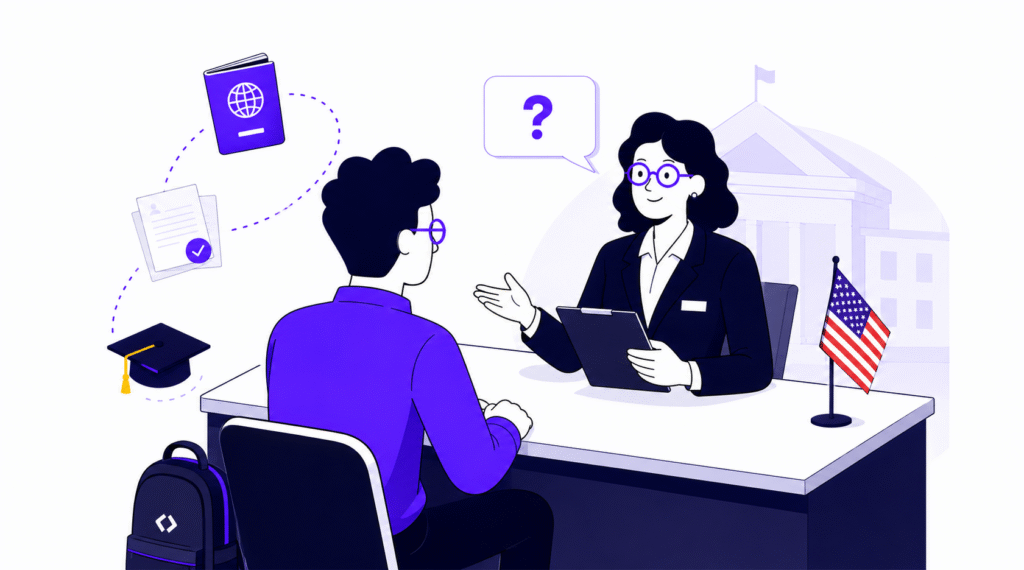
The best preparation for your visa interview is to give consistent answers to why you chose the program and school you got selected in, what outcomes you are targeting, your funding source and presenting documents supporting your claim.
Here is a document checklist for your visa appointment in 2026:
- Passport – Your passport must be valid at least 6 months beyond your planned stay in the USA.
- DS-160 – The DS-160 confirmation page (the one with the barcode).
- Visa fee receipt – Your USA student visa application fee payment receipt, if you’re required to pay before the interview.
- Photo – You upload a photo within the DS-160 form. If the upload fails, bring one printed photo that meets the photo specs.
- Form I-20 – Your Form I-20 issued by the school, signed by you and the school official
- Academics – Transcripts, diplomas/degree certificates, and test scores the school required.
- Intent to return – Evidence you plan to leave the USA after the course (ties to India: family, job plan, assets, etc.).
- Money proof – Clear proof of how you’ll pay tuition, living and travel expenses (loan sanction letter, sponsor proof, bank statements, scholarship letter).
You will not be allowed to enter the United States on an F-1 student visa more than 30 days before your program start date.
What does the USA F-1 student visa cost in 2026 and how do you avoid common mistakes?
The two main government fees most F-1 applicants will have to pay are $350 (SEVIS) and $185 (visa application) which totals $535.
If you get a visa, you might also have to pay an issuance fee. This USA student visa cost excludes exchange rate spreads, courier, travel to VAC/consulate, and document procurement.
Common mistakes that can cost you more time (and sometimes outcomes) on your USA visa application are:
- Uploading bank letters with names or currencies that don’t match passport/portal entries.
- Missing your signature on the printed/e-signed I-20
- Paying before the correct SEVIS ID appears on your I-20
- Omitting required social-media usernames on the DS-160
- Forgetting original documents like a signed I-20 form, SEVIS receipt, etc.
With the new rules, visa screening has also become stricter and more detailed. The National Association of Foreign Student Advisers (NAFSA) had warned last July that:
“A visa processing pause, increased and opaque social media screening requirements, and an outright travel ban would have a significant negative impact on international student enrollment.”
The tighter vetting for F, M, and J applicants and the 36 percent drop in F-1 issuance in summer 2025 make careful prep more important. Consulting with visa experts at GradRight can help you submit a stronger application.



 Australia
  Canada
  France
  Germany
  India
India  Ireland
  UAE
UAE  United Kingdom
  United States