





One of the primary concerns for Indian families when applying for an education loan for study abroad is the question of collateral: do you need to pledge your house? What counts as acceptable security? And does pledging collateral actually get you significantly better terms?
This guide covers everything about collateral for education loans: what counts, how lenders value it, when it is required vs optional, the secured vs unsecured comparison in 2026 numbers, and when pledging collateral is genuinely worth it – versus when it is not necessary.
Collateral for Education Loan 2026 – Quick Reference
|
Question |
Answer |
|
What is collateral? |
An asset pledged to the lender as security. If the borrower defaults, the lender can possess and sell the asset to recover the loan amount. |
|
When is collateral required? |
Public banks: typically required above Rs 7.5 lakh. Some require above Rs 4 lakh. RBI mandates collateral-free up to Rs 4 lakh. |
|
Types of collateral accepted |
Immovable: residential/commercial property, non-agricultural land. Liquid: Fixed deposits, government bonds, NSC/KVP, LIC policies. |
|
Is agricultural land accepted? |
Some banks (PNB) accept it; most do not. Confirm with your specific lender. |
|
Loan-to-value ratio typical |
80-90% of the collateral’s current market value. Property worth Rs 50 lakh may secure up to Rs 40-45 lakh loan. |
|
Who must own the collateral? |
The student, parent, or guardian. Some banks also accept third-party collateral (friend or relative) with proper documentation. |
|
Can I pledge collateral from another city? |
Depends on lender. Most public banks have geographic restrictions on collateral; some NBFCs accept multi-city collateral. |
|
What does “clear title” mean? |
The property must have no disputes, encumbrances, or outstanding mortgages. Bank verifies through title search. |
|
Interest rate difference (secured vs unsecured) |
Typically 1.5-3% lower for secured loans. On Rs 40 lakh over 10 years: Rs 6-12 lakh in total interest savings. |
|
Collateral-free limits (2026) |
Rs 7.5 lakh (public banks standard). Up to Rs 50 lakh (SBI premier institutions). Up to Rs 1 crore (ICICI premier). Rs 40-75 lakh (most NBFCs). |
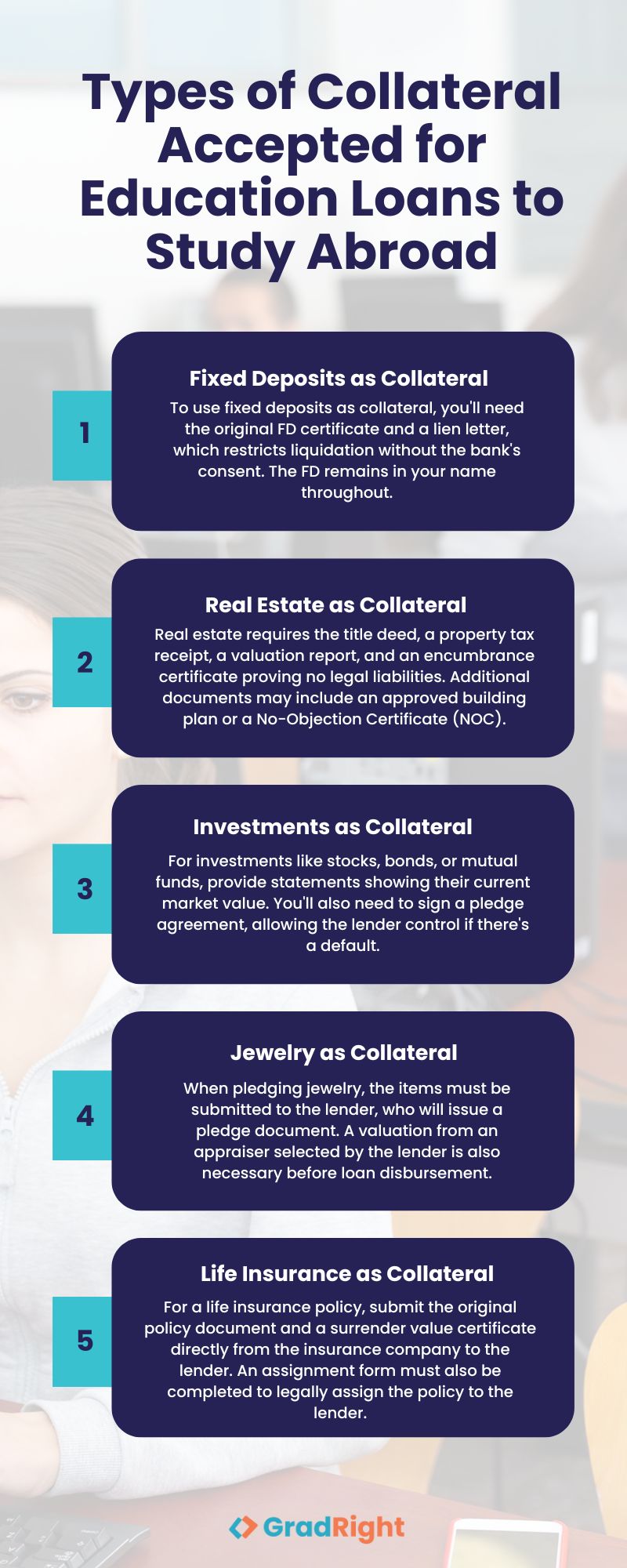
What is Collateral for an Education Loan?
Collateral is security that protects lenders in case a borrower defaults on repayments. When you pledge collateral for an education loan, you provide the lender with a legal interest in an asset you own. If you fail to repay for an extended period, the lender has the right to possess and sell that asset to recover the outstanding loan amount.
The practical effect: when you pledge collateral, lenders face lower risk. They respond by offering better terms – typically lower interest rates, higher loan amounts, and longer repayment tenures than they would for an unsecured loan to the same borrower.
Collateral can be any asset, movable or immovable, that can be reliably valued and converted to cash if needed. Lenders assess three things about any proposed collateral: market value, liquidity (how quickly it can be converted to cash), and legal clarity (clear, undisputed ownership).
Types of Collateral Accepted for Education Loans in India
|
Collateral Type |
Sub-types |
Accepted By |
Key Requirements |
|
Immovable Property (Residential) |
House, flat, apartment |
All public banks, most private banks, some NBFCs |
Clear title, no encumbrances, government-approved valuation certificate within 6 months |
|
Immovable Property (Commercial) |
Shop, office, commercial space |
Most public banks, select private banks |
Same as residential – clear title, valuation |
|
Non-Agricultural Land |
Plot, site (non-agricultural designation) |
Most public banks |
Non-agricultural classification required; boundary and layout specification |
|
Agricultural Land |
Farm land |
PNB (explicitly), some others |
Relatively rare; most lenders do not accept agricultural land as collateral |
|
Fixed Deposits (FD) |
Bank FDs, corporate FDs |
All banks and most NBFCs |
FD in name of student, parent, or guardian. Bank may hold lien on FD. |
|
Government Securities / NSC / KVP |
National Savings Certificates, Kisan Vikas Patra |
Public banks primarily |
In borrower or co-borrower name; must have sufficient value |
|
LIC / Life Insurance Policies |
Life insurance with surrender value |
Public banks primarily |
Sufficient surrender value relative to loan requirement |
|
Public Sector Bonds |
PSU bonds, government bonds |
Public banks |
Standard bond documentation required |
|
Third-party collateral |
Friend or relative pledges their property |
Some banks (with conditions) |
Relationship documentation, third party consent, standard property documents |
Most important: your collateral must have clear, undisputed legal ownership and be registered in the appropriate land records or financial registries. Any legal dispute over the collateral will significantly delay or prevent loan processing.
Also Read: Collateral vs No-Collateral Education Loan – How to Choose
Find lenders with the best secured rates for your specific collateral type. Compare 18+ lenders on GradRight. Compare Education Loans on GradRight
How Lenders Value Your Collateral
Lenders use a careful valuation process to determine how much loan your collateral can support. Key factors in this assessment:
|
Factor |
How It Affects Loan Amount |
|
Current market value |
Primary driver. Bank appoints an approved government valuer to inspect and certify the property value. This certificate must typically be within 6 months. |
|
Loan-to-value (LTV) ratio |
Banks typically lend 80-90% of the collateral’s market value. A property valued at Rs 50 lakh may support a loan of Rs 40-45 lakh. |
|
Liquidity |
Fixed deposits and government securities are the most liquid – banks can recover immediately if needed. Property is less liquid – recovery takes time, reducing LTV slightly. |
|
Legal clarity |
Property with clear title, no encumbrances, no pending disputes, and all dues paid commands full LTV. Any legal issues reduce the usable value. |
|
Location and condition |
For property, urban location with good demand for the property type allows higher valuation than rural or distressed properties. |
|
Ownership structure |
Sole ownership = simpler. Joint ownership = all owners must consent. Inherited property = succession documentation required. |
For FDs: the bank typically gives you a lien-marked FD where the FD certificate is held by the bank for the loan tenure. The loan amount is usually 80-90% of the FD value. For property: the bank registers a mortgage over the property in their favor, which is recorded in land records. This prevents the property from being sold without bank clearance until the loan is repaid.
Other Banks & NBFCs Offering Education Loan to Study Abroad:
- Union Bank of India Education Loan
- Yes Bank Education Loan
- IDFC Bank Education Loan
- Bank of India Education Loan
- State Bank of India Education Loan
- Tata Capital Education Loan
- Auxilo Education Loan
Secured vs Unsecured Education Loan – 2026 Numbers Comparison
|
Parameter |
Secured (With Collateral) |
Unsecured (Without Collateral) |
|
Interest rate range (2026) |
8.33% – 10.5% (public banks secured) |
10% – 14% (NBFCs/private banks unsecured) |
|
Maximum loan amount |
Up to Rs 1.5-2 crore (most public banks); Rs 3 crore (ICICI) |
Rs 40-75 lakh (most NBFCs); Rs 1 crore (ICICI/select) |
|
Processing time |
Longer – includes property valuation (adds 3-7 days) |
Faster – no property valuation needed |
|
Risk to family |
Property at risk if default extended |
No property risk; co-applicant CIBIL affected on default |
|
Government subsidy eligible |
Yes (at public banks) |
Yes (at public banks); No (at NBFCs) |
|
Total interest on Rs 40L (10yr, rate diff 2%) |
Approx. Rs 6.5 lakh less than unsecured |
Approx. Rs 6.5 lakh more than secured |
|
Best for |
Students whose families own property worth more than loan requirement |
Students whose families cannot provide collateral |
When Is Pledging Collateral Worth It?
|
Scenario |
Recommendation |
Reason |
|
Family owns property worth > loan requirement |
Pledge it – take secured loan |
Rate savings of 1.5-3% = Rs 6-12 lakh on Rs 40L over 10 years |
|
Family owns FD of sufficient value |
Pledge FD instead of property if possible |
FD-backed loans have lower risk – FD recovered at repayment vs property seizure if default |
|
Large loan needed (above Rs 75 lakh) |
Secured loan is often the only option |
Most NBFCs cap unsecured at Rs 40-75L; public banks require collateral above Rs 7.5L |
|
University is not on premier lists |
Collateral significantly improves approval chances |
Unranked institution = higher lender risk; collateral de-risks the loan |
|
Co-applicant has weak CIBIL (below 700) |
Collateral compensates for credit weakness |
Banks may approve with collateral despite weaker co-applicant credit |
|
Loan amount below Rs 7.5 lakh |
No collateral needed |
RBI mandates collateral-free below this threshold for IBA scheme |
What If You Cannot Provide Collateral?
Not having collateral does not mean you cannot get an education loan. Several options exist:
- ICICI Bank: Collateral-free up to Rs 1 crore for premier institution admits
- SBI Global Ed-Vantage: Collateral-free up to Rs 50 lakh for premier institution admits
- NBFCs (Avanse, HDFC Credila, InCred, Auxilo): Rs 40-75 lakh collateral-free based on profile strength
- International lenders (Prodigy Finance, MPower): No collateral AND no Indian co-signer for eligible programs
- GradRight FundRight platform: Compare all collateral-free options simultaneously
Trade-off: collateral-free loans typically cost 1.5-3% more per annum. On a Rs 30 lakh loan over 10 years, this adds Rs 4.5-9 lakh in additional interest. If your family can arrange even partial collateral (an FD), the interest savings justify it.
Also Read: Education Loan Without Collateral for Study Abroad
Whether secured or unsecured, compare your best rate from 18+ lenders in 48 hours on GradRight. Compare Education Loans on GradRight
Documents Required for Collateral-Backed Education Loans
|
Collateral Type |
Required Documents |
|
Residential/Commercial Property |
Property title deed with chain of ownership, latest government-approved valuation certificate (within 6 months), Encumbrance Certificate (EC), property tax receipts, building plan approval (if applicable), NOC if rented/mortgaged elsewhere |
|
Fixed Deposit |
Original FD certificate, lien letter from issuing bank, bank account statement showing FD |
|
LIC/Life Insurance Policy |
Original policy document, surrender value certificate from LIC/insurer, premium payment receipts |
|
National Savings Certificate/KVP |
Original certificate, certificate of balance/value from post office |
|
Government Bonds |
Bond certificate, proof of ownership, current valuation |
Arrange all collateral documents well in advance – particularly the property valuation certificate (which requires scheduling with an approved valuer and takes 3-7 working days), and the Encumbrance Certificate (which can take 1-2 weeks from the Sub-Registrar office).
Related Education Loan Guides
Collateral vs No-Collateral Education Loan – How to Choose
Education Loan Without Collateral for Study Abroad
Compare Education Loan Interest Rates – All Lenders
SBI Education Loan for Study Abroad
IBA Model Education Loan Scheme Guide
Step-by-Step Education Loan Guide
RBI Guidelines for Education Loans









 Australia
  Canada
  France
  Germany
  India
India  Ireland
  UAE
UAE  United Kingdom
  United States