





For many international students in the USA, graduation does not immediately answer the most urgent question.
It creates a new one.
Can I stay and work in the USA after my degree, and if so, how?
That is where OPT or Optional Practical Training enters the picture.
If you have seen phrases like OPT student, OPT visa, or OPT after graduation, they all point to the same core idea. An eligible F-1 student is allowed to work in the United States for a limited period in a job that is directly related to their field of study.
This matters because OPT often sits right at the point where education turns into employment. At this juncture, a first USA job becomes possible. Many students begin thinking seriously about longer-term career options, such as H-1B sponsorship.
In this guide, I will explain what an OPT student is, who qualifies, what types of OPT exist, and other details.
What does an OPT student mean?
OPT stands for Optional Practical Training.
In plain terms, it is a period of temporary work authorization available to eligible international students in F-1 status. It allows them to work in the United States in a role that is directly related to their major field of study.
That last part matters.
OPT is not a general permission to take any job. A computer science graduate working in software development is an easy example of OPT-aligned work. The same student taking a role with no meaningful connection to their degree could run into compliance issues.
In practice, OPT is meant to extend learning beyond the classroom, not replace the academic purpose of the F-1 route.
Who is called an OPT student?
An OPT student is usually an international student who:
- Holds F-1 student status
- Has received OPT authorization
- Is using that authorization to work, or is in an approved OPT period
This is a practical label, not a separate legal category.
On campuses and in employer conversations, people use the term “OPT student” as shorthand for an F-1 student working under Optional Practical Training. The underlying immigration status remains F-1.
Also Read: What is OPT in USA?
Is OPT a visa?
OPT is not a visa. It is a work authorization benefit attached to F-1 status.
So when someone says, “I’m on OPT visa,” what they usually mean is that they are still in F-1 status but now have approved work authorization for a limited time.
Once that definition is clear, the next question becomes obvious. Why does OPT matter so much in the first place?
Why does OPT matter for international students?
OPT matters because it is a lawful bridge between study and work in the USA.
A degree gives academic credibility. OPT gives students the chance to turn that into professional experience.
That matters at several levels:
- OPT helps students gain USA work experience in their field
- Gives employers a way to hire international graduates without immediate sponsorship
- Allows students to test roles, industries, and career paths
- It often becomes the first step toward H-1B or other long-term pathways
For example, a student who finishes a master’s degree in analytics may use OPT to join a data analytics firm, build experience, and then explore longer-term options with that employer.
But OPT is not automatic, and that is where eligibility becomes critical.
Who is eligible for OPT?
To qualify, students generally need to meet a few core conditions:
- Valid F-1 status
- At least one full academic year of study
- Enrollment in an approved institution
- Work that is directly related to the major
These rules show that OPT is not a general stay option and is tied closely to academic training.
There are also important limits. Students in ESL programs are not eligible. Students who use 12 months or more of full-time CPT at the same level may lose OPT eligibility.
Can undergraduate and master’s students both apply?
Yes. OPT is available across bachelor’s, master’s, and doctoral levels. What matters is meeting the eligibility rules, not the degree type itself.
Can you use OPT more than once?
Yes, but only once per higher degree level. This means a student may use OPT after a bachelor’s degree and then again after a master’s degree.
However, it does not reset at the same academic level.
What are the types of OPT?
There are three main types of OPT that students should understand: pre-completion OPT, post-completion OPT, and STEM OPT.
What is pre-completion OPT?
Pre-completion OPT is used before finishing the degree.
Because studying is still the main purpose, this type is more limited. During the academic term, students usually work part-time. During breaks, full-time work may be possible.
Many students avoid using this option to preserve time for after graduation.
What is post-completion OPT?
Post-completion OPT is the most common form.
It begins after the student completes the program and allows full-time work for up to 12 months.
This is what most people mean when they refer to OPT after graduation.
What is STEM OPT?
STEM OPT is a 24-month extension for eligible students in STEM fields.
The typical sequence is:
- Complete the degree
- Use post-completion OPT
- Apply for the STEM extension
This can extend total work authorization to 36 months at that degree level.
In the next section, we look at the duration of an OPT and when a student can apply for it.
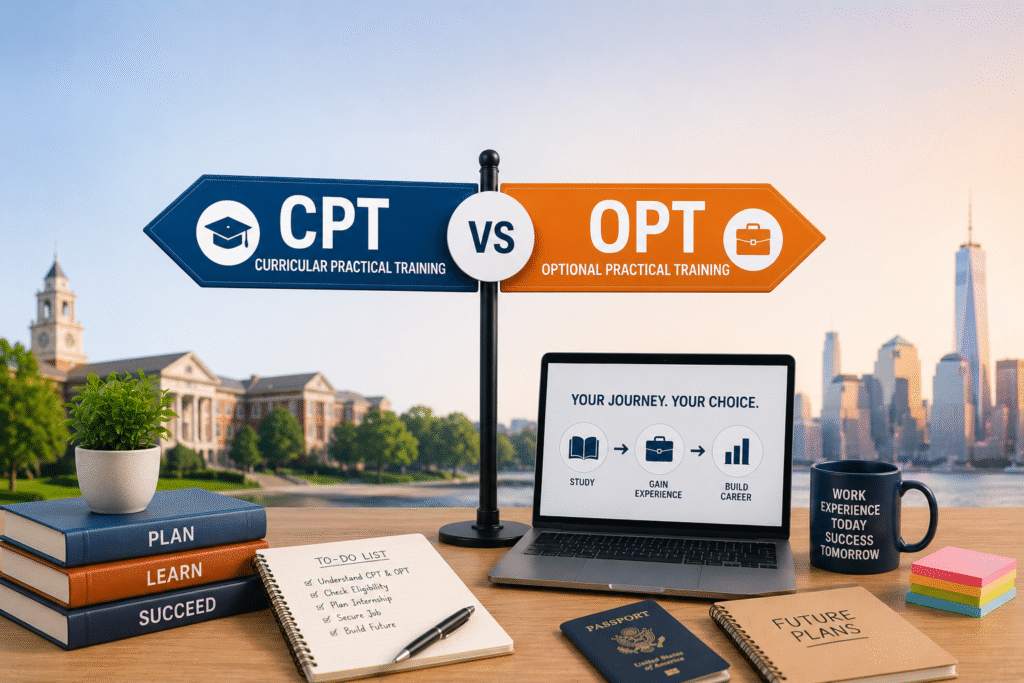
Also Read: OPT vs CPT: What Are They and How Do They Work
When should you apply for Optional Practical Training?
Understanding OPT is one thing. Acting at the right time is another.
When can you apply before graduation?
Students can apply up to 90 days before program completion and up to 60 days after.
However, they must also file within 30 days of the DSO recommendation.
When does OPT usually start?
Students choose a start date within the allowed window after graduation.
The choice should balance job timing and processing expectations.
Why does timing matter?
Late action can lead to:
- Delayed approval
- Delayed job start
- Reduced employer flexibility
Timing affects both immigration compliance and career outcomes.
Once timing is clear, the next step is understanding the process itself.
How does the OPT application process work?
OPT is a step-by-step process.
What does the DSO do?
The process always starts with the school. The DSO verifies eligibility, updates SEVIS, and issues a new I-20 with OPT recommendation.
What documents are required?
Students file Form I-765 with supporting documents such as:
- I-20 with OPT recommendation
- Passport details
- Visa and entry records
- Photos and filing fee
What is the EAD card?
The EAD card is the official work authorization document. It shows when the student can legally begin and end work.
Students must not work before the start date on this card. Once approval is in place, the next question becomes what kind of work is allowed.
OPT Application Process Flow
| Step | Action |
| 1 | Request OPT from your university |
| 2 | DSO recommends you through SEVIS |
| 3 | Receive updated I-20 |
| 4 | File I-765 with USCIS |
| 5 | USCIS reviews the application |
| 6 | EAD issued to the student |
| 7 | Start working full-time |
What jobs are allowed on Optional Practical Training?
USCIS rules stipulate that:
- An OPT job must be directly related to an F-1 student’s major
- It must require at least 20 hours of work per week.
For example, a major in finance and accounting should work as a financial analyst, accountant/auditor, tax specialist, and controller.
They cannot work as a sales manager.
Can OPT students work full-time or part-time?
- Pre-completion OPT is usually part-time during the term.
- Post-completion OPT allows full-time work.
Can you do freelance or self-employment on OPT?
Certain flexible work arrangements may be allowed, including:
- Multiple employers
- Contract work
- Self-employment in some cases
However, documentation and relevance become very important. Students should always ensure their work can be justified clearly.
Once job rules are clear, the next compliance factor is unemployment.
What is the unemployment limit on OPT?
OPT comes with limits on how long a student can remain unemployed.
How many unemployment days are allowed?
- 90 days for standard OPT
- 150 days total if STEM OPT is included
What happens if you exceed the limit?
Exceeding the limit can lead to loss of status. Students should track employment carefully and report changes promptly.
What are the most common OPT mistakes students make?
By this stage, most mistakes are not about misunderstanding the concept.
They are about missing details.
Common mistakes include:
- Applying too late
- Starting work before EAD approval
- Taking unrelated jobs
- Failing to report changes
- Miscounting unemployment days
- Assuming OPT guarantees sponsorship
OPT works well when treated as both a career opportunity and a compliance process.
At GradRight, we offer students complete support ranging from personalized university matching to arranging for education loans, helping with SOP/LOR, and providing advice related to OPT. If you need guidance, we are always there for you.
What should students remember about OPT?
An OPT student is an F-1 student with approved work authorization.
OPT is not a separate visa. It is a time-bound opportunity that connects education to employment.
Students who succeed with OPT usually do a few things well:
- Plan early
- Choose jobs carefully
- Track timelines and reporting
- Stay aligned with official guidance
Used properly, OPT is not just permission to work.
It is often the first meaningful step from studying in the USA to building a professional future there.





 Australia
  Canada
  France
  Germany
  India
India  Ireland
  UAE
UAE  United Kingdom
  United States